
When the Soviet Union’s ambassador to the US needed to send urgent dispatches home about the Cuban Missile Crisis, he called Western Union. “The telegraph agency would send a messenger to collect the cable. Usually it was the same young black man, who came to the embassy on a bicycle,” Anatoly Dobrynin wrote in his memoir. Then, they would wait and “pray that he would take it to the Western Union office without delay and not stop to chat on the way with some girl!” Eight months later and a crisis averted, the US and the Soviet Union agreed to a direct line of communication that’s often referred to as the “Red Telephone.”
Only, it’s not red. And it’s not a telephone. “The hot line uses the written word, rather than voice or video transmission. It was originally thought that text would reduce the chance of improper translation of an urgent message,” according to Bruce Kennedy. “It would also give each side time to consider the other's message before replying, and would avoid a person's body language or tone of voice from being misinterpreted.”
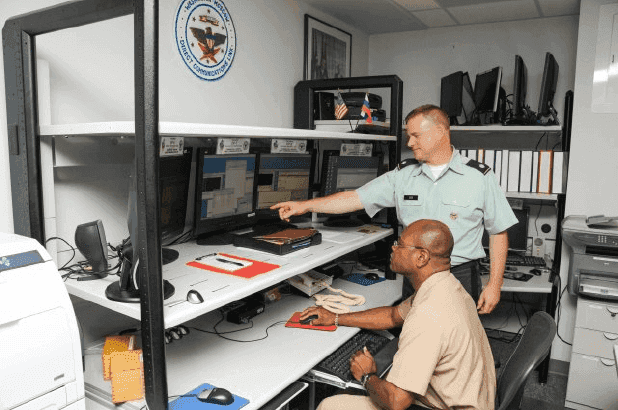
At first, the hotline was a single telegraph line routed through London, encrypted using paper keys. Then, a second line was added after a farmer in Finland cut the cable while tilling his fields, followed by the addition of satellite-based redundancy in 1971. In 1984, the hotline switched to fax transmission until 2008, when a fiber optic line was subbed in and the hotline moved to email.
The US government had been running on email long before the hotline made the switch. And today email in government is pervasive, so integral that drawing a throughline from its adoption to its modern use in government would require several Ken Burns–shaped series. What it mostly comes down to, though, is that email is backwards compatible (perfect for slow-moving bureaucracy), interoperable (and therefore compatible across departments and borders), and relatively easy to customize (a non-negotiable for classified communication and archives).
Working out the kinks
Although email arguably started out as a government project, and was responsible for three-quarters of all ARPANET traffic in 1975, it was mostly unrecognized as official communication in the 70s and much of the 80s.
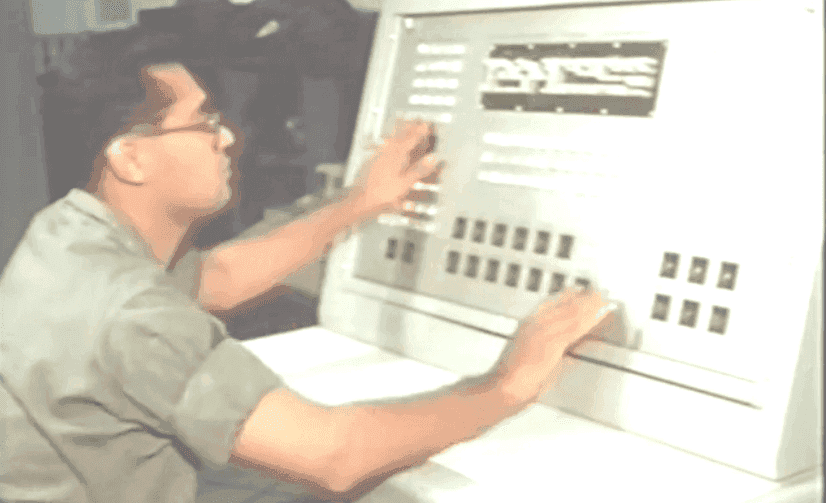
For example, anyone under the umbrella of the Department of Defense who needed to send a message through proper channels in 1976 would have gone through the AUTODIN messaging system, which by then was routing 30 million messages per month. And outside the military, most government offices were still using telex for text-based communications over long distances. Many, President Carter included, wanted a better solution.
When he took over the White House, Carter had already been “using computers in running his peanut business in Plains, Georgia, and he thought that the federal government could also benefit from the technology,” according to a former IEEE board member who agreed to help.
The first priority was “to replace the process of using manual typewriters and manual mimeograph machines to make copies of every communication to be distributed to the distribution list.” But with no budget to purchase hardware, the White House had to convince Burroughs, an early mainframe computer company, to donate outdated models to run IBM’s PROFS email program on an ARPANET connection.
Carter’s experiment was limited to sharing public, unclassified information. Staff didn’t need the latest software or significant customization, so email was an easy sell. But as its scope and popularity exploded among White House staff, upgrading the system became unavoidable.
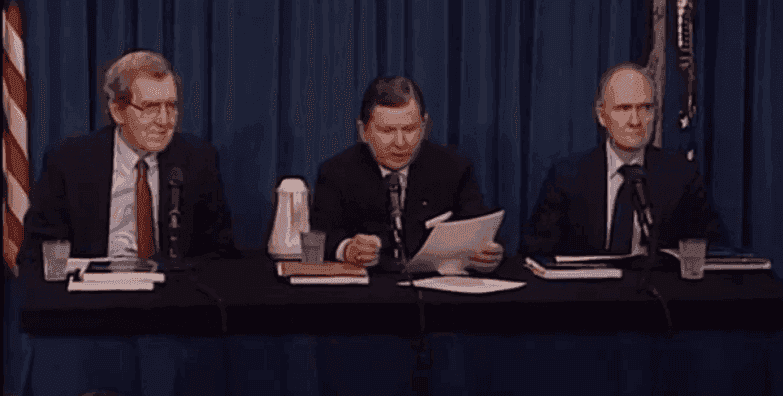
The National Security Archive’s book White House E-mail explains how “in 1985 and 1986, e-mail had become [Oliver] North and [John] Poindexter’s favorite means of communication, allowing them a back-channel called ‘Private Blank Check’ that avoided central bureaucracy.” As the scandal over arms sales to Iran erupted, North and Poindexter deleted almost every email in their account, over 5,700 in total. They knew the backups would be deleted after two weeks and held their breath. A career public servant saw a scandal on the horizon, and saved them, resulting in a four-foot-tall stack of PROFS conversations for the FBI to pore over.
When a U.S. District Judge ruled that emails fell under the retention requirements of the Federal Records Act, the necessary changes weren't particularly difficult to make. PROFS still fit the bill, outdated as it was by that point, with only a few updates to how and where backups and archives were stored. The NSA’s book speculates that “The White House e-mail system might still be secret today but for the Iran-Contra scandal.” But, like so much bad publicity, all it seemed to do was make other parts of government more interested in email.
Settling into their inboxes
The Senate and House of Representatives started their own foray in the early 90s as a way to connect Hill offices to each other, as well as offices in legislators’ home states. Senator Kennedy’s Technology and Policy Advisor, Chris Casey, “believed that it was in our office’s interest to be able to reach each and every other office in the Senate via electronic email. Even if we were to use some of these connections infrequently—or never—as a Boy Scout, I had been taught to ‘be prepared.’” Not everyone was onboard, though.
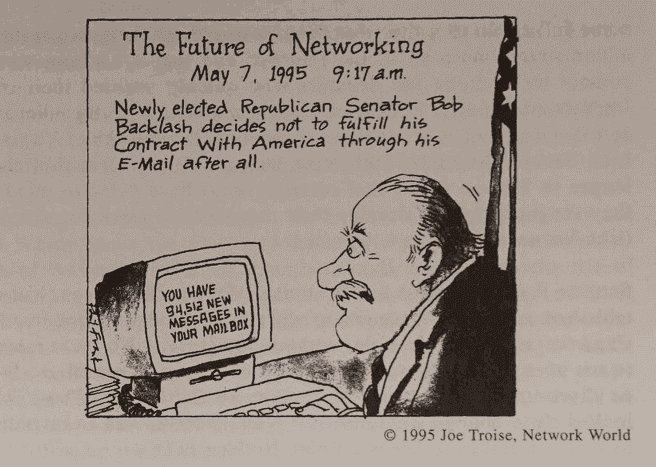
At first, email was limited to inter-office messaging across local area networks. But critics came out of the woodwork at the mention of messaging between different offices. In one meeting, a Democrat systems administrator grumbled that “Do you mean Republicans will be able to send us e-mail?!” This, on top of the fact that Hill staffers were already buried by letters from constituents and mass mailers from lobbyists.
In the House of Representatives, the short-lived solution to too many emails was a clumsy system where anyone wanting to send to a congressperson first had to mail a post card with their address on it. Then, the receiving office would add the sender to a special allowlist. Internet-savvy users were not impressed and the process was quickly walked back.
The Senate seemed far less interested in adopting or adapting email to its needs. Casey recalls how “although the House and the White House had developed the tools to allow for some automation of the management of electronic mail, particularly the use of auto-acknowledgement messages, the Senate Computer Center did not follow suit.” It was, in his opinion, the senators facing tough reelection campaigns in 1994, who wanted more ways to reach constituents, that pulled the upper chamber along. Campaigns didn’t need specific software or fancy hardware, they just needed a few computers and lists of voters’ addresses.
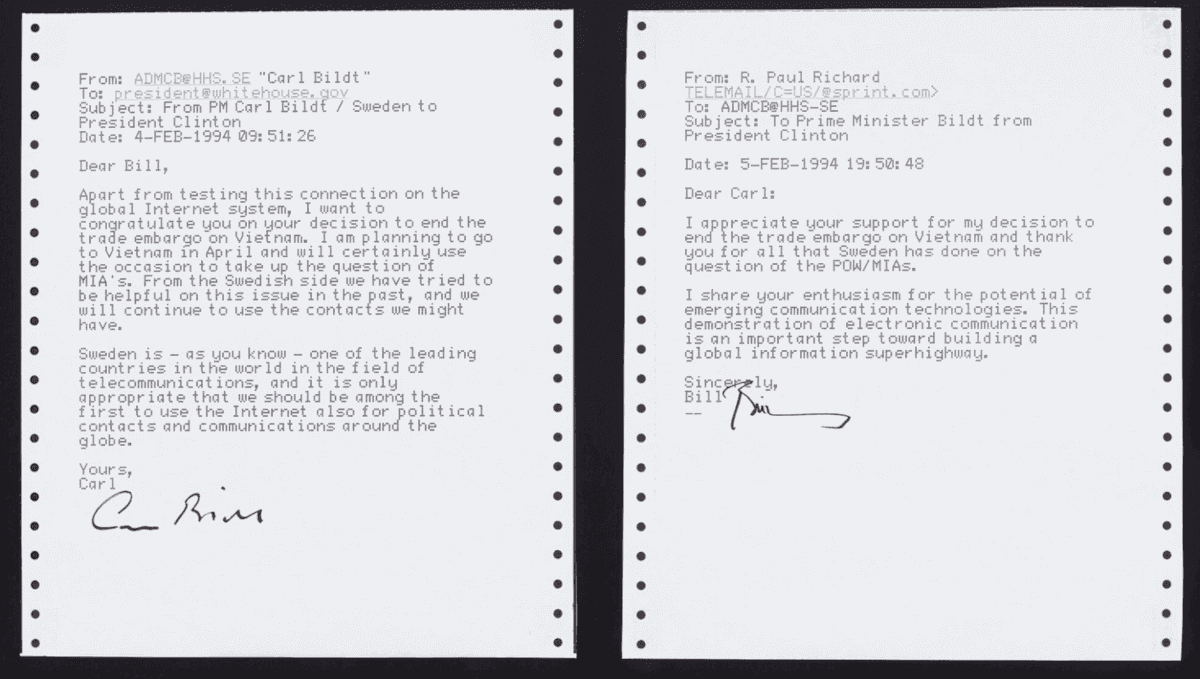
That same year was the first time two heads of government emailed each other, according to the National Museum of American Diplomacy. “Sweden is - as you know - one of the leading countries in the world in the field of telecommunications, and it is only appropriate that we should be among the first to use the Internet also for political contacts and communications around the globe,” the then Swedish Prime Minister sent to President Clinton. Except that, by that point, the US Department of State had already been using email for international messaging for several years.
Establishing a new state of affairs
It’s incredibly hard to pin down when embassies and consulates switched from telegraphs to emails for diplomatic cables. Each branch and location of the State Department transitioned on its own schedule, sending telegrams from an IBM Selectric one day and emails from Microsoft Mail the next. Some offices were lucky enough to make the switch by the early 90s.
For example, the State Department’s database of released FOIA documents has several messages regarding the abduction of a Catholic nun in Guatemala, with one particular exchange showcasing the gap between paper and electronic documents:
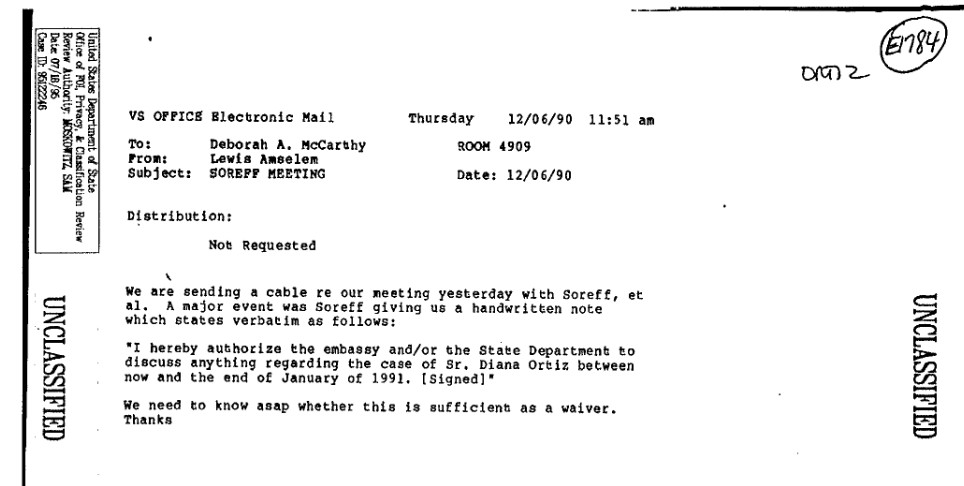
It would be another 18 years before the Moscow hotline switched over to email. And another 11 years before Colin Powell was handed a laptop and a 56K modem after becoming Secretary of State. If that’s not a perfect example of why email works so well for the government, I don’t know what is. Everyone can send and everyone can receive, no matter how outdated their tools are.
A 2026 email could theoretically make it to a Reagan-era PROFS inbox with surprisingly few adjustments. You’d have to stick with plain text to avoid non-English characters and attachments being converted into base64, and specify the message’s source routing, but it would arrive faster than a Western Union telegraph.
Powell ended up ordering 44,000 computers for the Department and making it a point when visiting embassies overseas to “find a computer, sit down, and check his own e-mail.” It didn’t need to be fancy, just a way to send and receive the same types of messages that diplomats had sent over fax and telegraph.
For most of its tenure, the Moscow hotline was tested hourly, with the US sending a message on even-numbered hours and Russians on odd-numbered hours. “Operators on either side of the hot line try to test each other's translation skills with selections from obscure texts,” according to a CNN article from 2000. They didn't need typing indicators, sorting algorithms, or embedded video. Plain text instantly delivered to the opposite side of the globe was more than enough then.
And it's more than enough today.
| Image | Credit |
|---|---|
| Header photo of a Blackberry | Unsplash |
| The Washington-Moscow Hotline terminal room | Army.mil |
| AUTODIN messaging | YouTube Archive Footage |
| The Tower Commission delivering its report on the Iran-Contra emails | YouTube Archive Footage |
| Political cartoon from Chris Casey’s The Hill on the Net | Archive.org |
| First emails between heads of state | Diplomacy.state.gov |
| E-Mail RE: Soreff meeting | FOIA.state.gov |