
Diffusion of AI
2026-10-31
Excerpting to emphasise
This post is riffing on a believable and reputed leader to substantiate some of topics I have been writing in the past few months around AI.
Shyam Shankar of Palantir was chatting with Ben Thompson. They had an interview on AI. The title is clearly misleading because there is alpha in this post. Ironically, they also talk about Alpha and Beta.
I am only picking the relevant excerpts and remixing it with my own writing. The entire interview is self recommended.
Let's kick things off with this wonderful quote that captures the complicated nature of enterprise.
The atomic unit of the enterprise is the workflow, you can make a single supply-chain analyst more productive and generate no incremental ROI, you have to make the entire supply-chain workflow measurably more productive to capture the value.
There are some roles where the cardinality collapses — the knowledge worker is the workflow, like coding — so you have perfect product-market fit for those things, and you can chase unbounded productivity. But that’s a very small part of everything we do in the real economy.
In understanding systems of work, I wrote about why workflow is a system of simple tasks combined with complicated organisational policy and structure which exists in a complex environment.

Embedding AI to increase the overall throughput of the workflow is why I keep harping about Boring Tiny tools and build to order.
The other topic that they touch on is diffusion of AI. It needs to be top-down, i.e where is the economic value created. The business of AI is going great but the benefit from AI is still struggling. I will let Sankar's words set the frame(emphasis mine).
Let’s call that diffusion, how does the miracle of electricity diffuse into the economy? There’s a similar question with AI. I think we are very focused on how to make better models, smarter models, more machine intelligence — and we should keep doing that — but we’re very under-indexed on how to accelerate the rate of diffusion. Where is the economic value being created? How do we turn these tokens into economic value more quickly with a great ratio around it? I’m obsessed with that, because I think there’s a license to operate in society where the benefits of this stuff diffusing really do matter and I think we’re getting the calculus around some of this pretty wrong.
No surprises, I totally agree with this statement. One of the reasons why this is happening is that leaders are not serious about AI. Org and change management have to come in step with AI adoption.
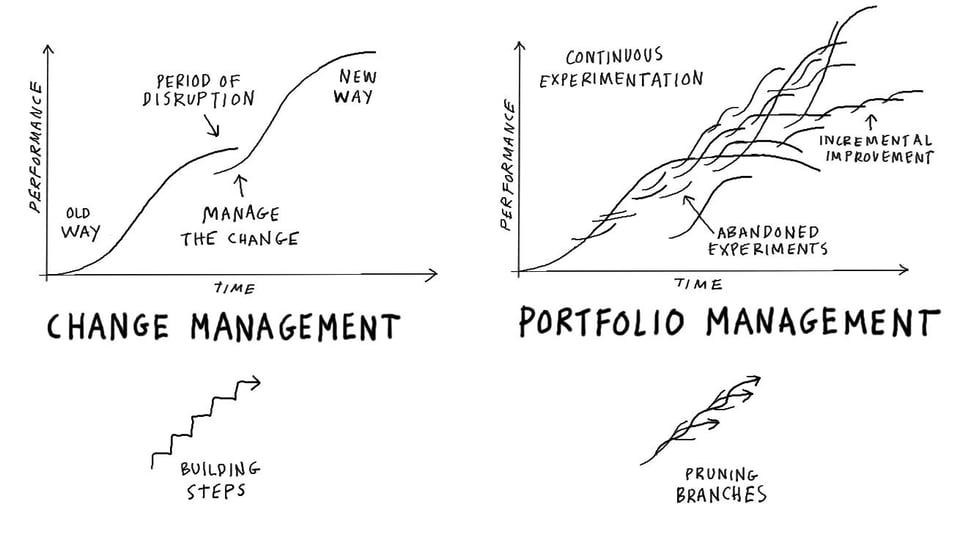
Shankar talks about how leaders who want to leverage AI to outcompete are better off than the ones who are looking to cut costs.
Understanding the jagged nature of AI and leveraging it requires a sense of humility and experimentation that is top-down.
This brings me to the excerpt on how to displace labour with AI. Shankar mentions how to purpose fit AI to do the labour that fits in the workflow.
Another way to reframe it, “I have this miracle intelligence now, how do I build the workflow around what it can do, rather than shoehorning it into the error that always exists between the human and the AI?” — the AI maximalist would say, “I’m just going to keep training a better model”.
The last bit is about forward deployed engineers which had my full attention. Shankar candidly mentions that within Palantir there are probably 4-5 people who understood what FDE means and can replicate elsewhere.
Next, he mentions that is strategically very difficult to product building.
The first part of it is if your product exists on some Gaussian distribution of features, “I’ll average the signal across my thousands of customers and decide what to build next”, forward-deployed engineering is not the right strategy for you. If, on the other hand, your customer set exists on some power law, where for a set of problems you’re solving, there’s a small number of customers with the hardest version of the problem and if you can solve it, you get the entirety of the market, because everyone else will have this problem, they just don’t know it yet, some are living in the future — then you have to go from specific to general.
This is crux of why the current narrative around FDE feels almost comical is summarised by Shankar with these words.
I think a lot of folks are jamming a sparkling form of sales engineering, they take the FDE role and say, “We have really smart engineers who can go work with customers”, but there’s no way of metabolizing the pain the FDEs are experiencing into product, if you don’t have that, you don’t have FDE — it’s just sparkling sales engineering.
Jonah MacIntire wrote a post about product management in which he mentions the archetypes of craftsman and visionary for Product Managers. Shankar follows a similar line of thinking where the FDE is focused on solving the problem with agency while the l artistic software engineer aspect of generalising software is only tackled later. An FDE in many domains would comprise of being scrappy but have an overall vision for generalisability at a later date.
Overall it is interesting to see how Shankar thinks about the AI diffusion, it’s where Palantir is playing. They clearly have the culture and organisational structure in place to benefit from this narrative. And, they have been at it for 15 years now and there is believability behind their approach.
Still, the labour market is trillion dollar economy and there is enough alpha in the market for businesses and leadership willing to dedicate resources to diffusion of AI in a safe manner. There is latent demand for it thanks to model distribution that the frontier models have achieved.
Round up
While the main topic of this issue was meta about AI, I wanted to talk about a concrete practice I have started to adopt thanks to Jess.
To go from vibe-coded to programmed, I build that theory. I get the agent to start a document explaining what’s going on in that software and why. Then I iterate on that document with it until we’re in agreement. I check it against the world and what we need and what makes sense to me; it checks it against the code.
Building that document together builds the theory of this software for me. Reading it builds the theory for every agent that starts up in this repository
I build many Boring Tiny Tools but then they are part of the workflow. This skill is helping me build the theory for the agents.
Links that resonated
An example of an AI product that is leveraging alpha. SuperMe helps people like you and me share our knowledge that others could rent to solve their own problems.
Open AI publishes a dataset across several countries and categorise the usage based on standard definitions. Some interesting statistics, worth checking out.
Sign off
It's been a static week, no external stimulus or travel to blame for skipping last week. I did write a post on my personal site and will continue to write more over there.
The premise of solving a problem is the highest order bit. AI enables us to solve it like never before. The challenge is not to cede agency and force fit the model to replace human. It is focused on displacing labour. The more clear it is in our minds, the easier it is to leverage AI. Diffusion is a beautiful word to talk about impact and distribution of AI in the overall economy.
Signing off till next time,
Vivek, trying to build theory while forward deployed
Don't miss what's next. Subscribe to On the side:

