
Truth and Beauty and Business
Your sense of possibility is around here somewhere, you just might have to wrest it away from an MBA

FORTUNE, July 1967
Hello, friends! Thanks for clicking in.
A few weeks ago, we were talking about cheerful fatalism and the necessity of staring the past in the face, even if it’s unflattering. This week, we’re on to shaping the future and not treating speculation as predestination.
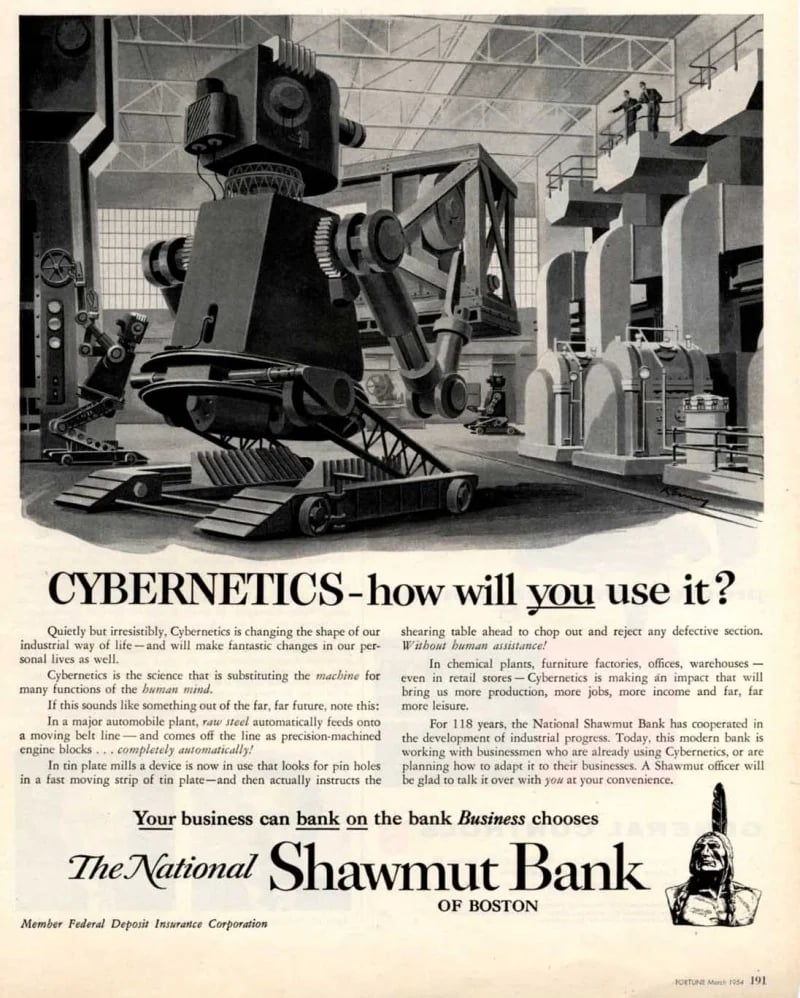
Read to the end for a very accurate and timely portrayal of automation taking jobs from humans.
Right after these messages…

We’re keeping it spooky through the rest of October. How to Negotiate was fantastic. We’ll be doing that one again. Remember, power is relational. Leverage is situational. And negotiation is just a conversation to get to a mutually beneficial agreement.
Speaking of conversations…
🤝
Friday, October 23 @ 10am PDT | How to Have a Conversation Because conversation is at the heart of both human relationships and good interactive system design, but not like that. If you’re waiting for the second edition of Conversational Design to come out, you should just go to this. Plus, we’ll help you deal with holiday party bores.
🕴️
Friday, October 30 @ 10am PDT | How to Business Good We have your seat at the table right here. Because no one knows how to run a business (or a business school). We’ll talk about why. The business model is the grid, yo.
🍂
The Fatalism Flaw
“The ultimate hidden truth of the world is that it is something that we make, and could just as easily make differently.” — David Graeber
Yesterday, I did an interview with a design strategist in Europe about the state of the field in these times. I do love to talk about that sort of thing. At the end, he asked me to react to certain prevalent and specific predictions about the future of design and technology, and to offer my own.
That I do not love to do. The whole point of design as a profession is to help shape the future in large and small ways. Yeah, it’s often a quixotic ambition, but it’s the whole entire premise of the work. If you accept that the future is written, or that you have no power to meaningfully intervene, why bother. Reacting to someone else’s speculation isn’t any better than doing your own. Reject that framing.
I will engage in prospection, but that is very different from speculation, and needs to be grounded in both evidence and a sense of possibility. And history. You can’t talk about the future without acknowledging what came before. And the discourse at this moment is so much ahistorical trash.
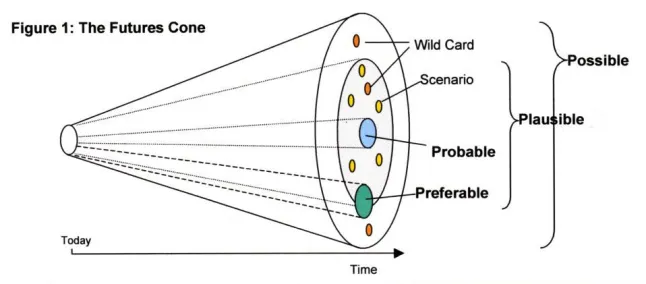
I don’t totally subscribe to David Graeber’s “just as easily” formulation because there are things about human behavior and cognition and material conditions that make certain preferred situations — often the really desirable situations — harder to attain than others. (Difficult things are no less worth doing.) But he was mostly pointing out the arbitrariness of so many of our foundational choices. The truth of the arbitrariness isn’t as much hidden as forgotten.
“Putting facts into nice cleanly demarcated buckets of explanation has its advantages — for example, it can help you remember facts better. But it can wreak havoc on your ability to think about those facts. This is because the boundaries between different categories are often arbitrary, but once some arbitrary boundary exists, we forget that it is arbitrary and get way too impressed with its importance.” — Robert Sapolsky, Behave
Recalling the fact of this arbitrariness is the thin edge of the wedge that reopens our sense of possibility. And a sense of possibility is the primary material of design.
“It is what it is.”
“Why, though?”
Maximum Overbusiness
“I’ve come to a grim conclusion: The problem with business schools is not repairable misalignment but the design itself. Business schools are not malfunctioning institutions; they are highly efficient machines doing exactly what they were designed to do. An ethics elective here, a sustainability center there, a “responsible leadership” badge — they all serve to legitimize the machine, not change its output.” — Christopher Marquis, professor at the University of Cambridge Judge Business School and the author of The Profiteers: How Business Privatizes Profit and Socializes Cost.”
Earlier this week, Christopher Marquis, a veteran business school professor, declared it’s time to shut down business schools.
Over 20 years ago, Sumantra Ghoshal, a professor at the London Business School, got there first in his banger of a paper Bad Management Theories Are Destroying Good Management Practices (PDF, read it!). He wrote this in the wake of Enron’s collapse, and then “died unexpectedly after drafting the manuscript.”
If you weren’t around back then, Enron was sort of like FTX for oil.
(My favorite Enron story is that time Ken Norton flew on the Enron jet.)
“Business schools do not need to do a great deal more to help prevent future Enrons; they need only to stop doing a lot they currently do. They do not need to create new courses; they need to simply stop teaching old ones. But, before doing any of this, we — as business school faculty — need to own up to our own role in creating Enrons. Our theories and ideas have done much to strengthen the management practices that we are all now so loudly condemning.”
Calls for business transformation accompany every new wave of promising (what? to whom?) technology, but the narratives and the incentives, and the way we keep falling for fraudsters and hucksters again and again, through boom and bust, remain so much the same.
We need to substantively, deeply transform management, not merely adopt new enterprise software.
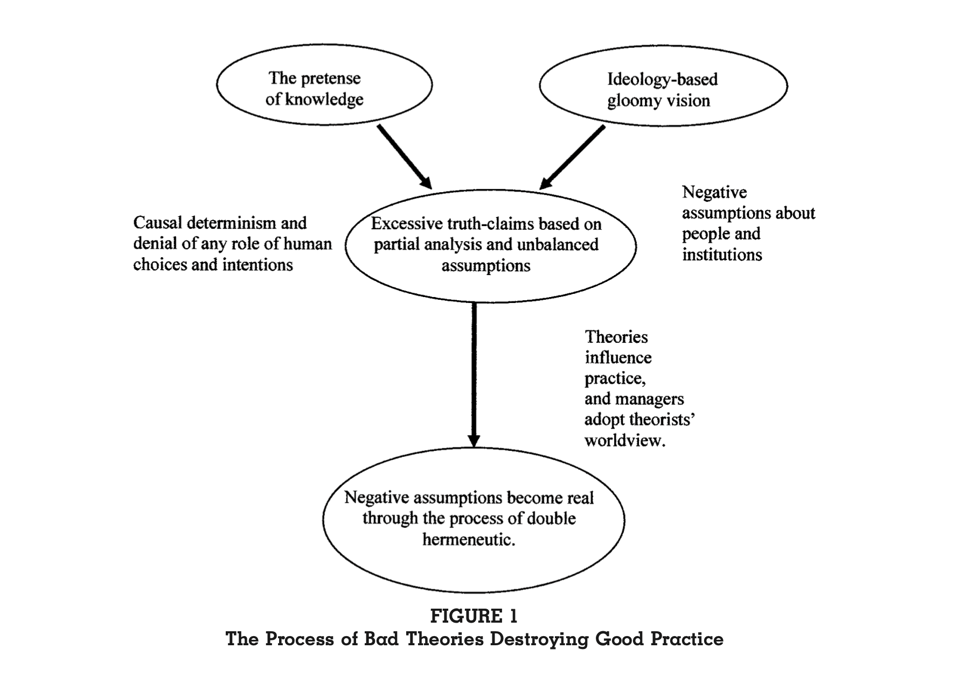
Ghoshal handily diagrammed his take on how theories go wrong and perpetuate the wrongness. The key is the “double hermeneutic.”
It’s a tricky piece of jargon for a critical concept developed by Anthony Giddens. The relationship between theory and reality is very different in natural sciences than social sciences. While, say, a theory of physics, good or bad, doesn’t affect the underlying material reality it purports to explain, a social science theory, even a bad one, has the capacity to alter society to conform to the theory.
As economist Diane Coyle says in Cogs and Monsters, “Whenever expectations matter, ideas have the power to shape reality.” Management theories become self-fulfilling prophecies, a term popularized by sociologist Robert K. Merton, who also inspired focus groups and started out as a magician. His son basically invented hedge funds.
Ergo, CEO-said-a-thing journalism can help make those things come true, to the extent the pronouncements don’t violate the laws of physics. And finance is untethered from physics. If your ungrounded assertion that your business idea will certainly be successful attracts enough investment, your business will have a much better chance of being successful.
The extent to which business schools propagate amoral theories and exclude human intentionality and accountability in service of a “scientific” approach crowds out design, for any definition of design requiring intentional, ethical decision-making. Empathy was only ever window-dressing.
Returning to Ghoshal:
“Since morality, or ethics, is inseparable from human intentionality, a precondition for making business studies a science has been the denial of any moral or ethical considerations in our theories and, therefore, in our prescriptions for management practice.”
This is not necessarily the best way to shape an organization, or a society, or an economy. So, it’s critical to remember we could always make different choices according to a different theory with different costs and consequences.
We just have to stop pretending that economics is physics. It’s closer to a subfield of graphic design. The Laffer Curve is graphic design, a very compelling drawing that communicated an idea without regard to its truth value.
“Why don’t we actually acknowledge in our theories that companies survive and prosper once they simultaneously pay attention to the interests of customers, employees, shareholders, and perhaps even the communities in which they operate?
The honest answer is because such a perspective cannot be elegantly modeled — the math does not exist.”
We should aim higher than “number go up.”
Telling FORTUNES
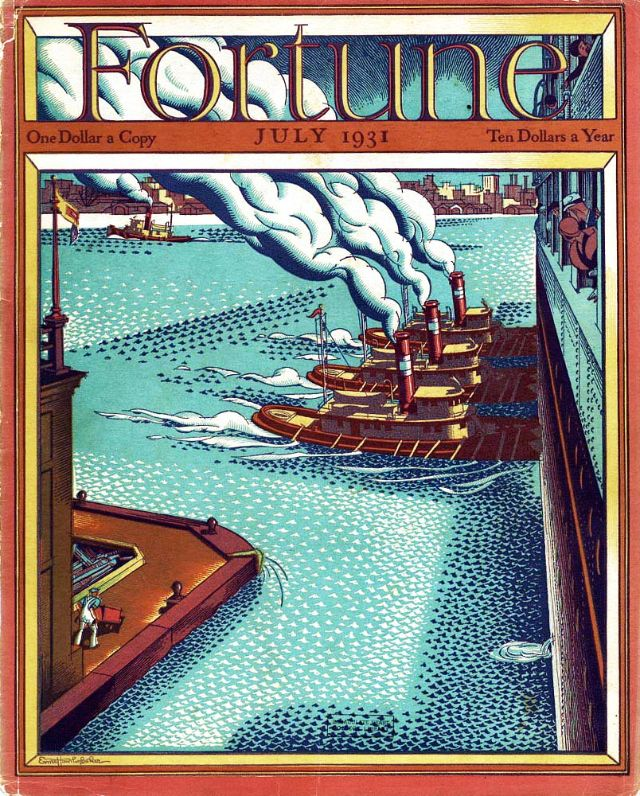
Henry Luce started FORTUNE in 1930, at the start of the Great Depression, and charged wild prices for it. The original cover price was $1 in 1930, about $19 today. He declared it the "Ideal Super-Class Magazine…And the Ideal Super-Class Magazine’s price ($10.) will be a barrier so high that only the reader both enthusiastic and well-to-do will vault it.”
I only recently learned that back issues of FORTUNE magazine are some of design’s greatest historical documents.
This all started with a little quest to find the article about industrial design that Victor Papanek referenced in the preface to Design for the Real World:
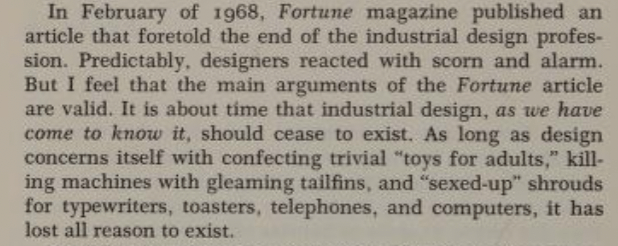
Design dies more often than Kenny, and I love chasing down a citation.
There are no publicly accessible digital archives of the magazine I could find. So, I turned to eBay. (Think about everything that isn’t in the training data.)
Up through the 1970s, FORTUNE was gorgeous. Some of the most prominent 20th century artists and illustrators created covers.
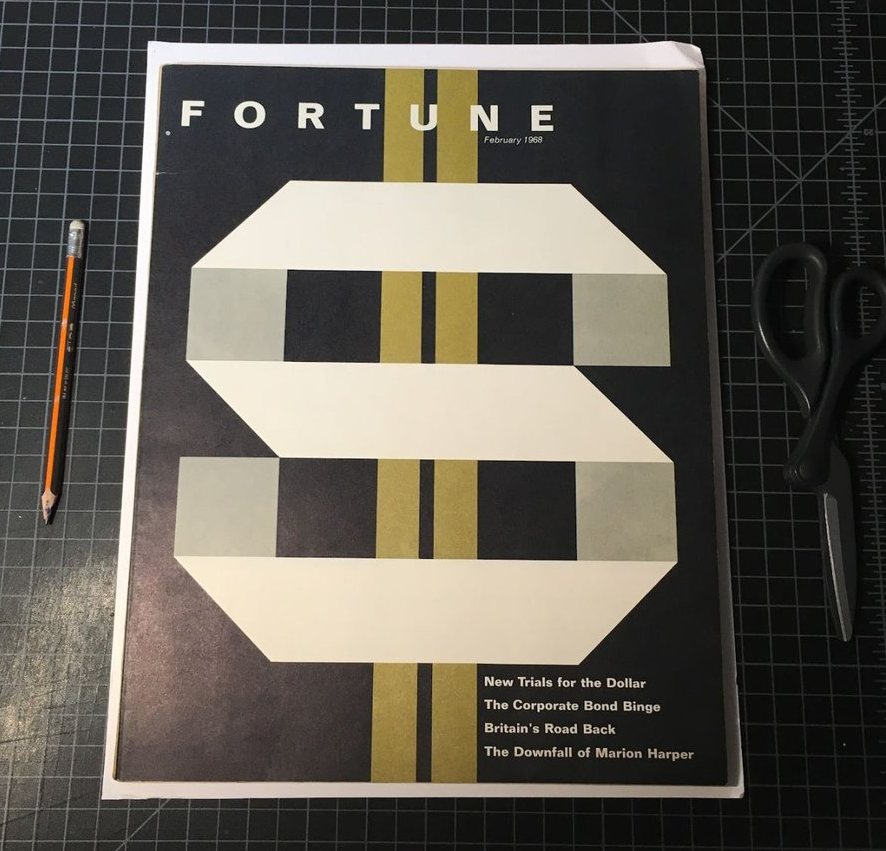
I found my article, with its sexed-up sewing machine shrouds and coffee can labels. Thanks to the magic of OCR, you can read “The Decline of Industrial Designers” for yourself.
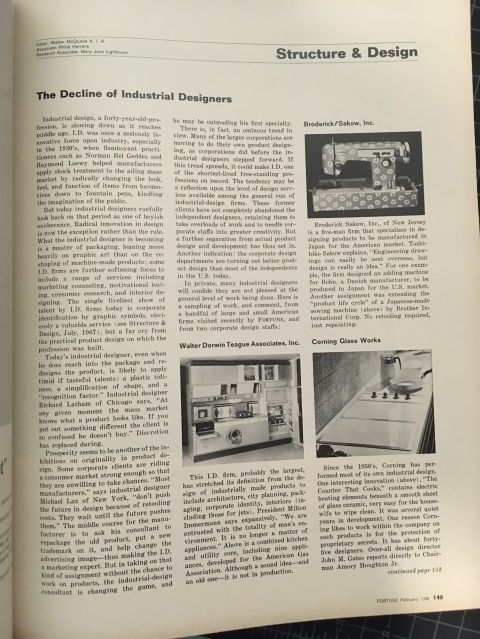
This article refers back to “The Graphic Art of Corporate Image” from July 1967.
“The single liveliest show of talent by I.D. firms today is corporate identification by graphic symbols, obviously a valuable service (see Structure & Design, July, 1967), but a far cry from the practical product design on which the profession was built.”
To eBay!
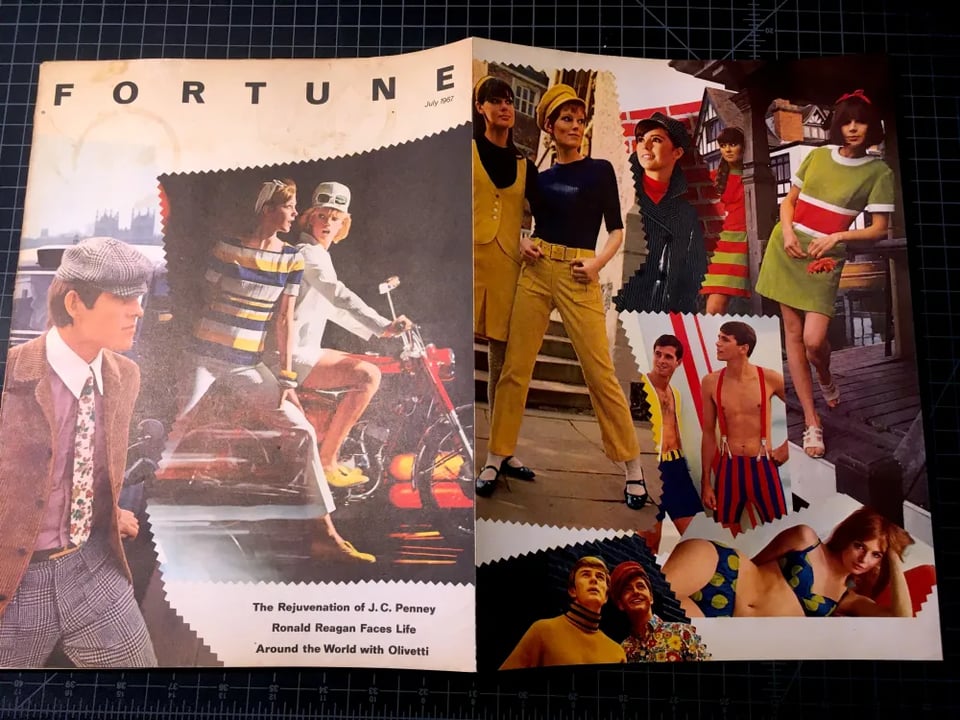
I enjoyed the branding, sorry, corporate image piece even more than the weak industrial design profiles. It’s very relatable, and also refreshing to read about logo design as just a regular business asset created by specialized workers, not a mysterious, rarified process.
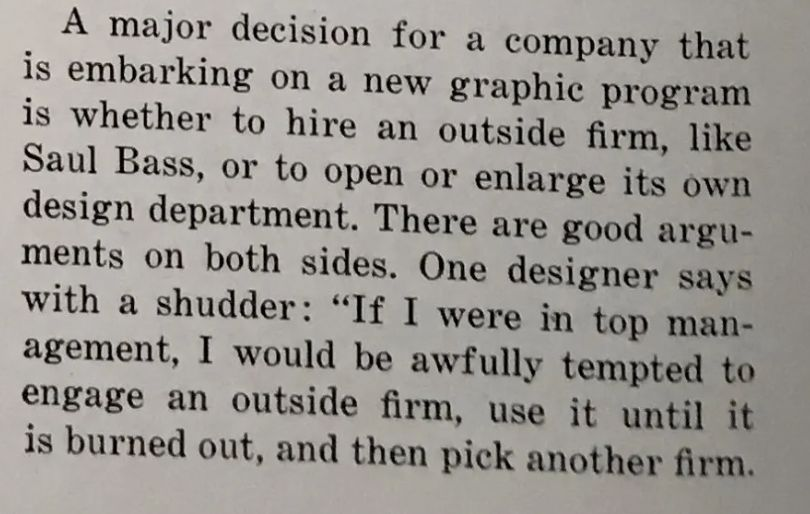
Towards the end of his career, Paul Rand did a pretty sweet mark for Enron, coincidentally a company FORTUNE named "America's Most Innovative" for six consecutive years
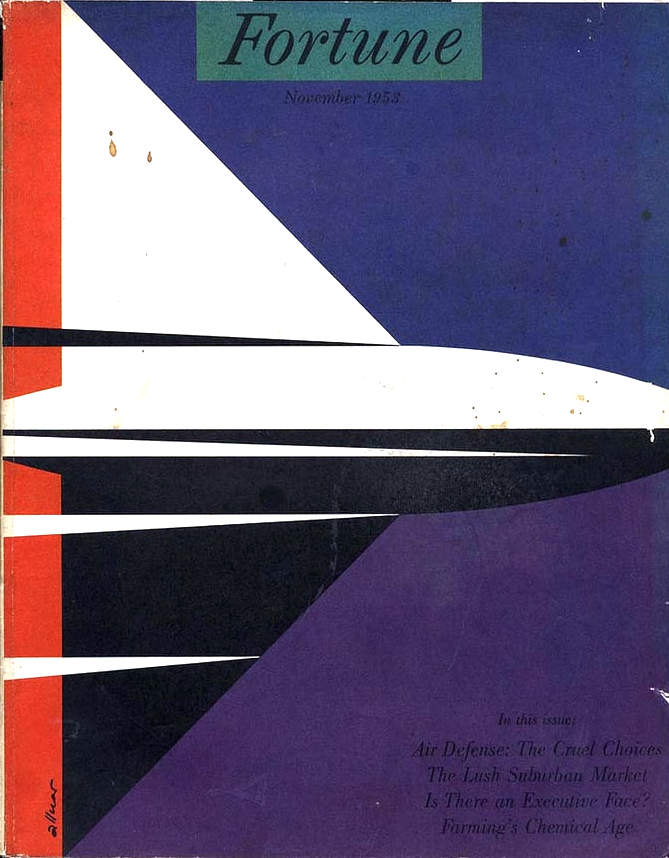
I’ll leave you with one of my favorite covers, from 1953.
And an ad inside, posted without comment.
🤖