
I only date models.
What if Bain had been born at Atari computer camp instead of in darkness
Hey friends, thanks for clicking in!
This one is personal (to me, Erika), and long. If you read until the end, you get to see my very favorite review of Mule on Google Business.
I’ll get started right after these messages…
[Past upcoming events snipped from archive]
If your team needs help with research, collaboration, or communicating across disciplines, get in touch about an in-house remote workshop, just for you.
Need strategy consulting, practice development, or anything else? We’re happy to receive your inquiry anytime: [email protected]
I only date models.
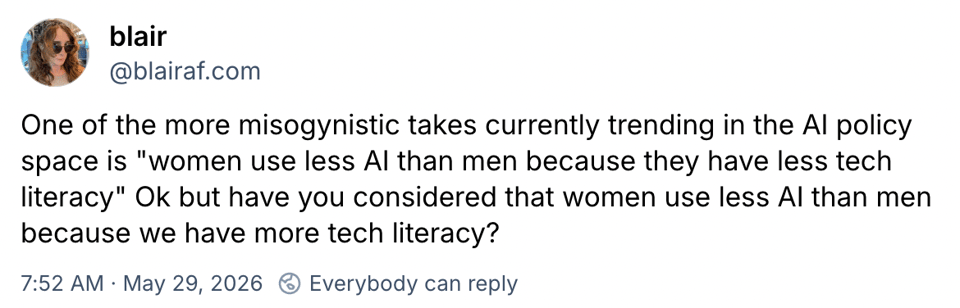
If you’re in the business of noticing, like I am, it’s impossible not to notice the gender differential in the discourse around “artificial intelligence.” Not to get all binary about it, but the most notorious CEOs and many of the most prominent boosters seem to be men, while many of the most prominent critics are not. And there are a lot of misogynistic takes going around, which is…a bummer.
Is this different from the stereo/typical gender differential in digital technology and anything associated with Silicon Valley more broadly? Well, I’ve been soaking in it for a very long time, and the most striking aspect to me this time is that the hype is being met with such a quantity of deep criticism, much of it coming out of academia, or from scholars who have worked in industry, in addition to journalists and advocates for workers in many vocations.
Artificial intelligence, if it’s anything — and we’ll get to that in a second — is a field of study. So from one perspective this era is similar to how crypto(currency) and blockchain swamped cryptography, but so much moreso. Decades of wide-ranging inquiry, aspirations, and mythology are being projected onto a few very recent products, while their makers are racing for the exit events. How do you bring the discourse down to earth when it shares a designation with a Spielberg movie?
In my lifetime, the gender mix in higher education has changed wildly (shoutout Title IX). But instead of reaching utopian gender equilibrium after sex-based discrimination became illegal, schooling and scholarship have become fem-coded.
(And, if you’re wondering about enrollment patterns after the end of race-conscious admissions.)
Research has shown that “dynamics of occupational segregation are highly nonlinear and exhibit tipping patterns”. When around 30-40% of workers are women, men tend to bail. At the same time, inequities persist, especially in STEM fields and the more secure and high status academic jobs.
When Sam Altman described GPT-5 last year as being like having a team of "PhD-level experts in your pocket,” it made me think about the extent to which actual research and expertise are increasingly disparaged and dismissed, and, lately in the US, dismantled (while simultaneously gendered), going back to Peter Thiel’s anti-college rhetoric and before. And we’re now in a situation in which LLM-based products are being positioned as superior to interacting with skilled, caring, or educated humans, while remaining parasitic on human work product.
(See also: Pygmalion displacement. And I’m not going to get into the name thing here, but I have beef with our bank.)
As someone who has been keen on science and technology my whole life, and in the business of technology-adjacent consulting quite a few years, I can tell you, it sure feels like negging and gaslighting, and I don’t like it.
I really thought we’d be doing better by now.
The term “artificial intelligence” was coined in 1955 by John McCarthy, a Dartmouth College math professor at the time. He and 3 colleagues from other institutions proposed to the Rockefeller Foundation a “2-month, 10-man study of artificial intelligence carried out during the summer of 1956…to proceed on the basis of the conjecture that every aspect of learning or any other feature of intelligence can in principle be so precisely described that a machine can be made to simulate it.”
So, “AI” has always been a marketing term, intentionally phrased to attract funding and to carve territory out from Norbert Wiener and the cyberneticists, who had named their new cross-disciplinary field in the 1940s and were already creating mathematical models of behavior and cognition.
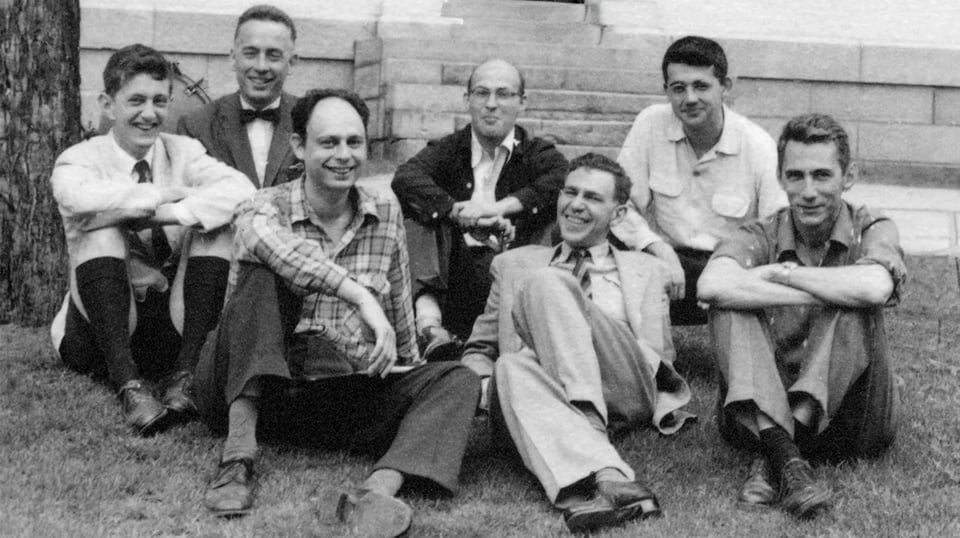
John McCarthy (back right, white shirt) and friends had big ambitions for a summer seminar. The Rockefeller Foundation was a little skeptical, I guess, and awarded $7,500 (~$92,000 today) of the requested $13,500 (~$166,000) that was meant to cover salaries and living expenses. Hence, the whole thing was shorter and more casual than proposed. Many of the 20 or so invited scholars and their families dipped in and out over the course of eight weeks. Ray Solomonoff (plaid shirt) was there for the duration and took copious notes, which was helpful because the reduced budget no longer paid for a secretary (at least that would have maybe allowed a woman to participate in some official capacity). Marvin Minsky (to the left of McCarthy, glasses) who would go on to become a giant of the field, advise Kubrick on 2001, and spend quality time with Jeffrey Epstein, was also a core participant.
As I mentioned, I’ve always been hyped on computer — a case of congenital nerdiness, unlike anyone in my immediate family. While not a genius, I’m a bit of a sport. And because I predate the iPhone by a lot, my interest has included many diverse iterations of computer.
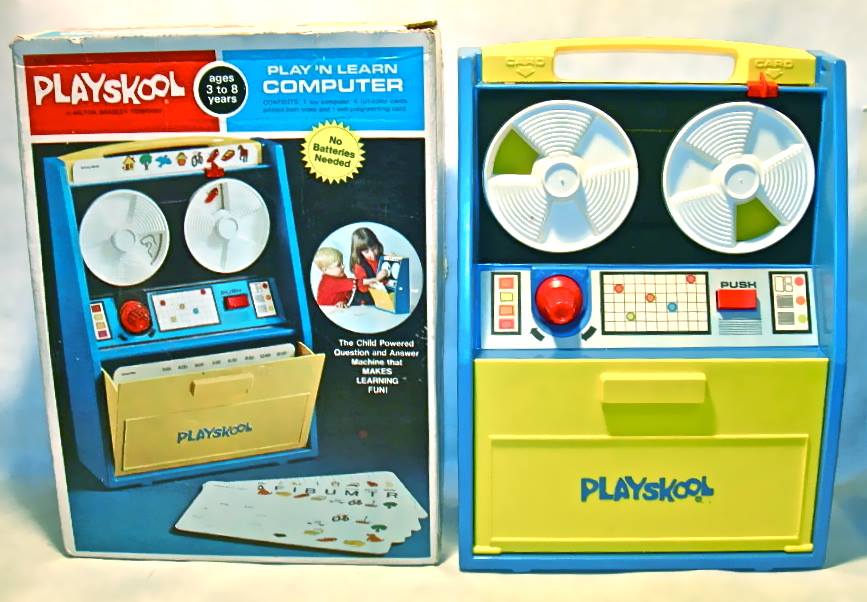
Maybe it started with my Playskool mainframe (video). Maybe it was because I was lucky enough to have early exposure to the Eames’ Mathematica exhibit (actual genius). But I never internalized the nonsense left brain/right brain (totally debunked btw), logic/empathy, man knowledge/lady knowledge dichotomy. Hashtag blessed.
I saw Disclosure Day immediately after writing the above paragraph and now I have beef with Spielberg, too.
In elementary school, the reward for being good at math was more math. So, I learned how to do arithmetic in binary and other bases, and a tiny amount of coding in FORTRAN. We filled out programming forms in pencil, which was the style at the time.

The teacher handed the sheets off to an unseen keypunch operator who punched some cards. And a few days later, a green and white printed banner bearing the output came back to us.
That was neat. I was into it. I wanted to learn how to program for real. I asked Santa for an Atari 400 computer. On Christmas morning, I ripped the wrapping off the big box only to find an Atari 2600 game system.
So mad. Hot tears. Could not believe Santa thought so little of me. I did not want to play video games at home (that’s what the roller rink arcade was for). I wanted to do serious computer things. I played Atari spitefully, but continuously, until my birthday rolled around and I received a Commodore Vic-20 from extended family members in the chip business.
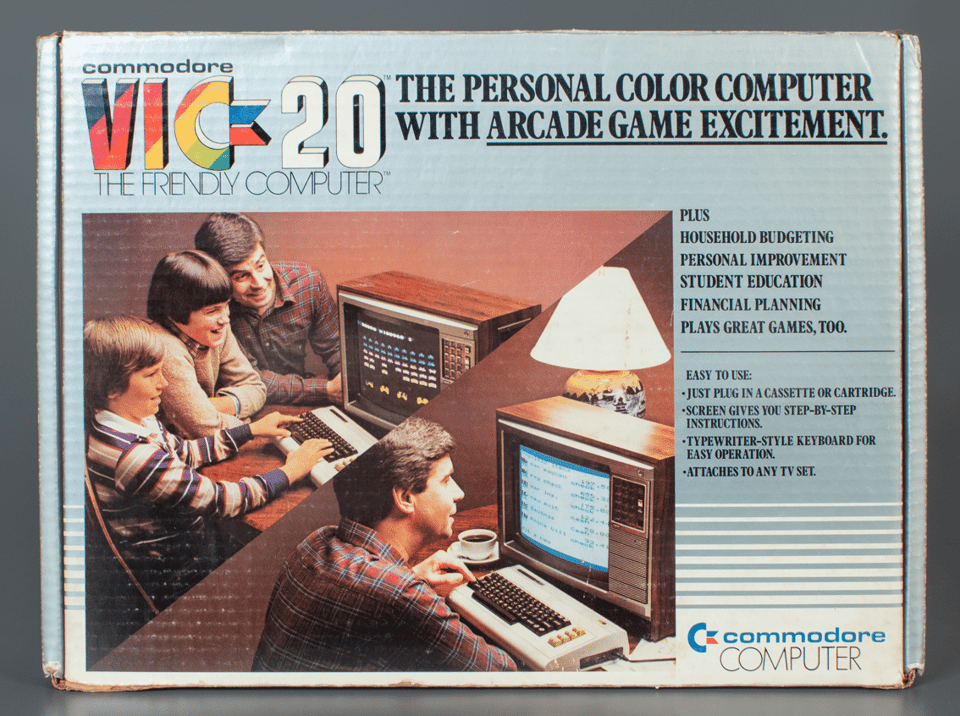
I learned BASIC, mostly for sound effects and motion graphics, anticipating “should designers code?” by a couple decades. One afternoon I spent several hours typing in the instructions for a simple shooting game from some nerd magazine, and then enjoyed obliterating a large rectangle with smaller rectangles until I enthusiastically knocked out the power cord and realized I hadn’t saved the program. Learnings!
In high school, I focused on becoming a person with a social life and getting into college. No one else in my family had more than a high school education. But thanks to a library card and in response to growing up on government assistance in a turbulent household, going to college, going away to college, had been my highest priority from a young age.
I overshot my mark. I applied to and got into Dartmouth. Look, this was surprising to everyone.
At the time, I didn’t know that Dartmouth was particularly high tech. I knew it was very far from Los Angeles, and very old, and also in the woods. This was before websites and I couldn’t afford to visit, so I was working off the printed brochures they sent me in the mail. Serendipity!
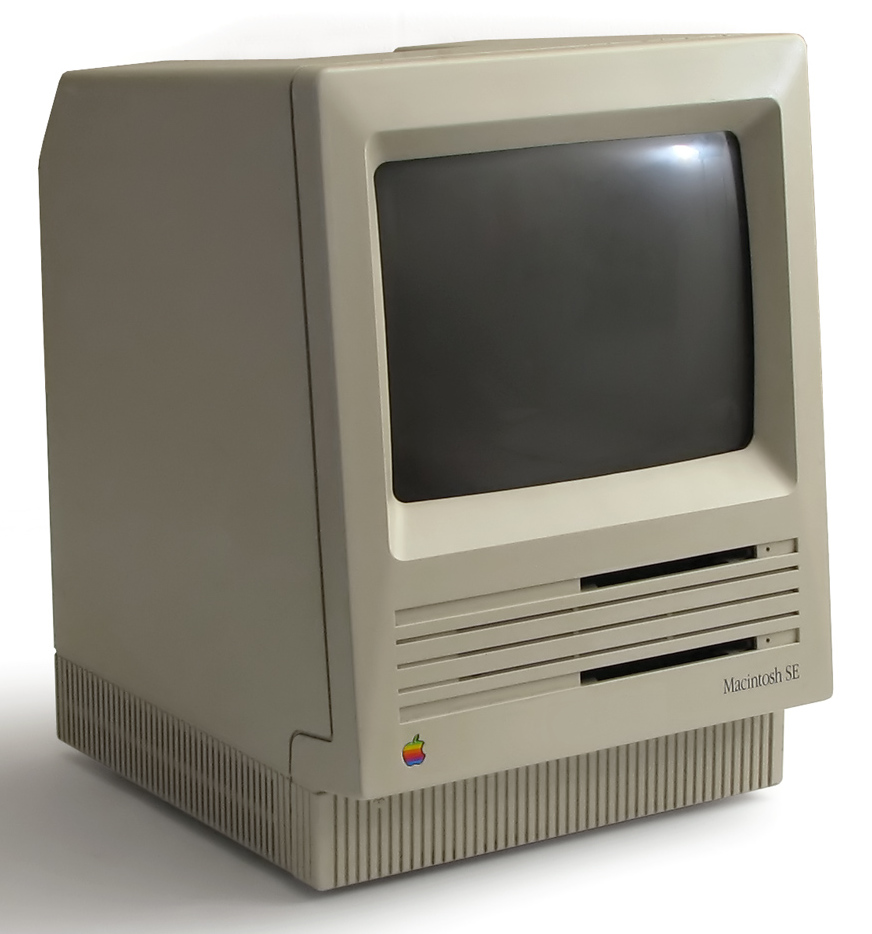
I was informed I’d be getting the mandatory Macintosh computer with an earmarked $2000 loan. (That’s about $5600 today, at the educational price for an SE with no hard drive.) I remember computer pick-up day clearly in the tumult of orientation week. The box of my dreams had my name on it. Too big to carry so there was a shuttle service to the dorms.
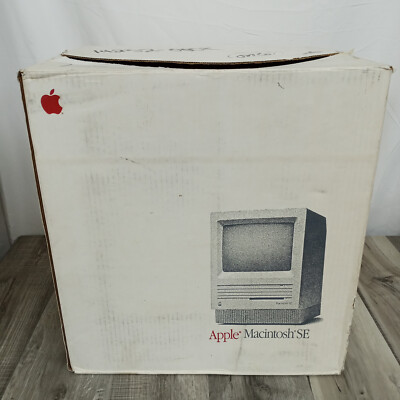
I unboxed it, plugged into the AppleTalk port in the wall and I have been online more or less continuously since September 1988. My brain is great, thanks for asking!
Because Dartmouth was an all-Mac campus at the time, I just thought that was the next evolution of the PC. (HyperTalk, so fun.) I’d used an X terminal, but didn’t encounter MS-DOS or Windows until I graduated. And then I got sad. Well, not as sad as graduating into a recession made me.
My first week at Dartmouth was also the first time I really started to encounter guys who didn’t totally think of women as other people (if you follow that link, notice he wasn’t volunteering to bro down across the river). Apparently, my 1980s Los Angeles was some sort of charmed gender-inclusive paradise.
The college had begun admitting women only 15 years earlier, under the leadership of President Kemeny, coincidentally one of the professors who’d invented BASIC and the first large-scale time-sharing system in the 1960s, so that a wider range of students could learn to code. The first women at Dartmouth had a legendarily bad time, but not due to computer.
I had an OK time. My formal education was phenomenal. I was so lucky in many ways. It’s upsetting to read about universities cutting philosophy, humanities, and social science, because wow do we need the liberal arts now.
Like John McCarthy, I visited the Soviet Union. Unlike him, seeing how their flavor of communism worked out didn’t turn me Republican. (Expansionist patriarchal authoritarianism is bad whatever your position on markets.) Spending a term in Moscow did cause me to change my major from Russian to Philosophy, because I didn’t exactly see the seeds of sound institutions to build a career around in the rubble of empire.
My informal education — in class, gender, colonialism, and institutional inertia — was even better/worse (not linking to the vile semi-secret murals painted in response to Orozco). And while I took a couple classes in computer science and engineering, most of my technology education was informal. Networked computing was a part of everyday life, before nearly anyone else was doing it, thanks to McCarthy and Kemeny and friends.
My senior year, I was introduced to artificial neural networks in my Philosophy of Mind class. (I recommend John Haugeland’s Artificial Intelligence:The Very Idea and also John McCarthy’s review of it. Haugeland’s book is just so well-written.) We talked about Turing and interacted with ELIZA, the very first chatbot.
(Read this 1985 interview with ELIZA’s creator, Professor Joseph Weizenbaum.)
Encountering AI for the first time in the context of philosophy at an institution founded in 1769 is great for never worrying about getting “left behind.”
An existential freakout gave me my first opportunity to use a laptop. Me being me, I decided to write a final paper comparing Kierkegaard’s and Heidegger’s approaches to living an authentic life in the face of one’s ultimate non-being. Party. Halfway through it, I lost the ability to eat or sleep, let alone write. And I had unalterable tickets to fly back to California for spring break. So, I saved my unfinished paper on a floppy (ask your parents) and took a leap of faith.
The only person in the vicinity with a Mac was a friend’s physicist dad who worked at the Stanford Linear Accelerator and was willing to loan me his government-issued PowerBook 170 so I could bang out the angst at a sunny kitchen table. It took wild shenanigans and BinHex to get the file back to campus in one submittable piece.
I don’t recommend doubling up on existentialism classes winter quarter, but it worked out. Thanks to friends, I escaped death with an A-.
So…
I could go on to enumerate every successive iteration of computer or networking infrastructure that expanded my world or helped me get a job or get out of a jam or frustrated me or introduced me to new people, some of whom frustrated me, but you get the gist. While fun to reminisce, this is all just background and preamble to a couple things I need to say…
I became a designer, not a technologist, because I’m not interested in technology for its own sake, but as a set of tools for “changing existing situations into preferred ones” in the words of Herbert A. Simon (who was there in 1956 for the first couple of weeks). And in my experience, the really thorny part of the problem is how you define preferred situations and who gets to do the defining.
(“I will occasionally use "man" as an androgynous noun, encompassing both sexes, and "he," "his," and "him" as androgynous pronouns including women and men equally in their scope.” These are also the words of Herbert A. Simon, in a footnote, which caused me to chuck my copy of The Sciences of the Artificial across the room.)
Much of our work as consultants is helping organizations in search of technology solutions figure out whether what they have is actually a technology problem. If you don’t actually have a technology problem, adding new technology tends to exacerbate the real problem, and also gives you a bonus technology problem.
Usually, the organizations that need our help have a people problem they need to tackle first. It’s cognitive biases and Conway’s Law all the way down.
I’ve come to realize that even without having any sort of special genius, I was always encouraged to be curious and critical and never made to be afraid of math or science or technology (the privilege of growing up a white girl with glasses in a particular place and time). Somehow I ended up in rooms where UNIX dudes were holding up copies of Vogue magazine and saying, “Now that web pages are a thing, we need to learn about layout.”
My personal early experiences with technology are relevant because everyone’s experiences are relevant. We don’t need to go along with the preferred situations of men who assert that statistical models have thoughts and feelings worth considering, but other living human beings do not. Because that is bananas.
We need to spend more time sitting with present material reality and taking a hard look at who is doing what work for what reasons under what conditions before we rush to reshape the world under the banner of terminology crafted for a grant application 70 years ago that was — and is — more aspirational than descriptive. (Contemplate AI winters.)
Five decades on from Play N’ Learn, we have arrived at this incomprehensibly toxic moment in digital technology — and society more broadly — that seems antithetical to both. Simultaneously the stakes have been raised to the rafters and critical inquiry is shutting down all around me. The worst men in the world are demanding everyone get on board. And too many of the better ones are handwaving material harms and observable outcomes.
This is no more a “tech literacy” problem than pollution is a littering problem.
I refuse to accept that the preferences of the few who stand to gain outweigh the concerns of the many whose skills and expertise are being dismissed when they can’t be subsumed. We can do well, and do better, together.
![You have a new review. [Two stars] "Their designs are fine, but that misandrist rhetoric they publish to the Internet is unacceptable and…"](https://assets.buttondown.email/images/f7b095b6-9aef-4159-b528-013da0cebb46.png?w=960&fit=max)