
Summer School Teachers' Edition
We're just giving you the answers

Hey friends, thanks for clicking in!
This week, we’re talking about Summer School in review. Enjoy a page full of practical advice for you to take as needed. Right after these messages…
[Past upcoming events snipped from archive]
If you or your organization needs help, get in touch anytime: [email protected]
What We Learned On Summer Break
Over the summer, when we were talking about refreshing our services in these times, we had an idea: What if we tried out a slate of new potential workshops as short classes with a low ticket price? Topics could include anything we had some expertise in and a strong point of view on, that seemed potentially useful to people out there in the world. And we could bring in some folks we knew with related expertise as co-presenters to see how that went.
Because we’re big nerds, we called it Summer School. The sessions recalled the best part of Quarantine Book Club. We had a lot of repeat attendees and good community vibes. Participants were making connections and helping each other out right there in the chat. We learned. Everyone learned. A huge success overall.
Here are the big themes and a few key pieces of information and advice from each session.
People are hungry to make and do good stuff. Yes, there are several significant, possibly existential, current events dominating the news, but that isn’t the whole story. People are out there doing things and helping each other, and they are eager to do more and help more and find each other.
Give yourself permission. That “ask forgiveness, not permission” line is used too often to justify reckless disregard for other people, but don’t wait for permission to do things that don’t materially or adversely affect anyone else. You can just try things.
Everything is a conversation. Most things we need to do in life involve other people and systems we’re a part of, but don’t have control over. This requires us to pay attention to relationships and feedback loops. Speak and listen. Sense and respond. Most importantly, get out of your head and talk to other humans, even if it’s awkward.
Figure out where your shoulds are coming from. This applies to organizations as much as it does to individuals (since organizations are just collections of people and policies). What you should be doing depends on your goals, resources, and values. Don’t reflexively adopt someone else’s or maintain your own unexamined factory settings. Misplaced comparison and FOMO will lead you down the bad path.
Friendship is magic. No one is an individual contributor. Life is a group project. You can’t take it all on. You do need clarity about your own skills and boundaries, so you know when to ask for and offer help. Assemble your hype/heist team.
And now onto the specifics. If you missed a topic you’re keen on, let us know. Some of these we’re planning to offer again in the short form. Others we’re expanding into full workshops.
How to Sell
Everything is sales.
Kristina Halvorson and I text each other about sales all the time. We genuinely really enjoy selling services, because we love solving problems and talking shop. Hate to see good people doing it badly and con artists doing it well, which is so often the case.
Good sales is simply making a match between something you have and what another person needs. Could be information. Could be an app. Could be a coffee machine or consulting services. The difference between an ethical and an unethical salesperson is that the former cares about the customer, and will recognize and acknowledge a mismatch.
If we’re not the right people to help a potential client, we are very up front about that. And over the years we’ve gotten better and better at figuring that out quickly.
The keys to being good at sales:
You have to sell yourself first. If you aren’t totally convinced of the value of what you have to offer, you’ll have a hard time convincing anyone else. Yes, the RuPaul maxim.
Ditch the scarcity mindset. Abundance has a lot of weird connotations at the moment, but you have to believe there are enough customers or clients out there. Otherwise you’ll get in a zero-sum, desperation place that prospects can sense from a mile away. Saying no to bad work is hard in hard times, but saying yes often costs more.
Customers don’t know what they need. Prospective customers often ask for the wrong thing because they aren’t the experts in your business. You are. Don’t hold that against them. Your job as a sales person is to help them figure out what they need without condescending.
No one is a rational buyer. No one.
Focus on the customer. Focus on their problem. Good sales is knowing your business, and talking about theirs. And listening. Buyers buy when they feel seen and understood. So you have to understand them. Bad assumptions will chase a prospect away just as fast as a brush on the butt.
How to Talk To Strangers
Kio Stark is a researcher and storyteller who can, in fact, invite you to enjoy her TED talk on Why You Should Talk to Strangers, as well as her book. She joined us to help get people out of their homes and into the streets to meet each other.
It’s important and good to talk to strangers. We each personally need intimacy and society as a whole is better off when we feel more connected to than afraid of each other.
The fear is encoded in folktales, but a lot of our contemporary attitudes towards strangers and safety started developing during the Industrial Revolution. Rapid urbanization introduced new social interactions, new threats, and new types of policing. Mass-produced clothing made it harder to read people.
This is when detective fiction really took off. Clues are evidence of behavior. (Fun fact: the word clue/clew originally referred to a ball of thread. The sense shift comes from a translation of Greek myth. Ariadne gave Theseus a clew of thread to help him find his way out of the Labyrinth.)
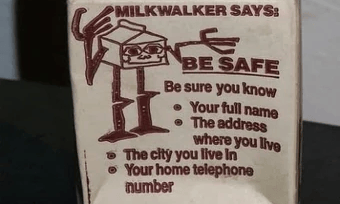
“Stranger danger” is mostly a myth. But anything that rhymes is going to stick. Fewer than 1% of cases reported to the National Center for Missing and Exploited Children are nonfamily abductions. An Iowa dairy started that whole milk carton campaign in the 1980s.
Small talk isn’t small. A lot of people profess to hate it, but small talk, also known as phatic communication, is important to establish feelings of solidarity and familiarity, critical to social cohesion. Useful information is not the point. Talking about the weather is good, actually, because it’s a shared experience.
There are unwritten rules. This is what makes it tricky. You need to watch for the clues and cues that tell you whether someone is open to interacting with you at the moment. Are they leaning in or are they looking for the exit?
Get started by observing people. Just go to a public place and watch how people do and don’t interact for a while. This is a good practice for everyone and requires no awkward conversation.
Try triangulation. Comment on something you can both observe, like a cute pet, a parade float, or piece of art. Or just say “hey” in passing.
Stick the landing. You can end an interaction by stepping away and saying something like “It’s been nice talking to you.” Past tense. It takes practice to be graceful, and that’s OK. Don’t take it personally if the other person leaves abruptly.
Worried about being perceived as a threat yourself? Say something friendly and keep moving along.
Check your closeness-communication bias. It’s very common to overestimate how well we communicate with those who we feel close to. Strangers often listen more attentively to one another which can make it easier to open up.
These are the people in your neighborhood. Get to know them.
How to Start a Newsletter

We were joined by former colleague and friend of Mule, Steph Monette from Buttondown, but we’re happy for you to use any platform or service that isn’t Substack. There are many options, depending on what you need. See Molly White’s newsletter cost comparison (updated August 2025).
This is about a writing practice that you share with others over email, not your offers blast. Even if your newsletter is primarily a marketing vehicle, do everyone a favor and make it useful and interesting.
Ask yourself “Why?” As with all things, you won’t know whether you’re successful unless you know why you’re doing something. Maybe it’s fine if you’re writing regularly for 10 friends. Maybe you want your newsletter to grow to be a major source of income, or it’s your nascent media empire.
Write about something you really care about. It can be anything. Often the best newsletters are about niche topics. The most mundane topic can be made interesting, but if you’re bored, they’re bored.
Study your inbox. Which newsletters do you look forward to and open every time? Which feel like clutter, a waste of space, or an unrelenting hard sell? Think about what works and why or why not.
Ideas don’t come when you’re in front of a screen. Don’t sit down to write until you know what you’re going to say.
Find your voice. Thinking of it as “writing” is the fast track to stress town (more on that further down). Keep your audience in mind and write like you talk. Voice comes from your values and your choice of subject matter.
Make it a habit. Put it on the schedule. Give yourself deadlines. It will never be perfect, but it will get easier.
The right frequency depends on your goals and your audience. What’s sustainable for you and desirable for them? You can always adjust.
Don’t obsess over metrics. They’re often meaningless or misleading. Look at trends over time and outcomes.
How to Make Books

We were joined by our pal, adventure cartoonist Lucy Bellwood who has been a part of so many book projects in so many ways.
They can be whatever you want them to be.
Does it have to be a book? As with everything else, be extremely clear about your goals and assumptions. There is a lot of glamor and mystique surrounding books, but they are a lot of work and most of them don’t make much money. What is your project? How does book fit into that?
If yes, then you have to write the book. There’s no way around it. You physically have to record the words and pictures.
Friendship is magic. We can’t say this enough. You need a heist team, or a pirate crew. Or, at least an editor, and an illustrator, and someone who knows how to lay out a book. Even if you work with a traditional publisher, you will probably need additional support.
There are many paths. Whether you should work with a traditional publisher, or print-on-demand, or a secret third thing all depends on your topic, audience, and goals.
Don’t call it “self-publishing”. It’s just publishing. You’re the publisher. If you assemble a team with the right skills and expertise, you can produce and distribute something of quality.
Just because an agent or a traditional publisher isn’t interested DOES NOT mean you shouldn’t make your book or that it won’t be successful. Publishers like things that fit into neat, easily marketable categories. Ruined By Design was the first book we published ourselves and it did great.
Whatever you do, you’re going to have to promote your own book. There is no magical publisher daddy who will take care of everything for you. Start cultivating your audience long, long before you have a manuscript.
Book merch and promotional items can be anything you can imagine and fit into your budget. Have fun with it. Stickers. Postcards. Socks. Torso covers.
It doesn’t take that much to get the attention of an independent, local bookstore. If even half a dozen people special order books from them, a bookseller will probably notice. And remember that reciprocity, go support other author’s events and promote all the books you enjoy.
How to Just Do Things
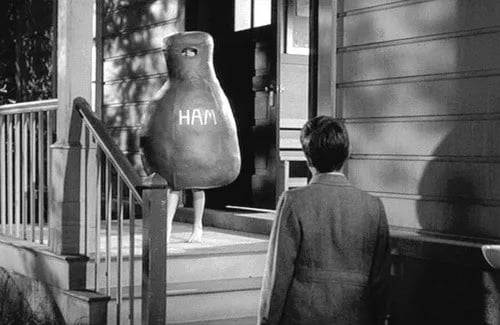
We have done so very many things over the years, that it’s very common for us to hear “I have an idea for something you should do!” We aren’t special. We just do things. You can just do things, too. We give you permission (unless it’s a bad idea).
Do it like no one is watching. Getting too much attention is unlikely to be your problem. Often the greatest impediment to doing things is tearing oneself away from the areas where you’re already getting attention.
Everything has been done before. Do not be deterred by prior art. How many painters have painted flowers? How many Dracula movies are there? So many!
Have a POV. No one has done it your way. So do it your way. As long as you aren’t harming yourself or others, don’t worry so much about how you should do it.
Plan for success. Very many people are so worried about failure they are caught off guard when their project takes off, and it starts taking over their lives in unanticipated ways. The more clear you are on why you are doing a thing, the better you can set boundaries.
Accept that things will go wrong. You will make so many mistakes when you’re trying anything new. Often, the mistakes and crises pay off later in amazing ways that are impossible to anticipate. Maybe just in experience points. Over the long run, very little is wasted.
Ask for help. Friendship is magic. You don’t have to do it all yourself. Again, be clear about what you’re asking for and what you are willing and able to offer in exchange. Do you need an accountability partner? Do you just need a pep talk? Do you need a contribution of time and skills?
Tell everyone. If you are doing something you want or need other people to know about, like starting a business or a newsletter, or exhibiting art, or selling a book, tell everyone you know and meet about it. Everyone.
Everyone.
You can just stop. Unless you’ve entered into a contractual agreement or made a commitment to someone else to keep going a certain way, you get to decide when it’s done. Projects have a lifespan. You can be sad about that, and then you can be happy about your new free time.
If you have made a commitment you need to get out of, that’s where your negotiation skills come into play.
How to Have a Conversation
Humans are social and conversational creatures. The extent to which communication involves our bodies and our identities can actually make it more difficult to figure out whether and why things are going wrong. And now we’re adding software that sounds like people to the mix. The first edition of Conversational Design is available as a free download while I figure out what to put in the next one.
Humans have been talking for a really long time. Well, having multi-modal conversations is more accurate. We don’t know exactly how long because there aren’t any documents, but anatomic and other evidence puts it at 100,000 — 500,000 years ago.
We started reading and writing basically yesterday. The first writing — a sign system that represents a particular language — we know of, cuneiform, emerged around 6000 years ago. Something like 40-50% of the roughly 7,100 living languages don’t have a written form today. (So, no, not all knowledge is in the training data.) Writing feels arduous because it is. Huge cognitive load, no immediate reward.
Literacy changes culture. It’s not just recorded speech. Reading and writing change the way we think and interact. In oral cultures, words are ephemeral and knowledge is social, communal, contextual, and embodied.
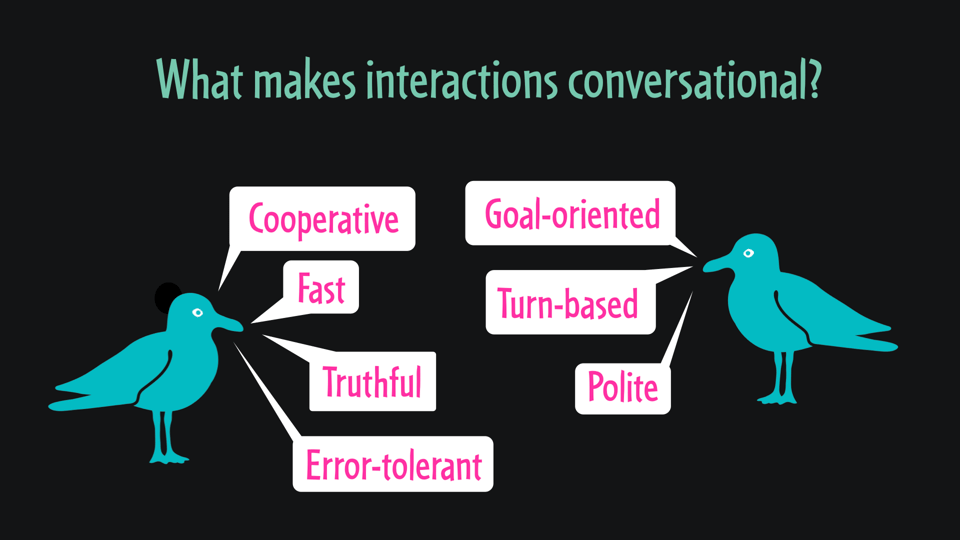
Just because an interaction resembles a conversation doesn’t mean it functions like a good one. Making everything a chatbot doesn’t make it easier to deal with. These interactions often violate the cooperative principle (which isn’t universal, but is conventional). Plus, a more structured or less verbal interaction may be most appropriate.
When you start to sense an interaction going wrong, it can help to pinpoint the missing value:
Goal-oriented: All interactions should be organized around a clear, shared explicit or implicit goal, without a hidden or unfocused agenda.
Context-aware: The difference between interactions and documents is that you can and should be sensitive to what is or might be going on with or around the user or other party.
Quick and clear: Getting to the point is the most respectful thing you can do with someone's time and attention.
Turn-based: A conversation should be an effortless back and forth without one party dominating.
Truthful: Misleading summaries, confabulations, or confidently presenting unverified information are much worse that saying nothing. Misinformation is pollution.
Error-tolerant: In a functional conversation, all participants help each other succeed and clarify each other's misstatements in good faith. Pedantry is antisocial.
How to Get Laid Off
This session was inspired by the many newsletter questions Mike has been receiving. We talked about why layoffs are happening and what to do. A colleague who recently went through an extended period between jobs shared some of this advice.
Have grace for yourself. It wasn’t your fault. There was nothing you could have done. Truly.
Take time to rest. Getting laid off is a traumatic event. If at all possible take time before thinking about what’s next.
They hijacked your limbic system. A lot of employers, especially tech companies, tend to love bomb new employees and do a lot of internal PR. The way the human brain works, this leads to assumed mutuality. It’s almost unavoidable. However loyal and committed you feel to your job, you will project that onto your employer and expect that from them, even if they view you as a database record.
Try to stay on a schedule. Find an accountability partner if it helps. Allocate time to look for work, learn new skills, socialize, volunteer, and of course, take that stupid mental health walk for your stupid mental health. Timebox your doomscrolling. (Lol right.)
Think in terms of work not jobs. If you’re a professional who has been working in-house, it can be easy to over-identify with your job title. Many necessary things — money, community, purpose, learning, identity — might have been bundled together in your job in one way, and now you have to find a different way. That’s not easy.
Be useful. Arnold Schwarzenegger talks about this a lot. Take a look around you. You still have all your skills. Those skills have use. You probably have skills that are useful in ways you might not have considered because of your previous job description.
Remember that all labor is skilled labor. Time to let go of the caste system in your head and develop empathy for and solidarity with other workers.
Self-Promotion Clinic
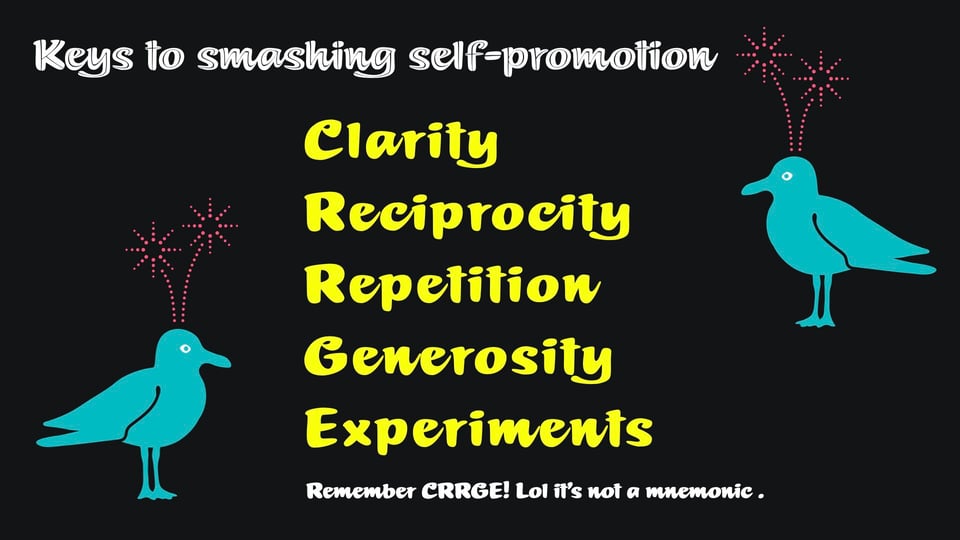
We had so much fun in this one. By the end, all the participants were hyping each other up.
Yes, it’s a conversation. Think about it like talking about your interests and areas of expertise in public, in a way that creates space for other people to participate. A lot of the negative associations with self-promotion come from people who just show up, blast out the thing they want to promote, and leave. Listening and reading the room are critical.
Sometimes the best way to promote yourself is to get other people talking or recommend what someone else is doing.
Know your audience. Who is your audience? Where are they most likely to see your stuff? Online? A flyer on a pole? What are the barriers to them doing the thing you want them to do? Is it an audience that you need to reach indirectly (through word of mouth)? The more you know, the less you’ll burn yourself out.
Friendship continues to be magic. This is where you really need your heist team/hype team. This stuff can be exhausting, especially in times like this, and especially if you’re more of a doer than a talk about it-er. Something that’s very hard for you might be easy for someone you know, and vice versa. Each according to their abilities. Get that web ring going. Form an informal collective.
You need clarity. The more clear and specific you are with yourself about your goals and audience, the better. For your messaging, your requests for help, and how you spend your time.
Reciprocity is key. This is an important principle in sales, too, and just a good way to be. Give something before you ask for something. Think of what you can give that doesn’t cost you much.
You have to know what’s actually valuable to your audience. You don’t get to tell them what’s useful or entertaining.
Repeat. Repeat. Repeat. You live with yourself so you will vastly overestimate how aware other people are of you or of the topics that concern you. There are a lot of numbers floating around out there about how many times someone has to see a call to action before acting. Is it 7? Is it 100? It’s definitely more than once.
Find ways to talk about the same thing in different ways.
Be generous. Get out of the scarcity, zero-sum mindset. Celebrate the success of other good people. Together we overcome the con artists dominating the conversation. Every time you want to react with outrage, promote a pal instead.
Do experiments. Try stuff to see what works. Think about whether the problem was the message not connecting or just not enough people saw it. You need to put a lot of stuff out there. It may feel like an ungodly amount of stuff.
State the “obvious.” It’s only obvious to you because of your expertise, experience, or interest. A lot of people and organizations unwittingly alienate neophytes. Don’t be afraid of saying basic stuff. Try to do it in an interesting way.
Promote the category. This is the “Got Milk?” or “Enjoy life, eat out more often” of promotion. Before anyone is interested in your specific thing, they might need to be made aware of and sold on the higher-level concept. Benefits/risks/fun facts. People love a fun fact.
Know yourself. You don’t have to do what everyone else seems to be doing. Your perspective and point of view are what you’re promoting and the activities you choose are part of that. Study what other people are doing to understand what does and doesn’t work for you.
What’s your face? This is a personal brand thing. What do you want to be recognized for? Does it need to be your actual face? Is it a book cover? Is it a concept or a visual art style? Your company name? A community you've built? You choose your persona and what elements represent you. This depends on your channels and goals. WWDD (What would Dolly do?)
Play the long game. Building an audience takes a long time, so accept that, pace yourself and do more of the things that are easy for you. Overnight success takes years and years.
Remember that promotion work in any medium is a physical practice. Your brain is a body part. People forget this.
Get concise. Think like an advertiser. Make things easy on your audience. Tell the more compelling story with the least work on their part. You don’t have to say everything all at once, but it helps if you get to the point. Especially with LLMs kicking out meandering verbose text, get pithy with it and you’ll stand out.
Getting good at this comes with practice, repetition, and iteration.
Have fun with it. Promotion is a slog. No matter how successful you are, you can’t ever coast. Sorry. (Look at movies stars doing press tours. Ugh). So, think about how to do things that are fun (or "rewarding" or "possible" if your topic feels too serious to apply the term “fun”) and easy over the long haul.
The bottom line
Friendship is magic. We’re all in this together. If there’s something we can help you with, just ask.