#13: watching censored films in the philippines
my new piece in seen, the film journal from blackstar projects
You’re reading Other Kinds of Intimacy, a newsletter by me, writer and journalist Juliana Feliciano Reyes. You can subscribe here.
Hi friends, I’m back after a long break, writing to you from Manila.
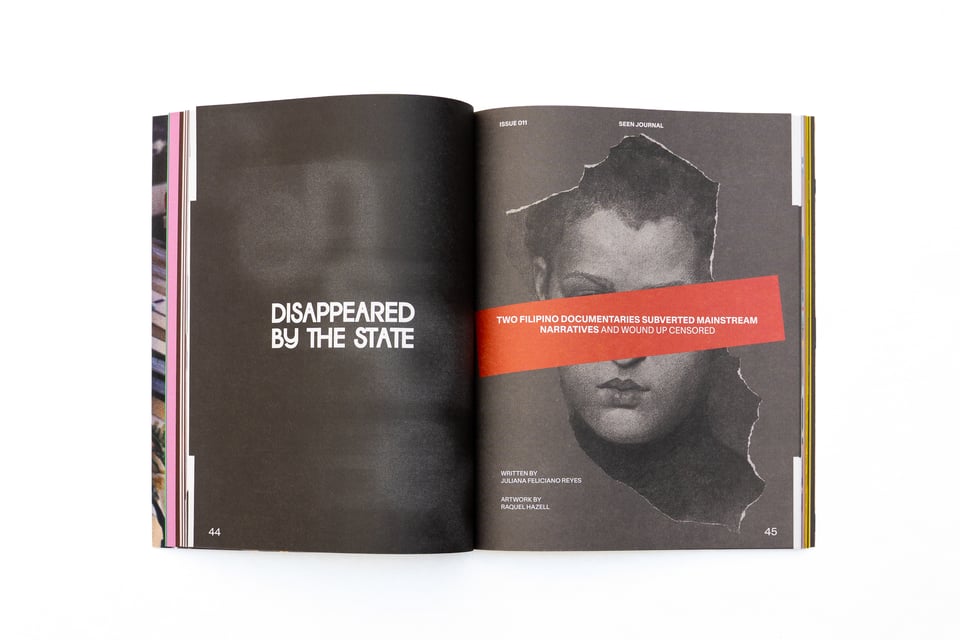
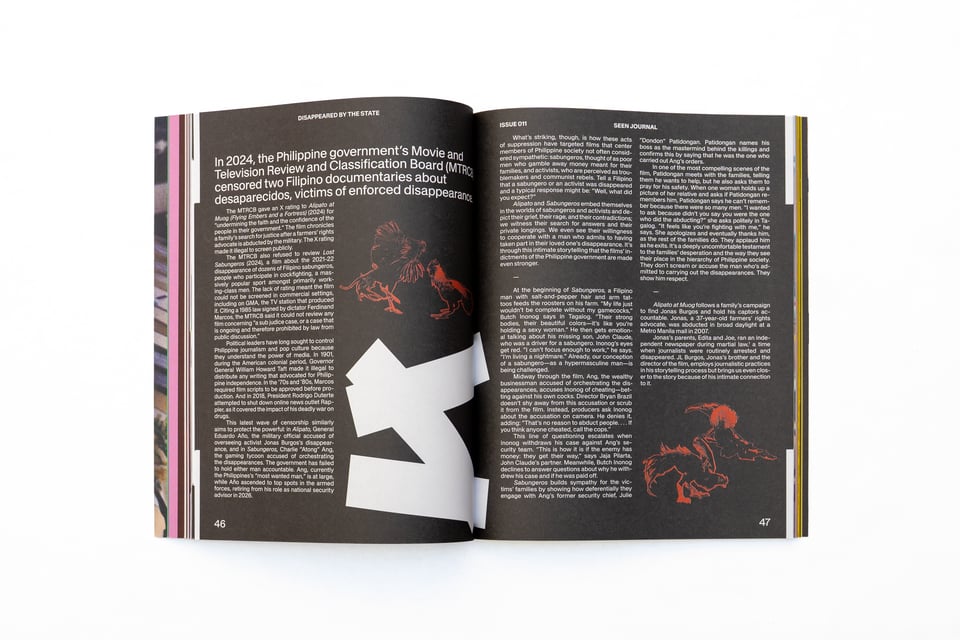
I’m excited to share a piece I have in the latest issue of Seen, the journal run by the BlackStar Film Festival. It’s a feature about two documentaries that were censored by the Philippine government: Alipato at Muog (Flying Embers and a Fortress), about the military abduction of activist Jonas Burgos, and Lost Sabungeros, about the disappearances of dozens of Filipinos who participated in cockfighting.
I look at the historical context of film censorship in the Philippines and examine both docs to understand what exactly the government deemed so important to keep from the public. You can read it here. (You can get a copy of the issue here. It’s a beauty.)
Big thanks to my editors Heidi Saman and Yasmine Espert; Keith Sicat, who put me on to the issue of censorship and helped me navigate the film world; and my friends Rocky Bernido and Ronn Angeles, whom I met just at the right time (read: working furiously on edits), for informing my thinking about the worlds of activism and sabong (cockfighting) in the Philippines.
It’s the first piece I’ve done from Manila, which was thrilling in so many ways. I got to use my fledgling Tagalog while reporting (more listening than speaking, but still). I got to dive deep into corners of Philippine society I knew little about. I got to show up in a different role than my usual here.
I’ve written some on here about my deep yearning to develop intimacy with the Philippines, and for much of my adult life, journalism has been one of the primary ways I’ve done that with a city. So it felt really good to find myself back in that position last (Filipino) summer, when I was doing the reporting for this piece. The story took me to the office of a major news station (an alternate life, perhaps) and a city university that I realized my grandfather used to teach at. I imagined him there, on the campus inside the old walled city, hurrying to get to his next teaching gig in another part of town.
Whether I was interviewing directors or shifting into reporter mode at a film event when I realized I was speaking to a potential source (lol, he was like, who did you say you were again?) — muscle memory took over. It felt, as I wrote to a friend earlier this week, natural and familiar, in a place where I don’t always feel that way.
It reminded me of when my friend visited me last month, and we went to San Andres Bukid to visit a youth group’s capoeira roda, where they sing and play instruments and do capoeira with each other in a circle. (The verb I’ve generally heard used is “play” when it comes to doing capoeira but one of the teenage girls I met there gleefully used a different verb, “laban,” fight.) My friend, a longtime capoeirista, joined them.
I was struck by how at home he looked there, singing the same songs they sang in Philly, playing the berimbau with the kids outside the market in this poor Manila neighborhood as jeepneys loudly backed up by the curb next to us and street dogs wandered around. Like it could’ve been the group he’d been training with for years, instead of one he had met only a few times. Maybe there are roles, identities, communities that transcend place. That afford you entrance, a little less friction. Instinct takes over. Your body knows what to do. Space, if you’re lucky, is made for you.
Thanks for reading.
Till Sunday again,
Juliana

Add a comment: