Entry Level Job: At least 2 Years of Experience Required
Learn how to get hired without experience in 2026 - show your skills, not just your degree

Are you still wondering why entry-level jobs require two to three years of experience at the very least? I’m spilling tea again!
It’s no longer surprising to see such kind of job postings these days. Companies would list an entry-level job and indicate that fresh graduates are welcome to apply.
But how do you get a competitive edge against more experienced candidates?
Answer: Use your remarkable extracurriculars as experience.

Inside:
Why do entry-level jobs require experience?
How do I get a job without experience?
Your next task
FAQ - How to get hired without experience
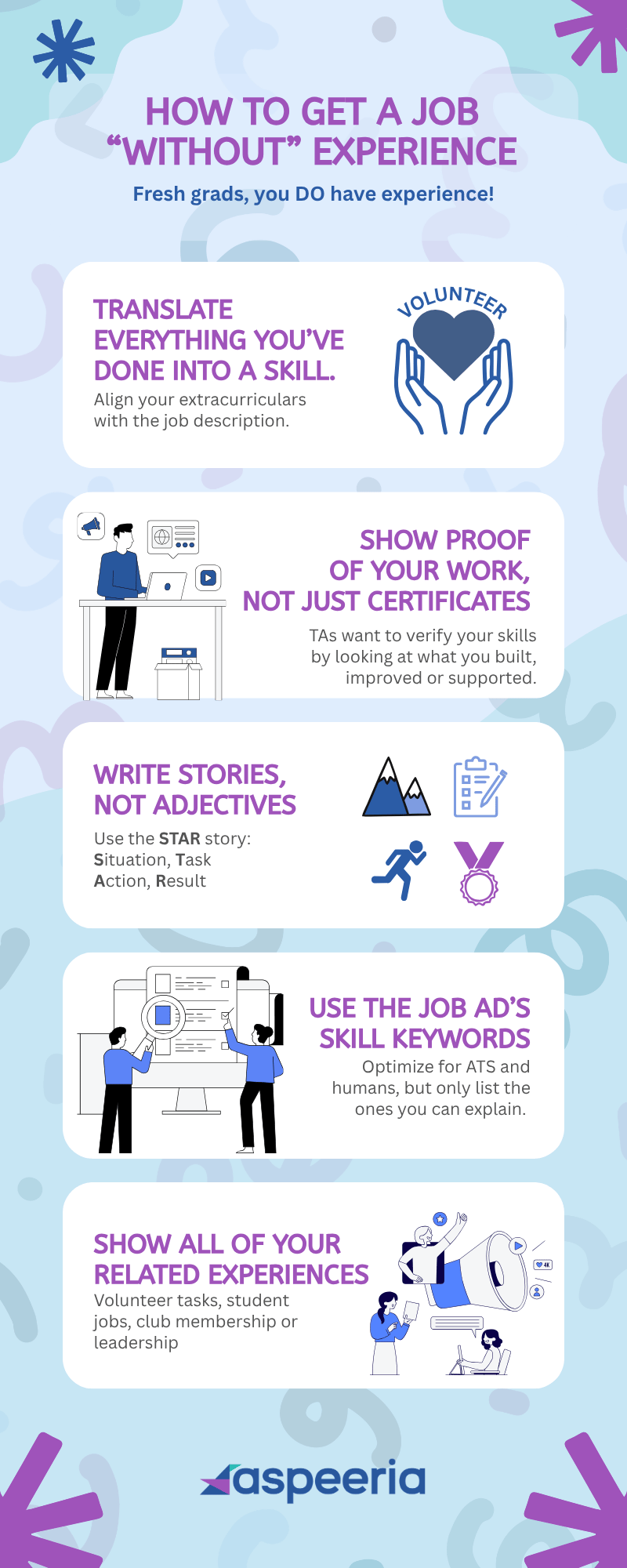
Save this infographic!
Why do entry-level jobs require experience?
tl;dr “competence over credentials”
Thousands of fresh graduates compete to enter the labor market every year. In Technology, this competition results in a job placement of around 23-25 months after graduation.
The International Labour Organization (ILO) acknowledges that there’s a high competition for the increasing number of university graduates that are looking for work (Global Employment Trends for Youth 2024 - Asia and the Pacific).
But then, there’s only a limited number of jobs resulting in unemployment of many degree-holders.
To screen applicants, employers now use a skills-based approach; they no longer rely on bachelor’s degree alone.
McKinsey said that this approach helps both employers and workers. Skills-based practices help companies find and attract a bigger pool of talent, create more resilient workers, and build a better-equipped workforce.
Ultimately, it leads to better hiring outcomes for both the candidate and employer.
Remember that as a fresh grad, they are considering your skills, not literally 2 to 3 years of work experience.
How do I get a job without experience?
💡 Key Takeaways
Translate everything you’ve done into a skill.
Show proof of your work..
Use the STAR technique to share your stories (don’t just write adjectives!).
Optimize your resume by using the job ad’s skill words.
Show all your related experiences.
1. Translate everything you’ve done into a skill. Link your extracurriculars and internship with professional skills by picking those that align with the job description. For example: “Built a student organization website that improved member communication and increased participation by 50%.” If you’re a senior high school student, this is the perfect time to plan your future extracurriculars.
2. Show proof of your work, not only certificates. Listing a skill is not proof by itself. It is now necessary to show: a portfolio, a small freelance project, a spreadsheet sample. Talent Acquisition or hiring managers can verify your skills by looking at what you built, improved, or supported.
3. Write stories, not adjectives. Use the STAR story (Situation, Task, Action, Result) wherever applicable. All fresh grads can say that they are “fast learners.” You want to rather give an example on how you demonstrated that you are adept at acquiring new skills. For example, “I taught myself to optimize the Computer Society’s website, leading to a 40% increase in efficiency.”
4. Use the job ad’s skill keywords. But only list the ones you can explain. This loops us back to ATS optimization and also makes your resume easier to read by a human. If the job ad says “stakeholder communication” use that instead of “talked with stakeholders.”
5. Show all your related experiences. Apart from an internship that everyone goes through, it is notable that you get some experience through apprenticeship and extracurriculars. Volunteer tasks, student jobs, and club or student org leadership all add up to experience as long as you list them the right way.
Follow Aspeeria on Facebook
Your next task
Now on to you. Feel free to use this guide side-by-side with your resume while editing. You’re welcome.
You will no longer say that you “don’t have experience.” You have led, organized, problem- solved in student orgs, summer jobs, and in your classroom!
Maximize the impact of your extracurriculars to your resume by focusing on their relevance, clarity, and demonstration of transferable skills that align with the job you’re applying for.
If you’re in senior high school or University, this is the best time to think about the clubs to join and extracurriculars to take. Participating in clubs related to your field of study and taking on a personal project like blogging or coding will be a useful addition to your experience.
FAQ
Can I really get a job without work experience? Yes, it will depend on how well you can translate your extracurricular activities into transferable skills. Instead of saying that you were simply a member of a club, highlight certain skills that you can use in the job that you’re applying for.
Do employers still look at GPA/GWA? Some may consider GPA/GWA in hiring while some prioritize work experience and skills.
How can I gain experience? Having leadership or membership roles in clubs, volunteering, and taking student jobs are a few ways of gaining experience while you’re in College or University.
How do I show my experience if I do not have work experience yet?
Ever organized a campus event? That demonstrates project management skills. Were you a member of the debate club? Strong communication skills. Volunteered? That’s empathy, reliability, and teamwork in action.