The Revolutionary: Samuel Adams by Stacy Schiff
Stacy Schiff’s The Revolutionary: Samuel Adams offers a revealing portrait of the Founding Father whose political activism helped turn colonial resistance into a movement for independence.
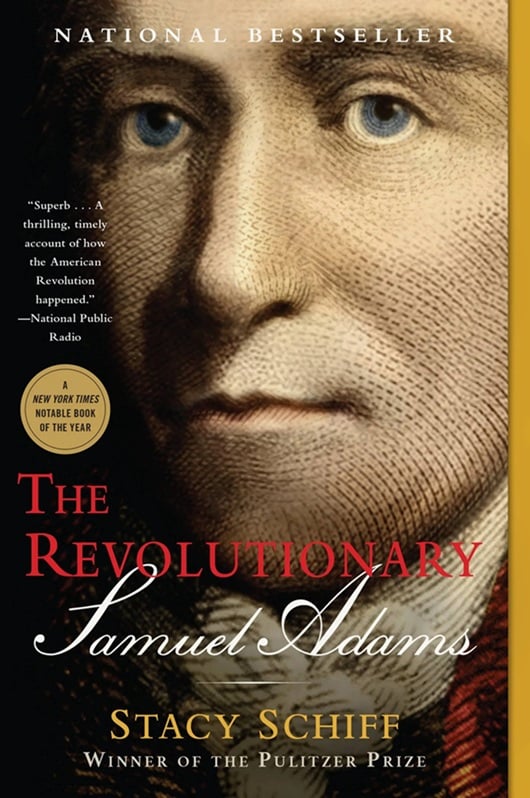
Stacy Schiff, the Pulitzer Prize-winning author, turns her attention to one of the most consequential yet often overlooked Founding Fathers in The Revolutionary: Samuel Adams, a revelatory biography of the man whose political activism helped ignite the American Revolution. It was first published in 2022 by Little, Brown, and Co. A paperback followed in 2023.
Upgrade nowThomas Jefferson once argued that if the Revolution had a leader, “Samuel Adams was the man.” Driven by lofty ideals but willing to employ hardball tactics, Adams became the driving force behind what may have been the most consequential campaign of civil resistance in American history.
Schiff restores Adams to the prominence he deserves, introducing readers to a shrewd, eloquent political operator who provided much of the moral foundation for the Revolution. He helped shape public outrage over the Boston Massacre, played a key role in organizing the Boston Tea Party, and used every political tool at his disposal to rally Boston, Massachusetts, and eventually the colonies to the cause of independence. In doing so, he helped create the movement that would ultimately create a nation.
Adams’ revolutionary activities also made him one of the most wanted men in America. When Paul Revere rode toward Lexington in 1775, part of his mission was to warn Adams that British authorities were preparing to arrest him for treason. In The Revolutionary: Samuel Adams, Schiff applies her considerable storytelling talents to Adams’ unlikely transformation from an aimless son of a prosperous family into a tireless and charismatic radical who helped mobilize the colonies.
Upgrade nowI learned a lot about Adams from the book that I didn’t already know going in. In fact, reading the book more than makes up for the historical liberties that were taken in History Channel’s Sons of Liberty miniseries in 2015. Can we talk about the fact that Ben Barnes, who was turning 33 when production took place, was portraying Adams during the 1765–76 time period when Adams was 43–54 years old? This is a reason why I far prefer books and documentaries when it comes to American history. In fact, I ruled out doing a rewatch to mark America 250, and I feel all the better for it.
Adams, who was just 14 when he enrolled at Harvard College, took a mandatory Hebrew class while he was a student at the Cambridge school. This particular course was “reviled by the undergraduates.”
When it came time to write his thesis paper, Adams chose to write about whether it is “lawful to resist the supreme magistrate if the republic cannot otherwise be preserved.” He was the only revolutionary in his graduate class, but Schiff sees “some truth” to the allegations that one can blame the American Revolution on the Harvard College library. All five Massachusetts signers of the Declaration of Independence had attended Harvard.
We’re introduced to James Otis Jr. when he delivers his five-hour speech on February 24, 1761. He used his speech to argue “against the newly fortified writs of assistance,” open-ended warrants that allowed Crown officials to enter and search premises for contraband. Otis was of the view that Parliament could regulate American trade but did not have the power to tax it. There would be times down the road when Otis went against the cause, but one can blame this on the injury that he later suffered, which is detailed later in the book. Otis made these arguments in front of Thomas Hutchinson, who served in the dual role of lieutenant governor and chief justice of the Superior Court.
In December 1765, John Adams wrote in his diary that his cousin was “a Man of refined Policy, stedfast Integrity, exquisite Humanity, genteel Erudition, obliging, engaging Manners, real as well as professed Piety, and a universal good Character.”
That same year, a subsection of tradesmen had begun referring to themselves as the Sons of Liberty. While he knew the Loyal Nine, he was not a member of that particular club. The Sons would prove to be pivotal in the years leading up to the first shots fired at Lexington and Concord. But for now, a number of colonists were uniting that October as members of the Stamp Act Congress.
The Stamp Act really did a number on Boston, let alone the other colonies. An effigy of tax collector Andrew Oliver was burned and his office destroyed, while Hutchinson’s home was also destroyed. While it would eventually be repealed after five months and never enforced, it helped propel the likes of Adams and Patrick Henry in their respective home states, years before they would be referred to as Founding Fathers. Boston was “leading the colonial pack” as its press “emerged the real heroes.”
In addition to the aforementioned Loyal Nine, there was the Long Room Club, Monday Night Club, North End Club, etc. There was no one sitting “at the radicals’ red-hot center for the simple reason that there was none.” Adams found himself along the perimeter of each.
Meanwhile, through his capacity as a member of the Massachusetts House of Representatives, he arranged for a gallery to be constructed. This enabled citizens to observe the representatives in action.
In June 1768, King George III had responded to the Circular Letter and demanded that the Massachusetts House renounce it. It was “an anti-government day” for Otis as he “shredded British authority for over two hours.” There is so much going on that it’s tough just pulling the moments that I feel stand out, and this is with another 200 pages remaining in the book!
Upgrade nowNot until 1768 did Adams “set his heart on American Independence.” There are various opinions as to when the die was cast and there was no turning back. Mercy Otis Warren put it at the “hostile parade up King Street.” Peter Oliver felt it “was settled in Boston in 1768, by Adams and his junto.” Governor Francis Bernard placed it a year earlier. Others believe it to be the Townshend Acts. By all accounts, if Adams hadn’t embraced independence by 1768, he did now.
When the Boston Massacre and its subsequent fallout is first mentioned, Schiff never outright refers to the March 5, 1770, events as the Massacre. It’s only because of how familiar I am with the Boston Massacre that I realized what she was describing as soon as I read it. Adams eventually coined it a “horrid massacre.” Hutchinson and other British officials used different phrases.
At some point, Benjamin Franklin had sent Hutchinson’s letters to Adams with the guarantee that they wouldn’t be published. Adams ended up reading them in the Massachusetts House. Unfortunately for Franklin, the letters were published, but only after Hancock got his hands on a copy that matched.
In the spring of 1773, the Tea Act was passed by Parliament to prevent the collapse of the East India Company. The act allowed them to “export tea directly, without additional duty, and to appoint agents to sell that tea to retailers,” eliminating the merchants in the middle. Oh yeah, thanks to the majority of the Townshend Acts being repealed, additional tax revenue went toward the royal governor salaries in America.
What we know about Adams is that while he did address the crowd at the Old South Meeting House, he was not actually present for the Boston Tea Party itself. He remained there with Joseph Warren, Thomas Young, and John Hancock. Even though he missed it, he referred to it “as remarkable an event as has yet happened since the commencement of our struggle for American liberty.”
When Hutchinson wrote to Lord Dartmouth after the Tea Party, he admitted that he “cannot find any persons who were at the meeting of the people willing to give any account in writing of the persons who were the most active there nor of any of their transactions.”
Following the Boston Tea Party, both New York and Philadelphia ordered the tea back. In South Carolina, they unloaded the tea, but it was never sold.
By 1774, it was time. The colonies were united, and those in correspondence with each other had agreed to meet in Philadelphia in what would be the First Continental Congress. They met at Carpenter’s Hall, relocating the next year to the Pennsylvania State House, now known as Independence Hall. Adams returned again the next year for the Second Continental Congress, weeks after the first shots were fired in the American Revolution.
Late in his life, Adams would become the third lieutenant governor of Massachusetts. Upon the death of John Hancock in 1793, he would become the fourth governor of Massachusetts, first in an acting position and then elected the next year, which would be his last hurrah in office. What did surprise me was that Adams was aligned with the Jeffersonian Republicans rather than the Federalists as political factions began to form.
When Thomas Jefferson delivered his inaugural address, he had Samuel Adams in mind. Rather than even make an attempt at summarizing their correspondence, I’ll just provide the direct links so you can peruse them at your leisure:
Thomas Jefferson to Samuel Adams, February 26, 1800
Thomas Jefferson to Samuel Adams, March 29, 1801
Samuel Adams to Thomas Jefferson, April 24, 1801
Samuel Adams to Thomas Jefferson, November 18, 1801
When Adams died in October 1803, he was eulogized by Boston papers as “the Father of the American Revolution.” In his diary, William Bentley wrote, “No man contributed more towards our revolution, and no man left behind him less.” And yet, he faded from view, while Warren was celebrated for generations before his own reputation eventually faded as well. Adams began receiving renewed attention around the centennial of the Stamp Act. Many of his papers were destroyed, and this has done no favors for his biographers. A statue wasn’t dedicated in Boston until one was placed in front of Faneuil Hall in 1880.
One thing I appreciated about reading the book is that Adams doesn’t come off as the mythical figure he has sometimes been made out to be, much of which can be attributed to the accounts left behind by his Tory adversaries. Schiff does her job in correcting the record, giving us a much fuller picture of the man behind the legend in the process. The result is that Stacy Schiff’s The Revolutionary: Samuel Adams is an illuminating biography of a Founding Father whose contributions to the American Revolution deserve to be better remembered.
Upgrade now