King Hancock by Brooke Barbier
Brooke Barbier’s King Hancock offers a compelling portrait of John Hancock, a complicated patriot whose moderation proved to be one of his greatest political strengths.
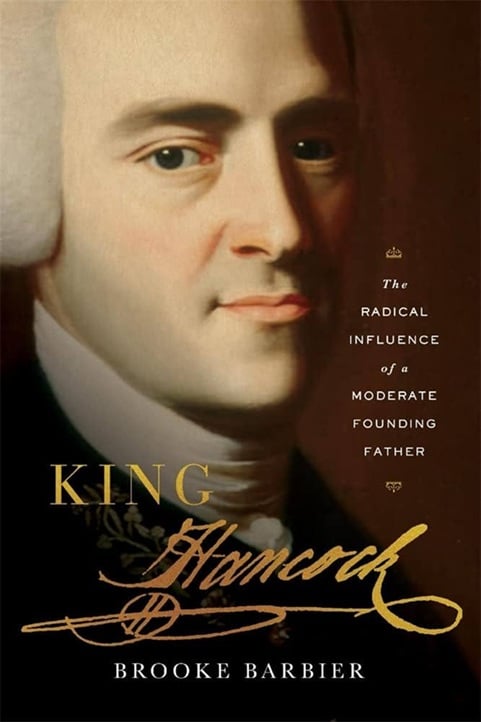
Brooke Barbier’s King Hancock: The Radical Influence of a Moderate Founding Father offers a lively portrait of John Hancock, a complicated patriot whose pragmatism and willingness to find common ground helped turn American independence into a reality.
Upgrade nowWhile his famously recognizable signature is known to virtually every American, the man behind it is considerably less familiar. Barbier presents Hancock as a study in contradictions: a man born into tremendous privilege who nevertheless connected with ordinary Americans, and a respected member of society who was wary of radicalism but became an important figure in the fight for independence. With a substantial portion of the population uncertain or conflicted about the Revolution, Hancock’s ability to speak to those Americans—and bring them into the cause—proved particularly valuable.
Orphaned at a young age, Hancock was raised by his wealthy merchant uncle and eventually inherited his business and fortune, including enslaved people whom he later freed. By his early thirties, he had become one of New England’s leading political figures, prominent enough to land on Britain’s most-wanted list and earn the mocking nickname “King Hancock.” Although he ultimately committed himself to the Revolution, his moderate instincts became an even greater strength in the years that followed. As president of the divided Second Continental Congress, Hancock helped provide a steady hand amid political disagreements. His diplomatic dealings with French military officials strengthened an essential alliance, while his later tenure as governor of Massachusetts saw him help persuade the state’s delegates to ratify the Constitution and ease tensions following the upheaval of Shays’s Rebellion.
The fascinating thing that comes with reading King Hancock immediately after reading The Revolutionary: Samuel Adams is essentially getting to read about their friendship and the same events through two very different points of view. The Hancock book runs 234 pages before getting into the endnotes, bibliography, and index, so I was able to zip through it rather quickly upon finishing the Adams biography. The main things I knew going into the book were Hancock being the president of the Continental Congress when the Declaration of Independence was signed and that he had signed with the largest signature when the engrossed copy was signed a month after its adoption.
Hancock also suffered in the same way that Adams did in the years after their deaths. It wasn’t just that he didn’t leave any personal writings that could be helpful for biographers (the first Hancock biography didn’t appear until the 20th century). Because of this, biographers had to depend on the writings of people who weren’t his biggest fans, so to speak. The monument at the Hancock tomb at Granary Burying Ground wasn’t erected until the late 1800s. At the same time, his home on Beacon Hill was demolished in 1863 despite hopes to preserve it. It stood in the southwest corner of what today is the Massachusetts State House grounds. Four years before it was demolished, Governor Nathaniel Banks proposed using the home as a governor’s mansion, but the measure was defeated. There was a suggestion to make it a museum, but these efforts failed. Much like the demolition of Penn Station in New York, it spurred preservation efforts in Boston to save a number of important landmarks.
Hancock was attacked for being a moderate. There were times when people wanted him to take a harder stand. These criticisms have lasted through the 21st century, portraying him as “a one-dimensional and vapid dupe.”
There was also the hypocrisy he faced—rightfully so, I must say—for calling for freedom from tyranny despite the Hancock family being slaveholders. It wasn’t until he became a Patriot leader that he started changing his mind about slavery and began the process of emancipating his slaves.
Upgrade nowAt some point, Hancock earned the “King Hancock” nickname from both friends and enemies. His British critics used it sarcastically to “taunt the colonists for being simple bumpkins.” However, allies used it to show their “support and admiration for the man who had sacrificed so much while also acting as a backhanded condemnation of the monarchy.”
Hancock’s opposition to the Stamp Act didn’t come in the form of taking to the streets as it did for so many in Boston. While he initially “had no time to meddle in politics,” he took to writing letters to London, but only after two officials were targeted by riots. Hancock was seen as a “prominent merchant” and, for those in London, he was a “reliable client and connection to the vast colonial market.” Hancock, like so many other merchants in colonial America, had debts to London merchants. But because of the Stamp Act forcing a stagnation in trade, Americans would not be able to pay their debts, forcing those in London to take their pleas to Parliament. And yet, Hancock kept going right up until the deadline—if ships arrived, he’d be able to sell merchandise that colonists couldn’t get anywhere else.
In listening to those in his vicinity, Hancock embraced what would be a key language of the American Revolution as many colonists feared being enslaved by the British, writing in October 1765 to Jonathan Barnard: “The people of this Country will never Suffer themselves to be made slaves …to that D—d Act.”
Historians have made an attempt to “quantify colonists’ loyalties,” finding that 20% were loyalists, 40% were patriots, and the remaining were “apathetic or uncommitted to a political side.” The remainder are what are commonly referred to as the “disaffected.” You couldn’t blame them for just wanting to be left alone.
A new nonimportation agreement was signed in 1768 following the Townshend Duties. This agreement went into effect at the beginning of 1769 and, with rare exception, it required that no British goods would be imported to the colonies. Nowadays, we’d refer to this as a boycott, but as I learned from reading the book, Charles Boycott hadn’t even been born yet. He was “the Irish landlord who gave us the term boycott.”
Samuel Adams had set up the Boston committee of correspondence, a group that included merchants, lawyers, and doctors, but notably, it didn’t include Hancock. Thomas Cushing, a moderate, also declined to join. It was cause for concern for both Adams and his cousin John. While both Hancock and Cushing didn’t want to suffer from taxation, Barbier notes that “they were also not as agitated as others about crown policies, especially after most of the Townshend Duties were lifted.”
Writing a Hancock biography over two centuries after his death gives Barbier an advantage. It allows her to provide context to the bigger picture and paint a portrait of a man that so many of us know for doing one thing. The author writes:
“We also know things the revolutionaries did not. Hancock had no idea that Parliament would pass another ill-conceived tax in a couple years and that he would join in to resist it. For he was not living in a pre-war society—with violent resistance, deadly battles, and colonial independence just a few years in the future—but a post-war one, in which Massachusetts had allied with British forces less than a decade before. Because he did not feel threatened by the crown’s policies in the early 1770s and had reason to hope any turmoil was over, he literally went about his other business.”
But even as Hancock didn’t join the committee, he still endorsed the Boston Pamphlet, which “enumerated grievances against Parliament, railed against the change to judges’ salaries, and restated colonial rights.”
For all of Hancock’s indifference, what especially changed things was the Tea Act. It was an “interference with his business.” After a three-year break, he came off the sidelines and joined up with Samuel Adams once again.
Upgrade nowWhen the Second Continental Congress met in Philadelphia, Peyton Randolph was president. He had served as president of the First Continental Congress and, back home in Virginia, he was the president of the Provincial Assembly. Because the Assembly was called into session by royal governor Lord Dunmore, Randolph departed shortly for Virginia. Members looked north for the next president, electing Hancock unanimously—he was a safe choice, both for conservatives and defiant delegates. The election was seen with little fanfare at the time. But being elected president was “the single most significant event in his career, and it ultimately made him famous.”
After Joseph Warren’s death at the Battle of Bunker Hill, Hancock offered his services to then-General George Washington as a volunteer. Washington declined the offer.
While Hancock was in Philadelphia, his Aunt Lydia and fiancée Dorothy Quincy were staying at the Fairfield, Connecticut, home of Thaddeus Burr, a cousin of Aaron Burr. Quincy ignored his letters. If not for Lydia Hancock, it’s possible that Quincy would have married Burr instead of Hancock, whom she married during the Second Continental Congress recess in August. One person surprised by Hancock’s marriage was John Adams.
After briefly touching on slavery earlier in the book, Barbier touches on the subject again during the back half when Lydia passed away in April 1776. Her will set free the enslaved men and women whom she owned. In some cases, there were contingencies, such as age or requiring a year after her passing.
Slavery’s immorality came up frequently during this time in the colonies. It wasn’t lost on a number of people when it came to fighting for liberty while also enslaving people. As a way of justifying slavery, Barbier writes that Hancock and his aunt Lydia “considered slaveholding to be protective and acceptable because it was part of the social order.” This doesn’t make it any less right.
During the fall of 1777, Hancock made the decision to resign his role as a member of the Second Continental Congress. He made the decision because of his health. He would never again set foot in a congressional setting. His departure came just before a key win in Saratoga against the British. He also would miss the finalization of the Articles of Confederation. Washington sent a dozen dragoons and an officer to accompany Hancock on his return to Boston.
French military officers didn’t arrive until the summer of 1778 to assist Americans in the fight for independence. Barbier points out something that I didn’t know about Massachusetts during the American Revolution. Obviously, I already knew that “the French alliance was critical to the United States winning the war.” I don’t know how much of this is because of the earlier wars between England and France fighting it out in North America since the 1600s, but “many colonists—especially those in Boston—hated the French.” Barbier further expands on this:
“The fear of France was worse in Massachusetts because most of the European country’s inhabitants were Catholic. The province, by contrast, had been founded by Puritans who wanted to purify the Anglican church from the rituals they found too Catholic—a dangerous religion that ultimately seemed too loyal to the pope, not the state. Recall that every year Boston celebrated Pope’s Day, when rival street gangs would try to capture each other’s pope. And destroy it. All in commemoration of a failed attempt by Catholics to blow up Parliament.”
One couldn’t blame New Englanders for being upset about Comte D’Estaing deciding to pull out of British-occupied Newport, Rhode Island. If Hancock had any prejudice towards the French, he didn’t openly display it. In fact, Hancock was able to “soothe tensions with Bostonians.” He was ultimately honored by D’Estaing as “a patron of the French.” Hancock played his part through means of soft power.
Both Samuel Adams and John Hancock had reconciled in 1789 when they were elected governor and lieutenant governor, respectively. They would be reelected for the next three years. What caused them to unite again is that they viewed the federal government with suspicion and they were “both protective of states’ rights.” It’s common for people to look at states’ rights and think of the Confederacy, but in the late 1700s, many states still viewed themselves as separate republics, despite being united under a constitution.
One has to look back at the early 1780s to know why Hancock felt such tension. Thirty-four slaves from South Carolina had been “captured by privateers and brought to Boston.” Hancock hired three of them. The slaveowner sought the help of South Carolina governor Benjamin Guerard. Guerard demanded their return in a letter to Hancock, citing the Articles of Confederation. Hancock was following the Massachusetts trend of “weakening the institution of slavery.” At some point in the 1770s, Hancock didn’t own any slaves. We know that some former slaves were hired because freed Black people did have trouble finding employment in Boston. Hancock held a ball in his home for “the free Black men of Boston,” and Barbier notes that “Black women were surely in attendance too.” But even if people in Massachusetts were against slavery, it doesn’t mean they were on the same wavelength regarding equality.
King Hancock succeeds in making John Hancock considerably more interesting than the man most Americans know primarily for having a very large signature. Brooke Barbier’s portrait shows a complicated figure whose moderation could frustrate his fellow Patriots but ultimately became one of his greatest political strengths, allowing him to navigate disagreements at home and abroad. At the same time, Hancock’s story is filled with contradictions, particularly when it comes to slavery and the meaning of liberty. What emerges is a portrait of a man whose importance to the revolutionary era came not from being the loudest or most radical voice in the room, but from his ability to bring people together when doing so mattered most.
Upgrade now