A Perfect Coincidence by Jim Rasenberger
Jim Rasenberger examines the extraordinary friendship, rivalry, reconciliation, and lasting legacy of John Adams and Thomas Jefferson.
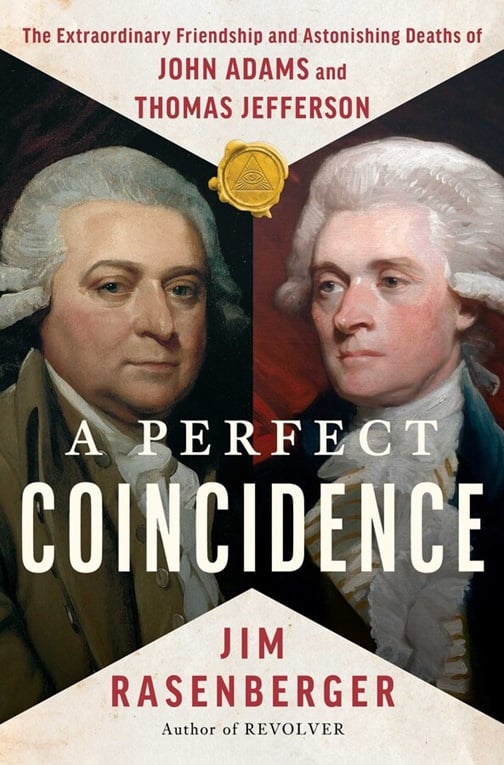
Jim Rasenberger’s A Perfect Coincidence: The Extraordinary Friendship and Astonishing Deaths of John Adams and Thomas Jefferson examines one of the most remarkable stories in American history.
It’s been a quarter century since David McCullough published his Pulitzer Prize-winning biography, John Adams. It later inspired an HBO miniseries about the nation’s second president, albeit one that takes historical liberties in its narrative. As for Jefferson, historians have had to reevaluate how they tell his story after DNA testing and the Thomas Jefferson Foundation affirming that he fathered Sally Hemings’ children in a 2018 statement. Jon Meacham published Thomas Jefferson: The Art of Power in 2012 and it was the first major Jefferson biography published since the testing. Earlier this year, Andrew Burstein published the first major Jefferson biography since John B. Boles published Jefferson: Architect of American Liberty in 2017. The late Gordon S. Wood also published Friends Divided: John Adams and Thomas Jefferson in 2017.
Framed by the extraordinary coincidence that John Adams and Thomas Jefferson both died on July 4, 1826—the fiftieth anniversary of the Declaration of Independence—A Perfect Coincidence traces the friendship, rivalry, and eventual reconciliation of two Founding Fathers whose lives became inseparable from the nation’s earliest decades.
Rasenberger follows the pair from their collaboration on the Declaration of Independence through years of political division and personal estrangement before chronicling their renewed friendship in retirement. Their reconciliation produced 380 letters reflecting on politics, philosophy, aging, and the American experiment, creating one of the most significant correspondences in the nation’s history.
Jefferson penned perhaps the most important words in American history, maybe even the world:
“We hold these truths to be self-evident, that all men are created equal, that they are endowed by their Creator with certain unalienable Rights, that are among these Life, Liberty, and the pursuit of Happiness.—That to secure these rights, Governments are constituted among Men, deriving their just powers from the consent of the Governed.”
It is impossible to ignore that Jefferson penned “all men are created equal” while enslaving hundreds of people. Was he a hypocrite or just tragically flawed? Historians have debated the contradiction for generations and undoubtedly will continue to do so.
In the early years of American independence, it wasn’t uncommon for whites to welcome free Blacks to Independence Day celebrations, both in the North and South. But years later, the only Blacks you’d find at any such celebrations in the South were the slaves who served food.
Maybe he was an optimist, but Jefferson believed America “would become more open to emancipation” in the years after the American Revolution. Jefferson never acknowledged his own blame in seeing the opposite happen. It goes back to what he wrote in Notes on the State of Virginia back in 1785, where he wrote that Blacks were inferior. In writing that, he allowed for further dehumanization of slaves while giving a “moral cover” to slaveholders through embracing “liberty.” As Rasenberger writes, “Jeffersonian liberty did not require whites to free slaves; it only required the federal government to keep its nose out of the South’s business.”
We have Dr. Benjamin Rush to thank for the reconciliation between Presidents Adam and Jefferson. He once referred to them as “the north and south poles of the American Revolution.” They were opposites in just about every way and yet these two men worked tirelessly in pursuit of American independence.
While they started out as close friends during the early years of independence and spending time together in Paris and London during the 1780s, they eventually became political rivals and later enemies.
I’ve read biographies on both Adams and Jefferson in the past, but it was fascinating to read about them in a dual-biography form, particularly during the years when their lives most closely intersected in the 1780s. Jefferson had been posted in Paris while Adams was posted in London. In fact, Adams and Jefferson spent a week together traveling through the English Midlands, even carving off a splinter of wood that belonged to Shakespeare’s chair, which is now in possession of the Thomas Jefferson Foundation at Monticello. Try doing this today and you’d be arrested!
Something I didn’t know until reading the book, in part because it’s been a while since looking at the painting is how John Trumbull’s painting depicts Jefferson’s foot turned at an angle and stepping on Adams’s toe.
Where Alexander Hamilton led the Federalist faction, Jefferson and James Madison led the Democratic-Republicans. What really undid things was how Jefferson undermined Adams while the latter was president. The Alien and Sedition Acts of 1798 turned out to be Adams’ undoing. If you think today's politics are bitter, the 1790s were arguably even worse.
The Alien Acts targeted noncitizens but the Sedition Act targeted Americans. Until the act was repealed, there were 25 arrests, 17 indictments, and ten convictions. One of the first people arrested was Benjamin Franklin’s own grandson, Benjamin Franklin Bache. Bache ended up dying of yellow fever during the three months in which he was awaiting trial. Not even sitting members of Congress were immune from the law—Vermont congressman Matthew Lyon was imprisoned for declaring that President Adams displayed “unbounded thirst for ridiculous pomp, foolish adulation, and selfish avarice.” James Callender was another journalist arrested, but being pardoned by Jefferson wasn’t enough. He published the first known account tying Jefferson to Sally Hemings.
Back in Virginia, Madison authored the Virginia Resolution and Jefferson authored the Kentucky Resolution. His text originally contained “nullification”, but the legislature removed it prior to passing. The word did enter the American lexicon and as the late Gordon S. Wood wrote, this “laid the basis for the nullification and states’ rights doctrines later used to defend slavery…in the period leading up to the Civil War.”
Jefferson sent James Monroe and Robert R. Livingston to Paris early in his term. His initial hope was that France would accept an offer for the Port of New Orleans. Ultimately, the entire Louisiana Territory was offered to the United States for $15 million. The U.S. delegation had only been authorized to spend $5 million but that was just for New Orleans. The Louisiana Purchase would double the size of the US by gaining 828,000 square miles.
While both had been out of office at the time, the book also covers the War of 1812, which Wood calls “the strangest war in American history.” Neither country wanted the war and while American maritime rights were continuously violated, Britain ordered that ship seizures and impressments come to an end. Federalists were against the war, while Republicans—especially the war hawks—from the South and West were in support. Ultimately, the war would serve as the effective end of the Federalist Party. Years before the Civil War, Northerners threatened to secede in the Hartford Manifesto. And then Andrew Jackson happened.
Jefferson’s presidency concluded in early 1809. This was the same year that Rush had a dream where he imagined both Adams and Jefferson reconciling. Coincidentally, it ended with them dying around the same time. He made it his life’s mission for the next two years to get them to reconcile after they stopped talking in 1801. It was Adams who made the first move, writing a letter in 1812. It was brief and awkward, but it resumed the greatest correspondence in American history. For everything that tore them apart, it was healed through empathy, civility, and reason. Although they exchanged hundreds of letters, they never saw one another again.
It’s long been said that Adams’s final words were “Thomas Jefferson survives” as family members gathered around his bedside. Jefferson had already predeceased him earlier in the day. Before giving his last breath, he whispered to granddaughter Susanna, “Help me, child, help me.”
Their deaths on the same day led to a change in the usage of coincidence, let alone its definition when Noah Webster published the first edition of the American Dictionary of the English Language in 1828. Webster’s definition, as provided in the book:
The falling or meeting of two or more lines, surfaces, or bodies in the same point.
Concurrence; consistency; agreement; as the coincidence or two or more opinions; coincidences of evidence.
A meeting of events in time; concurrence; a happening at the same time; as coincidence of events.
Jefferson “had in mind the second definition” when he wrote to Rush earlier about “his and Adams’s opinions and actions in 1776” being “a perfect coincidence.” But when they both died on the same day, the third definition was “enacted.” As Rasenberger notes, later definitions of Webster’s dictionary would include: “as, the coincidence of the deaths of John Adams and Thomas Jefferson.”
News didn’t travel as far as it does today, so it took a bit for news from Charlottesville and Quincy to spread across the nation. It was in Philadelphia on July 7 when news of both deaths reached the same city. Towns that were farther way might not know until a few weeks later. But whenever the news converged, it was enough to stop the presses and react with astonishment.
It’s arguable to say that Jefferson aged better in the two centuries after their deaths, but at the same time, it’s impossible to discuss him and liberty without talking about slavery. He originally wrote a line in the Declaration of Independence about slavery, but it didn’t play well with the Continental Congress. Jefferson wanted to see to the end of slavery, but he also felt that ending slavery would lead to a race war. There are numerous pages in the book discussing his views that my summarizing it would not do it justice.
Jefferson kept his promise to Sally Hemings and freed their children upon his death. Two had been allowed to escape earlier while the other two were freed in his will. He didn’t free Sally in his will but Martha Jefferson Randolph allowed her to leave and live with her children for the final ten years of her life.
There’s a memorial to Jefferson in Washington. Outside of his home in Quincy, the only thing Adams has right now is a building named after him at the Library of Congress—Jefferson donated 6,487 books following the War of 1812, two-thirds of which would be destroyed during another fire in 1851—but it is not an official memorial in the traditional sense. Congress authorized an Adams Memorial in 2001. There has been progress made by the Adams Memorial Commission in recent years. The House passed legislation this past December while the Senate hasn’t done anything. If they ever pass legislation, it’s expected to be located at President’s Park, just south of the White House.
In the final chapter, Rasenberger takes from their deaths all the way through present day, even looking at what lessons that Adams can provide for us today. Adams was concerned that “an imbalanced government would hand too much power to aristocrats, or oligarchs.” He was also concerned about democracy leading to autocracy. While there had been accusations of wanting monarchy installed in America, Adams was worried about “populist tyranny” paving the way for a dictator.
I want to talk about life, liberty, and the pursuit of happiness. Despite what is said in the Declaration of Independence, many people's liberties and pursuit of happiness are under attack by the current government. My own rights have been trampled on as a transgender American.
Published to coincide with America’s 250th anniversary and the bicentennial of Adams’ and Jefferson's deaths, Jim Rasenberger’s A Perfect Coincidence: The Extraordinary Friendship and Astonishing Deaths of John Adams and Thomas Jefferson reminds readers that the story of America’s founding is inseparable from the debates over liberty, equality, and democracy that continue to shape the nation today.
