The Ride: Paul Revere and the Night That Saved America by Kostya Kennedy
Kostya Kennedy revisits Paul Revere’s midnight ride with fresh research, revealing the people and events behind one of America's defining moments.
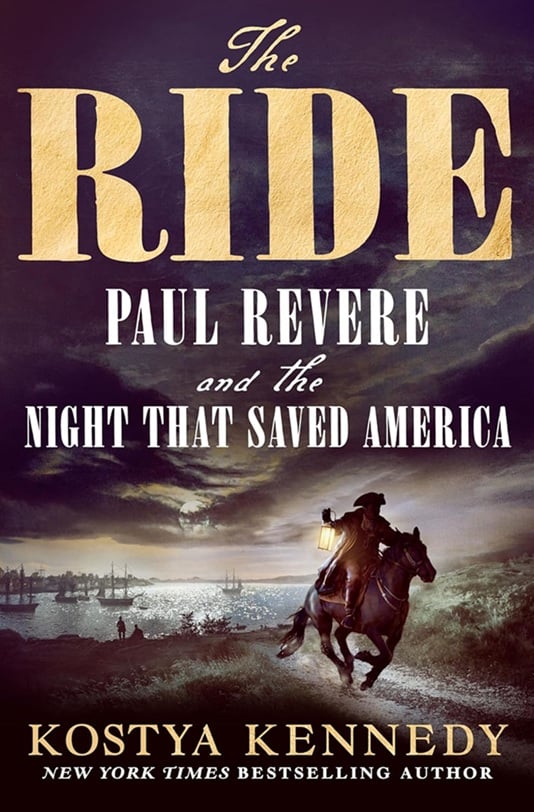
Kostya Kennedy’s The Ride: Paul Revere and the Night That Saved America takes a fresh look at the hours before the first shots at Lexington and Concord, offering new perspective on what unfolded. The hardcover was first published a few weeks before last year’s 250th anniversary. It was released on paperback this past April.
Upgrade nowOn April 18, 1775, Boston silversmith and political operative Paul Revere set out on horseback to warn colonial communities that British troops were on the move to suppress growing resistance. Though best remembered for this single midnight ride, Revere had already carried out numerous similar missions across New England, spreading intelligence about British activity. This particular journey, however, proved pivotal. As tensions escalated into open conflict, it became one of the defining moments embedded in the larger origin story of the American Revolution, remembered for its urgency and lasting historical weight.
In The Ride, Kostya Kennedy revisits this familiar episode with new archival research drawn from letters, diaries, and contemporary accounts, offering a more layered and less mythologized version of events. The book reframes the ride as a coordinated effort involving multiple riders rather than a solitary heroic dash, while also expanding the wider network of intelligence that made such missions possible. It also highlights moments of danger, including near capture by British forces, underscoring how precarious the mission truly was. Written in a way that makes it impossible to put down, the narrative reshapes a well-known story into something more complex and communal in its making.
While the title implies that this book is about Paul Revere, it’s about more than just him. Obviously, he gets the bulk of the focus, but Kennedy includes other figures who were important to that night’s events: Samuel Adams, John Hancock, William Dawes, Dr. Joseph Warren, and more.
Warren delivered an inspiring oration during the second anniversary of the Boston Massacre in 1772:
“May our land be a land of liberty, the seat of virtue, the asylum of the oppressed, a name and praise in the whole earth, until the last shock of time shall bury the empires of the world.”
Warren would be instrumental in sending both Revere and Dawes on their rides to Lexington. But before we go forward, let’s go backwards for a moment. Both men were Freemasons and first met each other at St. Andrew’s Lodge in 1761. They would become close friends in the process. Revere later studied and practiced dentistry. Warren was a man of privilege, so when it came to getting ivory implants, he turned to Revere. Those implants would prove invaluable following the Battle of Bunker Hill when Warren was bayoneted beyond recognition. A number of counties and cities are named after Warren.
Much of what I learned growing up about Paul Revere was based on myth rather than what was actually true. It wasn’t until reading the book that I learned that Revere never shouted “The British are coming! The British are coming!” on his ride. He made multiple stops along his route from Boston until reaching both Hancock and Adams at the Hancock-Clarke House in Lexington. He used terms like “Regulars” in informing fellow patriots that the British were on the way.
I knew the whole thing about one if by land, two if by sea, but I had assumed that the two lanterns were lit and hanging for multiple hours at Old North Church to alert everyone. In actuality, Robert Newman flashed them only briefly—long enough to alert the waiting patriots but not long enough to attract British attention.
Nobody knows exactly how the Sons of Liberty leaders were alerted to when and where the British would be dispatched in mid-April 1775. Kennedy notes that General Thomas Gage told Brigadier General Hugh Percy about the plan, and only one other person had been informed by that point. It’s assumed that this one person had been his wife, Margaret Kemble Gage. Kemble Gage was American-born, and her mother’s side traced their lineage in the colonies back to the 1630s. According to Thomas Hutchinson, Kemble Gage “hoped her husband would not be instrumental in sacrificing the lives of her countrymen.” This almost certainly referred to the patriots rather than the loyalists. When Rev. William Gordon chronicled the events, he wrote that it was “a daughter of liberty” that sent the message to Adams and Hancock. Her father was a loyalist, but her cousin was Philip Schuyler. But anyway, we’ll never truly know for sure.
Revere delivered his account of the night’s events to the Massachusetts Provincial Congress not long after the ride in 1775. In 1798, Massachusetts Historical Society corresponding secretary Jeremy Belknap asked him to deliver a fuller remembrance. To which he did. Both times, he gave William Dawes his due. This didn’t stop Henry Wadsworth Longfellow or Ebenezer Stiles from writing poems about Revere.
If not for Revere, Dawes might not be anywhere close to remembered. He obviously doesn’t have the same posterity that Revere does but books like The Ride can change this. Revere and Dawes weren’t alone in riding that night. Dr. Samuel Prescott was the only rider who made it all the way to Concord but doesn’t come close to enduring in the same way as Revere. In case you didn’t know, former vice president Charles G. Dawes is a second great-grandson of William Dawes. As for Dr. Prescott, he’s the 4th great-granduncle to President George H.W. Bush.
Kennedy met with Paul Revere III, which led to one of the most hysterical anecdotes in the entire book. Revere III’s fourth great-grandfather was Paul Revere the Patriot as he’s come to be known in the family. He descends through Joseph Warren Revere, born two years after the death of his namesake.
Revere III shares an anecdote about his father, Paul Revere Jr., who was pulled over in Lexington for speeding during the 1960s. After handing the police officer his license and registration, the officer returned to his car and “sat there for what seemed to Revere a long time.” When he handed Revere Jr. his documents back, this is where the story gets really hysterical:
“Okay, you can go home. There is just no way that I can go back to the station and say I gave Paul Revere a ticket for speeding in Lexington on April 18.”
Revere III always had a “Yeah, right, Dad” feeling until a few years ago when he was working on a case in Boston. That’s when another attorney asked if his father ever got pulled over in Lexington.
So as to get the full experience, Kennedy visited the steeple of the Old North Church in winter of 2024. It’s 150 feet off the ground. But when you have a fear of heights, the climb is not so easy.
Kennedy also shines a light on Sybil Ludington, a 16-year-old girl who is said to have made her own ride two years later. She “allegedly rode forty miles through parts of New York and Connecticut to rally militiamen against British troops who were aiming to seize a Continental Army supply depot in Danbury, Connecticut.” Her efforts ultimately proved unsuccessful in this instance as the seizure came without much resistance. Her ride didn’t get much public notice while she was alive, and it was over a century after it happened before it would be mentioned anywhere. While sign markers and statues have been built, historians are skeptical.
All in all, I devoured The Ride in just over 24 hours. Kennedy delivers a fast-paced, thoroughly researched account that separates history from legend while restoring long-overlooked figures to their rightful place in the story. It’s a worthy addition to the growing body of books on Paul Revere and the early days of the American Revolution.
Upgrade now