American Maccabee: Theodore Roosevelt and the Jews by Andrew Porwancher
Andrew Porwancher’s American Maccabee offers a new perspective on Theodore Roosevelt through his relationship with Jewish Americans, revealing a legacy defined by both advocacy and contradiction.
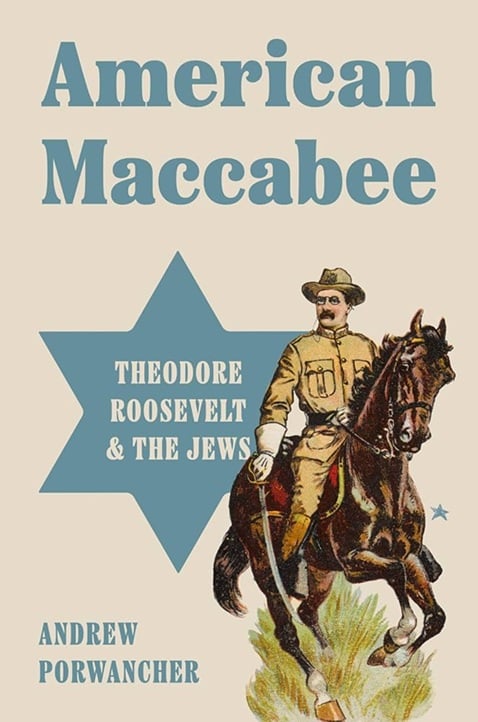
Andrew Porwancher’s American Maccabee: Theodore Roosevelt and the Jews is a significant biography exploring how Roosevelt’s bond with the Jewish people helped shape both Jewish life in America and Roosevelt’s own legacy. The book was published by Princeton University Press last year.
Upgrade nowAlthough born into New York’s Protestant elite, Roosevelt developed close ties with Jewish Americans throughout his political career, championing labor reforms, courting immigrant voters on the Lower East Side, and frequently invoking the Maccabees as examples of courage and perseverance. Andrew Porwancher also examines the limits of Roosevelt’s support as he grappled with the persecution of Eastern European Jews, rising immigration, and antisemitism during his presidency. Drawing on extensive archival research, the book presents a nuanced portrait of a president whose views on Jewish issues reflected both genuine admiration and the broader tensions of his era.
Roosevelt was a rarity among his generation and background. Where he built bridges to Jews, others found Jews to be “unacceptable.” As Porwancher writes, “Old Money gentry were generally fearful of becoming displaced by the New Money crowd born of industrial capitalism.” One such person was Henry Adams. A “scion of the Adams presidential dynasty,” he was “perhaps the most virulent antisemite of the upper classes.” To say that he “epitomized elite paranoia about Jewish domination” is not an understatement.
Adams wasn’t alone in displaying antisemitic views during this era. The book touches on the Populist Party’s convention in 1896. They had formed in the early 1890s and ultimately dissolved in 1909, absorbed into the William Jennings Bryan wing of the Democratic Party.
Rather than choose their own nominee while gathering in St. Louis, the Populist Party also supported Bryan. It was an attempt to form a third party in the early 1890s, but they ended up dissolving in 1909 and absorbed into the Bryan wing of the Democratic Party. AP coverage of their 1896 convention is pretty damning:
“One of the striking things about the Populist convention...is the extraordinary hatred of the Jewish race. It is not possible to go into any hotel in the city without hearing the most bitter denunciation of the Jewish race as a class and of particular Jews who happen to have prospered in the world.”
The Dreyfus Affair in France is another place where Adams’ paranoia was on display. He believed it to be “more evidence that Jews were secretly pulling the strings of world affairs.” Adams was mocked for these beliefs by John Hay, then serving as the US ambassador to the United Kingdom. Hay would later become Secretary of State under Roosevelt, but this is how much he mocked Adams: he joked that Adams would blame the eruption of Vesuvius on a Jew if he could.
Roosevelt, by this point Governor of New York, responded very differently when he heard that Dreyfus was going to be allowed a retrial. The news gave him “the most heartfelt joy.” Dreyfus would be convicted again but he would be pardoned due to the global outrage at France.
Roosevelt responded to one antisemite speaking in perhaps the best way possible. Rather than outright cancel the speech of German antisemite Hermann Ahlwardt, what Roosevelt did was recruit Jewish police officers to guard the event. Roosevelt wasn’t afraid to recruit more Jews into the police force. Even if he said it was on merit, his actions suggest otherwise. He wanted diversity on display. Jewish soldiers were even present as the Rough Riders battled during the Spanish-American War.
When President William McKinley was assassinated, Roosevelt ascended to the presidency. Roosevelt’s presidency coincided with what would become the “greatest crisis for global Jewry of his lifetime.” How he responded to this crisis would make or break his relationship with Jewish Americans.
It began with the Romanian Note, things got far worse when anti-Jewish violence exploded across Kishinev. Russian diplomats could respond in whichever way they wanted to, but Roosevelt could tell when they lied. He wrote to a friend, “What I cannot understand about the Russian is the way he will lie when he knows perfectly well that you know he is lying.”
What happened in Kishinev had been incited by the editor of the Bessarabetz newspaper. The same editor saw to it that the paper became the first-ever publisher of The Protocols of the Elders of Zion. The Protocols have played their part in contributing to over a century and a quarter of antisemitic violence and other baseless allegations of Jew-hatred. There’s no truth to these allegations and it’s all part of the world’s oldest virus.
Newspapers compared the violence against Russian Jews to that of lynching Blacks in America. What good were efforts at getting Russia to treat its Jews better when America couldn’t get its own racial violence under control. The Salt Lake Telegram published a list of all the people killed by lynching during the first half of 1903. Some newspapers minimized the comparisons, accusing Roosevelt of a double-standard. In fact, Roosevelt would erroneously tell Hay that the Jewish pogrom victims “infinitely” outnumber the Black fatalities in the years following the Civil War. Elsewhere in the US, both Jews and Blacks felt they had a common cause. Anna Strunsky, a Russian-born Jewish immigrant, was one who felt both resembled each other and became a founding member of the NAACP.
It was frustrating to read how Amb. Robert McCormick was so willing to take Russian diplomats at their word. McCormick paraphrased Russian Foreign Minister Count Lamsdorrf in a letter to Hay. Lamsdorrf’s antisemitism was no different than Russian Ambassador to the US Count Arthur Cassini. They both peddled in antisemitic canards and yet, it was McCormick who viewed these canards as being credible. McCormick quoted Cecil Spring Rice, who worked for the British Embassy in Russia, as if he were trying to add an exclamation point. Rice, much like others in his era, was antisemitic and aligned with Russia on that end. But even as McCormick displayed skepticism of Russia’s efforts on the Jewish passport question, he thought foreign pressure could help.
In a letter to Oscar Straus, Roosevelt wrote his predictions that America would have Jewish and Catholic presidents. While he was right about the latter, the former looks increasingly impossible as of 2026. Unless America is able to get rid of antisemitism, it’s highly unlikely a Jew will be elected president. The country is too partisan, divisive, and there’s way too much bigotry. But despite that, Roosevelt hoped these future presidents would be identity-neutral and treat their fellow Americans “without regard to the several creeds they profess or the several lands from which their ancestors have sprung.”
While a conference was held in Portsmouth, N.H. to put an end to the war between Russia and Japan, a few Jewish leaders felt it pertinent to meet with Count Witte about the passport question. Witte made a pledge as an individual that he would do everything in his power “to give the Jews their full constitutional rights.” Alas, it was no avail because the October Manifesto that was issued by Czar Nicholas was more or less just for show. Russians responded by, what else, an explosion of pogroms against Jews. The property damage during the 1905 wave was worth the equivalent of $1.1 billion today. That the Czar didn’t show any compassion for the Jewish victims and felt that they deserved their fate really speaks for itself.
While America just marked the 250th anniversary of independence, the year 1904 marked 250 years of Jewish life in America since a group of Jews arrived from Dutch Brazil and founded Congregation Shearith Israel in what was then New Amsterdam. A celebration took place at Carnegie Hall in December 1905. Roosevelt didn’t attend but sent a letter to be read for the occasion, one that spoke proudly of Jews in the United States. In fact, a judge would later use his letter in ruling against a hotel for excluding Jews.
The worsening pogroms may have strained Roosevelt’s relationship with the Jewish community but it wasn’t over. Not by a longshot. Obviously, Jews were disappointed in Roosevelt’s response to Russia. If he hadn’t had concerns about Russia rebuffing him, maybe things would have been different. But this idea that Russsia’s government would collapse in the chaos that followed the October Manifesto seems misguided at best. But at the same time, Roosevelt had serious worries that America overreaching would make things worse for Russian Jews. This is understandable to some extent, but things were already bad enough! But as the next election moved closer and wanting to do well with Jewish voters, Roosevelt had a card up his sleeve. One that he had been planning for some time.
Roosevelt announced that he would nominate Oscar Straus to join his cabinet as the head of the Department of Commerce and Labor. This made Straus the first Jewish member of a presidential cabinet. According to the Washington Herald, Joseph Seligman declined an offer of President Ulysses S. Grant to head the Department of the Treasury. Likewise, Isidor Straus had turned down President Grover Cleveland’s offer of Postmaster Generalship.
In elevating Straus to the cabinet, Roosevelt stressed that America’s Jews had “the same rights and opportunities as everyone else.” But alas, Roosevelt couldn’t help but use antisemitic tropes even as he hoped Straus would be “the ideal of a successful man” as a role model to younger Jews. It’s part of a longstanding problem that plagued him throughout his career. Even during those times when he meant well, he still resorted to tropes.
Putting Straus at the head of the Department of Commerce and Labor also meant putting the Bureau of Immigration under his purview. This came at a time when there were efforts to prevent immigration into the country, especially from Jews. While those efforts would stall under Roosevelt, they would worsen in the 1920s right when European Jews needed them the most. America’s borders had always been open since it declared independence in 1776. Nativists felt that this new wave of immigrants would hurt America’s character. They didn’t seem fine with the “new immigrants” coming from Southern and Eastern Europe. Where Jews accounted for just 4% of the Russian population, they made up nearly 80% of Russians immigrating to America in part because of the worsening pogroms. The Anglo-Saxon elites in particular “fear that American greatness could not withstand the unrelenting infusion of alien blood from Southern and Eastern Europe.” Not even Jews converting would be enough to satisfy their qualms.
The borders were comparatively open, but with rare exceptions in the early 1900s. America didn’t want anyone who would be “liable to become dependent on the state.” For those employers who depended on importing labor, a new statute would limit those efforts. It’s understandable why America would want to exclude polygamists, convicted felons, and the contagiously diseased. But after President McKinley was assassinated, political anarchists would soon be turned away. For Jews living in America at this time, they faced “cultural stigma” in American society.
In early 1908, Roosevelt planned to step down at the end of the term opening the door to Secretary of War William Howard Taft as his successor. Around this same time, it was learned that Russia would renege on its previous comments about repealing its passport restrictions on Jewish Americans. Other Americans were fine, but not Jews. In America, the State Department seemed to be doing Russia’s bidding, leading the newly formed American Jewish Committee to mobilize. Secretary of State Root had already revised the circular by the time that AJC leadership wrote their letter. It didn’t stop members of Congress from speaking out on the House floor, such as Francis Harrison (D-NY).
Many in America had hoped that Russia would emancipate their Jews and this dates back to the Treaty of 1832, which basically said that U.S. nationals in Russia would have the same rights as Russian natives. So if a Jewish American were to visit, there would be two different classes of Jews on Russian soil. American leaders, including President Chester Arthur, had subscribed to a “domino theory of Jewish emancipation.” Meanwhile, there was a push for America to withdraw not just from the Treaty of 1832 but an 1887 agreement as well. The latter provided for criminals to be extradited back to Russia. Russia viewed political dissidents as lawbreakers so if they sought asylum in the US, America would have no choice but to return them. It soon became an issue when Jan Janoff Pouren was facing extradition. He wasn’t Jewish but he was a Gentile Revolutionary. Roosevelt pushed for Root to intervene and overturn the commissioner’s ruling. If Root didn’t take action, Roosevelt would. The president even enclosed affidavits that supported Pouren.
Taft won the 1908 election against William Jennings Bryan. But in the Lower East Side, the vote wasn’t even close. Bryan defeated Taft by about 25%, showing that Taft didn’t have the same appeal as Roosevelt did over previous elections.
Roosevelt took out his anger in an eight-page letter to Ohio piano dealer J.C. Martin and rightfully so. Martin didn’t think that Taft would be electable because of his religious beliefs. Roosevelt made it a point to remind him of the First Amendment and that the Constitution explicitly bans religious tests for federal office. He pointed out the diversity of his cabinet. But also, Roosevelt displayed some faith in the American electorate:
“I believe that this Republic will endure for many centuries. If so, there will doubtless be among its presidents Protestants and Catholics, and very probably at some time, Jews.”
His letter made front page news in both Montana and Georgia. It was praised by numerous Jewish newspapers in America.
While Roosevelt championed Jewish causes through the biggest platforms available whenever he could, he wasn’t a man without his faults. The White House didn’t pressure Russia as much as it could have done so during the wave of pogroms in 1905. His endorsement of a literacy test equally did no favors in the Jewish community. Following the end of his presidency, Roosevelt lived another ten years—a period that is expected to be explored in another book by Porwancher. By placing Roosevelt's relationship with the Jewish community at the center of the narrative, Porwancher adds an important new dimension to the extensive scholarship surrounding America's twenty-sixth president.
Upgrade now