The Jewish World of Alexander Hamilton by Andrew Porwancher
Andrew Porwancher’s The Jewish World of Alexander Hamilton offers a fascinating reassessment of Hamilton’s Jewish upbringing and his relationship with America’s Jewish community.
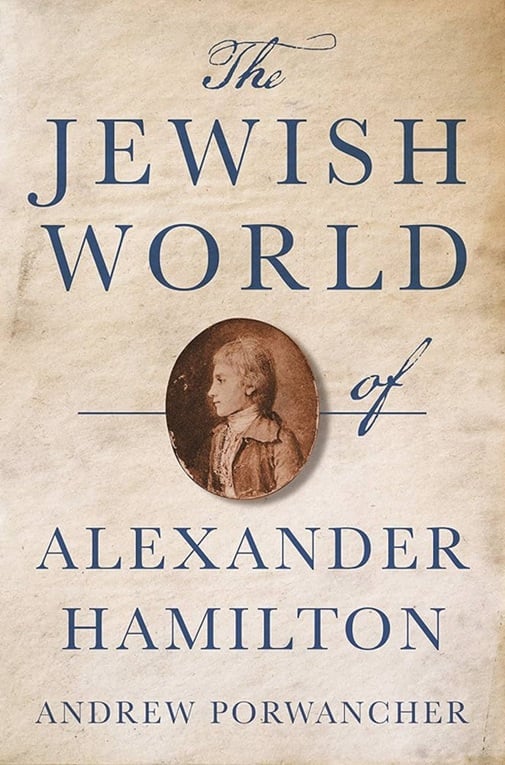
Andrew Porwancher’s The Jewish World of Alexander Hamilton was published a few years ago by Princeton University Press and it changes the way we look at him.
Upgrade nowIn The Jewish World of Alexander Hamilton, Andrew Porwancher takes a closer look at one of the great mysteries surrounding Alexander Hamilton: his childhood in the Caribbean. Rather than accepting the long-standing assumption that Hamilton was raised Christian, Porwancher revisits the evidence and argues that Hamilton was most likely born and raised Jewish. Hamilton himself left much of his early life deliberately vague, allowing the conventional narrative about his religious upbringing to go largely unchallenged for more than two centuries. Porwancher approaches the mystery like a historian solving a cold case, using archival evidence and careful research to offer a dramatically different account of Hamilton’s formative years.
That reinterpretation also changes how we might view Hamilton’s relationship with Jewish Americans once he reached adulthood. Although Hamilton never publicly identified as Jewish in the United States, he maintained unusually close ties to the Jewish community for a Founding Father. His work as a lawyer included defending Jewish citizens, while his economic and financial policies helped expand opportunities in areas where Jewish Americans were increasingly active. He also played a role in making Columbia, his alma mater, more welcoming to Jewish students. These actions stand out even more when considered against the widespread antisemitism of the period. At a time when the new republic was struggling to reconcile its ideals of equality with deeply entrenched discrimination, Hamilton advocated for a nation in which Jews and Christians could stand on equal footing.
Of all the Founding Fathers, Alexander Hamilton is among the most popular today, in part because he’s the subject of a hit Broadway musical. The book immediately piqued my interest when I saw it mentioned while reading Porwancher’s most recent book, American Maccabee: Theodore Roosevelt and the Jews. I was curious to see what Porwancher discovered while researching and writing the book and what made him so sure that Hamilton was likely born Jewish.
Hamilton’s mother, Rachel, was born Christian, but she married a man named Johan Levine in the British West Indies. What’s so fascinating here is that so many scholars have assumed Levine wasn’t Jewish even though Hamilton’s grandson described him as a “rich Danish Jew.” If this isn’t enough evidence, Rachel and Johan’s son, Peter, never got baptized until he was an adult, meaning that he likely converted. That he was baptized as an adult has “baffled” scholars even though they never “entertain the possibility that Peter had been Jewish.” Many historians currently rely on Gertrude Atherton’s comments in her biography of Hamilton. Her comments should be taken as mere speculation rather than fact.
As for the island of St. Croix, Denmark had an open-border policy, and Jewish merchants took advantage of it. Hey, so many countries had shut the door to us that we have to take advantage of openings where we can. While most were Sephardic Jews, there were some Ashkenazi Jews who made their way from Germany and Poland. When Levine eventually sold his plantation, he sold it to a pair of Jews.
Getting back to Peter for a moment, there were three reasons why he would have been baptized as an adult under the Anglican Church’s requirements at the time. The first two reasons do not apply to St. Croix, as those possible denominations were not practicing on the island. It’s only the third reason—that he was converting—that is most likely to be applicable in this scenario. And again, none of the scholars researching Hamilton ever managed to put two and two together. Not H.U. Ramsing. Not Ron Chernow. Not William Cissel. It’s right there in front of their eyes!
Porwancher describes the various identities of Jews: personal, community, public, universal, legal, ethnic, religious, and cultural. What we know about Judaism is that if the mother is Jewish, her children are Jewish. Even if she wasn’t actively practicing at the time of their births, the children would still be Jewish. Synagogue records don’t survive from the period, and parish records are unable to provide any “definitive conclusions.”
Upgrade nowWhat we do know is that when Hamilton was a child, he attended a Jewish school on Nevis. This is the biggest piece of evidence that points to his being Jewish. It comes by way of comments in John C. Hamilton’s History of the Republic:
“Rarely as he alluded to his personal history, he mentioned with a smile, his having been taught to read the Decalogue in Hebrew, at the school of a Jewess, when so small that he was placed standing by her side at the table.”
This anecdote never shows up in most Hamilton biographies. And when it is mentioned, none of them reflect on why Hamilton was at a Jewish school. Biographers assume without any evidence that churches wouldn’t teach children born out of wedlock. While records from the Jewish school no longer exist, the only reason why Hamilton would have attended is because he was accepted as a Jew. Porwancher cites Sanhedrin 59a as another reason for Hamilton being Jewish.
Another myth pertaining to Hamilton’s youth is that a reverend presided over Rachel Hamilton’s funeral. There is no source that substantiates this idea. The lack of evidence notwithstanding, it makes you wonder how it made it into so many biographies.
By the time Hamilton relocated to New York, Jews made up less than 1% of the city’s population but “played an outsized role in the city’s economic life.” While Jews were slave owners, slavery was less central to urban life than it was in the American South or West Indies. In colonial times, Jews—who numbered 2,000 in the thirteen colonies by 1776—were barred “at various times from all manners of civic life.”
One of the few Founding Fathers to have not displayed any prominent antisemitic bias was George Washington. It especially showed in his relationship with David Franks. Franks became the first Jewish diplomat in American history upon being appointed as an envoy to posts in France and Morocco. He would later contract yellow fever after taking a position at the Bank of the United States. Porwancher notes:
“In all his dealings with Franks, Washington showed a total absence of antisemitic bias, which is in itself notable by the standards of the day. Washington’s lack of prejudice against Jews was of a piece with Hamilton, although the former never developed the extensive ties to Jews that the latter would.”
To give you an idea of how so many Jews are related, Franks is my first cousin twice removed’s wife’s sister’s husband’s great aunt’s husband’s second cousin twice removed.
When King’s College was rechartered as Columbia, Hamilton played an active role as he served on a committee to rewrite the charter with John Jay. One of the modifications that they made dealt with religious freedom. The original charter required that students practice Anglican worship and that the president be a member of the church. Unlike other colleges of the era, Columbia got rid of the religious tests. Brown and Rutgers kept their tests in place until the 20th century! One of the trustees named in Columbia’s 1787 charter was Gershom Seixas, the chazzan of Shearith Israel. After Seixas left the board, Columbia wouldn’t have another Jewish member on its board until 1928.
And now we get to my least favorite part of The Jewish World of Alexander Hamilton: learning how disappointing the Founding Fathers were when it came to Jews. It’s well-documented as far as their stances on slavery, but Jewish concerns are a completely different story.
Let’s start with Benjamin Franklin. His resistance to Pennsylvania’s religious test was short-lived. He addressed his concerns in a letter to John Calder in 1784, although the published writings in 1906 have the letter as being sent to Joseph Priestley. Franklin was skeptical of Jews. He didn’t have the same objections to the New Testament as he did with the Hebrew Bible. It’s disappointing to learn that Franklin “repeatedly trafficked in tropes about Jews as money-hungry grifters.”
In a letter published by the Pennsylvania Gazette, Declaration of Independence signer Francis Hopkinson “disparaged” Jews when he wrote: “Is not the gravity which retains Jupiter in his orbit, the same gravity which operates on the sales of a Jew?” Other letters published in Pennsylvania newspapers weren’t kind to Jews, even accusing the Pennsylvania Jewish population of being for the British when they overwhelmingly supported the American cause.
When Miers Fisher resorted to antisemitic tropes in a speech, A Jew Broker—assumed to be Haym Salomon—responded. Fisher refused to serve during the war and was sent to a detention center. It wasn’t just that the remarks carried a derisive tone, but that America’s birth was seen as a “signal moment” after centuries of oppression.
John Jay showed some support for Jews while hoping that voters would reject Jewish candidates. As for John Adams, in helping author the Massachusetts Constitution, he pushed for free exercise while including religious tests for governors and legislators. Adams’s views towards Jews varied, but my G-d, did he have some disparaging views. And yet, both Jay and Adams endorsed Jews to reclaim Judea, but they had hope it would lead Jews to convert to Christianity instead.
But even as Adams voiced his disparaging views, he also found time to say something positive in another letter to Mordecai M. Noah in 1819. At no point in this letter did Adams take any time to mention that his draft of the Massachusetts Constitution had banned Jews from office. But then again, he also praised Jews once more in a letter to François Adriaan Van der Kemp while criticizing Voltaire’s antisemitic views in December 1808. Inconsistent at best.
Jonas Phillips, a member of Mikveh Israel in Philadelphia at the time, was the only person to submit a petition to the Constitutional Convention on the subject of religious freedom. As Porwancher notes, this petition hadn’t been necessary. What Phillips didn’t know was that eight days earlier, the delegates had decided to ban religious tests for federal office. Because so many state constitutions had banned Jews from office, this was all the more significant before the First Amendment allowed for free exercise of religion.
Hamilton knew full well that antisemitic bias would play a role in New York when it came to ratifying the Constitution. Hamilton and Jews were aligned in wanting to ratify the Constitution. Anti-Federalists at the time, not so much. They didn’t want Jews to be viewed as equals in the eyes of the government.
As soon as they reached the nine-state threshold to ratify the Constitution, Philadelphia played host to the Grand Federal Procession on July 4. The chazzan of Mikveh Israel was locked in arms with two ministers. They also made sure to have a kosher table during the feast.
Back in New York, though, they had to postpone their parade because of the Fast of 17 Tammuz. New York hadn’t voted to ratify when the parade was held, but it was hopeful that a parade would help increase support for ratification. And again, the Jewish population of New York City was less than 1%.
When Hamilton submitted his Report on Public Credit in 1790, opponents displayed their antisemitism as they thought the policies would favor Jews. The government bonds aspect of the plan led to more antisemitism than anything else. Eventually, the Funding Act of 1790 was passed after Hamilton met with Jefferson and Madison during the dinner that paved the way for Washington, D.C., to become the nation’s capital.
When Hamilton became Treasury secretary, the country had been bankrupt. But when he left office in 1795, America’s credit rating was on par with the greatest powers in the world at the time. As Porwancher notes:
“That Hamilton’s opponents often employed antisemitism against his agenda speaks to the persistence of Old World bigotries in the early republic. It also serves as a testament to the Hamiltonian-Jewish alliance.”
Hamilton also saw the dangers in both populism and elitism. He was a champion of meritocratic principles.
Chapter 7 goes hand in hand with what was covered by Adam Jortner’s A Promised Land. It discusses a circular letter authored by Shearith Israel’s Moses and Solomon Simson and then sent to shuls in Newport, Philadelphia, Richmond, and Charleston. Jews were anxious about their civil status and wanted Washington’s affirmation. The congregation in Savannah had already sent a letter to Washington, and he responded. The letter to Mickve Israel in Savannah is not as well-known in the Jewish community as Washington’s letter in response to the Newport Jews. Manuel Josephson would eventually address Washington on behalf of the remaining congregations toward the end of 1790, and a written response followed.
With the Shearith Israel circular failing to gain any momentum, Touro Synagogue warden Moses Seixas decided to take it upon himself to draft a letter to the president when he learned of Washington’s upcoming visit to Newport. Seixas delivered his address to the president during a “series of orations” to commemorate the visit.
On Washington’s response, Porwancher writes:
“In some respects, Washington’s authorship of what is arguably the most important document in American Jewish history may seem surprising. He had not been especially engaged with Judaism or Jewry. Unlike other founders, Washington drew no parallels between Americans and ancient Jews, offered little comment on Jewish suffering, and had sparse contact with Jewish people. But if discussion of Jews or their faith is strikingly absent from Washington’s writings, then so too is any hint of the religious prejudice that mars the records of so many other founders.”
In comments that went unpublished, not dated, and are incomplete, Hamilton had written his own comments on Jews.
Upgrade nowAnd now we get to Thomas Jefferson and his views on Jews. Jefferson is largely viewed as a champion of religious liberty, but he has complicated views when it comes to Jews and Judaism. Porwancher writes that “much of his private correspondence with non-Jews exhibits hostility towards the Jewish faith and its people.” Say it ain’t so!
He expressed antisemitic views to protégé William Short, former secretary of the Continental Congress Charles Thomson, and to Benjamin Rush. He compared Federalists to the Jews and in a letter to the Marquis de Lafayette, Jefferson wrote that “Quakers and Jews alike had failed to embrace an American identity.” But despite expressing these views when conversing with non-Jews, he didn’t display the same skepticism with Jews. As an author of the Virginia Statute for Religious Freedom, Jefferson ensured Virginia was different from other states in that it protected “civil capacities” for Jews.
Likewise with Madison, being committed to the separation of religion and state didn’t mean not harboring any antisemitic bias. Mordecai Noah had wanted to be sent overseas in a diplomatic post. He was appointed to Tunis in 1813. Prior to departing, Secretary of State James Monroe had instructed him to pay the ransom to Algiers for Americans recently taken hostage, but not in his capacity as an American diplomat, but on behalf of the crew’s friends. Noah was shortly relieved of the position more so because of his Jewish background than the Algiers affair. For what it’s worth, Madison appointed a Jewish consul to Scotland late in his presidency. When Noah questioned Madison after his presidency, Madison denied that Noah’s Jewishness played any role despite what was previously said when Noah was dismissed. In this way, Madison’s relationship with Jews is no less complex than Jefferson’s.
Gouverneur Morris may have written the preamble to the U.S. Constitution, but it is appalling that he attacked the character of Jewish witnesses, bluntly remarking that “Jews are not to be believed upon oath.” His remarks came after Hamilton had completed his six-hour closing remarks. Hamilton would not let antisemitic remarks go without being answered, and the court allowed him time for a rebuttal the following day. I’m not going to summarize his remarks because it simply wouldn’t do them justice, but they were the most forceful denunciation of antisemitism by any of the Founding Fathers.
As the French Revolution got underway, Jews began aligning with the Republican camp because Republicans had endorsed the French revolutionaries. It may be shocking—or not—to learn that there were some Federalists who started peddling the same antisemitism that had been previously expressed by Anti-Federalists, including a Federalist printer. The same thing happened in Pennsylvania when a Republican politician narrowly eked out a win.
But even if one were to think that the parties switched attitudes, it’s not so much the case. There was still antisemitism popping up on the Republican side. It was condemned by some Federalists when an 1802 column linked the Hamiltonian agenda to Jews. That same year, a number of Federalists weren’t afraid to call out the antisemitism within their own ranks when a Federalist paper in rural Pennsylvania attacked a Republican editor who had a Jewish grandparent. Hamilton, too, criticized another Federalist when he forcefully denounced Morris’s antisemitism.
When Hamilton was on his deathbed after being shot, he had two requests: his wife and a bishop to give him communion. The bishop refused to administer this because of Hamilton participating in a duel and because he didn’t belong to a church. Eventually, he caved.
The Jewish World of Alexander Hamilton offers a fascinating new way of looking at one of America’s most famous Founding Fathers. Andrew Porwancher makes a compelling case that Hamilton was likely born and raised Jewish while also showing how his relationships with Jewish Americans shaped his understanding of religious freedom, equality, and the new republic. More importantly, the book puts Hamilton in a Jewish context that has largely been overlooked by historians and biographers. Whether or not every question about Hamilton’s early life can ever be answered definitively, Porwancher makes it difficult to look at Hamilton—or the Founding Fathers and their complicated relationships with Jews—in quite the same way again.
Upgrade now