
The Lost Founder by Jesse Wegmen
Jesse Wegman’s The Lost Founder revisits the life and legacy of James Wilson, a largely forgotten Founding Father whose contributions to the Constitution, the presidency, and the Supreme Court helped shape American democracy.
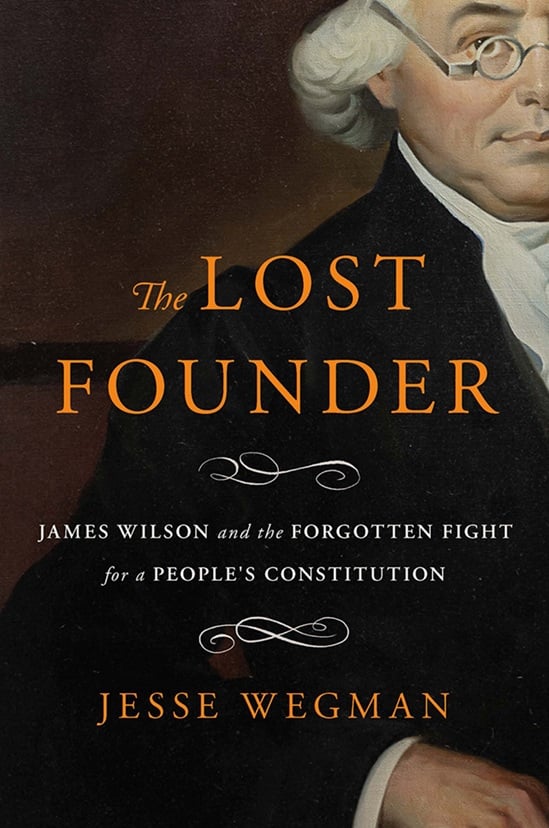
In The Lost Founder: James Wilson and the Forgotten Fight for a People’s Constitution, Jesse Wegman—a Senior Fellow at the Brennan Center for Justice—revisits the life and legacy of James Wilson, a Founding Father whose influential contributions to American democracy have largely been overshadowed by personal scandal.
Upgrade nowAs a young lawyer, Wilson made a powerful case for American independence in an essay that helped inspire one of the Declaration of Independence’s most enduring passages. He also played a significant role in drafting the Constitution, working alongside James Madison and other delegates to shape the nation’s founding document.
A firm believer that political power ultimately belongs to the people, Wilson championed a strong federal government and an influential presidency. He also advocated for the direct election of both the president and the Senate, though neither proposal prevailed. After joining the first Supreme Court, Wilson saw his fortunes collapse amid reckless land speculation. Hounded by creditors, he died of malaria in the back room of a North Carolina tavern.
Despite his considerable influence on the nation’s founding principles, Wilson largely disappeared from the historical narrative. Wegman seeks to restore his place in American history, examining the achievements, ambitions, and failings of a complicated figure whose ideas about democracy and popular sovereignty remain relevant today.
Subscribe now Upgrade nowI have to admit that, prior to reading The Lost Founder, I wasn’t really familiar with James Wilson’s name until watching The American Experiment ahead of its launch on Netflix. Gouverneur Morris gets a lot of credit for writing the preamble to the U.S. Constitution, but Wegman restores the credit Wilson rightfully deserves for his contributions to the document. Wilson also played a major role in shaping the presidency and determining how presidents would be elected. If you’ve ever wondered who helped establish the system that allows a presidential candidate to win the popular vote but lose the election, well, now you know.
When James Wilson was born in Scotland, Scots law differed considerably from English law. Wilson was apprenticed to William Robertson, and his training in Scots law “would turn out to matter a great deal to Wilson’s own legal, political, and philosophical development.” As Wegman explains, “the main difference between the two legal traditions was that the common law derived from decisions by the king’s courts; it was rooted in precedent and taught by practitioners.” Scots law, meanwhile, was “derived by documents used in ancient Roman law that had been rediscovered in the twelfth century, and it took a more intellectual and philosophical approach to resolving legal questions.” Of all the Founders, Wilson was the most steeped in Scots law.
Wilson wrote an essay in 1768 that would not be published until October 20, 1774. When it finally appeared in Rivington’s New York Gazetteer, it was published anonymously. Most notably, the essay contained a passage that would later be echoed in the Declaration of Independence:
“All men are, by nature, equal and free: no one has a right to any authority over another without his consent: all lawful government is founded on the consent of those who are subject to it: such consent was given with a view to ensure and to increase the happiness of the governed, above what they could enjoy in an independent and unconnected state of nature. The consequence is, that the happiness of the society is the first law of every government.”
Wilson’s belief in popular sovereignty guided him throughout the Constitutional Convention in Philadelphia. According to James Madison’s count, Wilson spoke 168 times during the convention, more than anyone else except Gouverneur Morris. Whether the debate concerned the number of seats each state would have in Congress, the balance of power between the federal government and the states, or the presidency, Wilson consistently returned to the idea that the people were the ultimate source of political authority.
One of the biggest questions facing the framers was who should elect the president. Various proposals were considered, including election by Congress and selection by freeholders, which would have restricted the decision to a more elite group. Enslaved people, meanwhile, would have no right to vote, even as their numbers contributed to the populations used to determine representation for Southern states. There was no consensus on how the president should be chosen, and the debate reflected the competing interests and priorities of the framers. In retrospect, having Congress select the president would be an especially contentious arrangement in modern American politics.
Wilson believed the people should have a say in electing the president, which is why he proposed the Electoral College. His plan called for states to be divided into districts in which voters could select one or more “electors.” It was not his preferred method of choosing an executive, but it may have been the proposal most likely to win the convention’s approval. The idea initially failed in an 8–2 vote, but the convention revisited it in September, and the Electoral College ultimately prevailed.
Wilson also favored a three-year presidential term, but a compromise established a four-year term instead. Presidents would be eligible for reelection, despite arguments from several framers that they should be barred from serving more than one term. Wilson’s work on the Committee of Detail was particularly important in shaping the presidency as we know it, earning him recognition as an “architect” or “intellectual father” of the office.
Before the Constitution was signed, the Committee of Style made “one last, critical tweak that Wilson surely approved of and possibly inserted himself.” The committee went through the document word by word, smoothing and polishing its language. One change produced the familiar opening, “We the People of the United States of America…”
The committee included James Madison, Alexander Hamilton, Rufus King, William Samuel Johnson, and Gouverneur Morris. Because Morris served on the committee, he has long been credited with the change to the preamble. According to Wegman, however, “the evidence for that proposition came from correspondence written decades after the convention.” Another account, written “immediately after the convention,” credits Wilson instead. This was not the only instance in which Wilson’s contributions may have been overlooked. Did he get robbed of credit that he deserved? It certainly seems that way.
We tend to think of Madison as the “father of the Constitution,” but Wegman makes a strong case that Wilson deserves to be considered alongside Madison and the other framers. Wilson’s belief in popular sovereignty was central to his vision of American government, and his ideas about the relationship between the people and their elected representatives remain relevant today. As Wegman writes, “modern America is remarkably aligned with what Wilson envisioned in 1787.”
Chapter 11 examines slavery and the Three-Fifths Compromise, one of the darkest stains on America’s founding. Rather than single out the quotations and passages that stood out to me, I would encourage anyone who picks up the book to read the chapter in its entirety. That said, it is particularly unfortunate that Wilson helped appease slaveholders by proposing the Three-Fifths Clause. His contributions to the founding of American democracy do not erase the compromises he was willing to make on slavery.
On October 6, 1787, Wilson delivered a speech at the State House Yard in Philadelphia that “has been largely lost to history.” The speech played an important role in the campaign for ratification of the Constitution, yet the writings collected in The Federalist Papers by Madison, Hamilton, and John Jay are much better known today. I’m pretty sure I have a copy of The Federalist Papers on the bookshelf back home, but Wilson’s speech is another reminder of how much of the founding era’s history can be overshadowed by the better-known figures and documents.
When people think about the Supreme Court during the early years of the republic, John Marshall usually comes to mind. After all, he served on the Court from 1801 to 1835. But the justices of Wilson’s era had a different role, including the responsibility of riding circuit. Some justices were reluctant to travel through the South for one reason or another. Wilson and John Blair served on the Pennsylvania circuit, where they encountered a case involving the Invalid Pensions Act, a law passed in March 1792. In connection with Hayburn’s Case, Wilson wrote a landmark letter that essentially asserted the judiciary’s power to strike down acts of Congress.
We often credit Marshall’s 1803 ruling in Marbury v. Madison with establishing judicial review, but Wilson’s work a decade earlier is an important part of that history. The reason it is less widely remembered may be that Hayburn’s Case did not produce the kind of written judicial opinion that would make the Court’s reasoning more accessible to later generations.
Many of the Founding Fathers have cities, towns, or counties named after them. Wilson’s namesake, Wilsonville, Pennsylvania, was eventually submerged when a reservoir was created in 1926. How ironic is it that the place associated with his name ended up underwater, just as his contributions to the founding of the country largely disappeared from public memory?
Had Wilson not speculated in land, as so many of his contemporaries did, and accumulated so much debt, perhaps his legacy would have turned out differently. Maybe he would have been better remembered, or at least remained better known beyond the years immediately following his death. A three-volume collection of his lectures, speeches, essays, and other remarks was published by his son a few years after his death, but that was not enough to secure Wilson a lasting place in the popular understanding of the Founding Fathers.
I feel better for having read The Lost Founder. What Jesse Wegman has done here is restore the legacy of not just a signer of the Declaration of Independence and the Constitution, but also one of the first justices to serve on the Supreme Court. Wilson’s story is a reminder that the founding of the United States involved more than the handful of familiar names who dominate our history books. His contributions deserve greater recognition, even as his shortcomings remain part of his legacy. Wegman makes a compelling case for taking another look at a Founding Father whose ideas helped shape the country and whose story deserves to be remembered.
