
Andrew Jackson‘s Hermitage and the Tennessee State Capitol
A long-overdue visit to Andrew Jackson’s Hermitage, a tour of the Tennessee State Capitol, and walking through downtown Nashville.

Last week, I took the trek to Nashville to visit Andrew Jackson’s Hermitage and tour the Tennessee State Capitol. The capitol was my sixth state capitol tour. President Jackson’s grave marked the second new-to-me presidential grave of the year and my twelfth overall. I’d previously visited the graves of both Lincoln and Polk.
Upgrade nowI was hoping that I would have started reading Andrew Jackson: His Life and Times by H.W. Brands before making my way to Nashville last week, but I didn’t start reading the biography until Monday. Even with Jewish holidays allowing more time to read on the weekends, it took me longer than planned to get through John Quincy Adams: A Man of the Whole People by Randall Woods. I finished on Sunday and am now behind on four book reviews. Don’t worry, you’ll see those soon enough…if I can just pull myself away from reading books to writing a few book reviews!
I’ve been wanting to visit The Hermitage for a long time, but unfortunately, things didn’t work out when I drove through Nashville in 2011. That may have been a blessing in disguise because they didn’t premiere their introductory video until 2017. As for the current visit, it may have been too soon because they just announced plans for a new Visitor and Education Center at a cost of $132 million. It will probably be a few years before the new 70,000-square-foot facility opens, but I expect it will be an improvement over the current facility, which was built in 1989. The Hermitage has been open to the public since the Ladies’ Hermitage Association (LHA), now known as the Andrew Jackson Foundation, acquired the core 25 acres from the state of Tennessee in 1889. It wasn’t until 2003 that the foundation acquired the last parcel of land that had previously been sold off.
What’s so funny about this announcement is that I was just thinking last week, while visiting, that the museum aspect of the experience felt subpar compared with other presidential libraries and museums. The Hermitage has 800,000 artifacts, and only a fraction of them can be displayed. There are a few things in the main lobby by the theater, but other than that, several wall galleries tell the stories of Jackson’s life, the War of 1812, the enslaved people, and especially the Battle of New Orleans. Off to the side, in its own room, is “Born for a Storm,” an exhibit devoted to Jackson’s origins as an orphan, his resilience as a general, and his leadership as president. One standout from the exhibit is the Brewster carriage that Jackson purchased in 1831.
As for the mansion itself, it is one of the most accurately preserved presidential homes, having been restored to its 1837 appearance. While Jackson bought the land in 1804, it wasn’t until 1821 that a brick Federal-style mansion was completed. In 1831, a renovation was underway while Jackson was living in the White House, and two wings and a two-story portico were added to the house. Unfortunately, the building suffered heavy damage during an October 1834 fire. In rebuilding the home, the Hermitage took on its current Greek Revival-style appearance. The house was ultimately completed in 1837, the same year Jackson retired to the Hermitage, where he lived until his death in 1845. A restoration was carried out in the late 20th century, but more than 80% of what visitors see is original to the home.

Next to the mansion are the garden and tomb. The Jackson Tomb was completed in 1838. The domed tomb is made of limestone with a copper roof. It’s one of the fancier tombs I’ve seen for an earlier president, but it isn’t as intricately designed as those of Presidents Lincoln and Grant. An obelisk stands between Andrew and Rachel Jackson. Adjacent to the tomb are the Jackson Family Cemetery on one side and Alfred Jackson’s grave on the other.
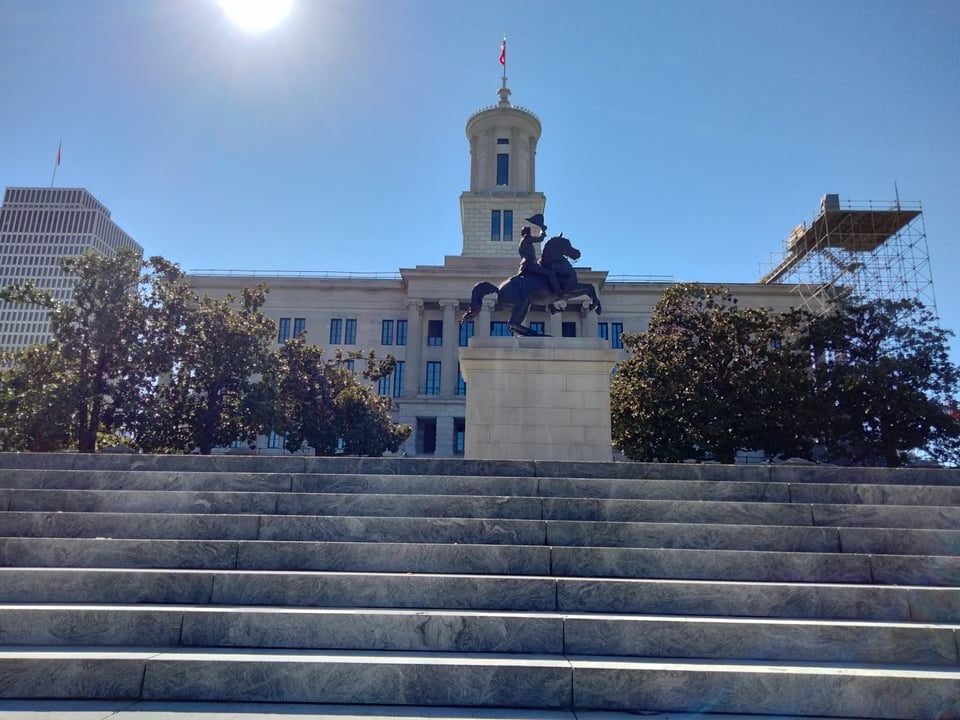
After The Hermitage, I made my way to the Tennessee State Capitol. I arrived too late for the 2 PM tour, so I perused the capitol grounds, which are currently under construction. The East Garden is home to statues of Andrew Jackson and Andrew Johnson, as well as the Tomb of James K. Polk and Sarah Childress Polk. There was talk within the past decade of moving the Polks to the only surviving private residence associated with Polk, in Columbia, Tenn. They were buried on the grounds of Polk Place in Nashville and reinterred at the capitol when their home was demolished in 1901. President Polk’s will requested that the home be turned into a museum, but family members refused to abide by his wishes.

The capitol grounds also contain a 1950 replica of the Liberty Bell. Why Polk doesn’t have a statue on the grounds is beyond me. Meanwhile, the Jackson equestrian statue is identical to the statues in Lafayette Park in Washington, D.C., and New Orleans.
Inside the capitol, the three Tennessee presidents have paintings by the information desk, and busts of them are prominently displayed in the capitol itself. There are busts of other notable Tennesseans, including David Crockett and John Sevier, to name a few.
Current renovations meant that I couldn’t visit the House of Representatives. We visited the Senate chamber and the former State Library, now the Legislative Lounge, which has been restored to its mid-19th-century appearance and contains the original cast-iron staircase. The 3 PM tour is the last tour of the day. To give visitors time to take in the views from the portico balconies, the tour lasted around half an hour.
One thing I learned for the first time while we were in the State Library was that Cave Johnson, U.S. Postmaster General during the Polk administration, changed the way mail worked. Before his time, people had to pay for their mail upon delivery. However, he was inspired by other countries to change the system to one in which postage was prepaid with a stamp affixed when the mail was sent. There are many people painted into the ceiling frescoes, but other portraits along the walls include Andrew Jackson, Rachel Jackson, James Chamberlain Jones, Sarah Mumford Jones, Andrew Johnson, and Samuel Watkins.
The former Supreme Court chamber was restored to its 1850s appearance in 1988. However, it wasn’t an official stop on the tour, and I didn’t think to go in there while waiting around.
When the door is open, visitors can peer in and view the Governor’s Reception Room. Alas, it wasn’t open during our tour, so I’m assuming the governor had a meeting. But at the same time, my visit came days after the botched execution. Which begs the question: Where were all the protests?
It was the first trip in over a month that didn’t feature any delays in arriving or leaving. However, I dealt with other transit delays while in the city, including a traffic slowdown that prevented me from making the 2 PM tour. It’s a primary reason why I ended up dropping the Tennessee State Museum and Bicentennial Mall from the schedule.
I walked around downtown for a little bit, stopped by the visitor center at Bridgestone Arena, and made my way down Broadway. Although I didn’t get to go inside, I stopped by the Ryman Auditorium and the recently opened Dolly’s Life of Many Colors Museum. I eventually made my way to Fort Nashborough. The history center had just closed, but the fort is a replica of the original fort. A monument honoring Nashville’s founding is nearby. Just a bit further south is one of the longer pedestrian bridges in the United States.
It was a rather quick trip, with my being in and out in under twelve hours. Barring a trip to New York that allows time to see Theodore Roosevelt’s grave in Oyster Bay and/or Sagamore Hill itself, my next trip is to the Herbert Hoover Presidential Library and Museum and the Herbert Hoover National Historic Site in December.
Upgrade now