
Benjamin Harrison: The Hoosier President
A day in Indianapolis exploring the Indiana Statehouse, Benjamin Harrison’s home, and Crown Hill Cemetery, where Harrison and three vice presidents are buried.
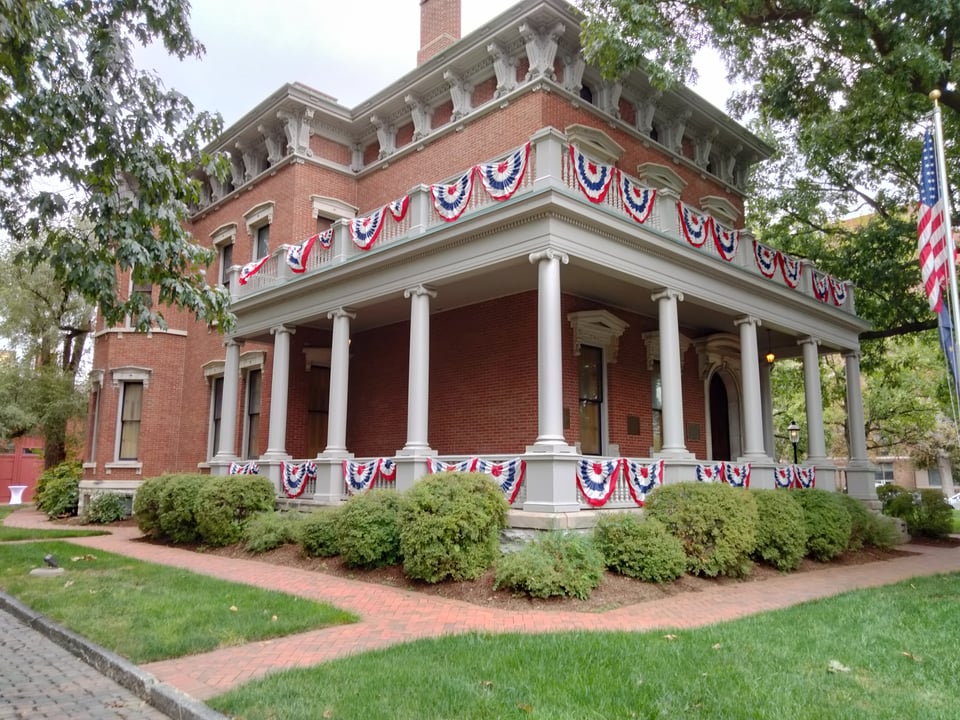
I’ve wanted to visit Benjamin Harrison’s home in Indianapolis for the longest time. It finally happened on Thursday. But before I toured his home and a small exhibit at the Welcome Center, I took a tour of the Indiana Statehouse.
Upgrade nowAfter delays on the way to both Springfield and Madison earlier this month, I was afraid that I’d be running on a delay again. Thankfully, this wasn’t the case. The Greyhound bus made great timing, and we arrived a few minutes early. This enabled me to get my long-overdue photo with the Peyton Manning statue just outside of Lucas Oil Stadium before making my way north to the Indiana Statehouse.
The Indiana Statehouse gives tourists a little bit of leeway before starting their tours. I took the 11 AM tour, which consisted of just two people. And surprisingly, they gendered me correctly when pointing out the restrooms!
The Indiana Statehouse tour starts in the rotunda, where the guide talks about the history of the building and the rotunda itself. The interior dome rises to 105 feet above the ground, with another dome rising to 235 feet. On the second floor, there are statues representing Law, Oratory, Agriculture, Commerce, Justice, Liberty, History, and Art.
From there, we walked past the governor’s office on the way to the treasurer’s office. The reason for this stop is to point out the two heavy vaults that are just for show these days. Unlike most tours, Indiana lets tourists sit in actual chairs used by senators and representatives when in those chambers. It’s been interesting to see which capitol building tours take people to the galleries and to the floor itself. But Indiana? They go above and beyond in that regard. Anyway, The Spirit of Indiana mural is above the House speaker’s desk.
Finally, we made our way to the Supreme Court chamber. Indiana is one of the few states in which all three branches are still working out of the same building. This was the final stop of the tour, and most surprisingly, everything is original to the room. The desk, the chairs, everything.
What I found interesting about how the Indiana Supreme Court works is how justices are chosen. A Judicial Nominating Committee selects three candidates and submits a list to the governor. The governor has 60 days to appoint someone after a vacancy. The Judicial Nomination Commission also selects the chief justice from the sitting justices. A term could be a maximum of ten years, but voters have the opportunity to retain or remove a justice after their first two years. The minute that a justice turns 75 years old, they have to retire no matter how much time is still remaining on their term.
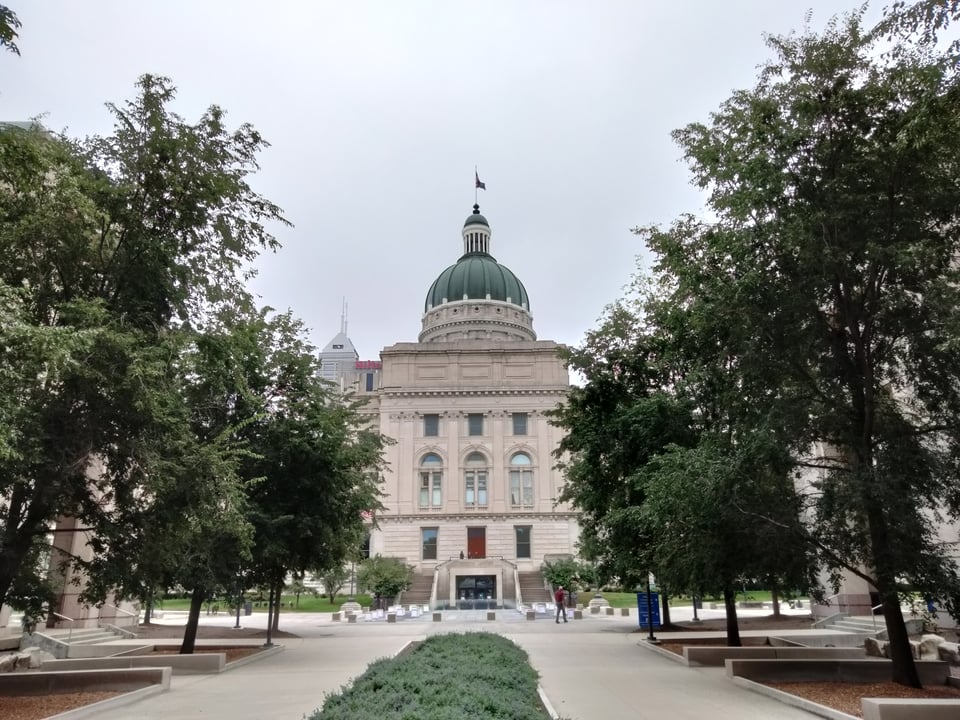
As far as statues on the capitol grounds, there are statues of President George Washington, Vice President Thomas A. Hendricks, Gov. Oliver P. Morton, and Christopher Columbus, as well as the Robert Dale Owen Memorial pedestal. The bust was stolen in 1970 and was never replaced. There are busts and portraits throughout the building. Walking down the plaza between the two Indiana Government Center buildings, one can find a statue of young Abe Lincoln by the South Building.
The easy thing to do would have been to take an Uber to the Benjamin Harrison Presidential Site. After a long morning of sitting on a bus, I opted to stretch my legs and walk the mile from Monument Circle to his home. The Soldiers and Sailors Monument in Indianapolis is actually taller than the Statue of Liberty, not taking the pedestal into account. Among the statues circling the monument are William Henry Harrison, George Rogers Clark, James Whitcomb, and Oliver Morton.
Slightly north of Monument Circle is University Park. Originally planned to be the site of a university, those plans fell through, and it’s now a square with statues of Presidents Benjamin Harrison and Abraham Lincoln, and Vice President Schuyler Colfax. The park sits directly south of the Indiana War Memorial Museum.
As I made my way north toward the Indianapolis Central Library, I walked past the American Legion national headquarters. In hindsight, I should have walked through the American Legion Mall itself to take in the neoclassical architecture on the west facade.
On the west side of the library sits the Arthur St. Clair Memorial, a bronze tablet commissioned by the Daughters of the American Revolution. St. Clair was a general during the Revolution, the ninth president of the Confederation Congress, Senior Officer of the United States Army, and the first governor of the Northwest Territory.
It didn’t take long to make it to the Harrison home from there. There’s no fancy name like Monticello or Mount Vernon. It’s simply the Benjamin Harrison Presidential Site. Rather than be turned over to the National Park Service, it’s run by the President Benjamin Harrison Foundation.
As for the Benjamin Harrison Presidential Site, the Welcome Center consists of a small gift shop and a rotating exhibit. There at the Founding is a special exhibit that runs through November 2026. It features artifacts on display that are associated with President Benjamin Harrison, his grandfather, President William Henry Harrison, or his great-grandfather, Benjamin Harrison V. One of the artifacts on display is a land deed signed by Benjamin Harrison V in his role as Virginia governor, authorizing land in Kentucky County to be sold to Robert Todd. Todd was a founder of Lexington, Kentucky.
Tours of the home last about 90 minutes. A docent discusses the Harrison family and his presidency throughout the tour, which takes people through much of the home. Harrison and his first wife, Caroline, bought a double lot in 1868 and started construction on the house in 1874. It only cost $24,008.59.
Caroline had died while Harrison was president, so he returned home a widower. But upon returning, he made some notable changes to the house: an English-Regency front porch, electricity, and updated plumbing.
In 1896, Harrison married his niece, Mary. It caused a falling out with both of his children, to the point that his daughter had nothing to do with him until his death in 1901. Harrison died in the second-floor bedroom. Mary and Elizabeth left Indianapolis for New York in 1913. The house was rented out during 1913–37 and eventually became a rooming house.
In 1937, the house was purchased by the Arthur Jordan Foundation, and the upper floors were turned into dormitories. By 1951, the music school had moved, and the house fully opened to the public as a museum.
What was once a third-floor ballroom is now an exhibit space. The exhibit running through December is Presidential Ink: 45 Signatures that Shaped a Nation. The signatures are part of the Holcomb Collection, the Huston Collection, and the Benjamin Harrison Presidential Site. Every administration is represented, and those taking a tour get a small card with auto-penned signatures of the three notable Harrisons.
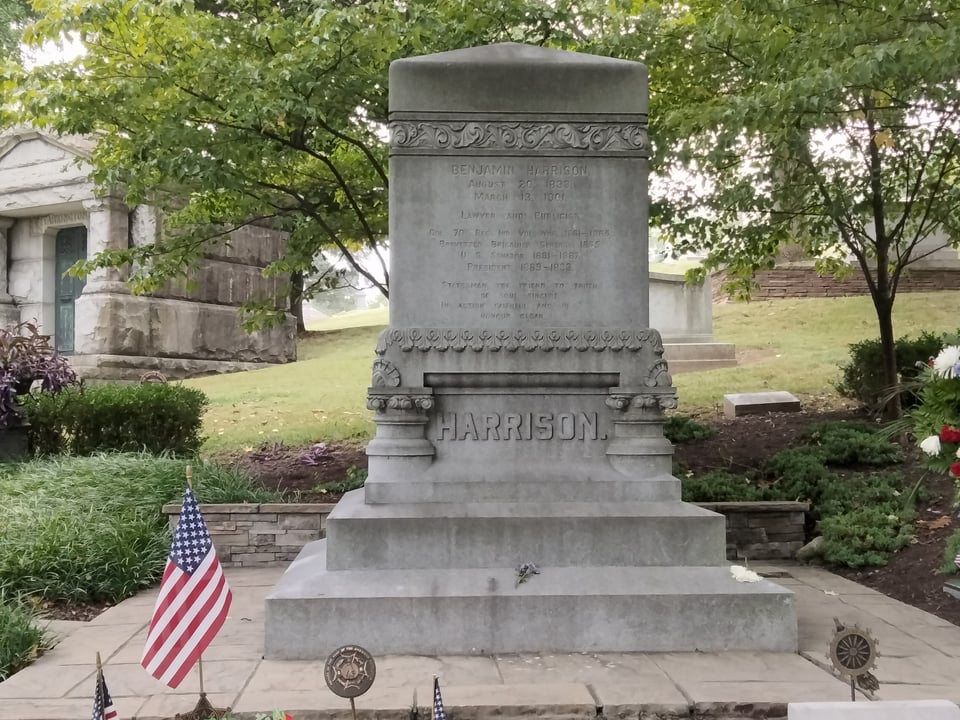
If one is visiting Indianapolis for the Harrison home, no visit would be complete without a trip to Crown Hill Cemetery, about 3 miles away in Indianapolis. At 555 acres, it is the third-largest non-governmental cemetery in the U.S. President Harrison is buried in a plot, sandwiched between both wives and joined by son Russell. His daughter Mary and her husband are buried just outside. Harrison’s monument is rather simple compared to other presidents of the time. There’s no fancy tomb or mausoleum compared to other presidents of the era.
Buried in the same cemetery are a trio of vice presidents: Thomas A. Hendricks, Charles W. Fairbanks, and Thomas R. Marshall. One is able to view Hendricks, Fairbanks, and Indiana Gov. Oliver P. Morton on the 0.7-mile walk toward the Harrison gravesite. However, Marshall is not on the way and requires a bit of backtracking to see where he’s buried.
Unless I hit up South Bend or Bloomington, IL, before the end of the year is out, I’ve got at least two more presidential trips this year to Nashville and Iowa City/West Branch. There might be another state capitol tour in the mix. With jet fuel prices being what they are right now, I’m trying to take care of as much as I can by way of train or bus if the logistics are right. I would love to do the Ohio presidential trail or get back to Baltimore and Virginia, but I don’t know when that’s going to be at the moment. The major vacation next year is set for a combo of Philly, New Jersey, and Upstate New York.
Upgrade now