The Great Contradiction by Joseph J. Ellis
In The Great Contradiction, Joseph J. Ellis examines the contradictions of the American founding, from slavery and the treatment of Native Americans to the ideals of liberty and equality that shaped the new nation.
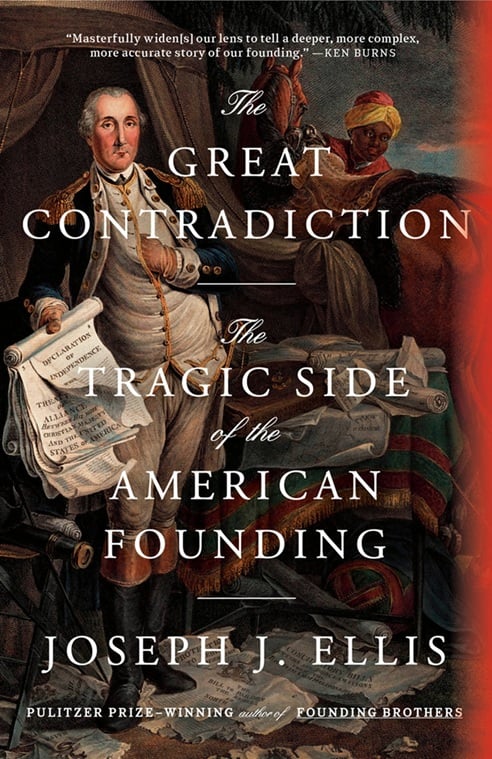
First published last year, Joseph J. Ellis’s The Great Contradiction: The Tragic Side of the American Founding will be released next month in paperback.
Ellis examines one of the central contradictions of the American founding: how a nation built around ideals of liberty and equality could simultaneously preserve slavery and pursue the displacement of Indigenous peoples. Focusing on figures including George Washington, Thomas Jefferson, Benjamin Franklin, James Madison, and John Adams, Ellis looks at how the Revolutionary generation confronted—or rationalized—the gap between its ideals and its actions.
The book follows the early debates over slavery and the treatment of Native Americans from the Revolution through the Constitutional Convention and the early years of the new republic. Along the way, Ellis brings attention not only to the founders but also to figures such as Quaker abolitionist Anthony Benezet and Creek leader Alexander McGillivray, whose perspectives complicate the familiar story of the founding.
Rather than reducing the founders to either heroes or villains, Ellis emphasizes the uncomfortable coexistence of extraordinary political achievement with profound moral failure. His focus is on the contradictions, compromises, and rationalizations that shaped the early United States—and on the consequences of the choices made during its founding.
Upgrade nowI’ve been a fan of Ellis’s work ever since I first read Founding Brothers in 2002. He’s one of America’s best historians. So when I heard that he had a new book available and that it focused on the biggest tragedies regarding the American founding, it immediately piqued my interest.
It’s not a lie to suggest that Americans have been reevaluating the Founding Fathers during the 21st century. Sadly, we have a current presidential administration that prefers to revise history and pretend that it didn’t happen. We’ve seen this through the attacks on the Smithsonian, especially the Smithsonian National Museum of American History. It makes The Great Contradiction all the more important as a book, reminding Americans that the Founding Fathers were flawed individuals. They were not perfect.
In the very first paragraph of the very first chapter, Ellis starts by saying that historians would “probably” identify the Holocaust as the greatest human tragedy of all time. A century beforehand, the answer would likely have been the Atlantic Slave Trade. While antisemitism has been a virus for two millennia, the Atlantic Slave Trade lasted at least four centuries and involved multiple countries.
Ellis notes the following:
“Between 1550 and 1860, European vessels embarked with 12.5 million African captives and landed 10.7 million in the New World. During the notorious middle passages, 1.8 million enslaved Africans died from some combination of disease, malnutrition, mistreatment, and suicide. Of the 10.7 million survivors, 4.8 million went to South America, 4.7 million went to the Caribbean, 800,000 went to Central America, and 400,000 went to North America. (An additional 60,000 entered North America indirectly from the British West Indies.) In effect, only a small percentage of the enslaved Africans, about 4 percent, were deposited in the future United States.”
The Atlantic Slave Trade was not the only thing that created an African diaspora. In a footnote, Ellis points out that “between fourteen and sixteen million Africans were carried east, across the Sahara, over the Red Sea and Indian Ocean.” While the Atlantic Slave Trade is usually mentioned in history books, there’s usually little mention of how Muslims enslaved Africans.
There’s no denying that slavery is one of the worst sins committed in American history. Ellis is quick to point out that we shouldn’t view the American founding through the lens of presentism. That is to say, we should not presume that “our political and moral values now are reliable standards of truth and justice for the assessment of our predecessors then.” Ellis prefers to take a historical approach that regards “the founding era as a foreign country, and all the inhabitants of that place in time can only be assessed, much less judged, after we have internalized their values and prevailing assumptions.”
There are two sides to this equation: pro-American and anti-American. The pro-American side is basically how the current administration wants history taught: by ignoring any of the tragedies. The anti-American side “focuses exclusively on the tragedies.” There must be a way to approach the founding era in the middle and acknowledge the flaws of all involved rather than exclusively placing them on a pedestal.
Slavery came up in the years preceding the American Revolution, but not in the traditional sense that we associate the word with today. James Otis used it in a pamphlet arguing for American rights and defined slavery as “being under the power and control of another as to our actions and properties.” Across the colonies, many held the belief that Britain wanted to enslave them.
Thomas Jefferson made an effort in 1769 by drafting legislation that would allow Virginians to free their own slaves without requiring permission from the governor or legislature. Jefferson didn’t present the bill to the House of Burgesses. Instead, he deferred to Richard Bland, and it did not go well.
Upgrade nowI’ve read numerous books in recent weeks about Founding Fathers, and they spend plenty of time discussing the Declaration of Independence or the U.S. Constitution. It should not be lost on anyone that Americans battled for liberty and independence at the same time that a number of Americans were slaveholders. Jefferson put it right there in what Ellis refers to as “the most important fifty-six words in American history”:
“We hold these truths to be self-evident, that all men are created equal, that they are endowed by their Creator with certain unalienable Rights, that among these are Life, Liberty and the pursuit of Happiness. That to secure these rights, Governments are instituted among Men, deriving their just powers from the consent of the governed.“
Lincoln put it “poignantly” in his letter turning down an invitation to speak at a Boston celebration honoring Thomas Jefferson’s birthday:
“All honor to Jefferson, to the man who, in the concrete pressure of a struggle for national independence by a single people, had the coolness, forecast, and capacity to introduce into a merely revolutionary document, an abstract truth, applicable to all men and all times, and so to embalm it there, that to-day, and in all coming days, it shall be a rebuke and a stumbling-block to the very harbingers of re-appearing tyranny and oppression.”
Two years earlier, Lincoln had addressed “all men are created equal” during a speech he made in response to Stephen Douglas on June 26, 1857:
“The assertion that ‘all men are created equal’ was of no practical use in effecting our separation from Great Britain; and it was placed in the Declaration, not for that, but for future use.”
The natural rights paragraph has grown through the years in what it refers to, whether it be abolition of slavery, women’s rights, racial equality, gay rights, etc. I’d definitely include transgender rights in the equation, seeing as how the current administration is doing everything it can to strip transgender Americans of our rights.
Upgrade nowGeorge Washington’s own views started to evolve while serving as commander in chief of the Continental Army. He was initially against any Blacks serving, whether they were free or enslaved. The army had trouble with enlisting new recruits, and Washington changed his mind. It was the only time that the army was integrated until the Korean War. By the end of the American Revolution, it is estimated that 10% were Black.
Things were different in the South, where over 800 slaves had escaped and volunteered for Lord Dunmore’s Ethiopian Regiment. The exiled royal governor had offered freedom in exchange for serving in the British Army. His flotilla grew to over 100 ships as more slaves escaped. Ultimately, when it came to what Americans were fighting for, the Cause was not aligned with freedom and equality for all, but a select few. White supremacy ruled the day, seeing as how nobody decided to counter Dunmore’s offer.
Among those who took up Dunmore’s offer were enslaved persons at Mount Vernon. Washington initially wanted to get them back, but General Guy Carleton, a senior British commander, eventually talked sense into him. It was enough that Washington advised then-Virginia governor Benjamin Harrison to drop the subject of returning escaped slaves. He even refused to sign a petition that protested British violations of the treaty. While Washington didn’t go far enough in taking a leadership position, he eventually freed slaves in his will.
The growing sectional rift between the northern and southern states was on display during debate on the Ordinance of 1784. It required that none of the territories could become colonies and that all must be admitted to the Union on equal terms with other states. When Jefferson drafted it, he wrote that slavery would come to an end “no later than 1800.” Alas, this effort fell by one vote. Just think how American history might have looked if slavery had ended decades prior to the Civil War.
When it came to revising the failing Articles of Confederation during the 1787 Constitutional Convention, the rift couldn’t have been more noticeable. It’s something that comes up time and time again whenever reading biographies of participants. Some were more vocal than others. But when it came to the matter of slavery, there were four compromises that made their way into America’s founding document.
The three-fifths clause was how they decided to count slaves when it came to representation in the House.
In the wake of the three-fifths compromise, a number of delegates traveled to New York to vote in the Confederation Congress on the Northwest Ordinance of 1787. All the delegates from the southern states were unanimous in voting to prohibit slavery in the Northwest Territory. There is said to have been a “grand bargain” of allowing slavery in the Southwest Territories by prohibiting it in the Northwest Territory.
The third compromise dealt with the slave trade. They agreed to extend it through 1800, although this date was later changed to 1808. This compromise led to the importation of 200,000 slaves on top of 500,000 enslaved people already in America. Factor in increasing population and the three-fifths compromise, and the South’s population would quickly grow in the decades between 1787 and the Civil War.
The fourth and final compromise dealt with the Fugitive Slave Act. What’s surprising is how this was passed unanimously. In states where slavery had already been abolished, they were required to return escaped slaves. By this point, it was already known that Georgia and South Carolina would bolt from the convention if they didn’t get their way on matters related to slavery.
It was only a matter of time before the rifts would grow further apart, leading to secession and the Civil War.
Upgrade nowJames Wilson—you’ll read more about him soon—was a member of the Pennsylvania delegation and later gave a speech defending the decision to extend the slave trade. He was opposed to slavery in general but felt that Congress would “exterminate slavery within our borders.” He felt slavery was on the way to extinction and that it wouldn’t be introduced in new states.
How did the South respond to Wilson’s comments? Charles Cotesworth Pinckney believed that the importation of slaves would be continued. Furthermore, he thought that emancipation could never happen. After the slave trade ended in 1808, Pinckney was still on the defensive, saying that the swamp situation obliged them to cultivate the land with Blacks. In short, he believed that white people “never would or could do the labor of Blacks.” If this weren’t bad enough, Pinckney and other South Carolina delegates were against a bill of rights because “such bills generally began by declaring that all men are by nature born free, and we should make that declaration with very bad grace, when a large part of our property consists in men who are actually born slaves.”
There’s a line from William Loughton Smith that really speaks to just how deeply white supremacy existed in the South at the time:
“No white man would perform the tasks required to drain the swamps and clear the land, so without slaves it must be depopulated.”
It isn’t just racist, but you can take a variation of this line and apply it to the 21st century. Only instead of being about Blacks, it could be about the Mexican laborers who frequently come over the Rio Grande for work in America. Well, they did before the current administration went after them. The irony is that they are wanting to do the jobs that ordinary white Americans generally refuse to do. It’s not lost on me. Some things just don’t change.
When the first census was taken in 1790, it showed that slavery was gradually coming to an end in the northern states. While the numbers were still large in the southern states, what’s striking from the numbers is how many free Blacks were living in Maryland, Virginia, and North Carolina. Virginia had the largest numbers, but none of the leaders you’d expect to take a lead were capable of taking a lead. Washington did show some leadership when he died by freeing slaves, but he didn’t do enough while he was alive.
While discussion of slavery takes up a big chunk of the book, the treatment of Native Americans is the focus of Chapter 7. The three main people responsible for coming up with the country’s new policy towards the Native American tribes living east of the Mississippi were President George Washington, Secretary of State Thomas Jefferson, and Secretary of War Henry Knox. The trio were in agreement that they viewed it as “a branch of foreign policy.”
Knox wrote to Washington on July 7, 1789:
“No individual State could with propriety complain of invasion of its territorial rights. The independent nations and tribes of Indians ought to be considered as foreign nations, not as the subjects of any particular state—each individual State indeed will retain the right of pre-emtion of all lands within its limits, which will not be abridged. But the general Sovereignty must possess the right of making all treaties on the execution or violation of which depend peace or war.”
Knox felt that Native Americans had “legitimate rights that must be respected.” A few weeks earlier, Knox cut straight to the point in an enclosure:
“The Indians being the prior occupants possess the right of the Soil—It cannot be taken from them unless by their free consent, or by the right of Conquest in case of a just War—To dispossess them on any other principle would be a gross violation of the fundamental Laws of Nature and of that destributive justice which is the glory of a nation.“
One couldn’t blame Washington for wanting a just policy with Native Americans. He was very invested, but even he couldn’t control how things transpired. Next to slavery or failing to end it, Ellis views “the inability to reach a just accommodation with the Native Americans was the greatest failure of the revolutionary generation.” Neither Washington nor Creek chief Alexander McGillivray had the power to reach a solution. Not as long as Americans made their way into the frontier and settled in Native American territory.
McGillivray is an interesting figure in his own right. His father was a well-to-do Scotsman and his mother was half French and half Creek, meaning he was just one-quarter Native American. However, Creek society is matrilineal, so they viewed him as a full-blooded member. He led the Upper Creek and Lower Creek and held influence over the Cherokee, Chickasaw, and Choctaw tribes. He was literate in both English and Spanish. His negotiating skills resulted in tools, clothing, weaponry, and amenities for southern tribes. All that said, McGillivray lived like an aristocrat and owned 50–60 slaves.
A lot of hard work went into negotiating the Treaty of New York. The Senate ratified it on August 7, 1790. Two Georgian senators were among the four who voted against it. Alas, it was all for naught as the demographics just couldn’t be managed. The Georgia legislature ignored the treaty as they cheered on Georgians settling in Creek territory. You can’t blame Washington for taking the failure personally. “Short of a Chinese wall,” nothing could have stopped it from breaking down. As we well know, everything ultimately led to the Indian Removal Act of 1830 and the Trail of Tears.
Something I learned for the first time while reading the final pages is how the Virginia legislature met during a special session in 1831 to discuss whether they should follow the northern states by gradually emancipating slaves or follow those in the Deep South. What they found during a county-by-county referendum was that the overwhelming number of Virginia’s white population were against any plan that ended slavery if it didn’t include a provision to remove freed slaves from the state. Thomas Jefferson had done the math a few years prior and found that the cost of freeing slaves and deporting them was just too expensive. One could see where the future of Virginia was headed at this point, as Ellis writes.
The Great Contradiction is ultimately a reminder that the American founding was never as simple as what we were taught in school. The Founding Fathers could articulate extraordinary ideals about liberty and equality while simultaneously failing to extend those ideals to everyone. Ellis doesn’t ask us to ignore their accomplishments or their failures. Instead, he asks us to understand the contradictions of the founding era and recognize how those contradictions continued to shape the country long after the Revolution was over.
Upgrade now