The Forsaken Founder by Scott S. Greenberger
Scott S. Greenberger’s The Forsaken Founder revisits Gouverneur Morris, a consequential Founding Father whose contributions to the Constitution and the early republic have largely faded from public memory.
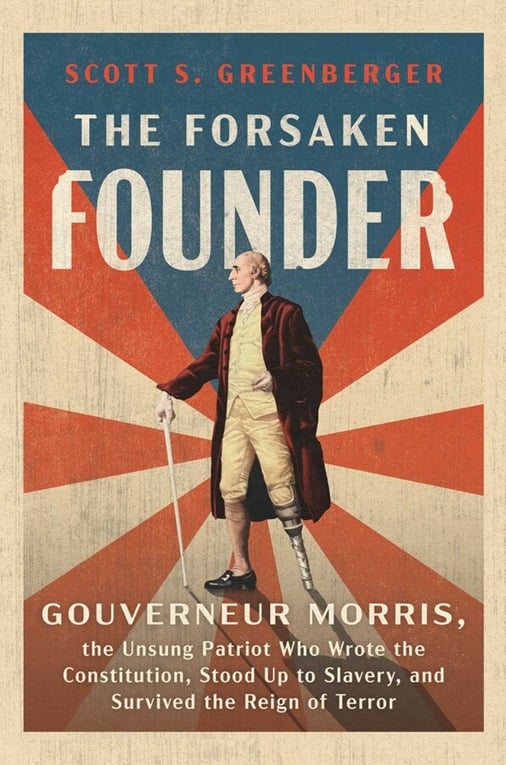
Gouverneur Morris was one of the more consequential figures of the founding generation, yet his contributions to the early republic have largely faded from public memory. In The Forsaken Founder: Gouverneur Morris, the Unsung Patriot Who Wrote the Constitution, Stood Up to Slavery, and Survived the Reign of Terror, Scott Greenberger examines Morris’s role in shaping the United States, from helping establish the nation’s financial system to crafting much of the Constitution’s final language.
Subscribe now Upgrade nowMorris’s contributions extended well beyond the Constitutional Convention. During the American Revolution, he helped George Washington address the Continental Army’s supply problems and later contributed to the development of the nation’s first bank and currency. At the convention in Philadelphia, he emerged as one of the document’s most influential voices, speaking more frequently than all but James Madison and forcefully opposing slavery. His personal connections also placed him among the leading figures of his era, including Alexander Hamilton, whose eulogy Morris delivered at the request of Hamilton’s widow following his death in a duel.
Morris’s public service continued after the Constitution’s adoption. As an American envoy to France, he witnessed the upheaval of the French Revolution and the Reign of Terror firsthand. He also recognized New York’s potential to surpass Philadelphia as the country’s leading economic center, anticipating the transformative impact a canal connecting the interior to the Atlantic could have on commerce.
Despite his accomplishments and connections, Morris has received comparatively little recognition in popular accounts of the founding era. Greenberger’s biography explores the reasons for this neglect, considering whether Morris’s outspoken opposition to slavery, aristocratic sensibilities, or belief in the importance of strong institutions made him an uncomfortable figure for later generations to embrace. Drawing on events spanning the American Revolution, the Constitutional Convention, and revolutionary France, The Forsaken Founder reexamines Morris’s place in the nation’s founding and the reasons his contributions have been overlooked.
The majority of my reading took place over Rosh Hashanah. As a result, I didn’t email myself an extensive number of quotes or comments that stood out to me while reading The Forsaken Founder. That’s why this review is shorter than most of my other book reviews. It doesn’t mean it’s a bad book, but reading most of it on Rosh Hashanah meant I wasn’t able to email myself comments to incorporate into my review later, as I’ve done with other books.
You’d be forgiven if you thought this was the first modern biography of Gouverneur Morris. An earlier biography was written by historian Richard Brookhiser and published back in 2003, so it’s been a while. The difference between the two is that Greenberger’s book runs 260 pages of main text, while Brookhiser’s is 221 pages. It’s a considerable difference in my opinion.
Having read how Morris was described in other books about the Founding Fathers, I was curious about how he ended up with a peg leg. I thought he might have been injured while fighting during the American Revolution, but he was on the political side of things, serving in the state legislature or Continental Congress. It turns out that part of his leg had to be amputated following a carriage accident in May 1780, when his horses bolted. His leg was caught in the spokes of one of the wheels.
Over a decade later, Washington appointed Morris to succeed Thomas Jefferson as Minister to France. When Jefferson returned to the United States, his private secretary, William Short, took over the post in an interim capacity. He was never meant to be a permanent minister, and Jefferson repeatedly told him that his position as chargé d’affaires was only temporary, pending the appointment of someone else.
Suffice it to say, Short wasn’t happy about Morris getting the appointment and expressed his disappointment in letters to Jefferson. Short wasn’t alone in not being a fan. Morris was confirmed in a 16–11 vote, but his tenure wasn’t long, as the French requested his recall in 1794, less than two years after he presented his credentials in June 1792.
After reading The Jewish World of Alexander Hamilton a few months ago, I was curious whether Greenberger would touch on the court case that saw Morris and Hamilton on opposing sides. This was the trial in which Morris made antisemitic remarks about the witnesses, forcing Hamilton to ask for more time so that he could make forceful comments repudiating those remarks. Alas, there was nothing in the book about them.
In his afterword, Greenberger notes that there wasn’t a massive crowd in attendance at Morris’s funeral at Morrisania, where he was buried in a cherry orchard. Only family and a handful of friends attended his burial in November 1816. Furthermore, his death barely garnered any news attention, which is rather sad for someone who signed the Constitution.
His son would build St. Ann’s Episcopal Church on the site where Morris was buried, naming it in memory of Morris’s wife, who passed away in 1837. Ann Cary Randolph Morris’s remains were moved to a vault beneath the church, while Morris’s remains are still outside. It wasn’t until more than a century after his death that a marble tablet honoring Morris was dedicated. A fence stands around the tablet today, making it the closest thing to a headstone that visitors can see. To my knowledge, the churchyard is not open to the public.
And what about today? There’s no mention of Morris in Hamilton, so he hasn’t really been introduced to a new generation of Americans. I only know the name because I’ve looked up the names of those who signed the two principal founding documents. A number of places in the Bronx are named for him, but unlike so many Founding Fathers, you won’t find a statue of him outside the National Constitution Center in Philadelphia.
Greenberger thinks the reason Morris was forgotten is relatively simple:
“One straightforward reason is that there isn’t a fitting place to remember him: Unlike Mount Vernon and Monticello, Morrisania no longer exists. Early in the twentieth century, some local preservationists tried to turn Morris’s manor house, where the floor still bore the marks from his wooden leg, into a museum, and the grounds into a public park.”
But as the twentieth century progressed, properties were bought and demolished to expand the railyards. If you were to go to the site of Morrisania today, what you’d find—aside from the church—are the concrete support columns and an entry ramp for the Robert F. Kennedy Bridge.
But, as Greenberger also notes, “the character and personality of the man” are another reason Morris disappeared from the American story. Being an aristocrat and skeptical of “unbridled democracy” can do that. It’s a primary reason why Short was so opposed to Morris being named to the post in France. But when you look at what Morris did for America during the Revolutionary War and the Constitutional Convention debates over slavery, those contributions are compelling enough to remember and honor him.
DeWitt Clinton gets a lot of credit for the Erie Canal, but Morris had the vision first. As one of three men on the Commissioners’ Plan of 1811, Morris played a key role in laying out Manhattan’s street grid as it appears today. Unfortunately, though, he was among those who supported the Hartford Convention, which threatened secession.
Writing to the Committee of Correspondence in Philadelphia on August 27, 1816, Morris was quoted as saying, “Let us forget party, and think of our country.” It may have been written as a warning to Federalists, but it’s advice that still feels prescient today.
Upgrade now