James Monroe: A Life by Tim McGrath
Tim McGrath’s James Monroe: A Life explores the fifth president’s life and legacy through extensive primary sources, examining his role in shaping the early republic, advancing American foreign policy, and confronting the enduring contradictions of slavery.
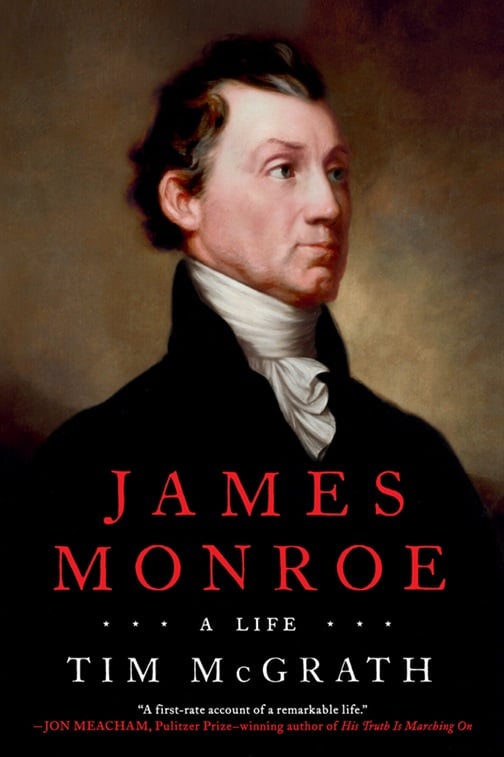
Tim McGrath’s James Monroe: A Life explores the life and legacy of the fifth president of the United States, the last Founding Father to occupy the White House. A soldier, senator, diplomat, and statesman, Monroe played a significant role in shaping the young nation as it evolved from thirteen colonies into a growing republic.
Subscribe now Upgrade nowRevolution and political conflict were recurring themes throughout Monroe’s life. His experiences ranged from fighting in the Revolutionary War to serving as an American diplomat in France during the Reign of Terror. He also became embroiled in the emerging partisan rivalries of the early republic, clashing with prominent figures such as Alexander Hamilton and George Washington, the latter of whom had once been a personal hero.
McGrath’s biography follows Monroe through pivotal moments in American history, including his wounding at the Battle of Trenton, the hardships of Valley Forge, negotiations surrounding the Louisiana Purchase, and his relationships with Thomas Jefferson and James Madison. It also examines his leadership during the War of 1812, when British forces attacked Washington and burned the Executive Mansion, as well as his lifelong entanglement with the institution of slavery. After winning the presidency in 1816, Monroe sought to ease partisan tensions and foster national unity, drawing on George Washington’s example of putting the country ahead of party loyalty. Across his two terms, he helped consolidate the nation’s position at home and expand its influence abroad.
Drawing on an extensive collection of primary sources, including materials that have received little attention since Monroe’s lifetime, McGrath presents a detailed portrait of a consequential figure in the founding generation.
I have to admit that, other than knowing he was behind the Monroe Doctrine, I wasn’t as familiar with Monroe as I was with the other three presidents included in the Virginia Dynasty. Monroe wasn’t the last Virginian to be elected president, but he was one of four Virginians to be elected to two terms as president during America’s first fifty years of existence.
By the time I started reading the Monroe biography, I had already read about numerous events shaping the early republic from various points of view. Tim McGrath’s book meant getting many of those same events from a different point of view. One such event was the Jay-Gardoqui Treaty and how it spelled the end of an American government under the Articles of Confederation. Much of the treaty had to do with Jay ignoring written instructions and surrendering American rights to the Mississippi River. Monroe “would never trust Jay again.”
There were two typos that I caught. I can understand the latter one being missed but the first typo is inexcusable. Worst of all is that the end notes make it very clear that the book is not discussing Peter Muhlenberg, but his brother—Frederick Muhlenberg—who served as the Speaker of the House. In another universe, I might not have noticed, but since I’ve done my fair share of research on the Muhlenberg brothers, it’s a typo that stood out immediately.
While Chapter 9 focuses on Gabriel’s rebellion, the fallout would extend into further chapters. Gabriel was an enslaved man who believed that he should be living as a free man. This required “a plan to attain his freedom.” Virginians were no doubt familiar with the slave insurrections in Haiti, and they didn’t want to see such events replicated on American soil.
When Monroe began his term as governor in December 1799, he didn’t know that Gabriel would include him in his plans. When other slaves informed their masters of Gabriel’s plans, the news rapidly made its way to Monroe, who ensured the rebellion was put down before it had a chance to begin. While Monroe knew that slavery needed to end, he also realized that it would end his political career. McGrath writes that “Monroe sought a solution to slavery that was morally, politically, and financially agreeable to him.” Alas, the nation’s fifth president never found the solution he was looking for, even though he would seriously consider emancipation in some form as reflected in an 1801 letter to Thomas Jefferson:
“As soon as the mind emerges, in contemplating the subject…vast and interesting objects present themselves to view. It is impossible not to revolve in it, the condition of those people, the embarrassment they have already occasioned us…We perceive an existing evil which commenced under our colonial system, with which we are not properly chargeable, or if at all not in the present degree, and we acknowledge the extreme difficulty of remedying it.”
Jefferson tasked Monroe with joining Robert R. Livingston in France to acquire Louisiana and, if that went well, traveling to Spain in an effort to acquire Florida. It sounded easy enough but Robert R. Livingston was standing in the way. Livingston was insulted by Monroe’s appointment as he wanted all the credit to himself for any success to be made during the negotiations. Furthermore, Livingston went as far as lying to Jefferson and Madison in the process.
McGrath wrote that nobody considered the impact on social issues at the time—forced removal of Native Americans or the expansion of slavery—because “the Louisiana Purchase made the United States a continental nation and is justifiably Jefferson’s greatest presidential accomplishment.” The purchase added “828,000 square miles of rivers, grasslands, mountains, and plains, for about three cents an acre, nearly doubling the size of the United States.” As for the negotiations, it resulted in the end of Monroe and Livingston’s friendship.
I didn’t email myself any particular notes about the chapter on the Missouri Compromise, in part because I’m so familiar with the Missouri Compromise just from learning about Henry Clay while growing up. Monroe just happened to be the president when Congress was debating Missouri’s admission to the Union. Chapter 21 focuses on the debate, which started in 1819. One would have thought that the Panic of 1819 would have been the greatest crisis of Monroe’s presidency, but no, it was the Missouri Compromise—a debate that would repeat itself again in 1850. Picking a few quotes from the chapter wouldn’t be enough to do it justice—it provides more insight than academic textbooks usually have about the time period in history. Monroe would go on to win a second term in 1820.
If there is a money quote to be found in the chapter, perhaps it is the very quote in which the chapter found its title. The quote itself comes from John Quincy Adams’s diary entry on March 3, 1820:
“I have favoured this Missouri compromise, believing it to be all that could be effected under the present Constitution, and from extreme unwillingness to put the Union at hazard. But perhaps it would have been a wiser as well as a bolder course to have persisted in the restriction upon Missouri…If the Union must be dissolved, Slavery is precisely the question upon which it ought to break.”
Monroe had the chance to appoint a Supreme Court justice when H. Brockholst Livingston died in March 1823. This was the first court opening in 12 years. Monroe planned to appoint Navy Secretary Smith Thompson, who previously served as Chief Justice of the New York State Supreme Court. Thompson asked for time when Monroe reached out to make the offer. Like other members of Monroe’s cabinet, Thompson wanted to be president. That’s why what he did next would make anyone spit out their drink or choke: he wrote Van Buren that Monroe was considering him for the court. Van Buren was 40 years old and while he was a lawyer, he had no experience serving in a judicial setting. Van Buren found out that he was never being considered for a seat on the court—this was all Thompson wanting to be president. Still though, Thompson took several months before accepting the appointment.
Subscribe now Upgrade nowThe Monroe Doctrine was decades in the making and it came as a result of the developments that were transpiring during the seventh year of his presidency: “the ongoing struggle for independence in South America; the reestablishment of the principle (and practice) of ‘the divine right of kings’ across Europe through alliances pledged to suppressing democracies; and the growing foreign presence on the west coast of North America.” In short, something had to be done.
What was originally going to be released as a joint declaration arranged with then-British Foreign Secretary George Canning changed when Canning had a change of heart. Monroe and Adams forged ahead on the foreign policy doctrine. Both men had spent a number of years abroad as foreign diplomats. They had both served as Secretary of State—Adams would succeed Monroe as president. But Adams’s 15 years abroad were unmatched by those of any other diplomat at the time. When Monroe delivered that year’s message to Congress, the point was very clear: The Western Hemisphere was closed for colonization.
While Chapter 24 was largely focused on the Monroe Doctrine, other things were transpiring. As I’ve been reading presidential biographies during the past few months, Cuba keeps coming up. During the Monroe administration, a “cabal of influential Cubans” met with Adams, hoping that Cuba would become the next state or states in the Union. The cabinet offered their opinions, but ultimately, Monroe and Adams agreed that they were better off not taking any action. The last thing that America needed was another war with Great Britain or to get involved with Spain over Cuba.
One thing that surprised me while reading the book was John C. Calhoun’s comments about Native Americans. I don’t think I need to remind anyone about how racist Calhoun was when it came to slavery, which is why I found his comments so shocking. He “looked to a day when Native Americans were not only successful farmers but also American citizens.” But despite the sentiment, the report that Monroe delivered to Congress essentially stated that it would be best for the tribes to move to the west and north of the current states and territories.
Being from Kentucky, it’s impossible to know when I first learned about the grand bargain between John Quincy Adams and Henry Clay, also known as the corrupt bargain among Andrew Jackson’s supporters. That being said, this bargain wouldn’t have been possible without the dinner honoring the Marquis de Lafayette at Williamson’s Hotel during his tour of the United States on New Year’s Day in 1825. Monroe attended this dinner, much to everyone’s surprise.
What makes the meeting between Adams and Clay so fascinating is both of them had “disliked and mistrusted each other since the negotiations at Ghent.” Both ran for president in 1824, but Clay didn’t have a path to the presidency. Adams had a path but only after the vote went to Congress. Jackson may have led in the electoral college, but he did not have a majority to take the presidency. Clay, for his part, decided to play spoiler and throw his support to Adams, paving the way for him to succeed Monroe.
Adams and Clay weren’t the only ones looking to make a deal. There was talk of Jackson and William H. Crawford joining together in an alliance. Crawford was recovering from a stroke and still a member of Monroe’s cabinet, even though Monroe loathed the man. Here’s how few people knew about the deal between Adams and Clay: Pennsylvania congressman James Buchanan told Jackson that he could get Clay’s support by announcing he wouldn’t keep Adams at State. Meanwhile, Calhoun hoped for a repeat of the 1800 election and that he could sneak through and become president. Whereas that election required 35 ballots over the course of several days, the 1824 election required just one vote. Adams won and that was it.
Four years later, when Adams was battling it out with Andrew Jackson again. If McGrath’s book is correct, Madison and Monroe were aligned with the faction that would come to call itself the Whigs after the Democratic-Republicans split into factions that would become the National Republicans and the Democratic Party. The National Republicans would merge with the Anti-Masonic Party and become the Whigs in 1833. For a number of years, Monroe had been part of the faction that supported Jackson and would eventually come to be known as the Democratic Party.
In just reading what I have about this era of American history, I can’t help but think that I would have aligned with the Whigs. What we know as the Democratic Party grew out of Jacksonian Democracy, but it was also founded on cross-sectionalism with race and slavery as the root cause that brought the party together. That’s not to say that there weren’t Northern Democrats opposed to slavery because I’m sure there were, but it’s just one of those things that leaves one feeling really icky just to think about it.
Tragedy followed the Monroe family in the final year of his life. His son-in-law George Hay died in September 1830, followed two days later by Monroe’s wife Elizabeth at their Oak Hill home. After both deaths, Monroe and Eliza made the move from Virginia to New York, settling in the home of Monroe’s youngest daughter, Maria.
I couldn’t help but start getting tears while reading Monroe’s final letter to Madison when he realized they wouldn’t be seeing each other again. Madison replied after he received it. They had a brief falling-out when Madison rejected a treaty that Monroe had arranged with Britain, but they eventually made up and stayed friends for the rest of Monroe’s life.
There is plenty to say about the Virginia Dynasty and their views when it came to slavery. Monroe shared Jefferson’s opinion that slaveholders were trapped in their times. And yet, of the more than two hundred slaves that Monroe owned during his lifetime, the only one that he freed was Peter Marks. It was his dying request.
Currently, James Monroe’s Highland in Charlottesville is the only Monroe home actively open to tourists. The main house burned in an 1829 fire, but an 1818 guesthouse survives. Monroe purchased the land in 1793, and his family permanently settled there in 1799. They were eventually forced to sell the property in 1825. Monroe Hill House, another Charlottesville residence, was built in 1790 and sold in 1814 before eventually becoming part of the University of Virginia, where it is now part of a residential college.
Monroe inherited the Oak Hill estate in Loudoun County in 1808, initially living in what is now known as the Monroe Cottage. The larger mansion was built between 1820 and 1823. After his presidency, Oak Hill became the family’s full-time home until Elizabeth’s death. The James Monroe Birthplace Park & Museum features an exact replica of Monroe’s original home. Oak Hill was purchased by the Conservation Fund last November after efforts to transfer it to the National Park Service or the state of Virginia had failed. There is hope that Oak Hill will eventually open to the public as a state park.
As the first comprehensive single-volume biography of James Monroe in more than a decade when it was published in 2020, Tim McGrath’s James Monroe: A Life draws on an extensive collection of primary sources, including materials previously unavailable to scholars. The result is a detailed portrait of a consequential figure in the founding generation and the world in which he lived.
Upgrade now