American Patriarch: The Life of George Washington by H.W. Brands
A look at Washington’s rise from Virginia planter to Revolutionary commander and the nation’s first president.
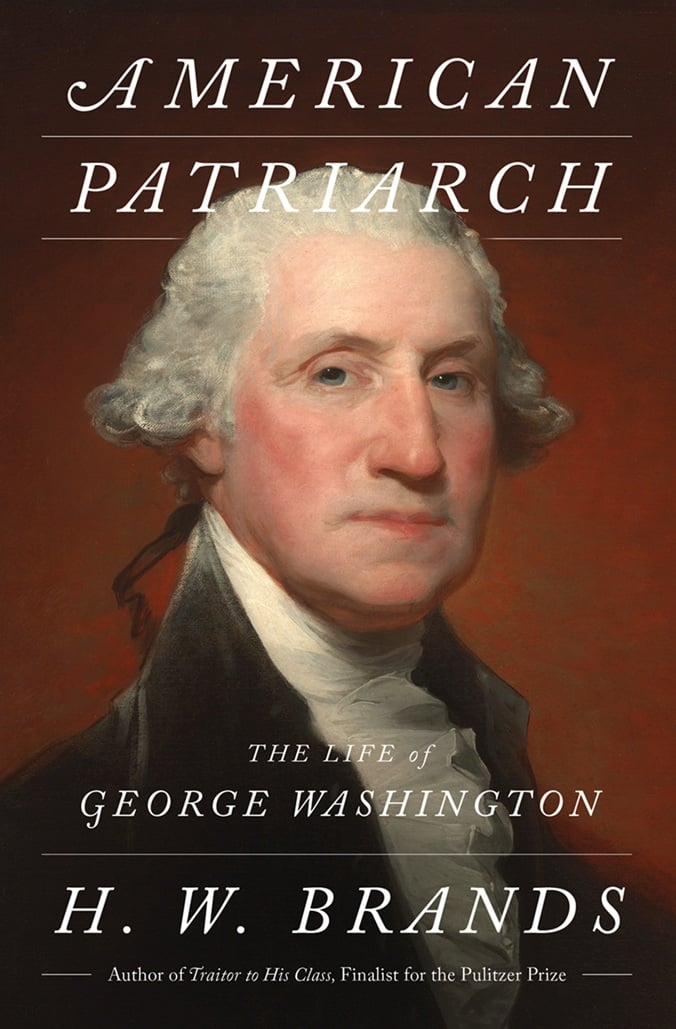
H.W. Brands’s American Patriarch: The Life of George Washington is the historian’s latest presidential biography, joining his extensive body of work on the Founding Fathers and the nation’s founding.
Upgrade nowAmerican Patriarch traces George Washington’s life from his early military service and rise among Virginia's planter elite through his leadership during the American Revolution and his reluctant return to public life as the nation’s first president. Along the way, it explores his relationships with allies, rivals, and contemporaries—including the Marquis de Lafayette, Benedict Arnold, Baron von Steuben, Thomas Jefferson, and Alexander Hamilton—while examining the leadership that helped secure American independence, establish the new constitutional government, and shape the precedents of the presidency.
Brands has touched on Washington’s life before, having written both Our First Civil War and Founding Partisans. But where those books alternated between the different aspects of the war or partisan divides, this book is entirely focused on his story. There’s nothing here about Washington chopping down the cherry tree (which is a complete myth), but surprisingly, Brands doesn’t really focus on Washington’s dental work either.
When England began to colonize the Americas, it increased the opportunities for land ownership, especially for those who had a challenging time acquiring land in England. But in buying up massive amounts of land for cheap, it meant needing to find people to work because “they had far more land than they could work themselves” and found “physical labor demeaning.” Native Americans didn’t take colonists up on the offer. Options included indentured service. Those wanting to come to America and couldn’t afford passage reached an agreement to “work several years in exchange for transport.” This often took the form of things like apprenticeships. Unfortunately for Virginia landowners in the 1600s, indentured servants died quickly for one reason or another and had to be replaced on a frequent basis.
Enter America’s darkest sin: slavery. It took Virginia decades to come up with the laws regarding slaves. Lawmakers decided on slavery being for life rather than a limited amount of time. When it came to children, the mother’s status decided if her children were also to be slaves. Virginians looked the other way to those men who clearly had relationships with their slaves and fathered children.
Benjamin Franklin had been voted to represent Pennsylvania’s interests to Parliament. This placed him in London at the end of the British war with France. However, he did not have a fan in then-Prime Minister George Grenville. Franklin testified to the House of Commons in 1766 about the Stamp Act and its impact on America. Upon being asked about whether military force could carry the Stamp Act into execution, Franklin was very frank in response:
“Suppose a military force sent into America. They will find nobody in arms. What are they then to do? They cannot force a man to take stamps who chooses to do without them. They will not find a rebellion. They may indeed make one.”
The Stamp Act was ultimately repealed but it was replaced with the Declaratory Act. Amongst other things, the act stated that the “colonies and plantations in America have been, are, and of right ought to be, subordinate unto, and dependent upon the imperial crown and parliament of Great Britain.” It also declared that only Parliament had the “full power and authority to make laws and statutes of sufficient force and validity to bind the colonies and people of America, subjects of the crown of Great Britain, in all cases whatsoever.”
When Washington wrote a letter to George Mason after the Townshend Acts, he was thinking as a military man. His opinion was that they should take up arms against Britain. But given how writing or speaking such a thing was treasonous against the crown, Washington spelled arms as “a—ms.” But at the same time, he also viewed taking up arms as being a last resort. Ultimately, we know how things turned out on that front. That being said, Washington agreed with the boycott strategy.
Washington was in Williamsburg as a member of the House of Burgesses when he learned of the newly passed Intolerable Acts. The burgesses responded by the closing of Boston Harbor by calling for a day of prayer and fasting. To which Virginia’s Royal Governor Lord Dunmore responded by dismissing the burgesses. While also endorsing the call for a continental congress, Washington captured his feelings in a letter to George William Fairfax:
“The cause of Boston—the despotic measures in respect to it, I mean—now is and ever will be considered as the cause of America…We shall not suffer ourselves to be sacrificed by piecemeal.”
If we want to discuss myths, Washington was in the room when Patrick Henry delivered his iconic speech during the Second Virginia Convention in March 1775. Brands cites a good portion of Henry’s speech as quoted in Attorney General William Wirt’s biography of Henry. The book was heavily criticized upon its publication, including by Jefferson. Henry’s speech was moving enough to draw a narrow majority to authorize the creation of a militia in Virginia, but there’s no actual proof that he delivered his speech exactly as Wirt had written it. Wirt drew on recollections from people—including Judge St. George Tucker—who were there for a book published over 40 years after the fact. No transcription of Henry’s speech had survived in part because he was an orator rather than a writer. Published newspaper accounts also contradict Wirt’s account of Henry’s speech—not the spirit, but the text.
The Americans were hopeful that Canada could be captured during the American Revolution. While smallpox received the blame in the army failing to accomplish this endeavor, the real reason is that Canadians simply weren’t interested. Even the French inhabitants and Indigenous natives had little interest in going to war against the British. Likewise, the same could be said for New York, which had been founded as a Dutch colony in the 1600s. New York might not have been the largest city at the time—Philadelphia had more inhabitants—but they expected the city to be fought over as the Hudson River met the Atlantic Ocean by way of New York Harbor and the Lower New York Bay. British access to the Hudson meant cutting off New England from the south, effectively splitting America into two. Washington wouldn’t allow this to happen without a fight.
When America defeated the British at Yorktown, King George III couldn’t believe it. Washington had been the better general but even the king couldn’t be surprised by this point, given Washington’s military record. What did surprise him, however, was Washington’s decision to put it all behind him and retire to Mount Vernon.
A number of Americans became emancipationists after the war ended. Under British rule, they had no say in whether or not slavery could be abolished. It was only when states became free and independent that they began to make their own laws regarding slavery. Pennsylvania mandated gradual emancipation, meaning that “existing slaves remained in bondage, but children born to slave mothers would become free upon majority.”
Abolitionists cited contradictions between the Declaration of Independence and the institution of slavery. The Declaration talks a good deal about equality and yet, enslaving people goes against the very ideal. Northern states had lower numbers of slaves when compared to Southern states. Washington expressed his sentiments in a letter to Robert Morris while writing about Alexandria, Va. store owner Philip Dalby.
“I hope it will not be conceived from these observations, that it is my wish to hold the unhappy people who are the subject of this letter, in slavery. I can only say that there is not a man living who wishes more sincerely than I do, to see a plan adopted for the abolition of it—but there is only one proper and effectual mode by which it can be accomplished, and that is by Legislative authority: and this, as far as my suffrage will go, shall never be wanting.”
I previously wrote about A Perfect Coincidence by Jim Rasenberg, a book that captured the friendship, estrangement, and reconciliation between Presidents John Adams and Thomas Jefferson. Adams wasn’t the only friend who Jefferson angered during the partisan wars in the late 1700s. Jefferson had also upset Washington, who wrote his last “substantive letter” to him in July 1796. The letter dealt with content published in the Aurora.
“If I had entertained any suspicions before, that the queries Which have been published in Bache’s Paper proceeded from you, the assurances you have given of the contrary, would have removed them; but the truth is, I harboured none.”
The entire letter—linked above—is worth reading in full. Washington wrote a very brief letter nearly two months later in response to Jefferson’s June 19 letter about papers.
Towards the end of his life, Washington was already thinking about the future. He wanted to make sure that Mount Vernon was in good hands and at the same time, he remarked to Tobias Lear that he wanted to emancipate his slaves and have them hired out as a paid workforce. This meant selling Western lands that he owned through previous speculating or as a payment for his previous military service by the Virginian government.
In terms of education, Washington bequeathed his 50 shares in the Potomac Company in hopes of the federal district becoming home to a national university. This was conditional on Congress backing the project. Unfortunately, the shares had lost their value, but his vision was finally fulfilled when Columbian College received a congressional charter in 1821, ultimately being renamed The George Washington University in 1904.
Liberty Hall Academy was the recipient of 100 shares in the James River Company. The school subsequently changed its name to Washington Academy. The school was eventually renamed Washington and Lee University.
One thing that did surprise me was that Brands didn’t write about Washington’s visit to Newport in 1790. For Jews like me, this visit was historic because Moses Seixas delivered a letter from Touro Synagogue on the subject of religious freedom. Washington was touring New England states to drum up support for the Bill of Rights. Washington sent a reply to the members of Touro Synagogue in what has become one of his most famous letters.
One editorial choice that stood out to me was Brands’s decision to refer to Native Americans as “Indians” throughout his own narration rather than limiting the term to historical quotations or period documents. While the terminology reflects the era Washington lived in, modern historical writing has largely shifted toward using Native Americans or the names of specific nations except when quoting primary sources. It didn’t diminish my appreciation for the biography, but it was a noticeable stylistic choice that repeatedly caught my attention while reading.
With American Patriarch, H.W. Brands adds another thoughtful volume to his extensive body of work on the Founding Era. While I found a few omissions and editorial choices noteworthy, the biography succeeds in presenting Washington’s life and leadership in a way that will appeal to both longtime students of American history and readers discovering the nation’s first president for the first time.
