The First American by H.W. Brands
H.W. Brands explores Benjamin Franklin’s life in The First American, from his early years in Philadelphia and scientific pursuits to diplomacy, revolution, and his final years.
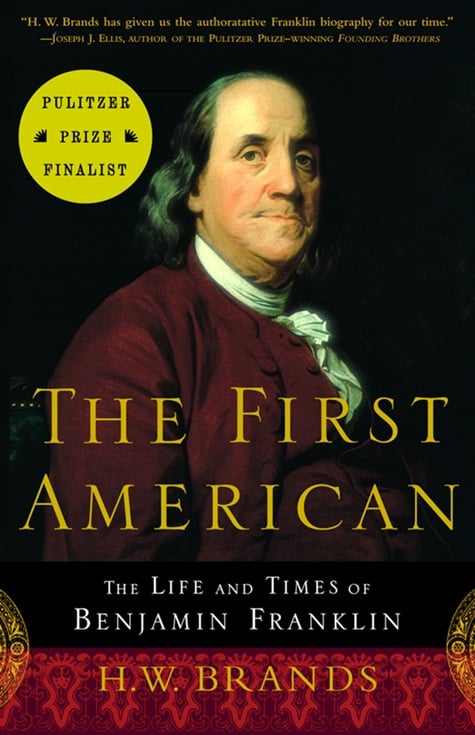
H.W. Brands’ The First American: The Life and Times of Benjamin Franklin offers a sweeping biography of Benjamin Franklin, tracing his remarkable rise from a runaway apprentice and struggling young printer to one of the most influential figures of the American Revolution.
First published by Doubleday Books in 2000 and by Vintage Books in 2002, the book follows Franklin through his many careers and interests—as a printer, publisher, scientist, inventor, businessman, diplomat, and political thinker—while also examining the contradictions and complexities of a man whose views evolved considerably over the course of his life.
Brands pays particular attention to Franklin’s transformation from a devoted British subject into a leading advocate for American independence and, ultimately, a crucial diplomat in securing French support for the revolutionary cause. Along the way, Franklin’s relationships with figures such as Voltaire, David Hume, Edmund Burke, and Immanuel Kant place his life within the wider intellectual and political world of the eighteenth century.
Drawing on letters and other primary sources, Brands presents Franklin not simply as an iconic Founding Father but as a remarkably versatile and sometimes complicated individual. The result is both a portrait of Franklin and a broader look at the turbulent era in which he lived, worked, and helped shape the course of American history.
Upgrade nowI bought The First American during the summer of 2002 while attending a Junior Statesmen program at Northwestern. And while I’d like to say that I read the book at one point or another while it sat on my bookshelf, I’m pretty sure that I didn’t. Other than the parts that are well-known to history students or were mentioned in Our First Civil War, the bulk of the text didn’t stand out as anything that I would have definitely remembered. I might have brought it with me on an overseas trip in 2007, but it definitely was not read during that trip.
I haven’t read the Walter Isaacson biography of Franklin, but I really don’t know how anyone can improve upon the Brands biography of Franklin, which was also a Pulitzer Prize finalist. Brands covers a lot of material in 716 pages of text before the notes, bibliography, and index.
One thing that surprised me the most was just how much Franklin missed out on due to living overseas in London or Paris for work. He missed weddings, births, and, yes, even the 1774 death of his wife Deborah after she suffered a stroke. He was abroad for the better part of two decades as an agent of the Pennsylvania Assembly.
In his youth, shortly after moving to Philadelphia from Boston, Franklin received the backing of Pennsylvania’s royal governor in starting his own print shop. Unfortunately for Franklin, William Keith was not an honest man and never followed through on his promise. Franklin wouldn’t start up his own print shop until after returning from a few years living abroad in London.
On his first trip back from London, Franklin wrote down four resolutions and thirteen virtues. He strived to adhere to them for the rest of his life. He didn’t just write them down; he actively worked to master them.
Little did he know upon being named the postmaster of Philadelphia in 1737 that it would go on to change his life. He served in this position until being appointed one of two deputy postmaster generals of British America in 1753. But for the time being, he just knew it was going to boost his newspaper business. He didn’t know at the time that it would “pull him into American and then imperial politics.”
Upgrade nowWhile I knew about the French and Indian War growing up, what I didn’t know was that there were more wars that preceded it and managed to involve the colonies because of how Britain, France, and Spain planted roots in North America. King William’s War lasted for eight years, ending a decade before Franklin’s birth. Queen Anne’s War took place from 1702 to 1713—Britain received both Acadia and Newfoundland, and its slave traders were the only ones who could legally be used for the Spanish American market. And then there was the aptly named War of Jenkins’ Ear, fought between Britain and Spain from 1738 to 1749.
King George’s War took place from 1744 to 1748 and restored Louisbourg to France. The Americans who played a role in capturing the fort could hardly have been happy about it. You’d be forgiven if you lost track of how many times parts of British America changed hands with France or Spain.
In 1748, Franklin decided to retire from the printing business. He was still able to live comfortably, but I wonder if he would have made this decision knowing he would live until 1790.
In 1749, Franklin proposed an “Academy for the education of youth.” It would not open until 1751, and we know it today as the University of Pennsylvania.
Brands writes in depth about Franklin’s efforts at testing his theories of electricity. These efforts played a key role in why he became famous in Europe prior to returning to London as the agent for the Pennsylvania legislature.
Franklin’s “Join or Die” is said to be the first political cartoon printed in America. It came during the French and Indian War and circulated through the mail. Meanwhile, in Albany, Franklin proposed a union of American colonies—a federal system—that was ultimately rejected by the Albany Convention when it met at City Hall (present-day SUNY Plaza) in 1754.
His most influential essay was published in 1755 after he first drafted it four years earlier. In essence, what Franklin wrote was that population growth would depend on the availability of land. He basically argued that America would benefit from the amount of land available, unlike in Europe. If someone wanted to move to America and own a farm, there was plenty of space. He also touched on how the population would double every 20 years. It was also an indication that he was starting to see slavery in a different way. Franklin noticed how the northern colonies grew in population when compared to the South.
Benjamin Franklin did not actually earn a doctorate degree. What he did earn was an honorary doctorate from the University of St. Andrews in 1762. Afterwards, he was referred to as Dr. Franklin.
Franklin experienced the prelude to the American Revolution in a different way than many of the other Founding Fathers. It wasn’t until the fallout from leaking Thomas Hutchinson’s letters led Franklin to go back to America in March 1775, just in time to be elected as a Pennsylvania delegate to the Second Continental Congress.
What Brands does in The First American is expand on the Intolerable Acts in ways that I haven’t really seen covered in some of the other biographies that I’ve read lately:
Boston Port Act
Massachusetts Government Act
Administration of Justice Act
The Quartering Act
The Quebec Act
The Quebec Act is an interesting one because, despite Virginia and other colonies having claims to the Northwest Territory (referred to as such because of how it lies northwest of the Ohio River), Parliament decided to extend the boundary of Canada south to the Ohio River. It also granted French Catholics religious freedom. You’d think the latter would not be so upsetting, but that’s not how Protestant colonists took it.
If you want to know why there are so many places named Chatham in America, it’s because of how William Pitt felt about America’s response to the crackdown coming from Britain. Franklin wrote about Lord Chatham’s comments in the Journal of Negotiations to his son William Franklin:
“They had acted, he said, with so much temper, moderation and wisdom, that he thought it the most honourable assembly of statesmen since those of the ancient Greeks and Romans in the most virtuous times.”
Chatham was one of the few in Parliament who were outspoken against British treatment of Americans.
If the American Revolution didn’t end when it did, it was likely that Russia would enter the fray. They sat it out completely while the Revolution grew into a world war that included both France and Spain.
Before going back to America, Franklin reunited with his son William for the first time since their relationship grew distant. William had chosen to side with the British, and it essentially ended their relationship.
After returning to America following the end of his diplomatic career overseas, he was elected as Pennsylvania’s sixth president. Pennsylvania had a Supreme Executive Council until the state constitution was reworked in 1790. Franklin served the maximum three full terms, but he spent plenty of time at home during his terms due to his health.
In The First American, Brands provides a comprehensive look at Franklin that goes well beyond the familiar stories of the Founding Father, while placing his accomplishments, relationships, and contradictions within the broader history of eighteenth-century America. It may have taken 24 years to read the book, but the wait was ultimately worth it.
Upgrade now