compatibility issues

Archives

compatibility issues

Archive

on suddenly, if briefly, belonging

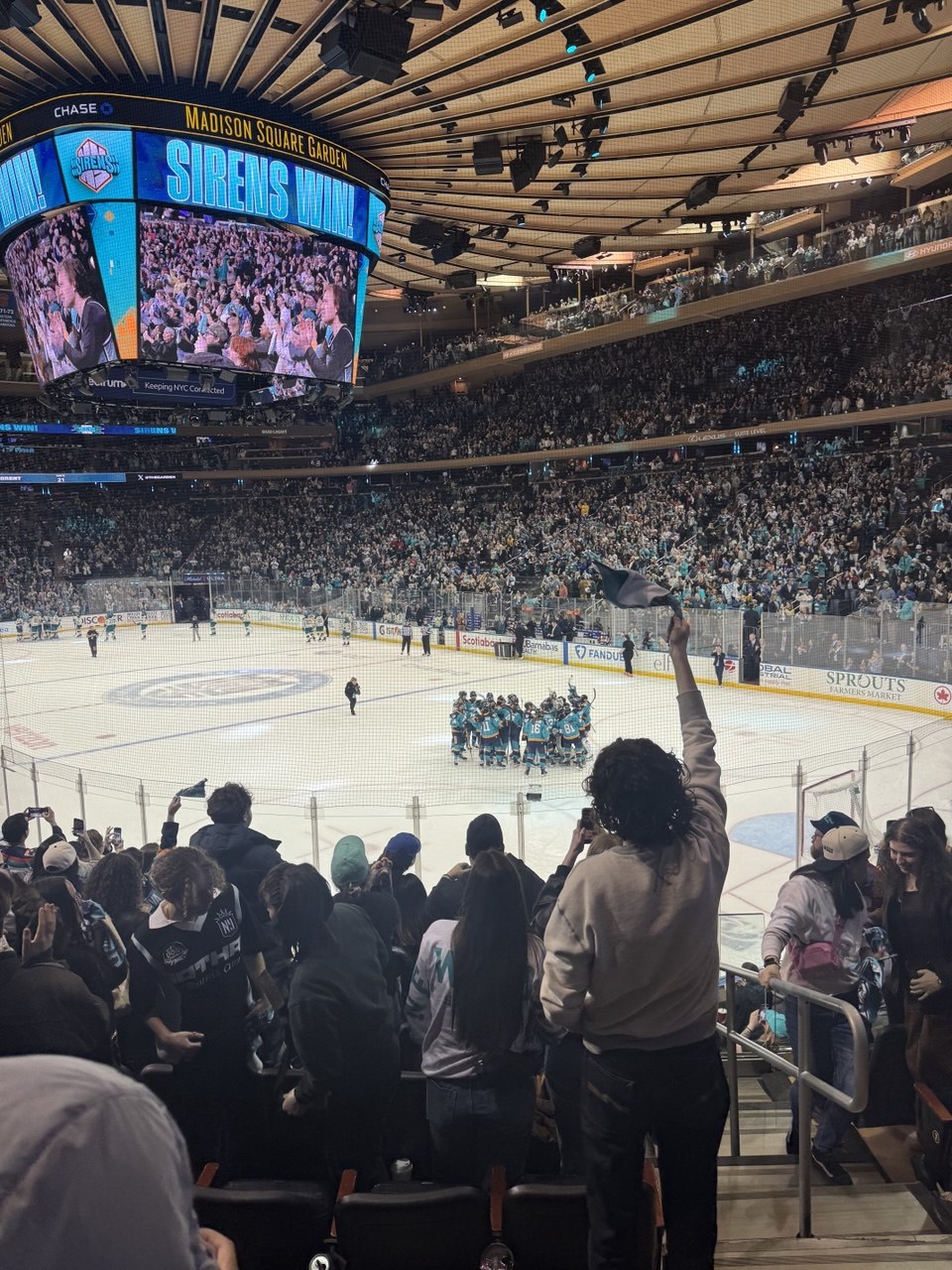
A picture of Madison Square Garden from the lower bowl seats as the New York Sirens hockey team gathers to celebrate their win.
I could write an equally long essay, probably, or several of them, about the current hockey cultural moment and the Heated Rivalry mania and everything else I’ve been through with this sport. But this is not this essay. It’s about the Sirens winning at Madison Square Garden. wee woo 🚨

I got to go to the New York Sirens game at Madison Square Garden on Saturday night. It was around the time that Corinne Schroeder was nearing the 20-save mark in the second period – in what was very nearly a game-stealing shutout – that I started to feel like I was dreaming. Surely this wasn't real, and I could not be feeling this way. It's not like I haven't had cause to be cynical, casually nihilistic, and enraged over the last decade or so, and my relationship with hockey felt somehow consequential as a barometer for that. I was shocked at how much I was enjoying myself. Two days later, I'm still shocked.

To explain: I've never really done well with group settings or community spaces. I have a sort of paralyzing social anxiety that I've had to work very, very hard to understand and cope with – or at least that is what I tell myself to give myself grace. I can be an asshole and I treat everything I do like an exercise in analysis or philosophy and ethics. I'm sure it's exhausting; I've been told as much. It is for me, too. I've been trying to chill the fuck out. Being alive is a community that we all are in and it's messy and complicated, but you don't have to be. Approach others with openness and honesty about what your values are and be willing to stand by those values. It is a challenge to be honest with others and yourself when we are confronted so constantly with hatred, violence, and war. It's disorienting. Responding with love is a radical act, even in its most depoliticized and co-opted forms. The idea that a room of over 18,000 people can feel like love goes against my instincts for anything I've ever experienced in a crowd. I've been watching hockey for about 20 years – but I've never felt at home in it.

I'm kind of a veteran of sports flights of fancy, you see. I present a mostly rational exterior, I think, and then people get me talking about sports. I've been called out about this in a variety of settings. Sports fans really are freaks. None of us know why we do any of this. For me, a huge part of it has to be that I get off on the analysis. I didn't even get like this in college studying literature, but it certainly didn't help. I came this way, like an instructor of an elective that nobody I'm talking to knows they signed up for – I'm always analyzing everything. Growing up, I didn't even know I liked sports – maybe because the only sports fan culture I really had access to was around the Pittsburgh Steelers, which is, you can imagine, naturally horrific. Once, I got dragged to a Steelers game and spent the entire time dissociating and trying to listen to my CD player. It was immediately post-9/11 and I'd tried to bring a purse into Heinz Field, which hadn't gone well. I didn't know what was going on, and I didn't care. There were men everywhere and I knew from growing up in rural southwestern Pennsylvania that men who were drinking beer and watching football didn't want to hear about my mix CDs and I was absolutely not allowed to change the channel to watch Animal Planet. My dad and his friend had brought me and his buddy's kid as well – we were and remain friends and we both turned out to be queer. Sports were not "for" us.

#8
April 6, 2026
Read more

9-1-1 update: a little punishment as a treat

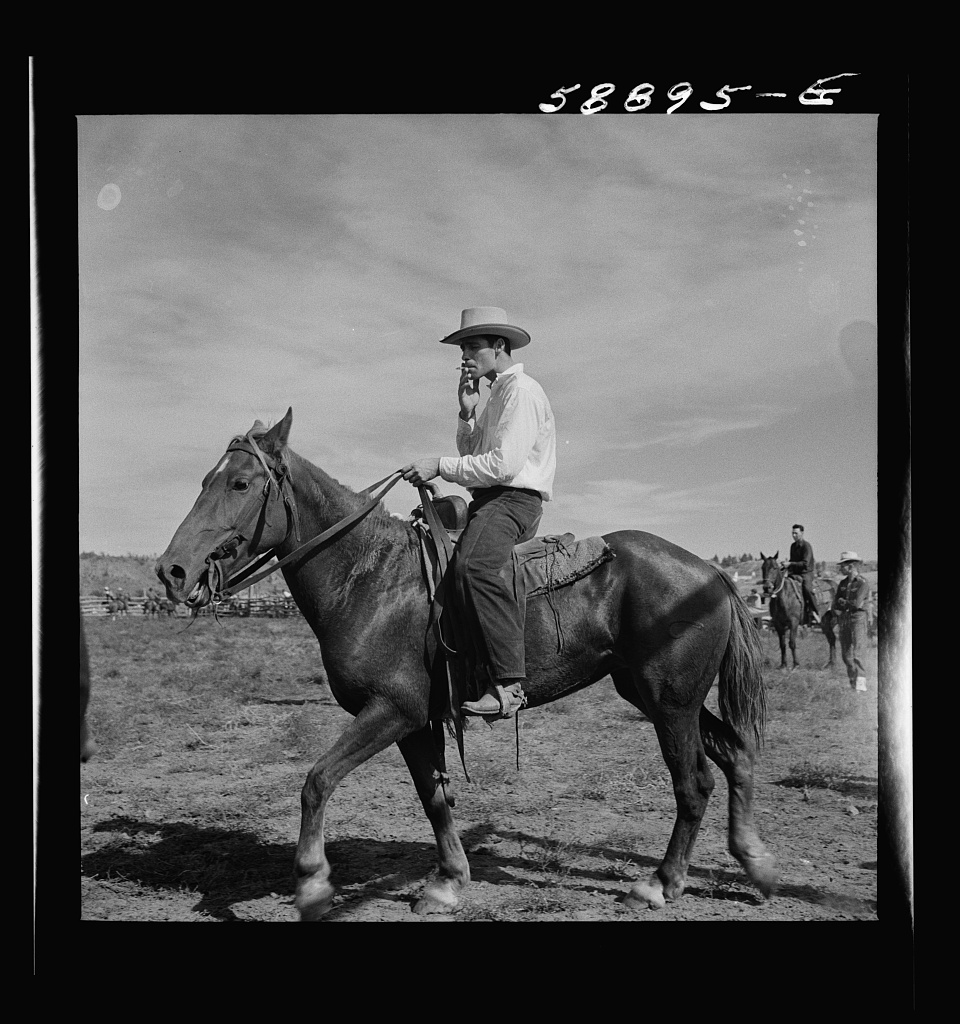
[I wanted to insert a public domain historical image of a hot cowboy at the top of this post but was unable to for some obscure technical reason. Read on to find out why the hot cowboy is relevant.]

[UPDATE: the cowboy is now below]

August 1941 nitrite negative, featuring an image of a cowboy sitting on a horse smoking a cigarette in Ashland, Montana by photographer Marion Post Wolcott, from the Library of Congress (public domain image)
August 1941 - cowboy at rodeo in Ashland, Montana by Marion Post Wolcott. Nitrite negative.

#7
March 19, 2026
Read more

on best-laid plans

(a self-indulgent brain dump on paper planners, music I like, and feeling like everything is bad and nothing is good)

When you're "going to get your fucking life together", you get certain urges. You might, for example, buy a planner. In my case, I bought a Hobonichi Techo Weeks, despite the fact that several years ago I realized that I do not have the kind of life anymore that requires a weekly paper planner. My job is with computers and all of my work stuff goes on the Outlook calendar. My wife and I have a Google calendar; that's where we put scheduling things that are relevant to our lives and where I note when the bills are going to be paid. We live paycheck to paycheck, like a lot of people do these days, scraping together enough money every month to cover the bills and the mortgage, but not without occasional 24-to-48 hour periods of overdrafted accounts between paychecks. I really shouldn’t have spent money on a planner that I might not even really use. So now, the onus is on me to use it, so that I didn’t light $75 on fire for an aesthetic.

This year, the Hobonichi Weeks can be purchased alongside a perfect mustard yellow carrying sleeve, with a generous zipper pocket for writing implements and several interior pockets for things like appointment cards, stickers, and page flags. I knew I would probably buy it as soon as I saw it – mustard yellow is my favorite color, and, like I said, I'm getting my fucking life together, which is best accomplished with a talisman of some kind. The paper planner, at many stages of my life, has been that talisman. At some point in the last five years, I switched to a monthly planner layout and discovered my strong preference for spiral bindings that can be fully folded over or laid flat – I had a lot of success with those, until the one I bought last year fell into a pit of my own anxiety and depression and I didn't end up putting much in it. The Hobonichi Weeks has a standard binding in a flexible but sturdy cardboard cover – it can't be folded over, or laid flat. I can open it and press it down with my fist and it will stay open reasonably to the desired page. Because it is not yet December 1st, each of these pages, aside from the monthly overviews where I have penned in birthdays and anniversaries and major holidays, is mostly blank.

In this planner format, a seven-day overview on the left facing page (Monday through Sunday, with an equal block for each) gives way to a blank grid on the right. I do not know what I am going to put on these pages, and so I feel like "getting my life together" has already hit a pretty big snag. In high school and college, I would use these weekly facing pages to jot down my assignments ("thesis draft... lol" I might write circa 2012; "pages 72-80 AP US History" back in 2007) and to make to-do lists. I would also include my work schedule – Panera Bread until I moved to Boston, where my shifts were at the IT Help Desk. If I was ever in doubt about what I was doing or what my upcoming schedule was, I would look in the book. It was easy. As my life has become more complicated and increasingly oriented around online or hybrid activities, I look at Fantastical. (I love Fantastical, by the way; I'm a longtime user and I would be lost without her.)

#6
November 15, 2025
Read more

9-1-1 and the End of America

(This is a a long essay that nobody asked for about the 9-1-1 franchise as an institution, reflecting on its legacy and values as posited by the narrative. Assume it contains spoilers for any episode of 9-1-1 or 9-1-1: Lone Star aired prior to February 4, 2025.)

The blind spots

9-1-1 is America's cultural desperation. It is our capitalist heart and the harbinger of our doom.

On one hand, the 9-1-1 universe (consisting, so far, of 9-1-1 and 9-1-1: Lone Star) is an astounding achievement of interpersonal emotional clarity and authenticity shining through in chaotic and harrowing circumstances. In our intimate relationships, we can flourish with communication, openness, and vulnerability. The show frequently delivers mature meditations on things like honesty, loyalty, boundaries, and how to love.

#5
February 4, 2025
Read more

women's sports have become a capitalist boondoggle project to give cover to the darkest shit you can imagine

Note: This essay draws heavily on ideas that I wrote about and edited pieces about over the years at my now-discontinued women’s sports news website, the Victory Press. Links to the articles that expand on these ideas are included throughout the piece.

Women's sports in North America are, as we all know, having a moment.

Revenue is exploding. Media companies have realized that the demand for women's sports broadcasting and content is there, and that providing visibility and coverage is a no-brainer. There's now a clear blueprint to look to for pro women's sports success: get a unified vision with the best players and staff you can muster, and invest money into it. People will flock to it. Even when it isn't executed perfectly. North American audiences are hungry for pro women's sports, and the upside is enormous. It was always obvious that the only thing standing between women's sports and success was money and resources. The deck has been stacked for over a hundred years.

I've written before that for women's sports to succeed, men's sports would have to start giving up space. Little by little they have – or at least, started sharing space more graciously – but not in the way that I thought. During the height of COVID lockdown, I genuinely believed that we had the potential to fall hard into a global economic depression that would radically re-frame the way that we consumed sports entertainment. In reality, the shifts have not played out that way. The "economic depression" has mostly served to create an even bigger discrepancy between the ultra-wealthy (like sports owners and investors) and regular people (like most pro women's sports athletes and fans). And the women's sports conversation has happened more context of the "culture wars" than actual labor and materialism – despite the fact that the two are, and always have been, intimately related.

#4
July 24, 2024
Read more

how do you tell the difference between good and bad tech?

I've been thinking a lot about "AI" obviously, or "artificial intelligence” (which is the popular term for generative language and image models despite the fact that they are neither artificial nor intelligent). It’s become an inescapable topic in many fields, and unfortunately I’m in IT, specifically in the education sector, where debates are ongoing as to whether “AI” can be considered a legitimate teaching tool or teachers’ aid. The consensus seems to be yes, for some reason. I don’t think this is necessarily wrong, but ever since ChatGPT and predictive language models became a hot topic, I’ve felt very strongly that people are putting the cart before the horse. I loved Ted Chiang’s piece in the New Yorker which used the analogy of compression algorithms to explain why the results from a generative language model, like ChatGPT, can inherently only be poorer imitations of information that already exists. In talking about this with a group of my friends, who also work in tech/education/media, I ranted about comparing ChatGPT to a calculator, and about the inherent differences between math and language. Math always has a correct answer, I said. Language and art requires choices and discernments:

i don't think any majority of people ever thought that like, doing math on an abacus or by hand for example enriched the human experience overall? it wasn't a universal thing that people did that was part of everyday life. but... language always has been, and so has decision-making based on experience or data. data calculation is one thing but interpretation has always been subjective and part of what makes us human

But again, I work in tech. I’ve always been a bit of a gadget nerd and interested in new pieces of technology. I’ve been an early adopter of some things, like the iPod and the Kindle, but have held out on others. I delayed getting a smartphone until 2012. I have refused a smartwatch and wearable tech. I love posting on Twitter (though it took me a few years to start using it in earnest) but haven’t been able to get the hang of TikTok. I think to myself: Some of this is just aging, right? I’m 32 now and I’m statistically less and less likely to adopt new technology as I get older.

But I keep telling myself that maybe there’s a line in the sand I’m not crossing, and I want that line to make sense. I want to know why I’m resistant to something. If I’m opposing something on principle, or on ethical grounds (which is basically how I’d characterize my opposition to generative models or “AI”), I want to be sure of my argument.

#3
April 3, 2023
Read more

Happy Valentine's Day! Please only fuck whom and if you want to, and be prepared for the best sexual release of your life when we destroy capitalism.

I am 32 years old and I feel like every Valentine's Day of my adult life has been rife with op-eds about the theoretical or actual decline of sex and romance. This year, it's the guest essay in the New York Times by Magdalene J. Taylor about how it is imperative for our happiness to "have more sex.” There's also this Pew Research survey about single people not necessarily seeking romance, which is (without data support) painting a picture of lonely single people across America who aren't even interested in sex or romance anymore. Ostensibly leftist folks online in the United States seem to be concerned about the fact that "no one is having sex anymore", sexlessness on television, and the strange, puritanical streak among teenagers (even queer/trans ones) on social media.

Of course, there is a very real right-wing panic about sex, sexuality, and gender in the United States right now — and these types of essays are very much related to it, but perhaps not in an obvious way. In fact, the narrow focus of these types of pieces seems to function as a kind of soft propaganda, plausibly adjacent to literal Nazis panicking about birth rates as an excuse to push homophobic, transphobic, and misogynistic politics on Americans. In these pieces, sex and dating and even marriage are painted in and of themselves as positives. They claim to be data-driven and compassionate pieces, but they seem blissfully unaware of the actual history of human sexuality in 20th century America, which, especially for LGBTQ Americans and women and people of color, has always had a subplot related to the participants' material conditions. (The same is true of sexuality and reproduction throughout all of human history, if you look at it through that lens.) Queer and trans Americans have been literally criminalized and institutionalized throughout much of the 20th century, and many states are pushing that agenda anew in the 2020s. A gay couple in the USA could only have a federally recognized marriage starting in 2015. An unmarried, childless cisgender woman over a certain age was, until very recently, considered an aberration, regardless of what she wanted out of her own life. I was born in 1990 and as an elder millennial I am very literally among the first generation of people born with a uterus who were not almost universally raised to think this way. It's hard to not read pieces like this as a sort of backlash to that idea. While neither Pew nor Taylor explicitly mention reproduction or heterosexuality, it's certainly between the lines.

The data presented by Pew and the conjectures presented by Taylor present a world where two genders (men and women) are unable to connect with each other. But the exact same data could be re-framed to suggest that adults of all genders (regardless of their assigned sex at birth) are no longer settling for relationships that do not satisfy them, are no longer having sex that they may not want to have out of a feeling of social or societal obligation, and are no longer going on dates as part of an ongoing mission to find a spouse who will legitimize them in society. Normalizing singleness does not necessarily mean normalizing loneliness -- and the correlation between not having a monogamous partner and being lonely is a dangerous one to make. This is especially in queer communities where sex with friends or acquaintances is normalized, or where "found family" holds much more power than the bonds of blood or marriage. It's also true of any adult who might find that because they are no longer obligated by propriety to marry up as soon as possible, they can spend more time doing things that they find fulfilling, like growing in their hobbies, interests, and communities — through which they are probably more likely to meet a compatible long-term partner than on a dating app. I don't doubt the conceit that Americans are more lonely now than they have ever been; I lived through the last 10 years too and they have fucking sucked politically, materially, and culturally. But I have to side-eye any presentation of data that doesn't acknowledge the social changes that are contributing to these conditions, some of which are very positive, and some of which are inextricably linked to the shackles of capitalism.

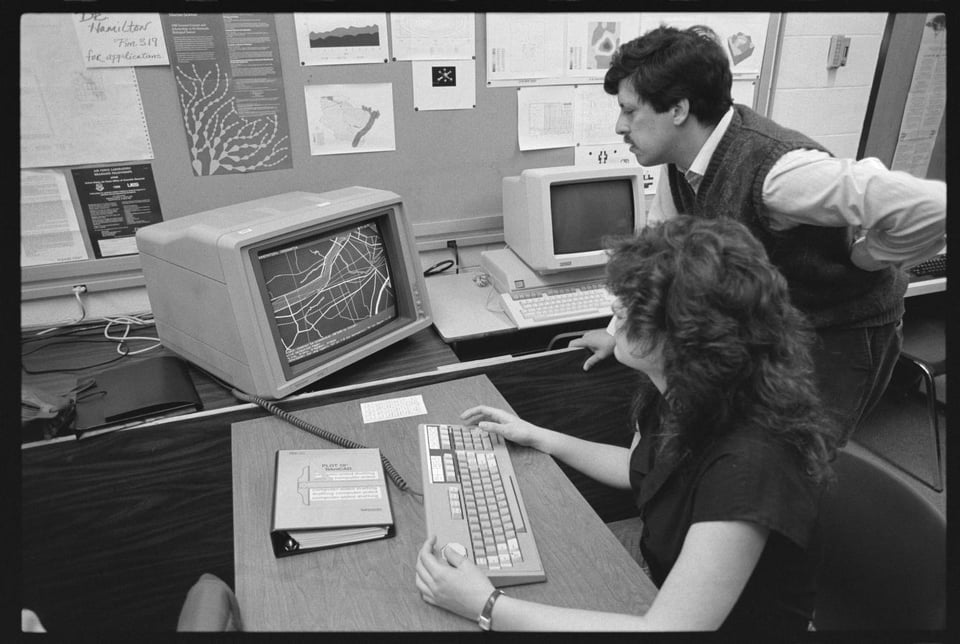
Under capitalism, we are all supposed to be aspirational and work to advance in our "careers." In a way, the career became an easy replacement for marriage in our amorphous social hierarchy, probably starting around the 1970s, when it started becoming more common for married women to work outside the home in the US. We tend to talk about people who have dead-end jobs with the same pity as we might have talked about an unmarried 40-year-old spinster in the early 20th century. Work can certainly be fulfilling for many people (I even like my day job most of the time myself!). When Taylor talks about the "loneliness epidemic" and presents sex as an easy solution, I think she wants it to come off as sex positive, but it really comes off as dismissive of the material conditions that might cause someone who wants to have sex to not be able to find a fulfilling sexual or romantic partner and thus find further richness and fulfillment in their life as a whole. Working a dead-end job for little pay and shit benefits in a soulless suburb can certainly lead to depression, anxiety, and reading each Tinder bio in a 50 mile radius like it's a pre-apocalyptic artifact discovered by the antiheroine in an Aldous Huxley novel:
#2
February 15, 2023
Read more

men as grifters not as people

Something my wife and I talk about a lot is how we are glad we are not in a position where we have to pursue dating again -- especially the possibility of dating straight cis men. Both of us are bisexual, and we are still attracted to men, but the practical process of engaging with them in society poses challenges. Any queer person could be forgiven for thinking there are two versions of reality: the queer one, where gender and sexuality are fluid and beautiful and whatever you want them to be, and the cisnormative, heteronormative one. The longer you're in queer space, the harder it is to return to the level of rigidity imposed by a cishet-normative world. In short, it's why "are the straights okay" has become its own meme. 

This is a long way of saying that it has been extremely fun for me to re-frame my attraction to cis men as a fantasy rather than something that exists in reality, and I think this says a lot about how masculinity currently functions in Western society. This is a period during which trans and queer visibility is more common and mainstream than ever before on a global scale -- which is of course why there is also a rabid group of assholes in various Western countries trying to restrict our rights, paint us as dangerous pedophiles, and prevent trans kids and adults from receiving transition care and basic human dignity. They are terrified, of course, because as trans and queer people become more visible, all gender constructs and are being openly challenged. Masculinity is being re-framed as something more tender, more fun, more loving, and something that everyone can have a part in if they so choose. We are living in the modern golden age of masculinity as performance.

One of the great joys my wife and I share is consuming narrative fiction, and there is a type of male character in media that appeals to me on a very basic level. I call him "the sincere grifter." This is a man who lies and manipulates, and who knows he's lying and manipulating, but is doing it for very personal reasons or sincerely held beliefs. The existence of this type of character pops up a lot in television in the 2000s and 2010s, but his origin story is everywhere throughout history if you look for it.

The rise of the sincere grifter in fiction in recent decades was, in retrospect, a harbinger of the ways in which "traditional masculinity" and gender roles were about to be disrupted. Queer culture is hardly new, but its mainstreaming is. And the sincere grifter shows us the cracks in cishet rigidity, because to him, masculinity has to be part of his performance, or part of the armor he wears to shield himself from pain, and he does this consciously and with intent.

#1
December 7, 2022
Read more
Powered by Buttondown, the easiest way to start and grow your newsletter.