
Notable Sandwiches #146: Peameal Bacon

Welcome back to Notable Sandwiches, the feature where my editor David Swanson and I eat our way through Wikipedia’s List of Notable Sandwiches. This week, David investigates a Canadian icon: peameal bacon.
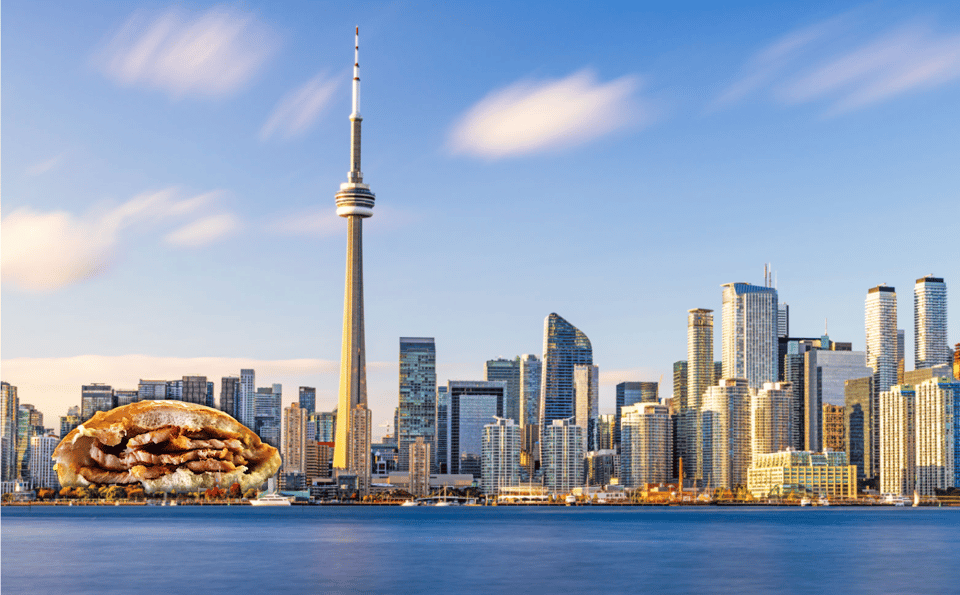
Barbra Streisand wanted a sandwich. It was October 23, 2012, and the legendary singer was in Toronto to perform in front of 20,000 adoring fans at the Air Canada Centre. That Streisand wanted a sandwich wasn’t so surprising: she has long taken the subject seriously. In her 2023 memoir, My Name Is Barbra, she wistfully recalls road trips across the American West with her husband James Brolin behind the wheel: “We'd buy the fixings for sandwiches and I'd make them on my lap as Jim drove.” The following year, she told Stephen Colbert that her favorite sandwich was turkey on rye with coleslaw and Russian dressing. Most notably, she concludes her memoir with a modest philosophy on life: “No matter who you are, you can only eat one pastrami sandwich at a time.”
But in Toronto that night, pastrami wouldn’t do. Streisand wanted peameal bacon, a north-of-the-border specialty. What, you may be asking, is so special about a Canadian bacon sandwich? It’s a story of evolution, economics, etymology, immigration, and identity.
The first thing to know about Canadian bacon is that, in Canada, at least, there’s really no such thing. In Canada you can find back bacon, side bacon, gammon, streaky bacon, Wiltshire bacon, Ayrshire bacon, and peameal bacon—arguably the most Canadian of all. The term “Canadian bacon” originated in England, where imported back bacon from Canada was labelled to distinguish it from the local stuff. What we in the United States call Canadian bacon is different. Most recognizable on traditional eggs Benedict or in an Egg McMuffin, it is made from the same lean loin but is cured, smoked, and sold fully cooked, a bit like ham. Peameal bacon is something else again. The loin is brined but left unsmoked, rolled in a golden coat of coarse cornmeal and sold raw, to be sliced and fried. So what Americans call Canadian bacon is not what Canadians call Canadian bacon, because Canadians don’t call anything Canadian bacon.
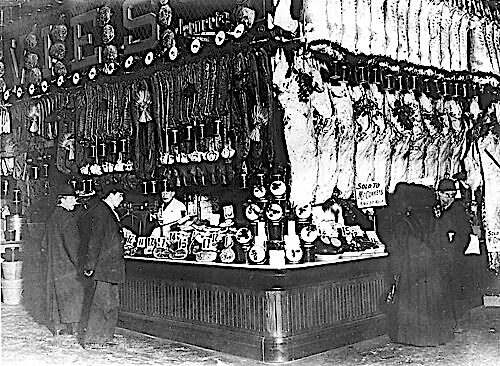
There’s a certain strange symmetry and circularity to all this, and it starts with William Davies, the inventor of peameal bacon. Davies was twenty-one—an Englishman already practiced in the arts of butchering and curing meat—when he arrived in Toronto in 1854 and opened a stall in the St. Lawrence Market. What caught his attention in his new home town were the hogs. Local farmers often fed their hogs on peameal, a protein-rich diet that produced lean, firm meat. Davies recognized that these were some terrific pigs, and rather than compete with the Americans in the burgeoning salt-pork trade, he went after the more discriminating British market for bacon and ham. In 1860, he sent a case of cured pork to his brother in England, who sold it to wholesalers at London's Smithfield Market. The following year, he opened a curing and smoking facility at Front and Frederick Streets in Toronto, specializing in the premium meat he marketed as “Pea-Fed.” Business boomed. By 1875, Davies was processing some thirty thousand hogs a year; by 1888, over eighty thousand, more than all the other pork packers in Ontario combined.
The Sword and the Sandwich is a newsletter about serious extremism and equally serious sandwiches. Please consider supporting this work with a paid subscription:
Then, in 1890, American politics entered the picture. The steep McKinley tariff effectively shut Canadian grain out of the American market, sending the price of barley, wheat, and other cereals plummeting. But Ontario farmers soon discovered that, instead of going to market, their near-worthless grain could instead be fed to a pig and exported, profitably, as pork. Hog production surged, with farmers increasingly favoring a leaner, longer animal—the very sort of pig on which Davies had built his fortune. There was another reason the economics worked so well: among livestock, the pig is an engine of efficiency. It’s omnivorous, prolific, and compact—the nearly perfect machine for turning the surplus of a farm into food that can be stored, shipped, and sold. As the pigs note in George Orwell’s Animal Farm, all animals are created equal, but some are more equal than others.
Davies had built his business around this proposition: Britain wanted bacon; Ontario had cheap feed and an abundance of pigs; Davies had the infrastructure to connect the two. By 1900, the William Davies Company was exporting more than four hundred thousand hog carcasses a year to Britain and was said to be the largest pork-packing concern in Britain: Toronto had become the butcher to the Empire. The hordes of pigs driven into the city helped give it a nickname, Hogtown (also a nickname for Cincinnati, but Toronto takes the Hogtown prize). And in the city of hogs, Davies is credited with inventing its signature pig-based food: peameal bacon.
About that name: According to most (dubious, self-repeating, and probably untrustworthy) sources, peameal bacon got its name because the cured loin was originally rolled in ground yellow peas to help preserve it. At some point, the peameal was replaced by cornmeal, but the old name stuck. It’s an easy explanation, and has been repeated so often that it’s hardened into fact—in the way of the many, many food myths we’ve busted in this newsletter over the past years. As a result, I’m jaded enough to be skeptical of a claim that makes superficial sense, but seems to have no basis in contemporaneous documents.
The earliest reference I’ve found to peameal bacon is an 1894 advertisement for MacWillies’ “Peameal Breakfast Bacon,” described as “superior in sweetness, flavor and tenderness to any other bacon.” A newspaper story in 1896 advises readers that those “who are accustomed to cornfed pork will enjoy a taste of peameal ham or bacon.” Another story from two years later hails peameal bacon as “cut from pea-fed hogs solid, nicely streaked.” (Pea-fed, here, echoes descriptions of corn-fed American beef: animals fattened on delicious, wholesome legumes, and thereby doubly fit for the table.) From then on, references to peameal bacon occur frequently in the Canadian press, but what, precisely, the peameal signifies is never stated. Meanwhile, contemporary accounts of William Davies and the Toronto pork trade repeatedly mention pigs fed on peas or “peameal.” Given that bacon itself once referred to the part of the animal from which the meat was taken, could peameal bacon have begun not as a description of how the pork was dressed but of how the pig was raised?
(There is, appropriately enough, some confusion as to the word bacon itself. Etymologically, it’s a question of anatomy. The word originally meant meat from the back of an animal and descends from the Germanic bak-, the same root that gave English the word back. From there it passed into Frankish as bako, then into French as bacon. The English borrowed it in the twelfth century, when it was used to describe a whole side of cured pork. Within a couple of centuries, the meaning had broadened further: bacon was no longer merely a specific cut—the back—but the cured meat itself.)
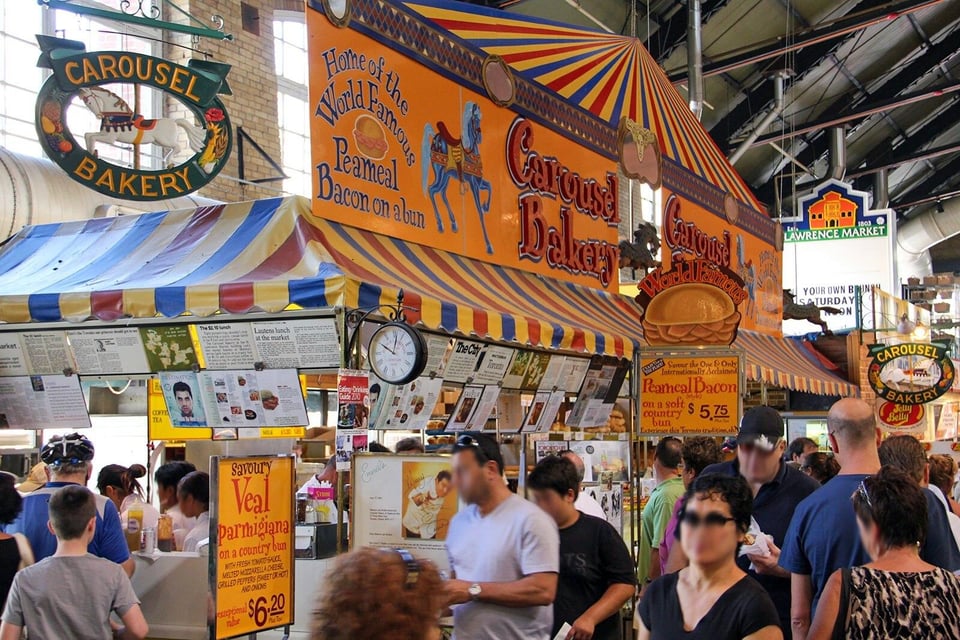
Whatever the origins of its name, the peameal-bacon sandwich became a Toronto institution largely through the efforts of Davies and another immigrant. In the nineteen-fifties, Elso Biancolin was working at Brown Brothers Butchers, in the St. Lawrence Market—the same teeming warren of food stalls where William Davies opened his first butcher shop—when he noticed that customers asking for the center cuts, leaving the ends behind. Biancolin put the scraps on a bun. In the sixties, he and his wife took over the neighboring Carousel Bakery, and their sons later made the sandwich its centerpiece: thick slices of cornmeal-flecked bacon, cooked on a griddle and piled onto a roll. Over the decades, Carousel became an institution, and the peameal bacon sandwich an icon. On that night at the Air Canada Centre back in 2012, Barbra Streisand sent a member of her team to Carousel to pick up an order. A few years later, Toronto Mayor John Tory proclaimed it Hogtown’s signature dish.
What’s so special about a peameal bacon sandwich, and why was Streisand so eager to try one? As previously noted: the woman knows her sandwiches. In addition to pastrami, turkey, and truck-stop, her memoir discusses grilled cheese (“nothing better”), PB&J, bologna, egg salad (which she threw up), roast pork (“my favorite”), chicken (“delicious”) ham and cheese, club, and English tea sandwiches. In total, there are more than 30 references to sandwiches in the book (which, to be fair, is a door-stopping 992 pages long.) Alas, peameal bacon doesn’t come up, but I get why she was so eager to sink her teeth into the Toronto staple. I like to think the explanation lies in the fact that one immigrant butcher’s solution to an overabundance of cheap grain and another immigrant butcher’s solution to a pile of unwanted bacon scraps became a symbol of Toronto. And for a world-historical diva with a taste for elite sandwiches, what could be more glamorous than one dressed in a golden coat?

-
What a lovely and well-informed entry. One question, though: What do you mean when you write, “Toronto, as a world capital…” Obviously, we’re the provincial capital for Ontario, but I would have thought that the only “world capital” in Canada would be Ottawa. Or are you merely referring to our status as pork producers?
-
thanks for the catch—that's been fixed
-
I need to try a Peameal Bacon sandwich!
Reply: