
Notable Sandwiches #147: Zapiekanka

Welcome back to Notable Sandwiches, the feature where my editor David Swanson and I eat our way through Wikipedia’s List of Notable Sandwiches. This week, we’re back with a mushroom-packed, open-faced Polish icon: Zapiekanka. But don’t worry—now that we’ve come to the end of the alphabet, we’ll be circling back and returning to our previously scheduled programming.
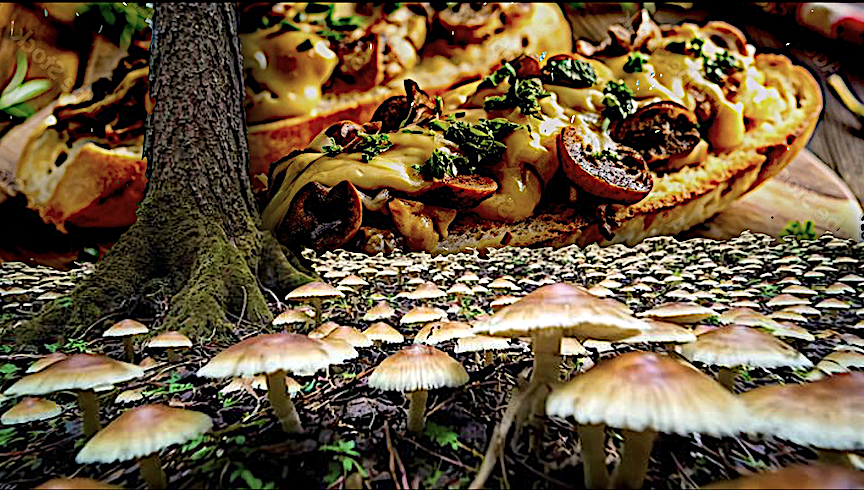
In so many stories, across different lands and languages, the tale is the same: the hero (a maiden, an orphan boy, a prince, a knight) goes into the forest, and comes out changed.
They walk into the woods for many reasons. In the Polish tale of the bear in the forest hut, a girl is driven out by her father into the depths of the forest to die. She returns a rich woman, wedded to a king she freed from a curse. In another Polish tale a prince enters a forest, and finds in a dead hermit’s hut treasures that make him invincible. In another, three princely brothers go to gather berries in the forest; two of them murder the third, and from his grave grows a cherry tree, and a man makes a quill from its bough, and the quill tells the story of the murder in a human voice.
You go into the forest, and something shifts, and something changes, and you are never the same again.
Many folktales from Poland involve the forest; the country is 30% forested, and over the centuries, those woods have seen many secrets, and been scarred by many wars. The forest is the site of many treasures: foraging for berries and mushrooms has been a national hobby for centuries, and often a lifesaving one in times of hunger. The forest also contains perils: beasts and poisons under the dark trees. Slavic legends about leshy—tutelary deities of the forest—evince the dual nature of journey into the forest. “Depending on the tradition, Leshy can be either a malevolent trickster, leading travellers astray and inducing madness through eerie whistling; or a benevolent guardian and steward of the forest, protecting it from harm while helping lost wanderers find their way home and filling children's baskets with berries,” write three Polish scholars in a paper entitled “The Invention of the Leshy.” In one Polish folk song for children, dwarves welcome children into the forest, announcing they can be found under the red caps of mushrooms.
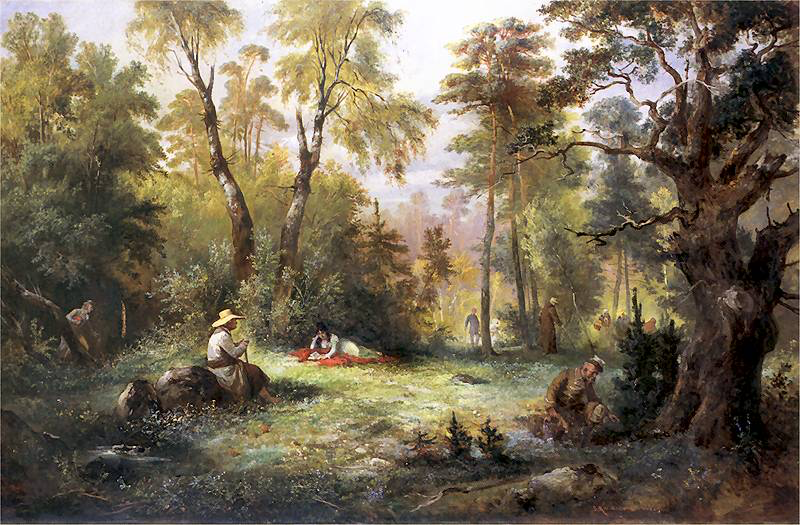
Mushrooming—what the Polish national poet Adam Micziewicz called “the ancient and decorous rite of the mushroom hunt” in his 1834 epic poem “Pan Tadeusz”—is serious business in Poland; wild mushrooms—chanterelles, porcini, saffron milkcaps—feature heavily in traditional dishes. In her memoir The Hunger Book, Agata Szczeszak-Brewer describes it as a national obsession: “Step into a forest anytime in September and you will see hordes of people carrying wicker baskets, metal pails, and discount-store plastic bags to their secret mushroom spots.”
It’s generally recommended to arrive at dawn after any heavy rainfall, so you’ll still get a share of the mushrooms that have sprung up overnight. Szczeszak-Brewer describes how gathered mushrooms formed a necessary complement to scanty food rations. All year round, strings of dried mushrooms hung over the radiators. “Those fungal garlands sitting on radiators helped us during harsh winters,” she writes. “They smelled of soil, moss, and wet leaves.” Later on in Szczeszak-Brewer’s childhood, her mother, an addict, attempted suicide by poisoned mushroom.
You enter the forest and you’re changed: your hunger is alleviated, or you come face to face with death. Walk long enough in the woods in Poland and you will see a scar from the blood spilled here: a trench, a bunker, a grave. When you walk out again into the sunlight with a wicker basket full of chanterelles and you go home, unaware of any change, and you may find it later: something restless moving under your breastbone like the dappled light shifting under heavy old oaks, slim birches, over dead leaves and the new roots beneath.
The Sword and the Sandwich is a newsletter about serious extremism and equally serious sandwiches. Please consider supporting this work with a paid subscription:
During the 1970s and ‘80s of Szczeszak-Brewer’s childhood in Communist Poland, hunger coexisted with a new, tentative openness to Western goods and private enterprise. The newly elected leader of the Polish Communist Worker’s Party, Edvard Gierek, spent much of his childhood in France after his father died in a coal mine in southern Poland; deported back to Poland after becoming a Communist agitator in the collieries of France and Belgium, Gierek retained a deep affection for France after coming to power in his native country. (A 1980 Time magazine profile described him as a “natty dresser” who “rarely misses an edition of the Paris daily Le Monde”).
After a long period of Communist austerity under his predecessor Wladyslaw Gomulka, Gierek took advantage of the Soviet Union’s relatively friendly disposition towards Poland to begin a campaign for Western trade and goods. This included courting Fiat factories from Italy, bringing Coca-Cola to Polish shelves for the first time in 1972, and integrating French aid into a newly expanded bus system—and, apocryphally, bringing the baguette from Paris to Poland.
At the same time, Gierek’s decade of financial misrule led to a ballooning national debt and an economic slump that compelled Poles to seek cheap eats and side hustles. Along with an active courting of contact with the West, the 1970s were a decade that allowed limited private enterprise: a concatenation of street stalls, food trucks and small restaurants known collectively as Poland’s “little gastronomy.” These often reflected a desire to recreate Western food with limited local ingredients and expertise: Poland’s first pizzeria opened in Słupsk in the 1970s, although this mostly meant savory waffles with cheese and ketchup.
A hybrid of both tendencies, the zapiekanka is a half-baguette with savory toppings, cheese, and ketchup. Despite the limited openings presented by the ‘70s, meat was still tightly rationed and difficult to obtain. The cheapest and still most common zapiekanka topping is the humble mushroom; the first zapiekanki, sold out of bars in Warsaw, were cheese toast served with a hash of button mushrooms.
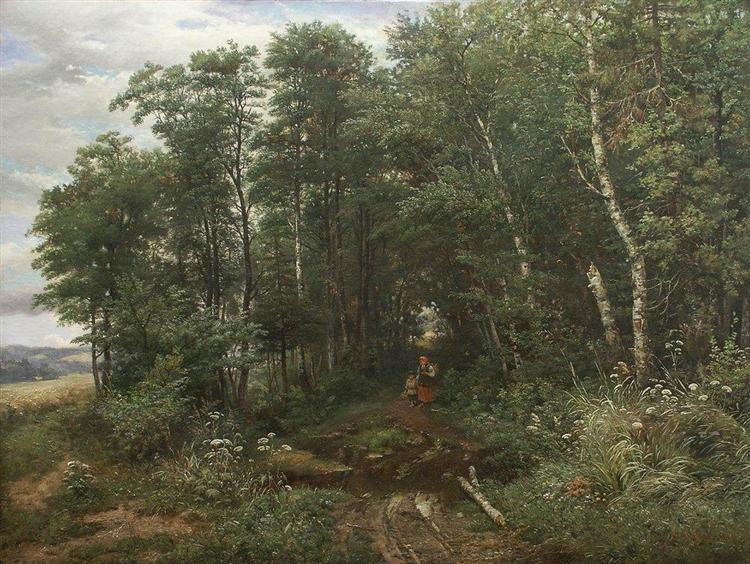
The humble sandwich was a star of streetside stands and the small restaurants that popped up in the final decades of the Polish People’s Republic. After the fall of the Soviet Union, it was eventually displaced to a significant degree by Western chains like McDonald’s, but you can still buy zapiekanki from Warsaw to Wroclaw, Krakow to Katowice, with a variety of toppings (including modern vegan variations). The mushroom-and-cheese baguette, a dirt-cheap product of poverty and austerity, is the classic form of the zapiekanka—and its availability even under austerity measures points at the significance, and endurance, of the Polish love of mushrooms.
Mushroom cultivation took off in Poland in the 1950s, in a period of hunger and confusion for the country. “Until relatively recently, there was a political and economic system that was not conducive to the development of areas that raised the standard of people's lives,” one Polish mushroom grower wrote in a speech to the pan-European Mushroom Grower’s Association (GEPC). “What mattered was the production of coal and steel, needed to produce tanks.”
Still, mushroom cultivation exploded over subsequent decades until Poland became the largest producer in Europe, provided much-needed foreign currency to Soviet Poland; at home, mushrooms served as a means to add savor and heft to meals during decades in which meat was closely rationed. And there was always the option to go into the forest with your wicker basket, as Poles had always done—during war, under the Tsar, under Lenin, Hitler, Stalin—and come back with food for your family. Sometimes enough to chop up and add to the sandwich sold at your street stall. Sometimes just enough for a pot of stew. The forest changes you: it alleviates hunger. The forest changes you: you keep going back.
The Polish poet Czeslaw Milosz uses a forest as the central image in his poem “Fear,” in which a childish voice cries out, first apparently to its father—“Father, where are you? The forest is wild,/There are creatures here, the bushes sway." By the end of the poem, the forest has become the site of bitter bread and starvation, and the beast is sulfurous, and the voice is crying out to God. “Where have you gone, Father? Why do you not pity/Your children lost in this murky wood?” In another poem, “With Trumpets and Zithers,” about the clash between the universal and the specific in literature, Milosz places the forest at the center of the collective unconscious of humanity.
“The dream shared at night by all people has inhabitants, hairy animals.
It is a huge and snug forest and everyone entering it walks on all fours till dawn through the very thick of the tangle.
… The “I” is felt with amazement in the heartbeat, but so large it cannot be filled by the whole Earth with her seasons.”
At the end of the dream, humans revert to two legs, but continue to yearn for the forest home only accessible to them while sleeping. The forest is in us, gave birth to us, and we want more than anything to return.
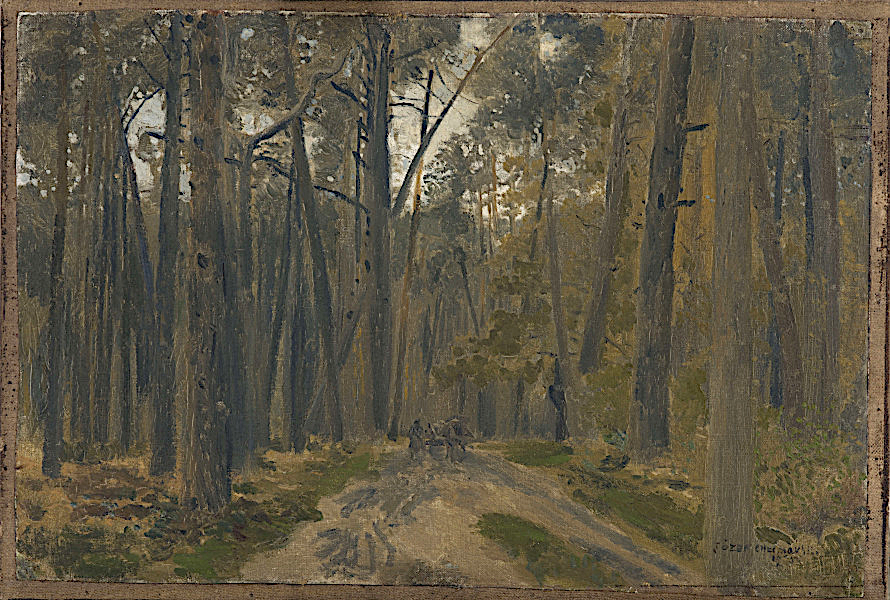
But you can’t go back to where you were before the journey; you can only go on from where you are now, knowing what you know now, in all its fullness. During the journey you found a berry, a talking bird, a cursed bear, a tutelary spirit. You return richer or poorer or don’t return at all, but you can’t go back unchanged. If this little story is a journey, you’ve completed it, and it has changed you at least a little; you can return to the beginning, but it won’t be the same person reading, nor the same book twice.
There are magic books in stories like that: but every book is like that, really. Hour to hour and tree to tree we shift as we live; scars accrue on us and in us; knowledge and the shadow-knowledge of the unconscious gather in us. We arrived at zapiekanka together, though, with basket in hand: we were open to what we could gather. The basket is full now. Turn back, and when you go home, find out again who you are.

Add a comment: