
Notable Sandwiches #148: Peanut Butter and Pickle

Welcome back to Notable Sandwiches, the feature where my editor David Swanson and I eat our way through Wikipedia’s List of Notable Sandwiches. This week, David takes a look at a strange entry with a split personality: peanut butter and pickle.
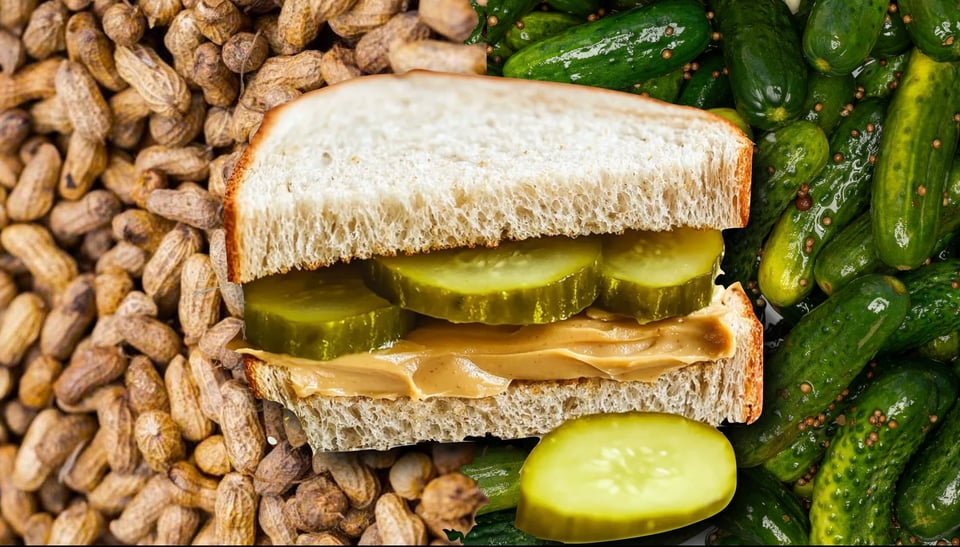
In 1922, a public-relations man named William Clendenin delivered an address, “The Story of Pickles,” to the Women’s National Health Association. The speech offered a history so filled with plausible falsehoods that many have passed into the realm of so-called fact. Julius Caesar and Cleopatra loved pickles, Clendenin assured his listeners, as did Napoleon and George Washington. “Queen Elizabeth and Catherine the Great were both amiably disposed to the pickle. Oliver Cromwell, Charlemagne, Gustavus Adolphus hardly less so,” claimed Clendenin. “Voltaire says Frederick [the Great] ate so many that he came to resemble a gherkin, his body bent at the waist, dressed in a green coat, too, cocked hat and all the similarities save the warts.” Clendenin also quoted Thomas Jefferson as saying, “On a hot day in Virginia, I know of nothing more comforting than a fine spiced pickle, brought up trout-like from the sparkling depths of the aromatic jar below the stairs of Aunt Sally’s cellar.” Jefferson, according to the authorities at Monticello, said no such thing.
Nor, suffice it to say, did Jefferson have any thoughts on the relationship between the pickle and the peanut, those strange bedfellows whose coupling gives us this week’s sandwich. We’ve written elsewhere about peanut butter’s place in sandwich history, so I won’t belabor that here. As Tal wrote in his essay on the peanut butter and jelly sandwich, “by the turn of the twentieth century, [peanut butter] had become a sufficiently well-recognized ingredient to merit inclusion in cookbooks aimed at both the highbrow and the down-at-heel kitchenista.”
Pickles are another matter—one on which Americans do not compromise easily. (Earlier this year the Times courted controversy when it convened a panel to taste forty-seven varieties of dill and sour pickles. “Our picks didn’t just ruffle feathers,” wrote Maki Yazawa, “they caused mass outrage.”) What is it about pickles? Why does a simple brined cucumber inspire such strong feelings? Over the hundred and forty-odd essays in this series, Tal and I have tried to cut a path through the thicket of culinary apocrypha that clings to so much American food history. Rarely have we been able to lay the blame so squarely at one man’s feet.
Clendenin was a pioneer in the art of spin: give a humble food a sufficiently illustrious past, and in time the legend subsumes the truth. In fact, the truth, as far as the pickle is concerned, is plenty interesting without any fictional embellishment. After all, pickling is nearly as old as civilization itself. Pickled vegetables appear in a Chinese manuscript dating back more than nine thousand years, and by the third millennium B.C., cucumbers, in particular, were being preserved in brine in the Indus Valley. The Mishnah, an ancient Jewish text compiled around 200 A.D., offers instructions on what might be pickled and when. Religious rites aside, preservation was the practical point: salt and fermentation carried the harvest through months when the earth provided little to eat.
The Sword and the Sandwich is a newsletter about serious extremism and equally serious sandwiches. Please consider supporting this work with a paid subscription:
“Through the centuries pickles have proved a welcome addition to bland, starch-rich staple diets wanting in flavour,” writes Jan Davidson in the indispensable Pickles: A Global History. “In many cultures fresh pickles have been created specifically to enliven the daily meal.” In other words, what began as a way of keeping food from spoiling had become something people actually wanted to eat. In the early modern era, barrels of brined cucumbers were a fixture across much of central, northern, and eastern Europe, where their sour, salty flavor enlivened bland winter diets heavy with bread and potatoes. By the 17th century, pickles were enough of an English staple that Shakespeare referenced them in his plays on more than one occasion. In a 1640 cookbook, the chef to British king Charles I included this recipe.
Pickles arrived in the Americas with the first wave of the age of exploration. In fact, before Amerigo Vespucci put his name on the map, he worked as a chandler in Seville, supplying Christpher Columbus’s ships with various provisions, including preserved foods—a line of work that led Ralph Waldo Emerson to dub him the “Pickle-Dealer.” By the 1700s, pickling had become big business in North America, especially in the Dutch settlements in Brooklyn, where cucumber farms flourished. “Soon New York City boasted the largest concentration of commercial picklers in America and cured cucumbers were sold from market stalls on Washington, Canal and Fulton streets,” writes Davison. Much like Vespucci, the pickle had planted its flag in the New World.
The great tide of immigration from Eastern Europe in the latter half of the 19th century helped make the pickle something of a ubiquity, at least in certain areas. “In New York, the pickle evolved into a broader symbol of the immigrant experience and cultural identity,” write Paul van Ravestein and Monique Mulder in The Pickled City: The Story of New York Pickle. This did not go over well with some of America’s the more conservative reformers and public-health officials. As Jane Zegil wrote in the Times in 2011, “Strongly flavored food, these officials believed, led to nervous, unstable people. Nervous, unstable people made bad Americans.” Few foods inspired more suspicion than the pickles being peddled in Jewish neighborhoods such as the Lower East Side, where Eastern European vendors sold various types from pushcarts. The physician and health reformer Susanna Way Dodds called the practice, “totally depraved.”
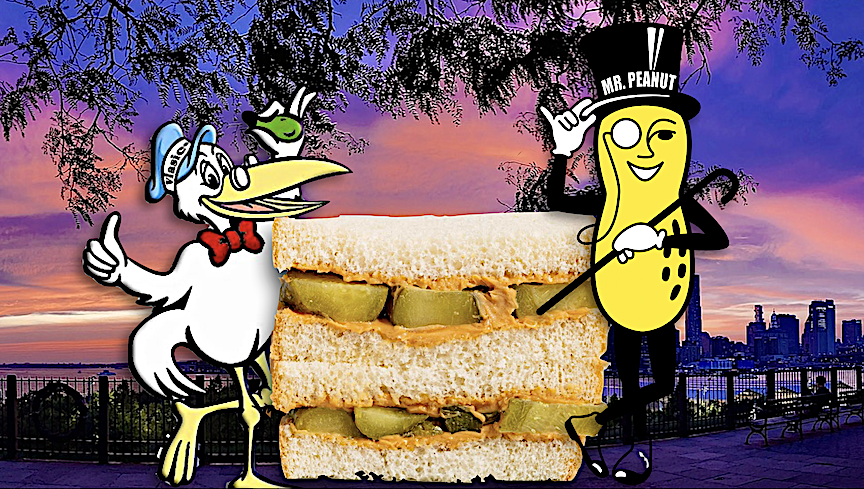
It was around this time that the pickle had its fateful meet-cute with the peanut. The earliest evidence for the peanut butter and pickle sandwich I could find comes from a 1914 Kansas City Journal notice for a Y.W.C.A. field trip: “The food will be of the peanut butter-pickle-sandwich variety, commonly supposed to go with picnics.” As Dwight Garner, the longtime book critic for the New York Times, noted in a 2012 encomium to the PB&P, it appeared on lunch-counter menus during the Depression and in cookbooks of the nineteen-thirties and forties; “a lot of people’s grandmothers used to eat them.”
Garner’s praise for the sandwich was effusive, noting “the vinegary snap of chilled pickle cuts, like a dash of irony, against the stoic unctuousness of peanut butter,” and calling the sandwich “a thrifty and unacknowledged American classic.” For years Garner’s essay remained something of a curiosity. Then, in 2018, the Times revived it on Twitter, and the public had opinions. “Haven’t we suffered enough?” one reader asked. Another prophesied that “the end times really are upon us.”
According to Garner, “suddenly, every shock jock and local TV-news host was eating it on the air to see if they could stand it, almost like a hot-pepper challenge.” Others tried it and joined Garner in his allegiance to two thoroughly ordinary American foods that had come together to become a scandal. (In 2018, when Slate’s Christina Cauterucci asked Garner whether he had managed to convert any of his friends to the sandwich, he replied, “Fuck no.”)
At Peanut Butter & Co., the cult Greenwich Village sandwich shop that Lee Zalben operated from 1999 to 2016, the PB&P went by the name “The Pregnant Lady,” a nod to that most curious of expectant-mother cravings. According to the restaurant’s cookbook, the sandwich made it to the menu after a customer, pregnant and two weeks overdue, ordered one to satisfy a sudden urge. The next day, she gave birth to a healthy boy. “Was it the sandwich that finally did it?” Zalben wondered. As Zalben told Garner, the PB&P is not quite the culinary aberration it appears at first glance. Americans tend to consign peanut butter to the sweet end of the pantry, pairing it with jelly, honey, or chocolate. In other corners of the world, peanuts are routinely paired with salt, spice, and acid, in curries, satays, and sauces. “I’d put peanut butter and pickle roughly in that tradition,” Zalben said.
But what kind of pickle, and what kind of peanut butter? Zalben’s recipe calls for white bread, two tablespoons of peanut butter—smooth or crunchy—and six slices of bread-and-butter pickle. Garner preferred Claussen pickles (“they’re crunchy and have a bright flavor”), Smucker’s unsweetened Natural peanut butter, and “whatever good bread is in the house.” He, too, began with bread-and-butter pickles, but, as he later told Cauterucci, his palate matured and he moved on to sour dills. Garner’s devotion to the sandwich, with its stoic unctuousness and ironic snap, is rivaled only by a character from fiction—“probably America’s best-known devotee” of the sandwich, as Garner called her.

“The texture of the peanut butter was a sublime contrast to the crunch of the bread-and-butter pickles.” So declares Kinsey Millhone, the flinty private eye at the center of Sue Grafton’s best-selling “alphabet” mysteries, which ran from A Is for Alibi, in 1982, to Y Is for Yesterday, in 2017. Millhone lives alone, investigates murders, and has simple tastes; her standby meal is the PB&P. In M Is for Malice, she considers the geometry of the sandwich, as well as golden ratio between its key ingredients: “The diagonal cut exposed more filling than a vertical cut would,” she observes, “and I savored the ratio of saltiness to tart.”
Millhone became so closely identified with the peanut butter and pickle sandwich that Grafton eventually felt obliged to codify it. Readers, she wrote, either recoiled from the concoction or tried it “with relatives standing by to dial 911,” only to discover that it was “strangely yummy.” She then supplied “the actual, true, unadulterated recipe for the Kinsey Millhone Famous Peanut Butter and Pickle Sandwich”
2 slices of Health Nut bread, or some whole grain equivalent
Gobs of Jif crunch peanut butter (no substitutions, please)
Vlasic sweet butter chips (again, no substitutions or we can’t be responsible for the results)
Serves one
Spread gobs of Jif crunchy peanut butter on one slice of Health Nut bread.
Place 6 or 7 Vlasic sweet butter chips on the peanut butter.
Top with second slice of bread. Cut on the diagonal.
In his 1922 speech on the glories of the pickle, William Clendenin extolled its health benefits, its culinary versatility, and its somewhat dubious place in history. One subject he neglected was sex. Perhaps inevitably, given its shape, the pickle has enjoyed a long secondary career as a… euphemism. But it took mating with peanut butter to make the thing truly erotic. For Millhone, eating the sandwich approaches the sublime. “This ranked right up there with sex without taking off any clothes,” Grafton writes. “I made a sort of low moan, nearly swooning with pleasure.”
When Millhone’s landlord asks for a bite, his verdict is considerably more restrained—and not far from my own. “Very weird,” he said, “but not bad.”

-
I can hardly believe I've never tried this. Well now I know what's for lunch today 😋
-
The absolute best sandwich. I will not be taking questions.
-
I have a very short list of things I don’t eat - aspic & pickled beets - I may take this plunge in the spirit of family solidarity and trying not to say “no, I don’t/wont try that” but I’m pretty certain it’ll be w bread n butter pickles while my wife watches in disbelief.
-
Great work! I’ve been eating pb&p since I was a kid, and I will be registering for Medicare in less than a year. I have a memory of enjoying pb&j as a kid, but I haven’t been able convince myself to eat it since I was about. I go with dill pickles (kosher or Polish), sometimes even pickled jalapeno. And yet since I was 8 I have had to defend it. My mom always told me to respond, “don’t knock it until you’ve tried it.” Almost no one ever does. I had missed the fad of broadcasters trying it, but glad to know of it.
-
Thank you so much for finally addressing my favorite go-to sandwich. My grandmother introduced me to the PB&P in the '60's and it's been a staple ever since.
Having a mature palate, my recipe is: Lightly toasted sourdough bread Room temperature PB (no sugar- I use Laura Scudders) Cold dill pickle slices, drained on a paper towel
The temperature and textural contrasts are critical to the experience, and no, I've never managed to convert anyone either.
Add a comment: