
Notable Sandwiches #145: Yakisoba-Pan

Welcome back to Notable Sandwiches, the feature where my editor David Swanson and I slip messily through Wikipedia’s List of Notable Sandwiches. This week, a carb-loaded Japanese treat: yakisoba-pan.
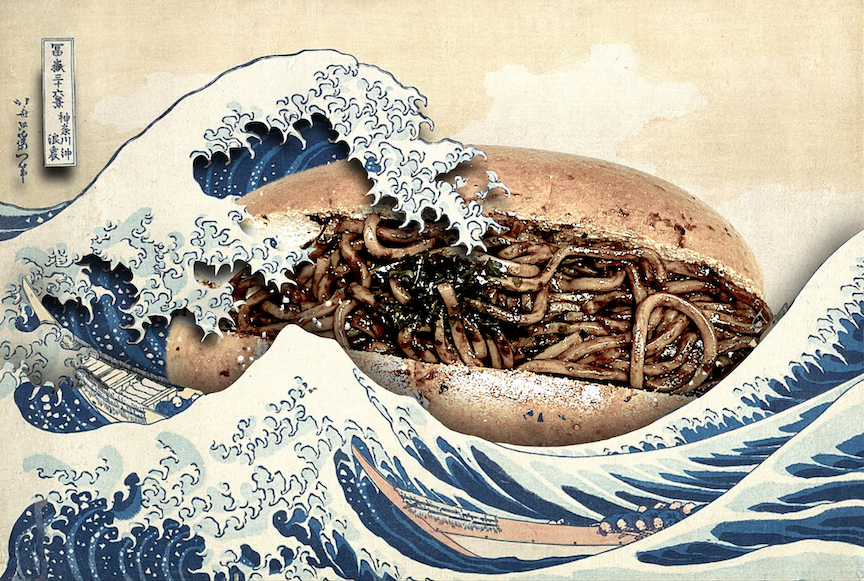
For most of Japan’s very long history, it was a nation of pescatarians and vegetarians. According to Yo-ichiro Sato, Director General, Museum of Natural and Environmental History in Shizuoka, large land mammals on the archipelago were hunted nearly to extinction during the Jomon period (ca. 14000-2400 B.C.), while domestic herds of sheep and cattle were scarce. The majority of the population took advantage of the island nation’s proliferation of river fish, mollusks, and marine life to supplement their diets. By the time rice-paddy cultivation became widespread in the fourth and fifth centuries, the foundation of Japanese cuisine—rice and fish—was laid.
Japan’s meatless diet was further reinforced by wide adherence to Buddhism, which spread throughout the nation in the seventh century; Japanese Buddhists—beginning with Emperor Tenmu, who issued a prohibition against meat-eating in 675—considered it unnecessary killing. Native Shintoism, meanwhile, considered meat-eating an impure defilement. In subsequent centuries, monks adapted fully vegetarian cuisine to an art, the exquisite—and fully plant-based—shōjin ryōri, which combined religious austerity with aesthetic refinement to create plates that were both minimal and beautiful. Among the non-elite, fish-eating remained widespread, and included the development of fermentation, salting, and other preservation efforts, such as wrapping fresh fish in astringent persimmon leaves.
Meat-eating features in premodern Japanese texts as primarily medicinal: wild boar, for example, was believed to be a cure for organ diseases, while fox meat had the potential to cure boils. Falconry was a popular, if expensive, pastime for the samurai nobility, particularly during the Tokugawa shogunate (1600-1808), when the sport of hunting geese, ducks, and swans with tamed birds of prey was permitted on specifically designated lands. Outside these limited contexts, for more than a millennium, Japanese cuisine both high and low focused on seafood, vegetables and grains, utilizing every part of the fish or shellfish in everything from fermented fish sauce to delicate sashimi.
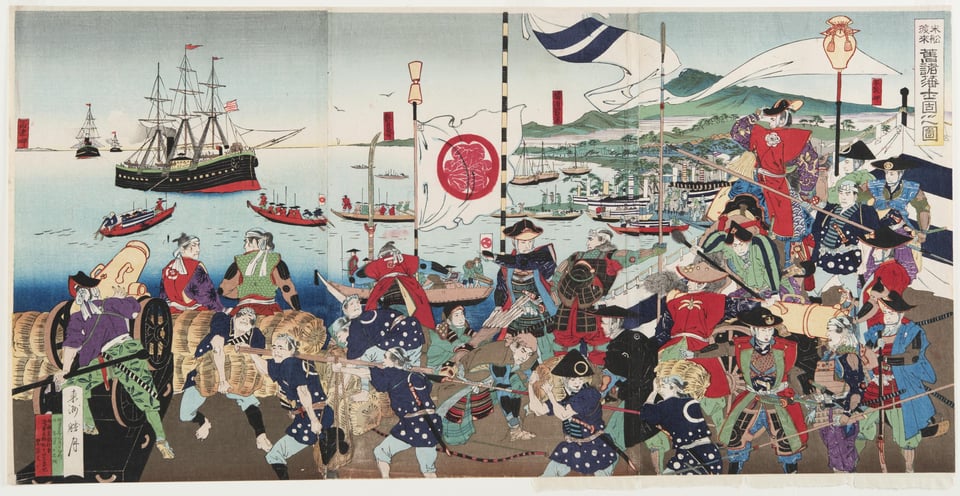
This long culinary history changed abruptly and dramatically during the Meiji Restoration—a complex period in Japanese history which began in the latter half of the nineteenth century. It was kicked off by an American commodore named Matthew Perry who showed up circa 1854 with a fleet of warships and decreed that an isolationist and socially stagnant Japan open up for trade—or else. This led to a series of agreements with western countries so lopsided their literal historical name is the Unequal Treaties; the downfall of the Tokugawa shogunate and the restoration of imperial rule and emperor worship, beginning under Emperor Meiji; and a stunningly rapid blitz of industrialization, urbanization, Westernization, technological advancement, and the eventual expansion that led to the Japanese Empire and, ultimately, its downfall in a cloud of nuclear fallout.
Included amongst the Meiji-era reforms was a lifting of a ban on consuming red meat. Meiji, in fact, announced that he had eaten beef in 1872, effectively imploding a twelve-hundred-year taboo. This opened the floodgates for dishes from meat-obsessed Europe and America, in addition to dishes from China and Korea. Emperor Meiji linked meat-eating to Japan’s rising militarism, insisting that the animal products featured so heavily in Western cuisine would create a stronger and more militarily capable populace.
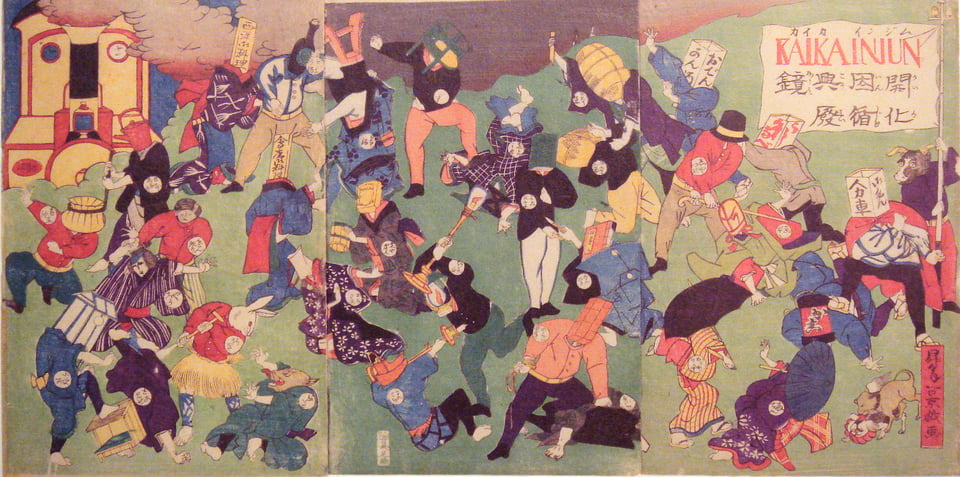
Scrambling to keep up with imperial policy and adapt to radical changes in diet, native chefs invented yōshoku, Japanified Western cuisine (the word yōshoku first appeared in print in 1872.) Veal cotelettes, a mainstay of French cuisine, became Japanese katsuretsu, which in turn became the panko-battered katsu served at elegant restaurants and street-corner diners in rapidly expanding Japanese cities at the fin-de-siecle. Western cuisine was served in railway dining cars, promoted in cookbooks aimed at middle-class women, and served as a status symbol for national elites; while the poet Kyoshi Takahama emphasized the alienness of “dark-colored, hard meat” served atop a white plate in 1897, other cultural elites embraced the new and thrilling aspects of Western cuisine. At the same time, a newly porous Japan began admitting more and more immigrants from a politically unstable China, and some of the expanded population of immigrants served as street vendors, providing meat-based meals to a Japanese urban populace at cheaper price points.
Two things really pushed meat—and a homogenization of Japan’s previously heavily regional cuisine—into the mainstream. One was the army, an increasingly important part of a Japan with international military ambitions. The Imperial Japanese Army was established by means of universal national conscription, requiring all eligible men between the ages of 17 and 40 to serve in the military. By the 1920s, following military excursions against China, Taiwan, and the Soviet Union, Japan had a standing army of some 300,000. But every army marches on its stomach, and with the newly expanded army came a newly urgent need to feed acceptable rations to men conscripted from all over Japan’s archipelago.
For many newly drafted peasant sons, the military was their first encounter with any form of non-traditional gastronomy. Discontent among the troops with unfamiliar preparations of traditional Japanese dishes was so intense that, in the 1920s, the army reorganized its menus entirely, to focus on Western and Chinese food. “Curries, croquettes and Chinese stir-fries introduced on a large scale during the 1920s turned out to be the best solution for making the taste of military menus agreeable to the majority of conscripts, since at the time the men were still equally unfamiliar with Western and Chinese food,” observed the culinary historian Katarzyna Cwiertka in the Asia-Pacific Journal. “By serving foreign foods that were new to all recruits, army and navy cooks not only helped to level regional and social distinctions in the military, but also speeded up the process of nationalizing and homogenizing food tastes in Japan.”
At the same time, newly developed mass communications—radio programs and, eventually, television—offered Japanese households recipes that used meat. Yakisoba—a stir-fry of pork, vegetables and noodles—first appeared in Chinese-run eateries in Japan around 1918; it spread in popularity in part thanks to a steep increase in the price of rice during World War I, which led to riots throughout Japan. By the 1930s, Chinese-style wheat noodles served with meat were fixtures in Japanese cities. Yakisoba flavored with Japanese-style Worcestershire sauce, a yōshoku condiment, became a regional specialty in Tokyo.
Yakisoba-pan—the sandwich that evolved from the street noodle dish—is a simple proposition: fill an American-style hot dog bun with yakisoba, and sell it everywhere from school canteens to convenience stores. But just as yakisoba was born out of profound change—the ripping open of a previously isolated Japan to the world, and the dissolution of a thousand-year taboo on eating meat in the process—yakisoba-pan was born out of an even more profound moment of national crisis.
The success and subsequent implosion of the Japanese Imperial Army, during the protracted, brutal and terrible Pacific Theater of World War II, left a nation in shambles. For the last two years of the Pacific War and in the years immediately afterward, Japan, humbled before the world, suffering the aftereffects of history’s first nuclear bombs, was also plagued by famine. Food production declined steeply during the last years of the war, and everywhere people were starving. From 1945 to 1952, the US occupied Japan under the administration of General Douglas MacArthur, enacting a sweeping series of military, social, political and economic changes to a devastated nation. But for the purposes of this essay, what matters most is the food aid—and the type of food aid—administered by Americans to a starving Japanese population.
Rice and fish were scarce after an abysmal 1945 harvest, but the US, which had a wheat surplus, issued care packages and rations to Japanese citizens, and flooded Japanese markets with cheap flour. It was a final alienation from the rice-and-fish bedrock of Japanese cuisine. US-provided school lunches were milk and a bread roll, and wheat, meat and dairy, the cornerstones of US cuisine, formed the majority of rations sent to Japanese citizens facing starvation. As a result, food in Japan changed profoundly.
Wheat-based udon noodles became a primary meal; the word ramen, referring to the familiar pliant, thin noodles that would later storm the world, was first recorded in 1947, a Japanization of the Chinese dish lamian. As the Otafuku sauce company—which offers gallon jugs of yakisoba sauce—puts it in their light, euphemistic page on the history of yakisoba, “after the war (from 1945 onward), noodle culture spread across Japan as people returning from overseas battlefields—particularly in China—brought back new culinary influences.” (The Sino-Japanese conflict was protracted, brutal, and marked by an astounding array of war crimes, from the Rape of Nanjing to what the scholar Edward Drea calls an eight-year campaign of "plunder, arson and widespread killing that characterized Japan's occupation of vast sections of China." But there were also, as in any moment of historical importance, meals: there was blood, and there were noodles, and the returnees to Japan brought both back.)
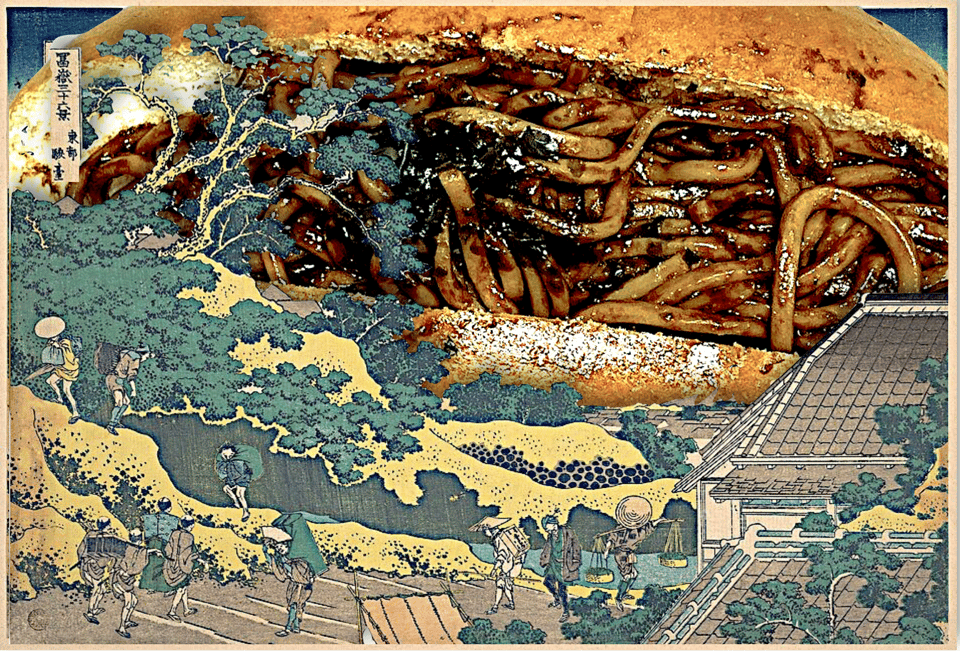
In the postwar years, black markets administered by criminal gangs and patronized by hungry, desperate citizens offered wheat-based noodles to the masses; ramen, udon, and soba were the foods of hunger and desperation for the postwar generation. But by the 1950s, under a new government and in a new era of prosperity, the food of desperation became part of a new era: a Japan thoroughly integrated with the modern world, stripped of imperial ambition but in the grips of an economic boom that would skyrocket for decades and astound the world. Yakisoba-pan—an American hot dog bun filled with Worcestershire sauce-doused wheat noodles—is a symbol of this era, and a herald of what was to come. Under the duress of war and then the explosion of commerce, yōshoku took on new forms adapted for an age of convenience: take-home curry packs, frozen croquettes, instant ramen noodles, and yakisoba-pan stands on the streets of postwar Tokyo, serving up hot griddled noodles in buns to the office-bound workers.
Born out of privation and buoyed by success, yakisoba-pan embodies the buffeting of a nation by external and internal change, and the way the dramatic swerves of history land softly on tables. Nowadays, you can get yakisoba-pan at bakeries like Koppe Tajima, which has branches from Kyushu to Okinawa and all over Tokyo; it’s served soaked in yakisoba sauce, between the glossy halves of a soft-crumbed bun, for 320 yen (roughly $2). As a package, it’s as close as you can get to a symbol—albeit a humble and rather cheap one—for centuries of change, some catastrophic, some simply profound, for a nation that continues to shift in a new millennium.

-
This was great! I learned so much.
-
The Sword & the Sandwich always delights. Thanks for another great issue!
-
Having lived in Japan for several years and visited afterwards, I found this article fascinating. In May, for example, I visited the capital city of Udon -- Takamatsu. In addition to their famous bonsai culture and artisanal laquerware production, their freshly prepared noodles -- topped with fried kobocha squash --- were a highlight.
-
Amazing! Thanks for a history lesson I never knew was out there!
Add a comment: