
Notable Sandwiches #144: Welsh Rarebit

Welcome back to Notable Sandwiches, the feature where my editor David Swanson and I slip messily through Wikipedia’s List of Notable Sandwiches. This week, a curiously-named Cambrian specialty: Welsh rarebit.
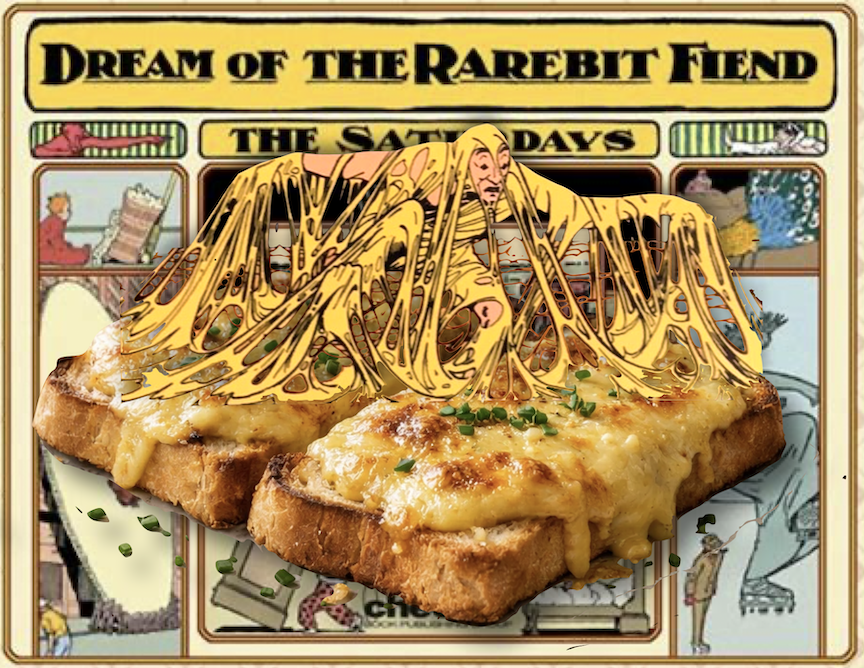
The first thing to note about the Welsh rarebit is that it’s a cheese sandwich. No rabbits, or indeed rarebits, are actually involved: the dish incorporates a thick cheese sauce, enriched with ale or Worcestershire sauce or mustard, broiled on toast. There’s no meat whatsoever. In fact, the very meatlessness of the dish is probably the origin of its curious moniker, which is the most notable thing about what is, essentially, just another variant on cheese toast.
Most sources agree that “rarebit” is a weird corruption of “rabbit”; the name is therefore a joke on the Welsh, who are supposedly either so frugal or so impoverished that they can’t afford the real thing, and must make do with cheese. Apparently, there’s nothing that adds savor to cheese toast quite like making fun of the Welsh. (The term for this is a regional dysphemism; laverbread, a paste made out of seaweed, is sometimes called “Welsh caviar”; bull testicles are “Rocky Mountain oysters”; blowing a derisive raspberry is a “Bronx cheer.” Syphilis, despite originating in the New World, has in one nation or another been named for the French, the English, Neapolitans, Castilians, Christians in general, and, in India, Hindus and Muslims named the disease after each other.)
Welsh rabbit is infinitely more pleasant than syphilis, but proportionate to its impact, it’s almost as well documented. Amid the frequent paucity of sandwich-related records, historical attestations of the Welsh rabbit/rarebit are surprisingly robust. It’s first mentioned in the eighteenth century, under the name “Welsh rabbit,” in the 1747 smash-hit cookbook The Art of Cookery Made Plain and Easy, by London dressmaker and bastard Hannah Glasse. The Welsh rabbit a la Glasse is quite simple: “Toast the bread on both sides, then toast the cheese on one side, lay it on the toast, and with a hot iron brown the other side. You may rub it over with mustard.” (The book has variants on the dish: English rabbit adds a tin oven and red wine; Scotch rabbit, even more parsimonious, omits even the possibility of mustard.)
The British were on a bit of a tear using Welsh as a pejorative in the 1700s and 1800s, apparently, thus adding insult to centuries of injury. Poking out all four fingers, in 1796, was to make a “Welsh comb,” and to welch or welsh on a bet appears by 1857 in racing slang, as a slur on the whole nationality for its poverty and dishonesty. By comparison, naming delicious toast after the poor Welsh seems like a mercy, even if its intent was to mock the hardship of the populace (a dick move in the first place).
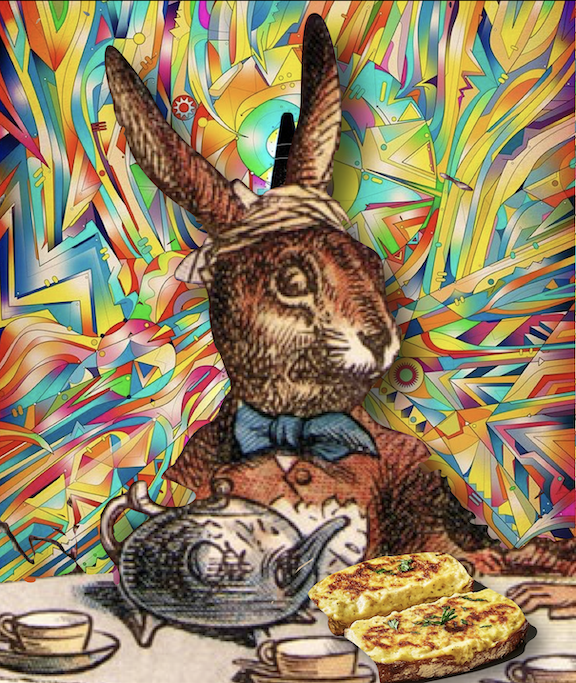
The one wrinkle in this otherwise straightforward history is the mutation of “rabbit” to “rarebit,” despite the former indisputably preceding the latter, and the latter’s general incomprehensibility. Food historians, including at least one expert on Welsh cheese, have speculated that it’s a bonus insult making fun of the lilting (and delightful) Welsh accent; cultural critics have largely stuck to jeering at the pedantry of anyone who insists that a rabbit is a rarebit in a toast context. It’s certainly not a rare bite, and, in fact, no one knows what a rarebit is, besides a folk variant of the word “rabbit.” The most likely conclusion is that a rarebit is a rabbit with corruption and/or mockery in its background, and pretension keeping it around.
What’s curious, though, and suggests a root for the Welshness of the rarebit beyond mere mockery, is the half-millennium of strong association between the Welsh and cheese. Despite the deliciousness of cheese, it’s often been a cruel joke made by Englishmen. Most notably, the Welsh propensity for cheese appears in A Hundred Merry Tales, a Tudor joke collection published in 1526. In “Of Seynt Peter that cryed cause bobe,” the book’s 75th joke, the number of Welshmen in heaven becomes problematic to the rest of the saved, due to the Welsh dead’s propensity for “crakynge and babelynge.” To resolve the problem, St. Peter tricks all the Welshmen out of heaven by slipping out the gates and announcing he had “Cause bobe, that is as moche to saye as rosted chese.” All the Welshmen raced out of heaven to get their cheese; St. Peter locked the doors behind them, and henceforth excluded all Welshmen from heaven. (“Cause bobe” is almost certainly the venerable Welsh dish caws pobi, Welsh cheese pudding spooned over bread, which sounds almost obscenely enticing, although permanent exclusion from heaven seems like an overreaction). The Welsh restaurateur and author Bobby Freeman claims a medieval origin for caws pobi, and adds that cheese-brining appears as a Welsh custom in The Laws of Hywel Dda, named for a Welsh prince who died in 950, and whose eponymous tome has several surviving 13th-century copies. Freeman’s recipe for caws pobi involves cheese, butter, cream, egg, and cayenne pepper, to be served with ale, and is so delicious-sounding it may have made me moan aloud while writing this essay.
Imagine mocking the Welsh for having taste this good. Honestly, I will never understand the English, and the whole thing makes me want to become a Welsh nationalist and thereby gain a newfound appreciation for strings of consonants. I won’t deny that some part of me now wants to get a tattoo of a Welsh dragon on my chest, eat caws pobi for every meal, and move to the small village of Llanfairpwllgwyngyllgogerychwyrndrobwllllantysiliogogogoch, probably to take up the traditional occupation of Town Jew.
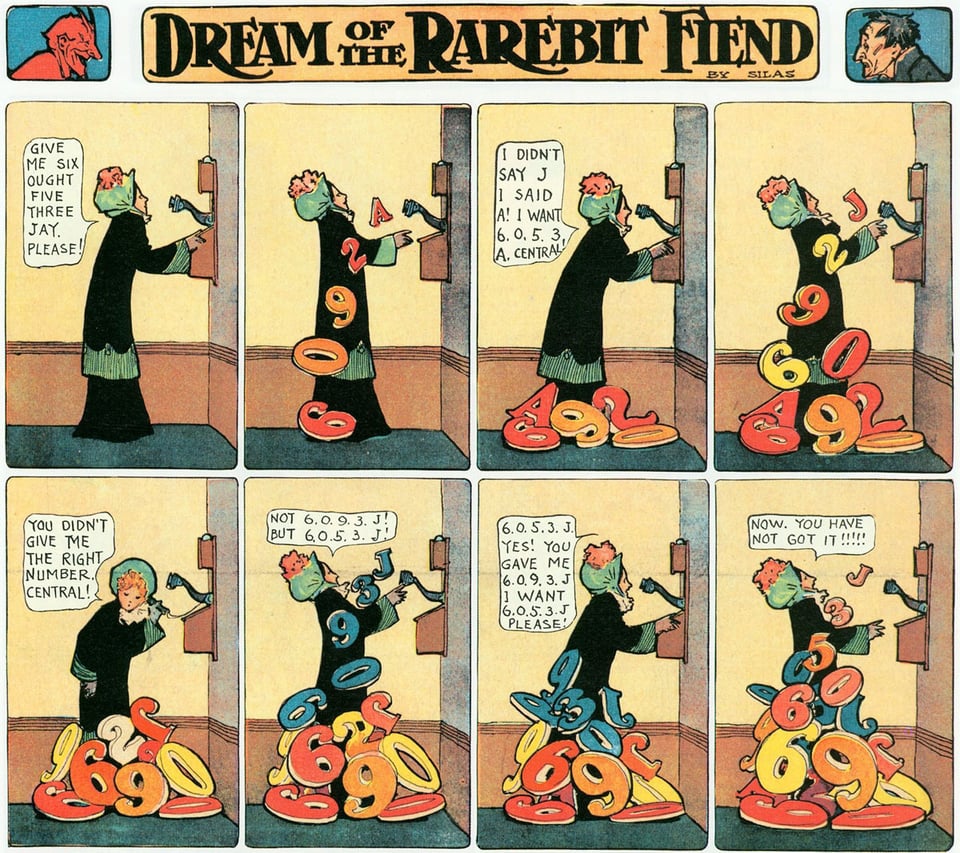
That being said, in subsequent centuries Welsh rarebit itself has acquired an interesting set of cultural associations. Perhaps the most notable rarebit creation is the comic strip “Dream of the Rarebit Fiend,” by famed cartoonist Winsor McCay, better known for the art nouveau comic-strip wonderland “Little Nemo in Slumberland”.
Rarebit Fiend’s premise is based on the notion that cheese consumed too close to bedtime gives the eater intense, disturbing dreams. It was also McCay’s longest running comic, appearing in American newspapers in various forms from 1904 to 1925. The panels have a vivid, hallucinatory quality, and no recurring characters; their only commonality is a habit of eating Welsh rarebit just before bedtime. The comics are often terrifying; its characters swim with giant rats, uproot cities, are buried alive, crushed by dinosaur bones, watch their homes get eaten by sea serpents. The cautionary admonition of each comic’s final panel features the character or their spouse, shaking in bed and lamenting the consumption of Welsh rarebit before sleep.
The association between dreaming and cheese is complex and enduring. For many years, folk wisdom has held that the nocturnal consumption of cheese, like other rich foods, could lead to wild and disturbing dreams. Examples of this link abound in popular culture: in “Dutch Fairy Tales For Young Folks,” a 1918 collection by folklorist William Elliot Griffis, issues forth a fearsome warning:
Now some dreams may be pleasant, but cheese-dreams were not usually of this sort. The dreamer thought that a big she-horse had climbed upon the bed and sat down upon his stomach. Once there, the beast grinned hideously, snorted, and pressed its hoofs down on the sleeper’s breast, so that he could not breathe or speak.…
In those days, instead of seeking for the trouble inside, or asking whether there was any connection between nightmares and too hearty eating of cheese, the Dutch fathers laid it all on the goblins.
According to the British academic Gillian Beer, Victorians viewed indigestion as a principal source of bad dreams, with cheese often a primary culprit. She notes that Ebenezer Scrooge, when confronted with the ghost of Jacob Marley in “A Christmas Carol,” at first accuses him of being merely a “crumb of cheese” transfigured into nightmare.
There is even a smidgeon of scientific evidence to support the notion of cheese nightmares: according to a study commissioned by the now-defunct British Cheese board, Blue Stilton in particular imparts vivid, nearly hallucinogenic dreams. According to the second-century author Artemidorus, in his dream-interpretation opus Oneirocritica, dreaming of cheesecakes or of cheese indicates deceit.
The Sword and the Sandwich is a newsletter about serious extremism and equally serious sandwiches. Please consider supporting this work with a paid subscription:
So why name a toothsome little snack after a literal nightmare, unless you truly despise your guests? Without having tracked down the originator of the recipe, it’s difficult to know with any certainty. But while Artemidorus might have disdained the meaning of cheese dreams—that is, dreams of cheese, rather than those caused by cheese—other more recent guides to the mysteries of sleep have been far more positive in their interpretations. From the nineteenth century on, book after book states that to dream of cheese signifies plenty. According to The Countess of Blessington’s True Interpretation of Dreams, Visions, and Omens of the Wedding-Day, Etc., published in 1861:
“Dreaming of sitting on a chair, denotes great respect, Chains sheweth imprisonment, bad news, death, and neglect.
To become a chaplain shows elevation high, Cheese signifies good-luck, to make it is to die.”
An 1851 guide to dreams claims that to have cheese in one’s dreams indicates profit; an 1876 dream manual by the pseudonymous “Norwood Gipsy” echoes Artemidorus, saying, “To dream you eat cheese, signifies profit and gain in trade—in love deceit.” According to a more recent guide, 2006’s The Little Book of Dream Symbols by Jacqueline Towers, “If you see yourself eating cheese, celebrate—for it means that you will be successful in love.”
When you dream of cheese, you may be deceived, or you may profit; you may discover a hideous horse on your chest. Or you may simply have supper—a savory snack for you alone, or for a multitude. Don’t be a tyromancer—one who, in the days of the Greeks, practiced divination with cheese—and think too deeply. And definitely don’t insult the Welsh, who did nothing wrong except create a delicious cheese toast. Just slice, spread, broil, and bite.

Add a comment: