
Notable Sandwiches #143: Tuna Melt

Welcome back to Notable Sandwiches, the feature where my editor David Swanson and I slip messily through Wikipedia’s List of Notable Sandwiches. This week, we dive into deep waters in search of a comforting miracle: the tuna melt.
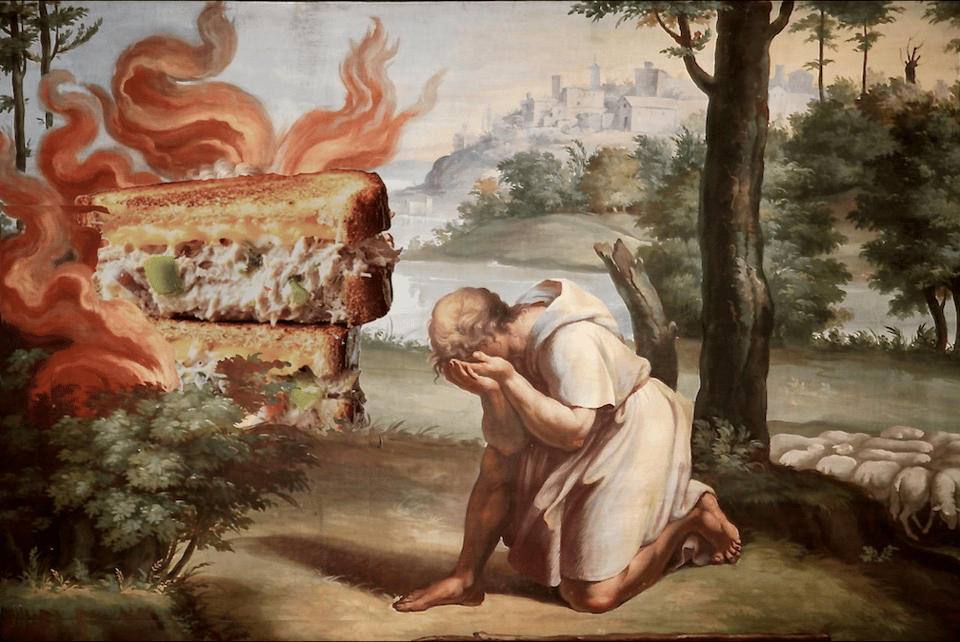
There have always been times in my life, and now foremost among them, when I’ve wanted to melt, although the title of this essay is not an instruction. The “melt” is a catchall name rather than a singular sandwich; it describes that category of dishes—among them the patty melt and the tuna melt—that judiciously combine bread, protein, and a substantive layer of melted cheese. There’s no fixed point of invention for this innovation, although the tuna melt in particular has many fathers, along with all the apocrypha that inevitably accrue around any great culinary success. “Melt” is a relatively new adjective for any kind of sandwich, dating to the mid-twentieth century, but attestations of melted cheese on bread date back centuries before it. At the center of it all, the tuna melt lies dense and rich and comforting, a backstop against the melting of the self in a melting world.
The most credible origin story, and certainly the most widespread, is that the tuna melt developed out of a “happy accident” (the kind that seems to feature suspiciously often in culinary origin stories) at a Woolworth’s lunch counter in 1960, in which tuna salad and a grilled cheese sandwich had a delicious collision. You already know my derisory attitude towards this sort of myth. Why the idea of a happy accident is so compelling, to eaters and restaurateurs alike, as opposed to the deliberate product of a savvy chef, is a bit mysterious to me. I suppose this sort of backstory makes the culinary creation feel miraculous, or inevitable, moved by the same great and unknowable forces that shape the universe.
But it could be argued that the ingenuity of invention is in and of itself a miracle; that the force that moves an idea from a mind to a hand to a menu is no less sacred and necessary than chance or fate or divine will. If a man behind a Woolworth’s lunch counter created something great with intention, it is not less worthy than such a man accidentally stumbling into greatness. And the gap between accidentally creating a great thing and recognizing it as such, and promoting it as such, is wide enough as makes no difference. Still, I like to think that the anonymous cook who mated tuna salad and grilled cheese knew exactly what he was doing: he was creating greatness behind that Woolworth’s lunch counter, and he knew it, and the story of an accident was something he spread to add a sense of destiny to the mix.
The tuna melt does feel a bit cosmic, a bit destined: to me, it’s the most comforting sandwich in the world. Once, in Brooklyn, I had a vegan roommate who came home with the weight of the world on her shoulders after a very bad day with a very bad boss. Without a word, she arrived in a private thundercloud, unpacked the materials for tuna melts, and baked them. As she made the sandwiches, and they melted, and she shared them, the thundercloud around her thinned particle by particle: that’s the power of a tuna melt, even and unto a breach in vegan armor, to take sorrow away.
Like a lot of the best sandwiches, a tuna melt is simple: childhood food, poverty food, comfort food. It’s four ingredients—tuna, mayo, bread, cheese—that are easy to assemble, broil or grill, and serve. It’s filling, and if your tastes align with it, it’s a perfect thing: a carby case of Kant’s impossible thing-in-itself—the self-contained noumenon, the ideal. It’s a quiet argument that the banal and the miraculous need not be exclusive categories, because the kind of satiation and comfort it can provide are, at the very least, a modern analogue to manna. Comfort in particular. It’s impossible to be swept away by sorrow in the presence of a tuna melt. It’s too solid for that.
And that’s apt, and needed: often enough in the last few years my life, and the life of my country, has felt like a thin foundation of substance smothered by a molten layer of sorrow. Sometimes a melt truly feels more like a directive than just a name. I’ve spent a not insignificant amount of time exploring new ways of fusing with my bed, a mixture of apathy, grief, and the careful construction of a carapace of numbness preventing me from moving. There has been nothing delicious about this process. It’s ugly, and it’s sad.
The Sword and the Sandwich is a newsletter about serious extremism and equally serious sandwiches. Please consider supporting this work with a paid subscription:
This is a bad time to be someone who cares about things, a faculty I have tried to cultivate in myself for my entire adult life. Someone who cares about women’s freedoms, who cares about trans rights and immigrant rights, who cares about food safety and climate change and democracy—in short, someone who had the capacity both for naive hope before 2024 (and 2016 before it), and for a broad and deep sense of betrayal.
However much I tried to temper my expectations, I did allow myself to hope—that the future could be better. That the horrors I’ve spent the last decade of my life examining, in my other guise as a spelunker into the abyss of the American right, would finally begin to recede. Instead the cracks opened up right under my feet; I felt the earth buckle and go. None of the paths forward are safe. And none are comfortable.
So why not melt?
The leftist aphorism that “a better world is possible” feels distant now. The truth is it always did. Anyone who takes a longer view of American history than the 1930s-1970s era of New Deal economics and hard-fought social freedoms knows that revanchism, blood, and cruelty—leavened with varying degrees of populism—are more consonant with our past than that brief upward blip to freedom. That those who have fought for their rights in this country nearly always did so in the face of public contempt and very real physical danger, the one complementing the other.
Awakening to the collapse of the American Republic doesn’t mean giving up, but it does mean abandoning a certain image of our nation as a beacon of inevitable progress, a shining city on a hill that can ultimately never betray, but only be betrayed. I think, on balance, it is better to discard this myth—because that’s what it always was—than to cling to it against all evidence, much of that evidence being the bones of our forebears. There are ideals to fight for, but principally they must reside in each other, not in a fiction of a nation whose flaws are always transient and whose institutions match resilience with capacity for change. That’s not the country we live in. And it tells us so again and again.
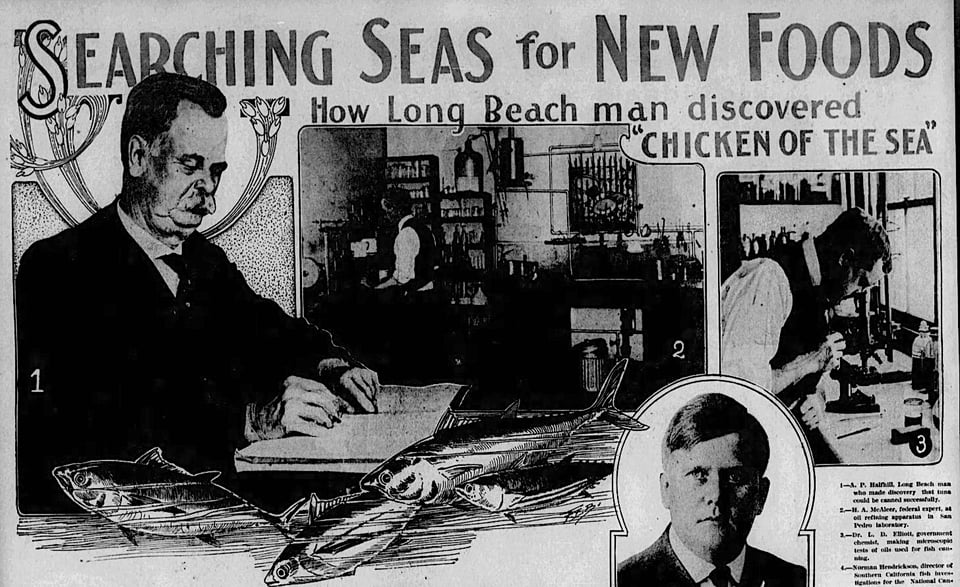
Still, this is the country that invented the tuna melt, and, for that matter, invented canning tuna. It happened in 1909, a period of rapid development and innovation for the canned-fish industry; canning, in general, was a rapid-growth business at the turn of the twentieth century. Fisheries tried canning every pescatory specimen they could get their nets on—shark, menhaden, carp—when the Southern California Fish Co., under the direction of Joseph Lapham and A.P. Halfhill, began experimenting with canned albacore tuna, concluding that the flaked flesh tasted agreeably like chicken.
At the time, tuna abounded off the California coast: albacore and skipjack, bluefin, bigeye, skimming through the water, muscular and sure. The product really took off during the First World War, when cheap, portable canned protein that could last to the trenches became a dire necessity for the millions involved. War, as in so many things (and for other sandwiches), rendered the exotic a ubiquity. To a soldier at war, every sense attuned to staying alive, nutrition becomes a central fixation; in peacetime this transmutes into nostalgia; and thereon into broader culinary adoption.
That’s the sketched outline of how such an odd fish—huge-eyed, hypermuscular, with an astounding capacity for speed and oxygen absorption—became, in our minds, comforting grey mush. According to Tuna: A Love Story, by Richard Ellis, the fish is what’s called an “obligate ram ventilator”: they must move to breathe, because their motion passes oxygen-rich water over their unusually large gills. “The great fishes slip through the water like polished torpedoes," Ellis writes. The dorsal fins, in some subspecies, are “elongated into sweeping scimitars,” a sleek empennage that “enables it to swim steadily for hundreds—even thousands—of miles. That has to be so; these fishes cannot stop to rest and live their entire lives in motion.”
Ellis writes about the tuna with a mix of bemused infatuation and real admiration; it’s clear in every syllable—about about scombrid and istiophorid tailfins, about the rete mirabile venous system that enables the tuna to regulate its temperature above that of its surrounding waters—that this is a book by a man in thrall. To him, the tuna is a miracle in the water, from tailfin to small conical teeth. And this is no doubt true: you cannot read Ellis and fail to recognize that truth.
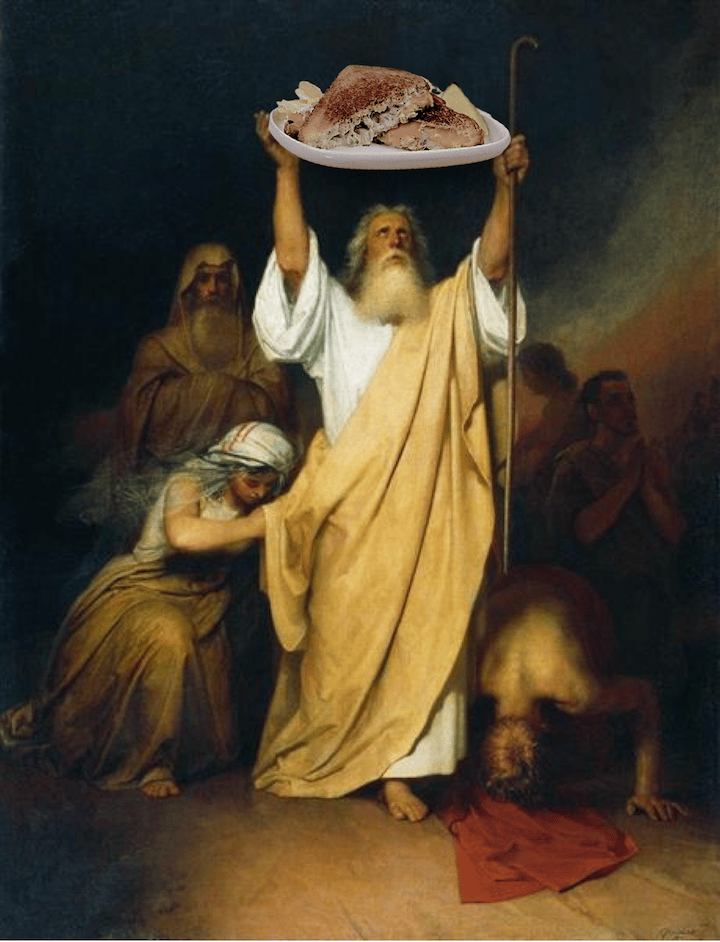
What I feel is that the man who canned them created a miracle too: the uniquely human capacity to render the wondrous into the ubiquitous, so that we are not paralyzed, at all turns, by wonder. So that the surprise and rapture engendered in us by things that are marvelous does not become paralysis; so that we can live in a world of marvels and still live our small lives, with our small worries, with our loves and obligations. The tuna is miraculous, but so is the inventor of the tuna melt; the toro and the toro hunter alike are driven through the waters, impelled on the one side to keep moving to breathe, and on the other to keep moving to live.
Every miracle contains within itself the seeds of its own reversion to the mundane. The Red Sea parts, but then it closes; the righteous may stride forth on dry land, but the drowned corpses of their pursuers, their extremities bloated with saltwater, wash ashore in time. In lands prone to fire, seeds pollinate on the hot winds generated by flame; when a bush burns, and the fiery voice of God speaks out of it, a seed grows elsewhere and produces another bush.
Transposed to the human realm, the brain—that miraculously complex organ whose full range of functions we are only beginning to understand—contains in itself the capacity for curiosity and wonder, and the equally marvelous and necessary capacity to turn pleasure-drunk astonishment at the universe’s scope into the trammels of sustained existence. The tuna swims ceaselessly through the deep; we invent cans and canning to feed burgeoning births and the wars that kill the born, and overfish the tuna; we learn to farm them. A man makes a miracle behind a Woolworth’s counter, and disguises it as chance, as destiny, camouflaging his genius as an act of the impassive vast universe. For every act of unthinkable kindness, there is an act of unthinkable cruelty.
This does not absolve ourselves of the responsibility to rescue one another. It is going to be a long bitter cold for people who care about things; and it therefore devolves upon us to lend each other comfort when we can, the little sun of the warm melt given from one hand to another.
It is also incumbent on us, I think, to deal with grief honestly. To face it head-on, and feel it in all its tremulous depth, with appropriate periods of dissociation as necessary. Not doing so would inevitably allow that emotion, denied its proper outlet, to explode into anger, to break fragile coalitions, to resort to the ferocious and futile cruelties of grief deferred.
To let grief rot under a thick stratum of self-denial in the conviction that emotional abstemiousness equals virtue—that sincerity, even in pain, is a sign of weakness—is a recipe for something rancid and cruel. You have to let yourself melt, feel fully the loss of possibility and wiggle room and safety and time, before you can renew your strength. Only then can you be warm and soft and present, be necessary, as small good things are necessary. Grieve with your whole self so you can offer yourself to those who need it most, when you must.
A bad time is here; a melting world. Now is the time to melt a little. Retrench. And harden for the long struggle, because a better world, despite all indicia to the contrary, still is possible. And when it comes, because we make it—when we put our hands to the wheel and make it so, and make our own miracles—it will be filling, and bedecked with cheese, and needs must feed us all.

-
This is so very very good. Thank you!!!
-
🩷🩷🩷🩷
-
An essay about sandwiches should not make me cry, and yet.
Btw, my father in law's variation is to replace the mayo with yet more cheese, melt it in the pan with the tuna, and sprinkle it with curry powder before scraping it between pieces of rye toast. It looks like cat barf but is perfection.
-
Excellent sandwich, and an even better essay. I share your grief about our world and especially our country for the last ten years. But I have seen a lot of bad (and a fair amount of good) in my 70 years. By nature I am a pessimist about humanity. Still, many decades ago I decided that I needed to become a tactical optimist if I wanted to make the world better. It helps. Almost as much as a tuna melt.
-
I started expecting a Heated Rivalry reference, and ended recommitted to love-in-action. Thank you. ❤️
-
Terrific and eloquent piece!
-
So good, I subscribed
Reply: