
Notable Sandwiches #1: American Hero

Welcome back to Notable Sandwiches, the feature where my editor David Swanson and I slip messily through Wikipedia’s List of Notable Sandwiches. This week, we go back to the beginning of the list with a new essay on the American Hero.
PS: Sorry I vanished for a few months while transitioning, finishing my book, and having a mental health crisis, and you all unsubscribed. We're back but still finding our feet.
A little over a hundred years ago, at the dedication of the Lincoln Memorial, the neighboring Reflecting Pool wasn’t yet complete. It was more than a pit, less than a reflection. Tens of thousands of people gathered for the ceremony on May 30, 1922, Memorial Day, but the pool itself would not be ready until December of that year; headlines at the time declared bemusedly, “Lincoln Memorial Reflecting Pool Begins to Reflect.”
At the dedication, a trio of speakers addressed the masses: Harding, former president and then-chief Justice of the Supreme Court William Howard Taft, and Robert Russa Moton, president of the Tuskegee Institute, and a lifelong, if incrementalist, advocate for civil rights. Moton’s speech was first and foremost an encomium to Lincoln, but he also—speaking before a segregated audience of 50,000 on the National Mall—put forth a theory of America divided by Manichaean conflict between two opposing forces.
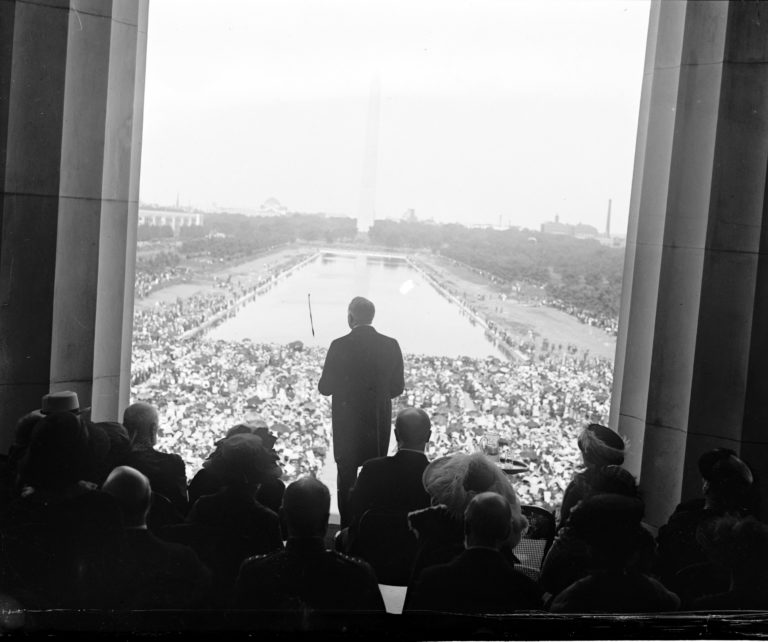
“While the Mayflower was riding at anchor preparing for her voyage from Plymouth, another ship had already arrived at Jamestown. The first was to bear the pioneers of freedom, freedom of thought and freedom of conscience; the latter had already borne the pioneers of bondage. Here, then, upon American soil within a year met the two great forces that were to shape the destiny of the Nation. They developed side by side. Freedom was the great compelling force that dominated all, and like a great and shining light beckoned the oppressed of every land to the hospitality of these shores. But slavery like a brittle thread was woven year by year into the fabric of the Nation’s life,” Moton said. “In the process of time, as was inevitable, these great forces of liberty and the forces of bondage from the ships at Plymouth and Jamestown met in open conflict upon the field of battle.”
There, in front of a vast, shallow pit, Moton’s thesis made a great deal of sense. A Black man was speaking beside the president, but to a segregated audience; he was speaking in memory of the man who signed the Emancipation Proclamation, and then was murdered by a white supremacist zealot. Over the ensuing century, the pool would become an iconic landmark. Civil rights icons from Marian Anderson to Martin Luther King, Jr. would speak and sing before it; one hundred thousand anti-Vietnam War protesters met before the pool in 1967; in 1985, the AIDS memorial quilt, in all its many heartbreaking colors, was laid out before water, on the green grass of the National Mall. This imperfect, tranquil thing, rebuilt and shored up again and again, seemed to embody the dual forces of bondage and the struggle against it that propel America through the decades.
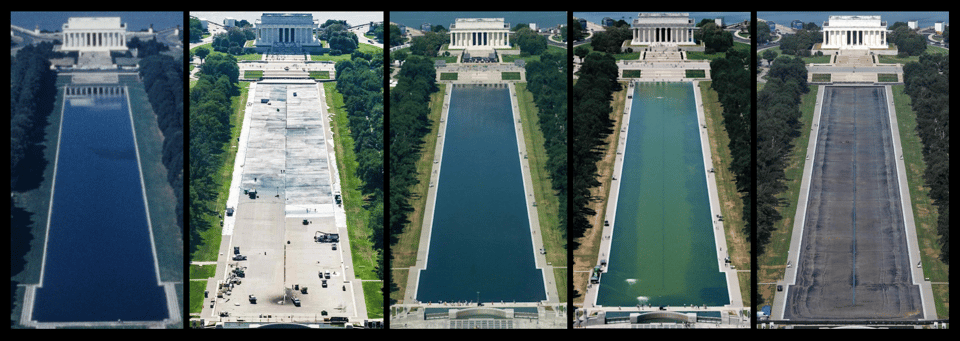
In 2026, a series of events involving the pool began to unfold, under the aegis of President Donald Trump. The whole thing took on its own tragicomic weight, a spiral set off by America’s 250th birthday. Among the projects the Trump administration undertook was a $16 million renovation that went spectacularly wrong. In late April, the White House set about painting the bottom of the pool “American flag blue,” an indigo epoxy that began to slough off in flakes, floating up to the top of the water to be skimmed off and taken home by tourists. A hot, humid June led to an algae bloom; the drained and refilled pool became a sickly, slimy green, too murky to see to the bottom.
So many pictures were taken amid general mockery that the National Parks Service—prodded by a president who kept claiming that the algae’s appearance and defeat of any attempt to clear it was due to microorganism-based vandalism—put up security fencing. Dozens of people were arrested and charged with felonies, including a U.S. Olympic canoeist. The water stayed stubbornly green. Months after the projected completion of the renovation and millions of dollars over its budget, the pool was drained again, its naked, torn sealant mute witness to the farce.
The whole thing has such a superabundance of metaphor that it feels liable to collapse. There’s the hubris of attempting to defeat nature (in the form of algae, in, essentially, a swamp—to wit DC—during a hot, humid summer). There’s the inevitable comparison to Narcissus, the first figure who ever had real abiding trouble with a reflecting pool, and whose very name means vanity. The paranoia of lashing out at flora-based vandals; the very real people facing the consequences of that paranoia. The irony of a president whose initial war cry was “drain the swamp!” creating an artificial one. The pageantry of a 250th anniversary evolving into literal rot as stand-in for the decay of an empire. And so on.
But what the farce of the Reflecting Pool ultimately suggests is not just the devaluation of national symbols under the decadence of a fascist aesthetic. (The pool has ample company in its tribulations: the Oval Office snowed under by gilt; the Kennedy Center’s abortive re-naming; the construction of a huge, gauche $600 million White House ballroom; the demolition and paving of the White House Rose Garden, to provide outdoor seating of the sort that would not be out of place at a midwestern Hyatt, and so on.)
These projects seem to mock our own self-seriousness at placing such outsize importance on a house, a garden, an arch. Any degradation seems to result, therefore, from the inadequacy of the symbols in the first place. Consider: on the 250th Independence Day, amid portentous lightning and thunder, the Washington Monument was adorned with objectively hideous patriotic projections; under the skin of garish stars and gaudy colors, it became less a majestic obelisk of plain stonework and more what it always truly was—an overlarge, phallic celebration of power. Even if you scrape away the gilt, clean up the algae, it’s too late: the poverty of the symbols we have valued without critical analysis is already laid bare.

In his most famous essay, Cultural Criticism and Society, the legendary philosopher Theodor W. Adorno lays out the damage done by fascism to the very notion of culture. (Adorno, a half-Jew and famous literary critic, was exiled by the Nazis from Germany in 1934.) “Official fascist culture provoked the laughter and incredulity of those upon whom it was forced,” he writes. Yet in its wake, mass culture is dominated by facile trash, art that can only exist as art if it ignores the manifest fact of social injustice, victimization, the injuries inflicted by those in power. “By relinquishing its own particularity,” he writes, “culture has also relinquished the salt of truth, which once consisted in its opposition to other particularities.” Under fascism, which cannot endure criticism, all of European culture “degenerated to mere ideology.” As a result, Adorno comes to his famous conclusion: “To write poetry after Auschwitz is barbaric.”
One may assume that to write poetry after the establishment of “Alligator Alcatraz” is no less so. Pomp and degradation, pre-approval and the neutralization or criminalization of criticism—these create, to Adorno and his modern heirs, an environment in which culture is neutralized, rendered impotent, another form of opiate for the alienated bourgeois.
And yet people do, still, write poetry. People still attempt to overcome injustice, and imbue their creative pursuits—writings, music, photography, symbology—with that spirit. It’s time, in the time of the murky pool, of the camps, of the mass production of crudity, misogyny and celebration of power, to reexamine uncritical reverence, and to move away from these idols of stone which we have created.
So in this critical moment I turn to something that happened the year before the Reflecting Pool was ever polluted: a crime, and trial, that created a new cultural icon, one whose very absurdity undercuts the pomp, violence and depravity of the fascist project. It also, centrally, and critically, involves a sandwich.
The Sword and the Sandwich is a newsletter about serious extremism and equally serious sandwiches. Please consider supporting this work with a paid subscription:
Enter into the historical record a complaint filed in federal court on August 13, 2025:
On August 10, 2025, at approximately 11 PM, Metro Transit Police (“MTP”) Detective Daina Henry, Badge # D948, and members of United States Customs and Border Protection (“CBP”) were patrolling the area of 2001 14th Street NW in Washington, DC. Detective Henry observed an individual (herein referenced as Sean Charles DUNN) begin to shout at CBP Agent Gregory Lairmore (herein referenced as V-1) who was, at the time of the offense, an employee of the United States and acting in performance of his official duties.
DUNN stood within inches of V-1, pointed his finger in V-1’s face, and yelled, “Fuck you! You fucking fascists! Why are you here? I don’t want you in my city!”
DUNN continued his conduct for several minutes before crossing the street and continuing to yell obscenities at V-1. At approximately 11:06 PM, DUNN approached V-1 and threw a sandwich at him, striking V-1 in the chest. An Instagram video recorded by an observer captured the incident. The video depicts DUNN screaming at V-1 within inches of his face for several seconds before winding his arm back and forcefully throwing a sub-style sandwich at V-1.
DUNN attempted to flee on foot but was apprehended. While being processed at Metropolitan Police Department’s Third District, DUNN told MTP Officer Gurkaranjot Thandi, “I did it. I threw a sandwich.”
As such, your affiant submits that probable cause exists to charge Sean Charles Dunn with violation of 18 U.S.C. § 111(a)(1) (Assaulting, resisting, or impeding certain officers and employees of the United States).
The affair of the sandwich—or as I call it, the Incident of the American Hero—involved Sean Dunn, then a 37-year-old paralegal at the Department of Justice’s Office of International Affairs, throwing a footlong turkey sub at a heavily armed Customs and Border Patrol agent. The events took place during a transparently authoritarian, and widely reviled, deployment of troops, National Guard, ICE, and Customs and Border Patrol onto the streets of DC, resulting in a rash of deportations, confrontations, the razing of encampments of the unhoused, and widespread warrantless arrests and vehicle stops. Dunn, walking through an area famous for gay nightlife, realized that the CBP were patrolling outside a club hosting “Latin Night,” and decided to confront Agent Lairmore. His weapon was an American hero—otherwise known as a sub, spiedie, grinder, hoagie, tornado, or footlong, but here I think hero fits best of all.
There’s neither pretense nor grandeur in throwing a sandwich at a heavily-armed fascist. There’s no murk in admitting right away that you did it. There’s no marble-cast bravado in the affair; there’s just a man in a pink polo and a ballistic sandwich hurled at a member of an invading force at the height of its power.
It’s a measure of the hubris of Trump’s Department of Justice that they brought the case to trial, forced to try Dunn for a misdemeanor after a grand jury failed to indict him on more serious charges. (The famous dictum that the average grand jury would “indict a ham sandwich” at the whim of a good prosecutor appears not to extend to throwers of turkey sandwiches.) The resultant trial is a magnificent coup de theatre, and yet in its own way it’s every bit as serious as, say, Joseph Brodsky’s trial for writing insufficiently Soviet poetry in 1964 (“Judge: And who said you’re a poet? Who ranked you among poets? Brodsky: No one. [Unsolicited] Who ranked me as a member of the human race?”), or the antiwar statements of Civil Rights icon Julian Bond that led to a 1966 freedom-of-speech adjudication by the Warren Court (“We recall the indifference, suspicion and outright hostility with which our reports of violence have been met in the past by government officials. We know that, for the most part, elections in this country, in the North as well as the South, are not free… We question, then, the ability and even the desire of the United States government to guarantee free elections abroad.”).
What Sean Dunn did—by his action, by his decision to fight the government in court, and by his acquittal—was to implode fascist pomp and terror by refusing to be made a criminal for throwing a sandwich. He made them fight him to the end, and they lost.
Which results in magnificent quotations like this:
PROSECUTING ATTORNEY: What was the impact like?
CBP AGENT: I could feel it through my ballistic vest. The sandwich separated and kind of exploded all over my uniform. I could smell the onions and mustard and had stuff all over my uniform afterwards.
LATER:
PROSECUTING ATTORNEY: Now, when defense counsel asked you about whether or not there was mustard coming out of the sandwich, I think I saw you smile a little bit. Can you explain why?
CBP AGENT: Because I had mustard and condiments on my uniform, and I had an onion hang on my radio antenna that night.
(Later, the alleged mustard stain, and the agent’s failure to document it, became a point of contention for the defense.)
The prosecution and defense summaries also offer sandwich-related gems.
“What he does is get to the point to do what he does and takes what happens to be in his hand, a sandwich, and he spikes it. Throws it like a baseball. Strikes Agent Lairmore in the chest. You heard Agent Lairmore. He could feel it. He crossed a line,” the Department of Justice attorney says, dramatically.
Witness the defense’s closing statement, by one Sabrina Schroff:
“This case, ladies and gentlemen of the jury, is about a sandwich. A sandwich that according to Agent Lairmore somehow both exploded on his chest in a spray of mustard and onion, but also landed intact on the ground, still in its Subway wrapping.
A sandwich that Lairmore testified he somehow felt through his ballistic armor, on his chest armor, that is specifically made strong enough so it stops a bullet from piercing a soldier’s heart. Putting aside Lairmore’s very questionable testimony, you all know, and we all know, that this was not a weapon hurled with force, anywhere near justifying federal charges brought in this courtroom.
And if there is any doubt at all about what I am saying, just ask yourself—ask yourself, would a man, genuinely injured, generally offended about having a sandwich thrown at him, joyfully, happily, display not one but two gag gifts, a plush toy sandwich, that he keeps on his office shelf and a second gift, the felony footlong badge, that he has on his lunch box?”
Dunn and his sandwich were acquitted on all charges. Schrodinger’s mustard and onion (which actually sounds like a German side dish) remain unadjudicated: were they on the ground, still in the wrapper, or hung all over the agent’s radio and splattered on his uniform? It’s a question for the public to decide.
But what Dunn did was illustrate a way to oppose fascism that doesn’t require ennoblement of empty symbols, or an assumption of bourgeois dignity that renders culture sterile and inert. It doesn’t require pomposity, or the embrace of sanctioned forebears. It requires courage—piss and vinegar; internal mustard—and it engenders hope. It’s possible to create new symbology in an age of totalitarian vulgarity. It just requires looking beyond the murky surface of a pool enscummed by failure. It requires new kinds of heroes, those on bread and those that wield them. “Culture thus contains an element of resistance to blind necessity—the will to determine oneself on the basis of knowledge,” Adorno writes.
Only through ingesting the “salt of truth” can a being truly be free, both of ideology and of the mindlessly self-reproducing status quo of petty self-satisfaction. But the salt of truth comes in many forms, and some of them are the nitrates in processed turkey, compressed in a hero, and hurled at a jackbooted agent of the state. This, too, is a kind of poetry; and if it is barbaric, then it is a barbarism ennobled by circumstance. This, too, is an embodiment of the dual forces Moton evoked at the dedication of the Lincoln Memorial: the forces of bondage and of freedom, whose continual conflict results in the complex ur-being we call America. The thrown sandwich is the act of a free being, served on white bread, wrapped tight enough to hurl with the hand, the mind, the spirit.

-
I never unsubscribed, figured you were recharging your powers or working on something I’d read later or both. Welcome back
-
Welcome back. I’m glad to see you again. You’re one of the best writers around, certainly the most courageous.
-
Bravo. Glad you’re back.
-
I remained faithful, and am so glad you're writing again. Your prose has a beautiful rhythm.
-
American Hero? Or Warlord? SNL formed the government sandwich connection back in 1992. https://www.youtube.com/watch?v=eYt0khR_ej0
-
Not all of us unsubscribed!
-
Welcome back. I too was transitioning and having a crisis, and i dont even have a book to show for it. Appreciate you.
-
Bravo! 👏
Add a comment: