
Notable Sandwiches #142: Turkey

Welcome back to Notable Sandwiches, the feature where my editor David Swanson and I slip messily through Wikipedia’s List of Notable Sandwiches. This week, an etymological mystery: turkey.
There are very few occasions in life in which someone gets to choose their own name: confirmation, conversion, or, in my case, transition from female to male. Out of all the names in the world, I chose my own; I wanted to pick something that would allow me to present as my male self, that would erase confusion, that would say something essential about me. Choosing your own name is not to be taken lightly.
In the case of the turkey—that busty bird whose thinly-sliced meat is a ubiquitous filler for club sandos, Thanksgiving-leftover feasts and deli lunch-hour specials—the ability to choose its own name might have been a mercy, and avoided a tremendous amount of confusion. The etymological journey of why a turkey is called a turkey makes the fraught rite of transgender name-choosing seem like a cake walk (or bird strut).
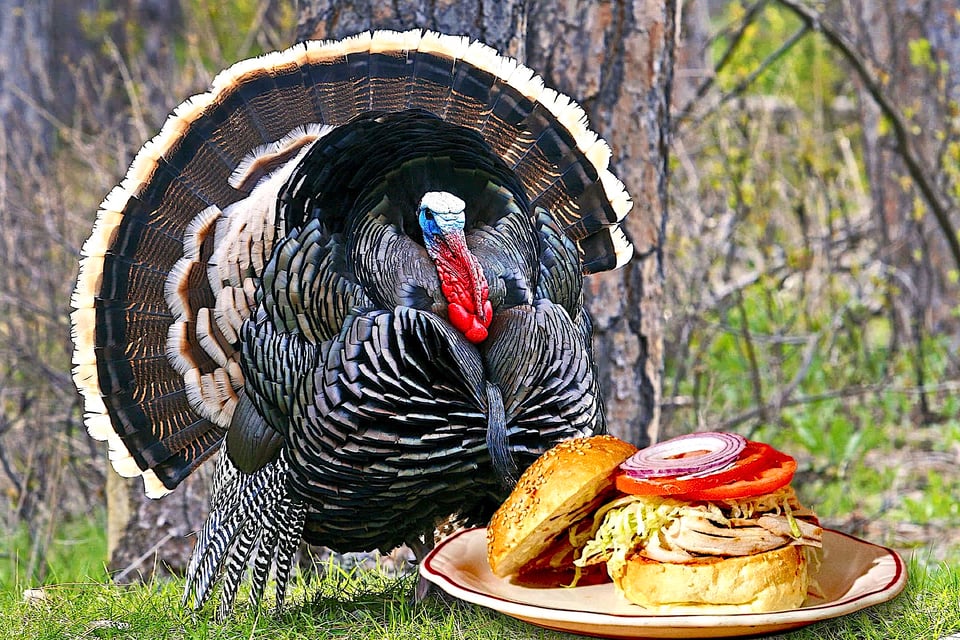
The turkey, meleagris gallopavo, is a big galumphing bird indigenous to the Americas, famous for its huge breast, commanding carriage, and bland but abundant meat. In English, it is named after Turkey, which is a country across an entire ocean from its native stomping grounds. In Turkish, the language of Turkey, a turkey is called a hindi, which means “from India.” In Hindi, the language of India, a turkey is called a टर्की (Ṭarkī). In Slovak and Albanian, its name means “chicken from overseas.” In Scandinavian languages and Dutch, it’s named for Calicut, a major trading post along India’s Malabar Coast. In Welsh, it’s twrci. In Polish, Russian and Ukrainian, it’s indyuk, indyk or indeyka—Indian bird.
In other words, languages across the entire world are eager to praise (or blame) the wrong country for this entirely American bird. And they can’t even agree on what wrong country to attribute it to. Linguists and historians have put their heads together on why this is, and it seems to come down to a fowl case of mistaken identity.
What’s undoubtedly central to this geographical misunderstanding is the role the Ottoman Empire played in trade to Europe around the period of the Columbian Exchange. The 1500s were the height of Ottoman power, and its standing as the gateway to the fabulous esoterica of the East. As such, many exotic goods derived their name from Turkey (the center of Ottoman power, with its capital in Istanbul). In this period, Persian rugs were known as “Turkey carpets,” and a precious blue stone from Persia was called, in French, pierre turquoise, or Turkish stone—“turquoise” in English. One of these exotic goods, destined to be called the “turkey cock” or “turkey hen,” was a bird native not to America but to sub-Saharan Africa—the guinea fowl.
Guinea fowl are also fabulously colored and larger than a chicken. They have polka-dotted plumage and blue heads, and, in the case of the vulturine guinea fowl, terrifying red eyes. They were big hits in the ancient world; helmeted guinea fowl appear in ancient Egyptian paintings, and the indispensable Roman chef Apicius includes a recipe for honey-smothered guinea hen in his De Re Coquinaria. But the bird appears to have died out in Europe sometime after the fall of Rome; guinea fowl are rather delicate birds, and hardier in warm climes than cold ones.
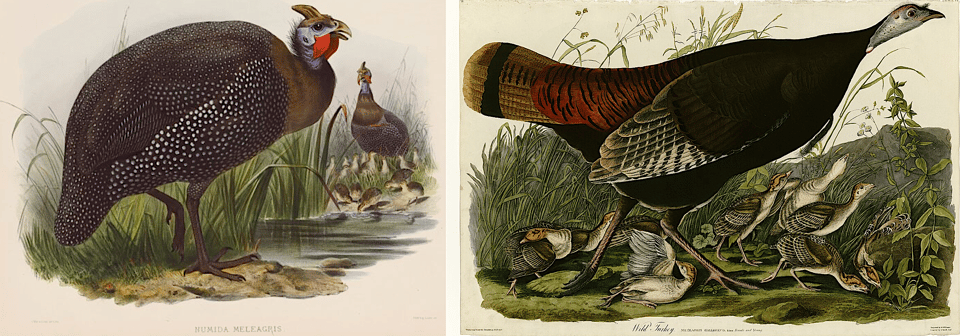
The guinea fowl was reintroduced to Europe by Portuguese traders, who began exploring—and pillaging—the Atlantic coast of sub-Saharan Africa in the 1450s, under Prince Henry the Navigator. By the end of the fifteenth century, Portuguese traders brought guinea fowl to the Ottoman Empire, along with gold and a staggering number of captured and enslaved human beings. A niche trade in guinea fowl—named “turkey hens” for their ostensible Ottoman origins—began in the late fifteenth and early sixteenth centuries.
A few decades after the Portuguese began to raid Guinea and its environs, the Spanish set out on their own bloodcurdling imperial expansion to the New World, initiating the Columbian exchange (and eventually creating a mass market for Portuguese slaves). At this point, one of two things happened, or possibly both: either colonizers of the Americas, encountering the indigenous wild turkey, mistook them for guinea fowl (categorizing both, presumably, as “large fancy chickens”), or Europeans in Europe, encountering imported North American turkeys for the first time, confused them for the guinea fowl that the Ottomans had traded from Africa (“large, fancy, exotic chickens from overseas”). Either way, the confusion was so pervasive for so long that both birds were given the same Latin moniker, meleagris. In 1548, English scholar Sir Thomas Elyot recorded in his Bibliotheca Eliotae an entry on “Meleagrides, byrdes, whiche we doo call hennes of Genny, or Turkie hennes.” To this day, despite being in different taxonomic families, wild turkeys are known as Meleagris gallopavo, while guinea fowl are known as Numida meleagris.
Because nothing about the name of the turkey can be normal lest I cease to rend and tear my hair, I looked up what meleagris might actually mean. “Surely this is something to do with bird characteristics,” I said to myself, naively. “Probably their feathers, or something.”
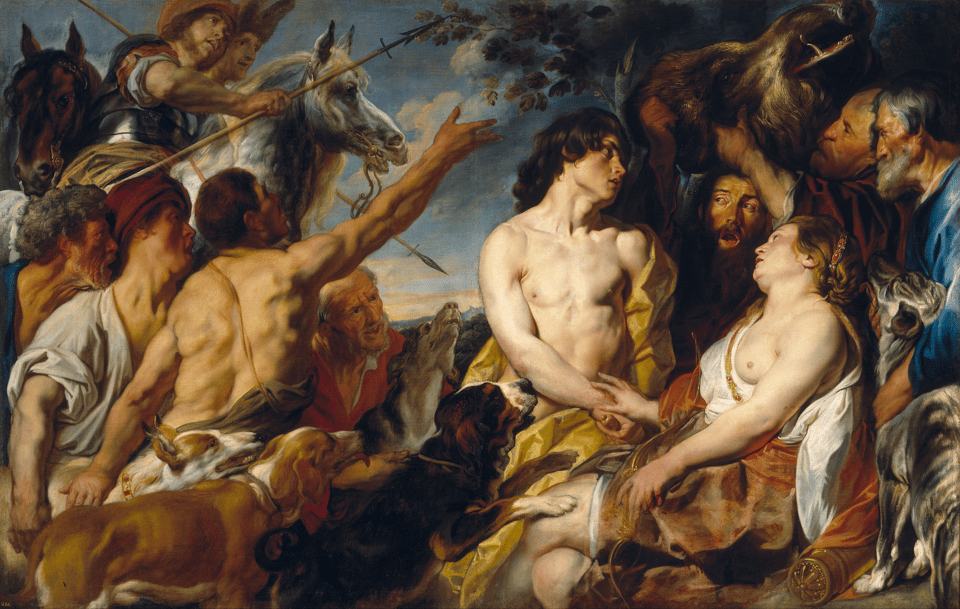
Wrong! Instead, I was plunged into—quite literally—Greek tragedy. Ovid’s Metamorphoses lays out the tragic fate of Meleager, lover of the legendary huntress Atalanta and hero of Calydon, who led a phalanx of heroes against the rampaging Calydonian boar, a creature that spat lightning, ravaged crops, and avenged the goddess Artemis. She was angry at Calydon’s king. Atalanta wounded the boar, drawing first blood and winning the right to its hide, but two of her fellow hunters, who were brothers, got very mad about a woman maiming the beast, leading Meleager to kill them. The murdered men’s sister got word about their deaths from the Fates and killed Meleager by burning a piece of wood that was linked to Meleager’s fate by prophecy.
Enter… the guinea fowl:
“Noble Calydon lies dead. Young men and old lament, people and princes moan, and the women of Calydon, by the River Euenus, tear at their hair, and beat their breasts. … Not though the god had given me a hundred mouths speaking with tongues, the necessary genius, and all Helicon as my domain, could I describe the sad fate of his poor sisters. Forgetting what is seemly, they strike their bruised chests, and while there is something left of the body, the body is caressed again and again, as they kiss it and kiss the bier on which it lies.
Once he is ashes; the ashes are gathered, and they press them to their breasts, throw themselves down on his tomb, and clasping the stone carved with his name, they drown the name with tears. At last, Diana, satiated with her destruction of the house of Parthaon, lifted them up… and stretching long wings over their arms, she gave them beaks, and, changed to guinea-hens, the Meleagrides, launched them into the air.”
Cry too much for your brother and the goddess of the hunt will turn you into a bird. Then, many centuries later, that bird will be confused for another bird. Americans will eat the other bird on Thanksgiving and in countless sandwiches. A cautionary tale!!!!
The Sword and the Sandwich is a newsletter about serious extremism and equally serious sandwiches. Please consider supporting this work with a paid subscription:
That’s the Turkey part of the story. As to why it’s called the Indian chicken, there’s a far less definitive etymology here. Your choices are: India was, like Turkey, shorthand for “exotic and foreign”; India can refer to the West Indies, which are at least somewhat closer to the bird’s actual origin point; or it’s the guinea fowl confusion striking again, and people thought guinea fowl originated in India, rather than Africa. (The last theory makes a bit more sense to me, as, by 1509, Portugal had consolidated its Indian and African trade under one national company, the Casa de Guine e India.) Either way people are very confused about this bird, although certain it originates somewhere far away. Just to add a bit of spice to all this geographical confusion, a turkey is called a peru in Portuguese, although turkeys are not indigenous to Peru. (Peru, however, served as a metonym in Portuguese for Spanish-colonized areas of the Americas).
In the Spanish of Spain, a turkey is a pavo, from the Latin for peacock (a peacock is a pavo real, or royal peacock). Only one thing is certain: people all around the world are united in confusion about big, fancy birds.
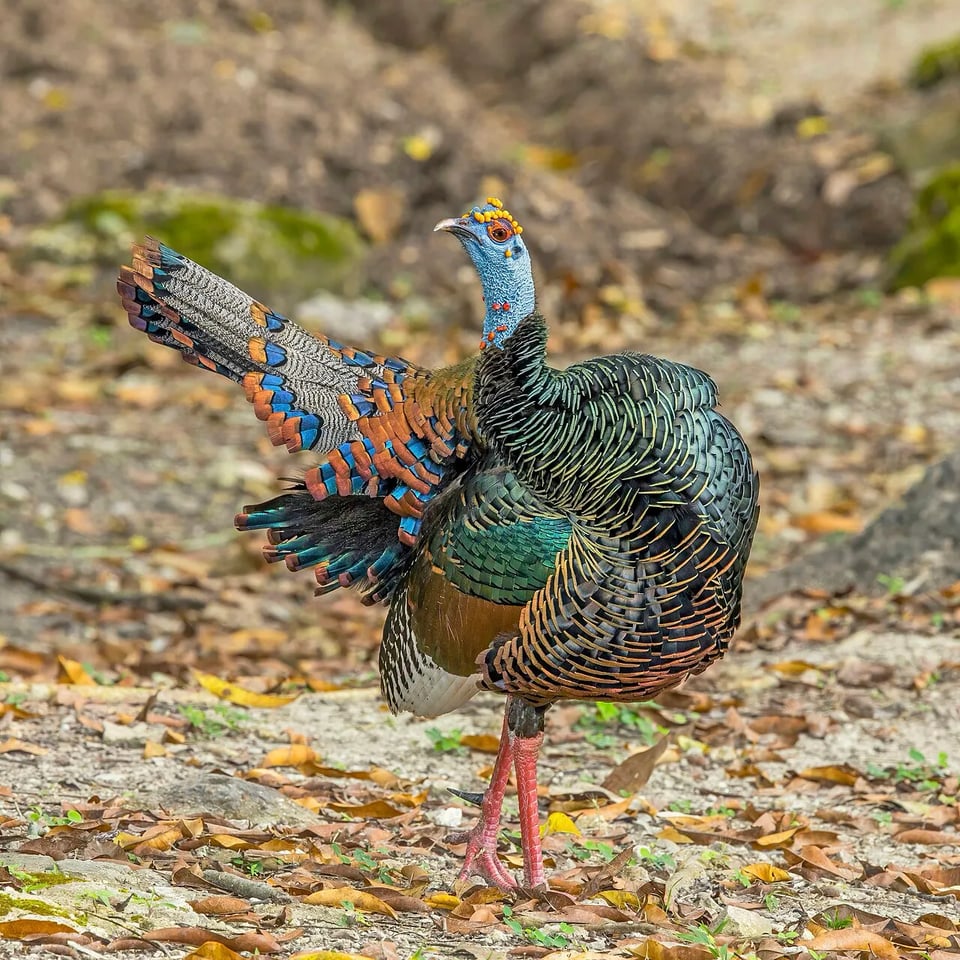
And in the regions to which the turkey is actually indigenous? In Mexico, the bird is referred to as guajolote, possibly named after the Aztec palace complex at Huexolotlán, where the turkey was a popular item of sacrifice. In Guatemala, a turkey can be called a chompipe, thought to derive from the highland Sacapultec call for a turkey, “pi-pi-pi.” In some dialects of Colombian Spanish, a turkey is a pisco, borrowed from the Quechua pisku, which means both penis and bird, inadvertently evoking a powerful image of a turkey wattle. In parts of Mexico the bird is a gallina de la sierra (chicken of the high sierras) or gallina de la tierra (chicken of the earth). It’s also worth noting that the Yucatán peninsula alone hosts a unique and separate species of turkey, which is a fabulous creature deserving one thousand names:
Other languages have passed beyond geographical and taxonomical confusion and met the turkey on its own terms; in German, truthahn means “threatening rooster”; its name in Mandarin translates to “fire chicken.” The Japanese call it the “seven-faced bird,” after the tendency of turkeys’ faces and wattles to change color according to their mood (white for peaceful, blue for horny, red for threatened, and combinations thereof). My favorite, however, may be the Luxembourgish schnuddelhong, or snot-hen. I’m not asking any questions.
Fire chicken. Snot hen. Penis-bird. Weeping Greek women. And other names for a big, wattled bird that I’ve become intensely attached to over the course of writing and researching this essay.
I’ve been thinking a lot about names recently—more so than usual, given that this year, I chose mine. In my case, coming out as a trans man meant switching to the male form of my previous name. In one fell swoop, I went from thirty-five years as Talia to a scant year of Tal. That was particularly poignant, perhaps, because chopping off the -ia meant going from “dew of God” to simply “dew”: surgically excising the name of God from my name, in favor of the stark fact of a harmonious natural phenomenon. Dethroning God and choosing my own name, I threw off the geographical, gender, and theological confusion of the name I once had. I raised my wattled head to the sky and let loose a throaty gobble of contentment. Let others confuse themselves into oblivion calling after a dead name. My own is mine, I chose it. If a turkey could do the same, what might it say, strutting and calling its way through a long dark wood to its home?

-
What an absolutely wonderful word-excursion. Thank you.
-
I really enjoyed this. You prove time and time again that a great writer can write about anything and make it captivating.
-
Fascinating history and very entertaining! People sometimes say that cats especially, but perhaps other animals, must have their own secret names known only to them and each other. Maybe turkeys do too!
-
Hello, I liked this essay very much! There was an old short story I'd like to recommend, about a possible dodo survival into the 20th century- I think the author got some sorts of awards for it, Howard Walfrops "The Ugly Chickens"
Add a comment: