|
Paceline's $50 million of preferred equity in Kelso Industries was redeemed in full when Peterson's $510 million continuation vehicle closed. So the vehicle refinanced the company as well as the fund. The buyers are multiplying too, because Pathway and TIFF each filed a secondaries vehicle on Tuesday and a former allocator opened her own firm. Meanwhile ARK wants its interval fund's shares to trade on an exchange. In all three, the secondary buyer is moving inside someone else's plan.
The tape
- Paceline Equity Partners said on Tuesday that its structured preferred equity in Kelso Industries was redeemed in full at the closing of Peterson's continuation vehicle.
- Yangge Seaman, formerly of Children's Health System of Texas, has launched Gordian Investment Group to buy LP-led deals and, opportunistically, GP-leds in venture.
- PitchBook's half-year fundraising report, relayed by AltAssets on Wednesday, has funds of $1 billion or more taking 78.2% of first-half capital, from 59.1% in 2021.
- Pathway Capital Management filed Form D notices on Tuesday for Pathway Secondaries Fund IV and an offshore twin, with no money raised yet and no press coverage.
- TIFF Investment Management, the outsourced CIO for foundations, filed a Form D on Tuesday for TIFF Secondaries 2026, a vehicle no outlet has covered.
- Columbia Threadneedle and Hamilton Lane filed the registration statement on Tuesday for an interval fund that will keep at least 40% of its assets in Hamilton Lane funds.
- The SEC's notice on ARK's application to list and tokenize shares of its venture interval fund takes hearing requests until Friday at 5:30pm Eastern.
-
Peterson's Kelso vehicle refinanced the company, not only the fund
Peterson Partners' continuation vehicle for Kelso Industries did more than buy out the fund's investors, because part of the money repaid a preferred holder. Paceline Equity Partners, a Dallas manager, said on Tuesday that its investment "was redeemed in full in connection with the closing of a continuation vehicle for Kelso." Terms were not disclosed, though the position itself is on record. It dates from November 2023, when an affiliate of Paceline put $50 million into Kelso to fund several add-on purchases. Paceline's own portfolio page then files it as preferred equity under corporate debt, October 2023 to September 2026, and Alternatives Watch called it "a nearly three-year hold."
Peterson's own release said nothing about it. The $510 million vehicle, reported here on Thursday, had NorthSands Capital as sole lead with more than $450 million, while Fund X rolled and added capital. The release earmarked the proceeds for acquisitions, people and new markets, but some of the money went to Paceline first. The reason lies in what structured preferred equity is, a loan that calls itself equity. It carries a fixed return and a right to be repaid, which is why a sponsor takes it out as soon as it finds cheaper permanent capital. NorthSands' equity was that cheaper capital, so the preferred was redeemed the day the vehicle closed.
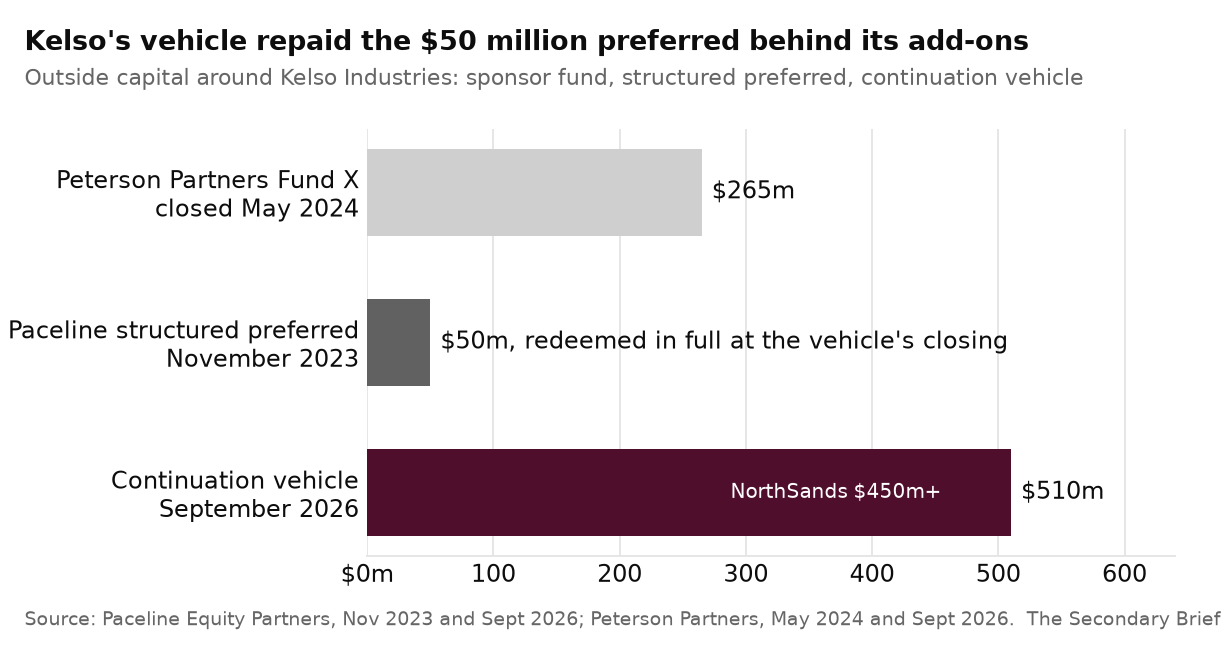 Source: Paceline Equity Partners, 27 November 2023 and 15 September 2026; Peterson Partners, 21 May 2024 and 9 September 2026. |
For the buyer underwriting a single-asset vehicle for a company built by acquisition, Paceline's release answers a question worth asking every time. A buy-and-build usually has structured capital in it, because the fund ran out of money before the company ran out of targets. If the vehicle then redeems that capital, the headline size overstates both the cash to the fund's investors and the growth money left over. So the lead is pricing the whole capital structure, whether or not the release says so. At Kelso, NorthSands wrote nine-tenths of the vehicle, and a $50 million preferred holder was paid out of it.
Three allocators set themselves up as secondaries buyers in a day
The buy side of the secondary market is being built by people who used to sit on the sell side, and Tuesday showed three of them at once. The largest is Pathway Capital Management, the Irvine fund-of-funds manager, which filed Form D notices for Pathway Secondaries Fund IV and an offshore twin. Pathway has run more than 115 customized programs since 1991, totaling more than $125 billion in commitments, but until now its secondaries vehicles were small and closely held. The first raised $100.5 million from three investors in December 2016. The second raised $150.75 million from three investors in November 2020, the month Pathway announced a custom secondaries fund for one client. The third, in September 2024, had raised $230.7 million of a $300 million target from seven investors when it filed. Against that history, a fund numbered IV with an offshore feeder reads as the first one built for more than a handful of clients. Pathway could also be raising a fourth custom vehicle, though, and nothing published rules it out.
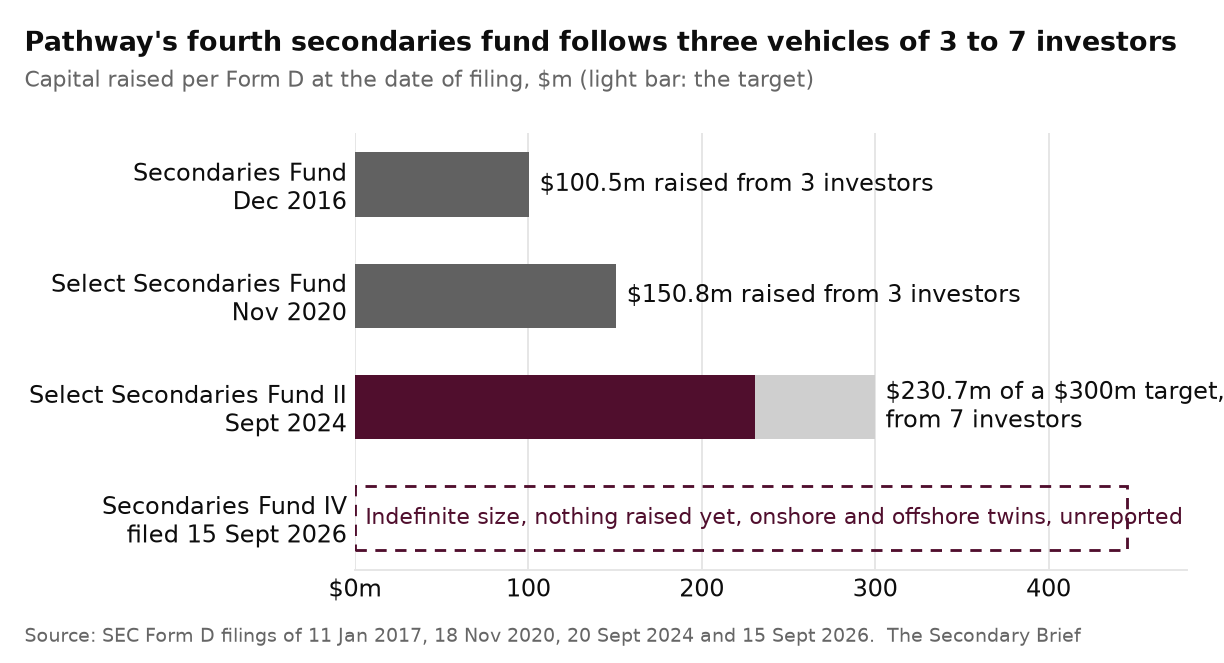 Source: SEC Form D filings of 11 January 2017, 18 November 2020, 20 September 2024 and 15 September 2026. |
The second filing came the same day from Radnor, Pennsylvania, and from a house with no secondaries vehicle on EDGAR before this one. TIFF Secondaries 2026, L.P. names TIFF Endowment Asset Management as promoter, with no money raised yet. TIFF is the outsourced chief investment officer for foundations and endowments, running more than $11 billion for them. Its clients are therefore the kind of small LP that sells fund interests as often as it buys them. The year in the name suggests an annual vehicle for those clients rather than a fund sold to outsiders, though nothing published says which.
The third is not a filing but a person leaving the allocator's chair. Yangge Seaman built the private equity program at Children's Health System of Texas from a 4% allocation. On Tuesday Buyouts and Venture Capital Journal reported that she has launched Gordian Investment Group, which will buy LP-led deals and, opportunistically, GP-leds in venture. Her reason for leaving is the gap she saw from the other side: institutions "often have the appetite and capital to pursue deals" but "aren't able to follow through."
The three share a starting point, which is why they can move so fast. An allocator that has bought and sold fund interests for its own book already knows the sellers, because they are its peers. It knows the managers too, because it committed to them. What it lacks is a vehicle, and a Form D is the cheapest part of the trade. Pathway's last custom vehicle raised $230.7 million from seven investors.
ARK wants an exchange to do what the 5% tender cannot
ARK Investment Management has asked the SEC to let the shares of its venture interval fund trade on an exchange, and the request clears its notice period on Friday. According to the SEC's notice of 24 August, ARK Venture Fund is an interval fund that invests in "disruptive innovation" companies, and ARK wants to add two classes to it. One is an "Exchange Class" listed on a national securities exchange, and the other a "Tokenized Class" that can trade "through peer-to-peer transactions between wallets that are approved." Hearing requests are due by 5:30pm Eastern on 18 September, and without a hearing the order issues.
Private Funds CFO's headline on Tuesday said the request "may open door to more liquidity for evergreens," and the reason is in how these funds handle redemptions. An interval fund promises to buy back 5% of its shares each quarter at NAV, and rarely more. The fund Columbia Threadneedle and Hamilton Lane registered on Tuesday, for instance, "currently expects to offer to repurchase 5%," the minimum permitted. When requests exceed that, every holder is cut back pro rata and waits, which is what happened at HLEND when 11.5% asked to redeem. A listed class removes the queue, because a holder can sell any day to another investor at whatever price the market sets. But for a closed-end fund holding private assets that price is usually a discount to NAV. An exchange would therefore give ARK's holders the secondary market's price in place of the fund's. ARK's earlier application, quoted in the notice, said the funds "do not expect there to be a secondary trading market for their shares." The new one asks for two.
On the radar
- Thursday 17 September, Olympia. The Washington State Investment Board votes at 11:45 on commitments to Clayton Dubilier & Rice XIII and GTCR XV.
- Friday 18 September, Washington. Hearing requests on ARK's application for exchange-listed and tokenized classes of its interval fund close at 5:30pm Eastern. Without a hearing the order issues.
- Wednesday 23 September, West Sacramento. The CalSTRS investment committee meets at 9:00 with the private equity consultant's semi-annual report in open session and a "consideration of investment decision" in closed session.
- Tuesday 29 September, New York. ILPA's Continuation Vehicles for the Limited Partner course meets the day before quarter-end. Sellers price every Q4 process off the 30 September marks.
-
|