Yes, I Have More to Say About Gambling
On $300 billion in sports betting, the great gambling rebrand, and the American polycrisis

Greetings from humid and hazy Abu Dhabi.
We arrived last night but I will spare you the play-by-play of my jet lag this time around, but boy it's something. I hear it just gets worse as you get older. But the only alternative to getting older is death, so I’ll take it.
Subscribe nowAlmost immediately after sending out the last newsletter about the normalization of gambling in the US, I came across several tidbits that I thought were worth sharing and could have included in my write-up.
First from Fortune, to help put the explosion in sports betting in context, “Americans wagered roughly $166 billion on sports in 2025.” That's more money than the entire US movie, music, book, and museum industries generated in revenue combined. Christopher Nolan’s The Odyssey is likely to crack a billion dollars this week and has been front & center in the cultural conversation since its release. But it’s nothing compared to the haul from gambling. That $166 billion figure means Americans are betting just over $3 billion dollars a week through legal channels but even that is likely an undercount:
That figure also excludes sports wagering flowing through prediction market platforms like Kalshi and Polymarket, which have rapidly expanded into sports contracts since gaining federal regulatory clearance. Matheson estimated that activity could represent another $50 billion-$100 billion… Put together, the true volume of American sports wagering in 2025—legal sportsbooks plus prediction markets plus unreported tribal handle—could approach $300 billion.
You know I love a random comparison: this means that people in the US are betting roughly the equivalent of the annual budget for the US Navy ($292 billion) on sports.
Second, I mentioned in the piece that the Supreme Court decided in 2018 that the regulation of gambling should largely be left to the states. NY Attorney General Letitia James said “bet” and filed a massive lawsuit against prediction market Kalshi. In writing about James’ suit this NYT piece explains the legal loophole Kalshi claims separates their “prediction markets” from mere gambling:
Kalshi claims it is not gambling — a stance that state lawmakers contest — but rather a form of financial trading that only the federal government can regulate. Kalshi and Polymarket have found a “legal loophole,” analysts say, that has propelled the companies to staggering success, but that is now being challenged in courts across the country.
So sports betting is gambling, a form of intra-state commerce, and therefore subject to state regulation. Betting on sports in prediction markets, on the other hand, is "financial trading," a form of inter-state commerce, making them a matter of federal jurisdiction. If that distinction strikes you as more semantic than substantive, congratulations. Your bullshit detector is working.
Finally, when I shared last week’s newsletter one of the replies really struck a chord with me; someone described gambling as the next opiate crisis (below).
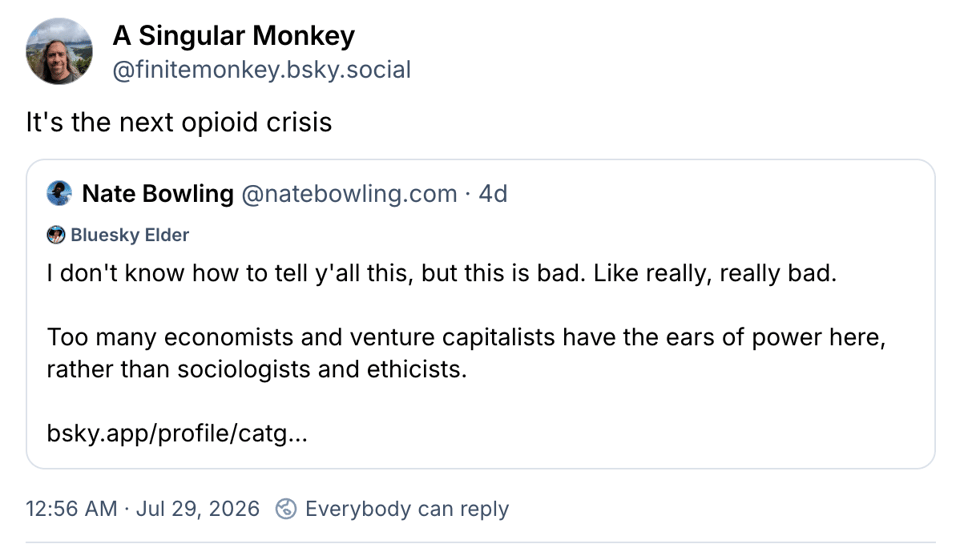
It doesn’t make headlines like it did a few years ago but the opiate crisis is still rocking the country. According to a whitepaper from Avalere Health opioid use abuse comes with a societal cost of about one trillion dollars per year. That figure includes healthcare spending, criminal justice costs, and lost economic productivity.
I'm not suggesting gambling and opioid addiction are the same thing. They aren't. But the comparison got me looking at how researchers think about gambling and gambling addiction. They view it as a public health issue, one with measurable social costs.
This 2025 article from Harvard Law Today discusses how the American Psychiatric Association views gambling addiction. The piece centers on Harry Levant, Director of Gambling Policy with the Public Health Advocacy Institute at Northeastern University:
Levant noted that the American Psychiatric Association has classified gambling addiction alongside substance abuse disorders such as heroin and cocaine addiction since 2013. Despite the risk of gambling customers becoming addicted, however, existing policies allow online sportsbooks, such as DraftKings and FanDuel, to deploy advertising campaigns that he says are designed to distract customers from the risk of harm.
Later in the article Levant summarizes the situation: “what we’re looking at is the total normalization of a known addictive product.” Precisely.
In an early edition of this newsletter, back when it was still on Substack, in a piece that is likely lost to time, I wrote about the polycrisis, a term popularized by historian Adam Tooze. Given the myriad crises facing the United States right now, climate change, job displacement driven by corporate AI adoption, the alleged male loneliness epidemic, housing affordability and homelessness, soaring levels of personal debt, the aforementioned opioid crisis, and more, I don't know why we decided to throw the fuel of problematic gambling onto those flames. But we did, and I don't see how any of this ends well.
—
On the podcast this week I have an interview with Arkansas based noir author, Eli Cranor. We talked about his novel, Broiler, which I read and thoroughly enjoyed this summer. It’s his second appearance on the show. If you want to get a sense of him as a writer, check out this conversation (below) and look for the discussion of Broiler on your feeds Monday.