Everything is Gambling Now
Twenty years ago, gambling was something you did. Today it feels like an environment you inhabit.

My time in the US is nearing an end. My departure is coming up but is dependent on events in the Gulf beyond my control.
It’s been a solid visit. Our parents are all doing better than last summer and my mom is much better than during my emergency return visit in the spring.
Each time I come back I notice changes. PorchFest felt like a walk through North Portland. A pilates studio appeared next to the Black Hebrew Israelite Temple on South 12 Street. There’s new apartment construction, new encampments for unhoused people, and new businesses popping up in mom’s neighborhood.
These changes feel radical to me because I see the terrain infrequently.
Every six months or so I parachute back into the country, spend a few weeks with the family, and then head home to Abu Dhabi. It's a bit like watching a movie but only seeing every tenth scene. The plot advances in giant leaps, and the changes people living here barely notice feel startling to me.
Subscribe nowEnvironmentalists have a name for this, shifting baseline syndrome. In short, every generation accepts the world it inherits as normal, even if that world would have shocked the generation before.
I could apply this shifting baseline syndrome idea to twenty different instances happening societally but the example I want to look at today is the deluge of sports betting and prediction markets in the US.
It hit me the other morning that there are guys out there who wake up, grab their phone, and place bets before they've even brushed their teeth. They do it casually, the same way I open Wordle or Map Tap before my morning stretch. For some reason, that thought really bummed me out.
My inner college libertarian and my inner dirtbag gambler both tell me sports betting should be legal but my eyes and the unfolding societal implications tell me otherwise.
Half of men aged 18-49 have an active online sports betting account. Ninety-five to ninety-seven percent of sports bettors lose money in the long term. In states that have legalized sports betting the average citizen is worse off. A 2024 UCLA study found that legalization is associated with lower average credit scores, increased debt collection instances, and a rise in bankruptcy filings.
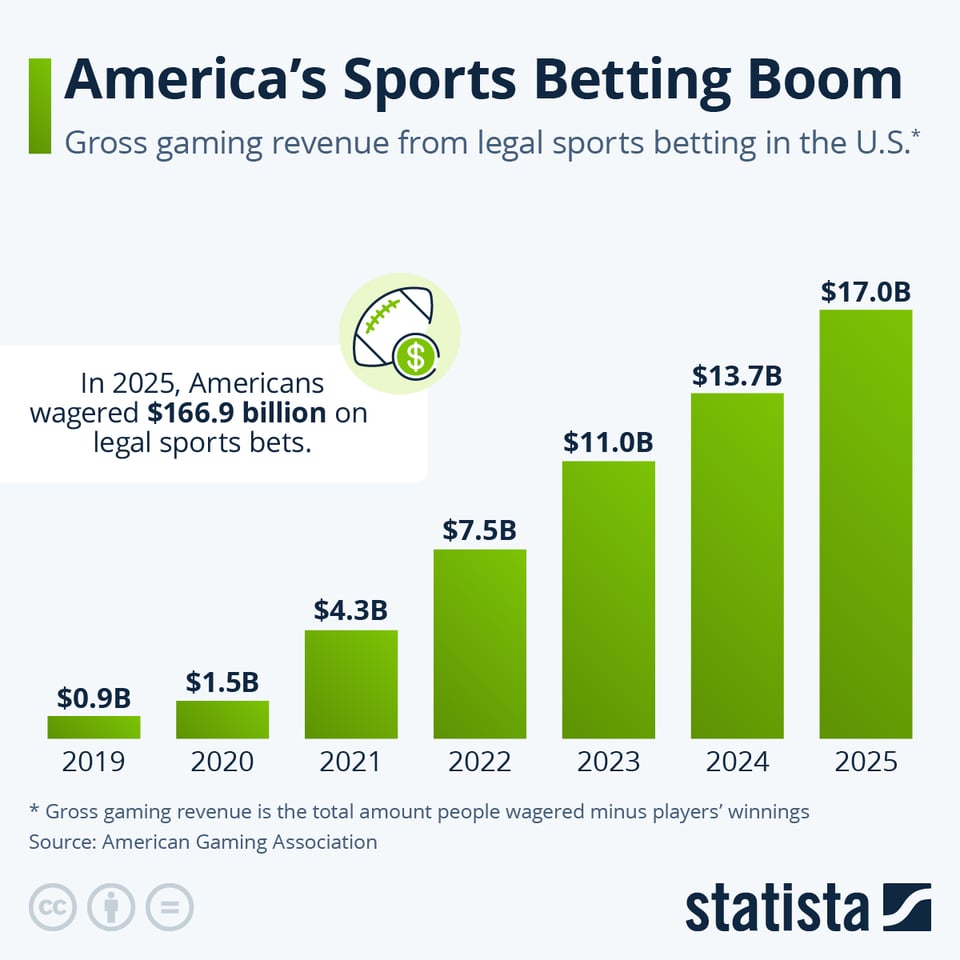
How did we get here? Murphy v.NCAA , the Supreme Court Case that opened the door for legalized gambling across the country, was decided in May 2018. The court found, using the Tenth Amendment, that the regulation of gambling ought to be left to the states, rather than allowing the federal government to broadly prohibit it.
In short order, sports betting and so-called daily fantasy games went mainstream. They were followed by prediction markets. These markets reside in a grey zone of US law. For instance, Polymarket is based overseas and allows customers to place bets and withdraw their earnings in various cryptocurrencies. Prediction markets manage to avoid even being called gambling, even though they clearly are and they are rife with insider trading and other scammy behavior.
Prediction market platforms have also listed contracts on questionable subjects, including individual deaths, natural disasters, and the outbreak of wars. They operate with less regulatory oversight than traditional sportsbooks, leaving ordinary users exposed to opaque rules and thinly traded (and easily gamed) markets where prices can move dramatically on relatively small amounts of money.
This hits me like a sledgehammer to the face when I come to states because in the Gulf this is all banned.
In Islam, gambling is haram (forbidden). The reasoning is both moral and social: gambling encourages speculation over productive work. It breeds addiction and most importantly it's considered a distraction from one’s walk with Allah.
I’m not a Muslim, but I have to admit they may be onto something.
Like any prohibition, people find ways around it (VPNs exist), but as a cultural norm it's effective. There are no sportsbook commercials during football matches, no casino apps fighting for your attention, and no prediction markets creating contracts on every occurrence.
To be clear, I'm not arguing that gambling itself should be illegal.
I've spent enjoyable evenings playing poker and we had a legendary shift on a craps table in Reno about a decade back. I understand the appeal.
What unsettles me isn't gambling, it's the normalization of gambling. Twenty years ago, gambling was something you did. Today it feels like an environment you inhabit, especially online (see video below).
To make matters worse, no one is winning on these markets. According to a paper from June 2026 published in SSRN, the top one percent of users on Polymarket capture 75% of the profits:
The vast majority of winning users, therefore, earned only a negligible share of total profits. This extreme concentration is consistent with a tiny fraction of traders accounting for nearly all of the net surplus, with the much larger pool of losing participants on the other side.
Prediction markets are a zero sum affair. If the top 1% of winners get over 75% of the profits, this leaves the remaining 99% of users with less than 25% of the profits and the vast, vast majority of the losses.
Prediction markets are sold through slick ads to young people who the economy has largely left behind. But the outcomes on the markets are as unequal and skewed as the broader economy they sought refuge from in the first place.
One of the industry's greatest achievements has been convincing people that gambling isn't gambling. Sports betting is now "fan engagement." Prediction markets are "information markets." It's the same wager wrapped in more respectable language, and the rebranding has been effective.
The sports fan turning twenty-one today has never known an America where betting wasn't integrated into the viewing experience. They don't remember when point spreads weren't discussed on every pregame show or when sportsbooks weren't major league sponsors. To them, this isn't a cultural change.
It's just sports nowadays. But it’s not just sports.
Investing now resembles gambling. Crypto is definitely gambling. Investment apps offer crypto; crypto platforms offer prediction markets. It’s all blending together.
The danger isn't that Americans suddenly woke up and decided to gamble. The danger is that gambling has become so thoroughly woven into our lives that many people no longer recognize it as gambling at all.
Until you leave.
Then you come back and realize the country has become something you don't quite remember.
—
There’s a really dope new episode of the podcast this week with Faine Greenwood on drone technology. Check it out if you haven’t already.