
Read and Watched | Q3 2026
19 books; 28 movie/series recommendations
On 13 September, I saw back-to-back two of the best and worst movies I have seen this quarter, possibly this year: Don’t Look Back in Anger and Practical Magic 2, not the order I expected to rank them when I set off for the cinema in the morning.
Both are about siblings, but the comparison that struck me while watching Practical Magic 2 is that the main cast in both films is in their late to mid-50s, yet they wear it very differently. Sandra Bullock and Nicole Kidman have extremely smooth faces, in a way that borders on the uncanny and is distracting and detrimental to the narrative. Over 20 years have passed since the events of the first Practical Magic, and Bullock’s daughters are grown women, but it’s hard to tell based on the actresses’ faces. The Gallagher brothers’ many wrinkles, on the other hand, support the overall arc of their documentary: two men who have mellowed with age and now know better.
It’s not an original take to say that men and women in the public eye are allowed to age differently, but it was extremely obvious during these two films. I don’t know if Practical Magic 2 would have been better if Kidman and Bullock had wrinkles; it would take a lot more to save that script. But it would have been less sad to see a movie about sisterhood and aimed at women that doesn’t reinforce ridiculous ideas around ageing.
Below are 26 more films and series and 19 books I read and watched this quarter:
📖 Read
The Best
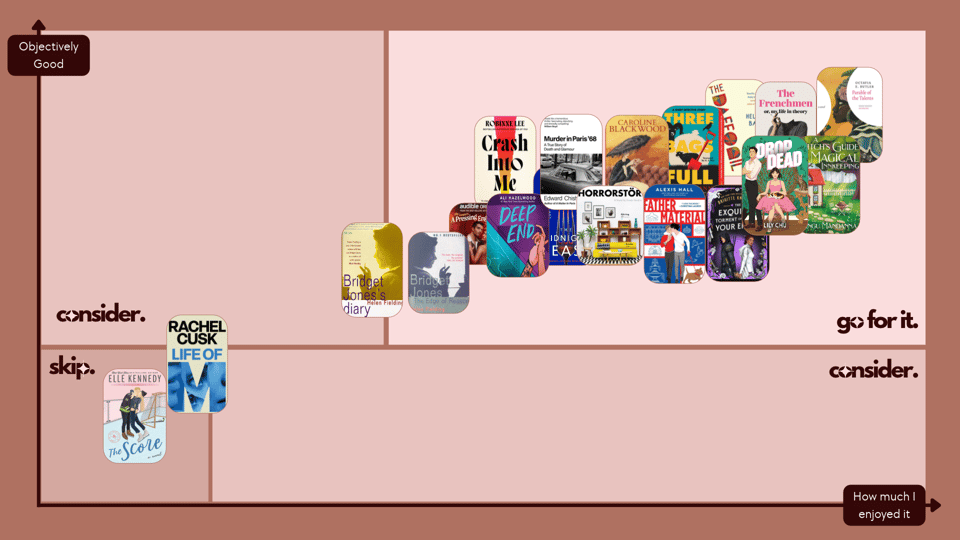
The Daffodil Days, Helen Bain (The London Library)| I struggle with the “literary” label, but this is truly a literary novel. It’s an imagined biography of Sylvia Plath in the last two years of her life through the eyes of people in a village in Devonshire. The reverse chronological order is fascinating, as is the fact that every chapter is told from a different pov with a distinctive voice.
The Parable of the Talents, Octavia E. Butler (The London Library)| Did Octavia Butler have an incredible imagination, or do descents into fascism and authoritarianism all look the same? Both. This second Parable novel is presented as if Lauren’s daughter introduces her mother’s diaries in each chapter. As a result, it is a slightly easier read than Sower.
The Frenchmen or My Life in Theory, Emily Eakin (The London Library)| Didn’t expect a part-memoir, part-biography of the French existentialists, structuralists, and poststructuralists to be one of the most fun books I read this quarter, yet here you are. Eakin touches on their ideas, but mostly she focuses on who these theorists were as people, i.e. dramatic, gossipy little bitches with overblown egos who fought each other through public lectures and academic journal article footnotes. Where’s the Netflix series?
A Witch’s Guide to Magical Innkeeping, Sangu Mandanna (PR gift)| The perfect cosy witchcraft novel to while away a Saturday afternoon in a heatwave. Sera used to be a super powerful teenage witch but lost it all when she resuscitated her aunt (and a rooster). She now runs an inn that people can only find when they need it. Enter Luke and his autistic sister. The cosy and relationship aspects are great and make up for the storyline interrogating the broader power systems in the world, which is tonally a bit off.
The Good
Good Night Sweet Ladies, Caroline Blackwood (The London Library)| A collection of short stories featuring slightly eccentric middle-aged women, most of them single or divorced, during crisis points in their lives. Matron is struggling with her handling of a dying patient’s family, Mrs Ripstone is meeting the boy she abandoned at birth for the first time, Mrs Burton’s dog is dying, Olga herself is dying, and Angelica is curing her depression by hanging out at the Old Brompton Cemetery (relatable). Loved the writing and the characters.
Murder in Paris ’68, Edward Chisholm (The London Library)| In 1968, Alain Delon’s friend Stevan Marković was found murdered. Chisholm investigates his life and death as well as the exact nature of his relationship with Delon. Likely most interesting if you have some idea of what is going on in France and French cinema at the time.
Drop Dead, Lily Chu (Audible Original)| Nadine and Wes have been at odds since journalism school. Now they are stuck in the house of literary legend Dot to figure out the truth behind her most popular novel. Their relationship is fun, mostly because Chu has them solve every issue that can be solved with a discussion with a discussion and therefore avoids my biggest rom-com pet peeve.
A Pressing Engagement, Jilly Cooper and Dare Aiyegbayo (Audible Original)| The story is standard Cooper fare, featuring a 1970s secretary who pretends she is engaged to her childhood crush rather than telling her boss she got a new job. Aiyegbayo’s dramatisation (he is a scriptwriter on RIVALS) and the full cast are excellent. Includes many commercial tropes, including fake dating, there is only one bed, the pretty girl is a b*tch, first orgasm, etc etc.
Bridget Jones: The Edge of Reason, Helen Fielding (Owned)| I enjoyed this more than Diary – Bridget is less oblivious and less beholden to her self-help books, but Fielding’s writing remains hilarious. Reads like a time capsule of the 1990s.
The Midnight Feast, Lucy Foley (PR gift)| Another Lucy Foley mystery based on class and being the outsider. This one interweaves three timelines: one in the run-up to a posh hotel opening, another the next morning focused on the policeman investigating arson + murder, and the last one based on the old diary of one of the guests. It has proper twists based on clever wordplay and information withholding, and it ties everything up neatly.
Father Material, Alexis Hall (Libby audiobook)| A bit self-indulgent – by this point, Alexis Hall’s trilogy is proven enough that many scenes are hilarious fan service, but could objectively be cut off. During the first third, Luc and Oliver adopt a dog; then they become foster parents to a teenage girl.
Deep End, Ali Hazelwood (Owned, audio)| There are thousands of new audiobooks I could have listened to, yet I picked this one – it’s one of my favourite Hazelwoods, alongside The Love Hypothesis. It didn’t hold up to a second listen as well as I expected; it was a lot better in my memory.
Horrorstör, Grady Hendrix (Borrowed)| Workers at an IKEA-type furniture store find themselves locked in overnight and discover that the ghost of the prison that previously stood there runs the place at night. The comparison between work and jail, workers and zombies, and the overall ills of capitalism mostly works. To reinforce the concept, the novel is laid out as a furniture catalogue, with item descriptions being increasingly unhinged. A quick read with an ending full of more horror potential.
The Exquisite Torment of Loving Your Enemy, Brigitte Knightley (purchased)|Laughed a lot reading this. Every time my mind tried to wander, Osric and Aurienne’s antics brought me back to the page, and sometimes that’s all I am asking of a novel. Even though the magic system, world and characterisation have evolved, you can still feel the fanfic DNA (complimentary).
Crash into Me, Robinne Lee (Wandsworth Library)| Positioned as a book about two women who, years after a traumatic incident on a fashion shoot, rekindle their relationship, but really, it’s about anti-Black racism in France and the US. This is not a second THE IDEA OF YOU, although they have many commonalities – the tone, the artsy background, the wealth, the focus on middle-aged women.
Three Bags Full, Leonie Swann (Wandsworth Library)| A flock investigates the death of their shepherd. Incisive, often dark humour because seeing ourselves from the perspective of sheep is funny but also highlights how ridiculous so many human actions are. MGM sanitised the story when transposing it to screen – here, the shepherd is mixed up with local crime, so the sheep get confused by discussions about “grass”.
The Meh
Life of M, Rachel Cusk (owned momentarily)| I should know better than to read a novel whose promotion was entirely based on the fact this is based on Natalie Portman, yet I apparently do not. This was boring and unoriginal. The prose had that weird quality that with every new sentence I read, I forgot the previous one. Cusk doesn’t seem interested in engaging with the celebrity ecosystem; it’s as if she will take the buzz that comes from it but otherwise thinks herself above it.
Bridget Jones’ Diary, Helen Fielding (Owned)| Five stars for nostalgia, two for “wow, the 90s were messed up”. I was in high school in France when this first got translated, and I thought Bridget Jones was a role model for what adulthood would be like. I'm older than Bridget now, and I'm pleased to say my life is nothing like hers. I am less of an alcoholic, not as obsessed with men and hopefully less oblivious. My writing is also less funny, so I guess you lose some.
The Score, Elle Kennedy (Audible Audio)| There are “characters”, and they have an “arc” in this “novel”. Dean goes from fuckboi hockey player to girlfriend guy; Allie from committed monogamist feeling guilty for having sex with Dean, to committed monogamy with Dean. This happens mostly through sex scenes, and when they are not having sex, Dean especially is thinking about having sex. I don’t get why this series is doing so well.
🎞️ Watched: Movies
The Best
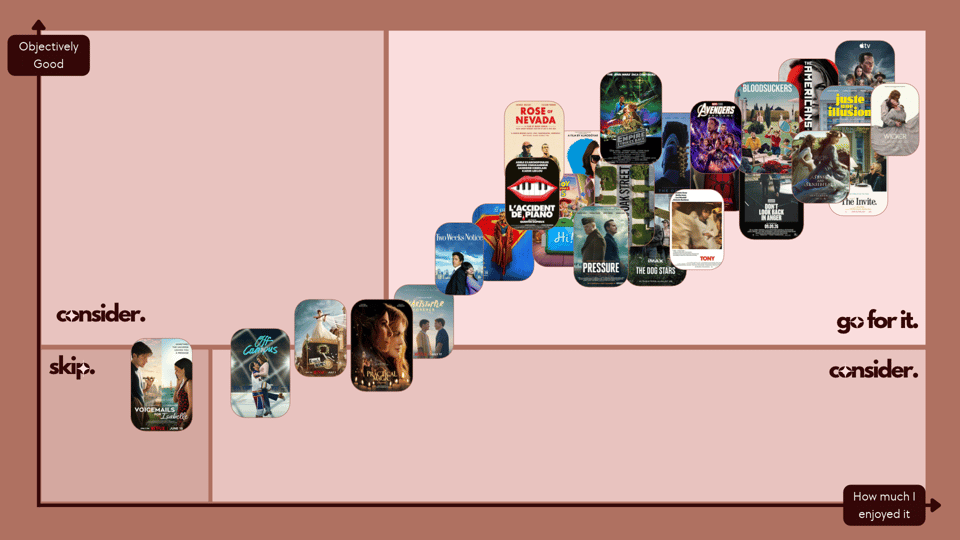
Widow’s Bay, Katie Dippold (2026, Apple TV)| Smart and tight storytelling; excellent acting. As someone unfamiliar with the horror genre, a lot of references went over my head. One of many recent cultural moments that made me wonder if I need to get more into horror. Also – am I Patricia?
Wicker, Alex Huston Fischer and Eleanor Wilson (2026, BFI London Film Festival Press)| Was it weird to hear Peter Dinklage tell Olivia Colman he didn’t build her “some fuckable furniture” at 10 am? A bit. The women in the village realise how much more they can ask of their husbands and lives when they see Colman’s wicker husband. The men are predictably unhappy, as is the Queen Bee.
Don’t Look Back in Anger, Will Lovelace and Dylan Southern (2026, Odeon Limitless)| Objectively, this is probably “good” rather than “great,” but it gets upgraded because I am extremely not the audience for that movie as someone whose knowledge of Oasis was spotty, yet I had a great time. The directors and writer went for a forgiveness-and-legacy arc; don’t mention the money. I was aware I was being emotionally manipulated the whole time, but I was fine with it.
Just an Illusion, Olivier Nakache and Eric Toledano (2026, Cine Lumiere)| Super funny French comedy about a French family in the 1980s dealing with the recession and changes to the world of work. Mostly told from the perspective of a 13-year-old Jewish boy falling in love for the first time. Will change the way you see that photo of Francois Mitterrand and Helmut Kohl holding hands in Verdun.
The Invite, Olivia Wilde (2026, Odeon Limitless)| I love being in a packed movie room where a lot of people laugh, and there were a lot of laughs during The Invite. I was fascinated by the continuity of Wilde’s dishevelled hairstyle.
The Good
Bitter Christmas, Pedro Almodovar (2026, Cine Lumiere)| Spent half the movie listing issues with the script only to be vindicated during a satisfying 10-minute scene in the third act when the fictional director’s former assistant points out all the shortcomings in his script. The fashion is colourful, and the actresses have wrinkles.
Spider-Man: Brand New Day, Destin Daniel Crettin (2026, Odeon Limitless)| Watched this at the first showing on the first day in a pumped-up room and I loved it. It is weighed down by Jean-Gray-the-villain-but-not-really, but the bits about Peter’s life more than make up for it. The way the last scene subverts the true love’s kiss trope referenced before is very sweet. The end credit scenes were a scam.
L’Accident de Piano, Quentin Dupieux (2025, Mubi)| Influencer Magalie, famous for self-mutilating videos, is recovering in the mountains after she had a piano dropped on her. An interview with a journalist unravels her world as the asshole side of her personality comes under scrutiny. Less improbable, darker than the usual Dupieux fare.
Supergirl, Craig Gillespie (2026, Odeon Limitless)| Add to the list of superhero movies that tackle an interesting theme but don’t commit to it because people need to fight in Act III. Supergirl is dealing with the trauma of her planet being annihilated. Also -- can killing someone for revenge ever be a good idea?
Rose of Nevada, Mark Jenkin (2025, at the BFI)| A movie about time-travel shot in 16 mm where the film format reinforces the atmosphere of the film – the colours changed in places, the film had small defects, and it all contributed to feeling back in the 90s. One morning, Rose of Nevada, a boat lost for 30 years, turns up at a down-on-its-luck Cornish port. Three men take it out fishing for the day, and when they come back, they have gone back in time to the 90s, when the port was thriving.
Tony, Matt Johnson (2026, at the BFI)| Knowing little about Anthony Bourdain didn’t stop me from enjoying this biography and Dominic Sessa’s portrayal – I appreciate a script that takes an unflinching look at what an arrogant, lying and creepy man Bourdain was aged 19. It made me put a hold on Kitchen Confidential at the library and want to eat all the seafood I can’t have.
The Empire Strikes Back, Irvin Kershner (1980, at the BFI)| I had never seen any of the original trilogy on a big screen. The beginning sequences are a bit rough, but then you get into it, and this is a movie that packs a lot – also probably the one I think of the most when I think of Star Wars since it introduces Yoda, features the fight sequence with the AT-AT walkers, the infamous “I am your father, Luke”, and also Leia kissing her brother twice, a real narrative choice.
Two Weeks Notice, Marc Lawrence (2002, Netflix)| The Sandra Bullock-Hugh Grant chemistry still sells this, no small feat considering the main character is a real estate millionaire based at least partly on Trump, who also makes a cameo.
Pressure, Anthony Maras (2026, Odeon Limitless)| The run-up to D-Day seen through the eyes of the Allies’ meteorologist. A very British historical drama; every actor is great, and people in power get convinced by facts and reason. I appreciate that they didn’t sanitise the cost of war; sometimes, when we talk about WWII these days, it’s almost presented in a vacuum, as if it were won magically.
The End of Oak Street, David Robert Mitchell (2026, in cinema)| One of many movies I saw for the AC this summer that turned out to be an entertaining two hours. It does suffer a bit from the “badly organised at the end of the world” trope (Hunter Harris wrote about it in more detail in her newsletter).
The Odyssey, Christopher Nolan (2026, Odeon Limitless and IMAX)| Visually and acting-wise great. I'm still thinking about Odysseus' overall arc because he realises in Troy that he did something monstrous, but then is determined to bring home the men who also did it, and everyone keeps being awful during the return journey, so what did he realise exactly? If you’re holding off for the IMAX 70 mm – don’t. It doesn’t add enough to justify the cost or wait.
Sense and Sensibility, Georgia Oakley (2026, Odeon Limitless)| No, we don’t need more Austen adaptations. But this one is fun, well-directed and well-acted. I left with a new story idea, what’s not to like.
Bloodsuckers, Julien Radlmaier (2021, Mubi)| What if Karl Marx’s assertion that the bourgeoisie are vampires sucking the blood off the proletariat is the starting point for this super stylish film despite a few slow passages. With nods to Nouvelle Vague and Wes Anderson.
Avengers: Endgame, Anthony and Joe Russo (2019, Odeon Limitless)| Possibly the first time I saw the full movie since it came off cinemas, as I tend to skip certain scenes. The additional footage was fine, but even without it, it was great to watch this on a big screen again. Still get a thrill from Cap walking into the lift or calling Thor’s hammer.
The Dog Stars, Ridley Scott (2026, Odeon Limitless)| This is a competent movie, somewhat let down by weakness in its script and some abrupt tonal changes – but then the book also does take turns. Neither the best movie of the year nor Scott’s best movie, but it’s one of those movies where I don’t understand the level of critical panning. Read my full review here.
Toy Story 5, Andrew Stanton (2026, Odeon Limitless)| I went for the AC, but this ended up being a solid movie about the power of imagination. It could have been a movie where Pixar interrogates its role in the decrease of hand-drawn animation, but that might have been asking for too much. One of the most uncomfortable things in the toys vs devices standoff is that, whereas toys coming to life is fantasy, with AI, a software deciding to play tricks on us is not that far off.
The Love Hypothesis, Claire Scanlon (2026, Amazon Prime)| I have read the book an indecent number of times – this is broadly a good adaptation. It doesn’t improve on the source material the way Heated Rivalry did, and some choices in the science and academia world are puzzling, but they also remove some of the more problematic threads from the original.
The Americans, Joe Weisberg (2013-18, Disney +)| I needed something during the heatwave that was good enough to keep my attention but not so good it would take over my life. I just wish Keri Russell spent less time unnecessarily naked and/or in her underwear.
The Meh
Enola Holmes 3, Philip Barantini (2026, Netflix)| I am fond of this franchise for reasons that become harder to remember in this third instalment. The first two had decent mysteries you could work out yourself; this one not so much. Still think this Sherlock is one of Henry Cavill’s best recent roles, and it’s fun to have him as the damsel in distress.
Practical Magic 2, Susanne Bier (2026, Odeon Limitless)| The smoothness of Nicole Kidman and Sandra Bullock’s faces was distracting; the plot comes together in the loosest sense of the term. Kidman was funny, I enjoyed the lace, and Lee Pace looked good, so there was that.
Off Campus, Louisa Levy (2026, Amazon Prime Video)| I know this has a dedicated fandom, but I kept wondering what I was watching, and not in a good, mind-blown way. Allie and Dean’s background story was my favourite, so I read their novel, big mistake (see above). My biggest issue with the series is how poorly they handle Hannah’s trauma following her rape.
Voicemails for Isabelle, Leah McKendrick (2026, Netflix)| Dude decides to fly across the country when he starts receiving voicemails from an unknown woman left for her dead sister. It’s creepy, and the two leads never spend enough time interacting on screen to convince me they are falling in love. Can we retire the falling-in-love montage and have people interact properly? I need banter and flirting to believe in romance.
Heartstopper Forever, Wash Westmoreland (2026, Netflix)| This ends on such a poor note that I half wish Netflix hadn’t ordered a film. Season 1 is still one of the cutest things I have seen on TV, so I am just going to pretend that the characters’ stories have never been underserved.
Thank you for reading this! I am going to make these monthly going forward to avoid such long emails, plus that means I can bring back exhibition and play reviews.