
Read/Watched/Visited in Q2 2026
20 books; 27 movies; 2 plays and 2 exhibitions
When I first saw Caroline Beaufort Frankenstein’s scarlet veil flapping in the wind on my small laptop screen in February, I immediately regretted not watching Frankenstein on a big screen. Luckily, the BFI held a Guillermo Del Toro season through May. I finally saw Caroline’s veil as the director intended – there is no way around it; they just flap more dramatically that way. The showing I went to was in 35 mm, and I hate to be that person, but the format combined with the dark room and big screen was just a better experience. Release all movies at the cinema, you cowards.
📖 Read
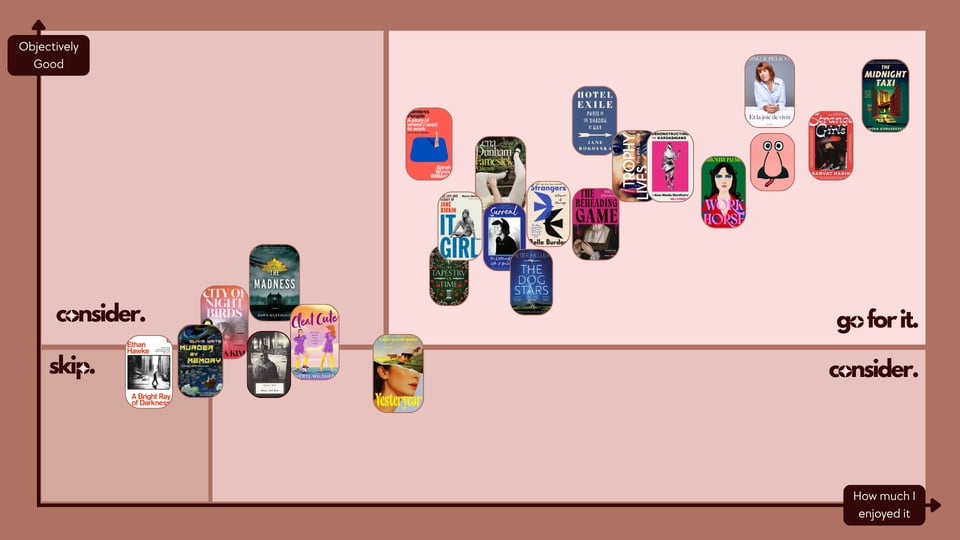
The Best
The Midnight Taxi, Yosha Gunasekera | Every time my mind started wandering, the combination of Gunasekera’s great plotting and characters, plus Isuri Wijesundara’s excellent audio narration, brought me back to the story. Taxi driver Siriwathi Perera is accused of murder when her last ride of the day dies in her yellow cab. With the Police convinced of her guilt, she is forced to investigate with her new friend and lawyer.
Et la Joie de Vivre, Gisèle Pelicot | You can feel that Pelicot worked with a novelist for this, both in the arc of the memoir and the role some people play in it. It’s a heavy read but never a hard read, as the narration jumps between Pelicot reflecting on her experience, the immediate aftermath of discovering that her husband raped her, and a close look at her family and marriage in an attempt to understand how she spent decades married to a stranger. Read for Lauren Bohn’s book club.
The Good
Strangers, a memoir of a Marriage, Belle Burden | This is a good companion to Pelicot’s memoir as it also asks whether we ever know the people we share our lives with. Overnight, Burden’s husband moves away from 20 years of family life. She mostly owns her financial privilege, but her book works because it covers themes that echo, like gender inequality in couples’ finances and divorce.
Dekonstructing the Kardashians, a New Media Manifesto, M.J. Corey | The Kar-Jenners (mostly Kim) analysed through the lens of philosophers, sociologists and other theorists. Corey argues that the family being under constant scrutiny helped normalise all of us always being under some form of surveillance. Timely, the week Kylie promoted the Meta AI glasses. Pairs well with Trophy Lives (Philippa Snow), about fame as performance art.
Famesick, Lena Dunham | I borrowed Famesick for the gossip, but I wish Lena Dunham spent more time on the Girls writing process or the creative community she developed when she was starting out as a director.
Strange Girls, Sarvat Hasin | Years after their close university friendship broke down, Aliya and Ava are forced back together during a hen do weekend. Told through a mix of flashbacks and present-day timeline, the story questions the durability of young-adult friendships.
The Dog Stars, Peter Heller | A month since I finished it, I still wonder what happens to the characters after the book ends. Hig has been surviving with his dog since a deadly flu brought on the apocalypse and is starved for community. The second half takes a weird turn, mostly because there are three chapters of sex written by a man.
The Beheading Game, Rebecca Lehmann | A beheaded Anne Boleyn wakes up in her coffin and decides to get revenge. The first part pairs Anne with a Fenwoman in London for a few days to earn money as a prostitute. They fall in love, though the sapphic romance is secondary. The second part, focused on Anne’s mission to behead Henry VIII, draws on English legends like Excalibur and the Green Man.
It Girl, the Life and Legacy of Jane Birkin, Marisa Meltzer | Delivers on the life more than on the legacy, but if you’re looking for a biography that goes beyond (though still covers a lot of) Jane Birkin’s relationships with famous male artists, this is a good start. I finished reading it and came away with a long list of movies to watch.
Workhorse, Caroline Palmer| The Devil Wears Prada meets The Talented Mr Ripley/Saltburn meets Grey Garden. Middle-class Clo gets a job at a fashion magazine when it still meant generous expense accounts. Over the next 10 years, as she ingrains herself in the life of her posh new friend, she gets a front-row seat to the decline of the industry and the rise of Internet publishing. Probably best if you care about fashion and/or magazines.
Hotel Exile Paris in the Shadow of War, Jane Rogoyska | Great if you’re looking for a primer on Paris in the run-up to and during WWII. Rogoyska takes you on a whirlwind of stories, from the German intellectuals who sought refuge there, to the German officers who invaded and finally, the people who came back from the camps. Not so good if you want to know more about Hotel Lutetia during the period, which is a barely-there thread.
Careless People, Sarah Wynn-Williams |The question I came back to most often while reading this exposé of Facebook screwing up our world wasn’t “how do they get away with all this” (I feel we know by now) but “why didn’t you leave before”? TL;DR: Meta, Zuckerberg and Sandberg are terrible, and knowing when to get a new job is a skill in itself.
The Meh
Yesteryear, Caro Claire Burke | I read so much discourse about Yesteryear before I read the actual novel; it was hard for me to have my own opinion. There is something very Sarah J. Maas about Burke’s writing: propulsive, best not to think about it too much while you’re reading it. The emotional note at the end erases some of the plot problems throughout.
A Bright Ray of Darkness, Ethan Hawke | This novel changed the way I go to the theatre. It also boldly asks, “Are women who don’t want to fuck the narrator worthy of consideration?” There are some fantastic chapters on acting; it’s just a pity/boring that Hawke writes an expected story about a famous cheating actor incapable of making good decisions.
The Tapestry of Time, Kate Heartfield | Fun premise: the Tapestry of Bayeux + the Nazis + four clairvoyant sisters and their dad. Ivy, the main character, is worried about fascists having the gift of Second Sight, but who needs that in 2026 when we have poorly regulated tech that tracks us?
City of Night Birds, Juhea Kim | A former star ballerina is in St Petersburg, the city of her youth and training, to dance one last ballet following a life-changing injury. I generally love books about the tension between the work, ambition, and control it takes to become and remain the best, and about athletes being messy in their private lives, but here it didn’t work for me.
The Madness, Dawn Kurtagich | A contemporary retelling of Dracula where Dr Mina Murray leads an investigation into the disappearance of poor young women in London and Wales, all found exhibiting a weird rash. Having read Pelicot’s memoir just before, plus with everything we know from the Epstein file, this felt like cathartic horror. IRL, vampires don’t traffic young women; powerful men do, and we can’t take them down as easily.
Henry & June, Anais Nin | Bit unfair to judge Anais Nin’s journals based on this anthology focused on the erotic extracts of her affair with Henry Miller, June Mansfield and a few others. I will, however, judge the publishing/estate decision: after a while, it gets repetitive and stale. Had to keep reminding myself this was written in 1931.
Murder by Memory, Olivia Waite | A cosy sci-fi novella comped with Becky Chambers AND Agatha Christie, this should have worked for me. A detective wakes up aboard a space ship in another passenger’s body. She must solve a crime plus figure out who tried to erase her memory. The novella format means many things, including world-building, happen too fast.
Cleat Cute, Meryl Wilsner | Phoebe grew up worshipping US soccer legend Grace. When she joins her on the New Orleans team, it’s a dream come true. The characterisation didn’t land for me, and many of the interactions read as disproportionately childish, given the players' ages. The sex scenes were hot, though, so there’s that.
🎞️ Watched: Movies
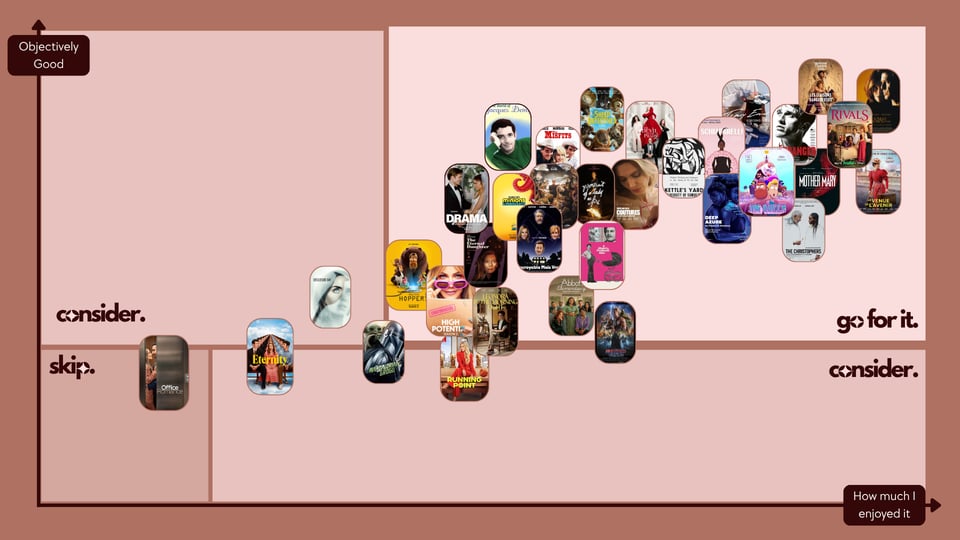
The Best
Colours of Time, Cedric Klapish (2025) | Arriving in Paris from a rural province is an event that looms large in the French psyche, yet Cedric Klapish shoots it in a new way – almost like the arrival in New York from the ocean. In 1895, Adele is going to Paris to find her mother. Nowadays, four remote cousins investigate her life as they inherit the dilapidated house she never came back to in September 1944. I got teary-eyed three times.
Mother Mary, David Lowery (2026) | A film about fame, fashion, the thorniness of creative relationships, with a Gothic second half and not a single man cast or discussed – Mother Mary was tailor-made for me. Michaela Cole and Anne Hathaway are brilliant, the fashion is interesting and makes sense for a pop star, and I’ve been listening to the soundtrack on repeat.
The Thomas Crown Affair, John McTiernan (1999) | I first saw it when I was 13, and as I get closer to the characters’ age, I still think Thomas Crown is one of the best movies ever made. I have made my peace with never becoming Catherine Banning. It’s a movie about hot, smart, and well-dressed people who are excellent at what they do.
The Stranger, Francois Ozon (2025) | Ozon filmed this in black and white in a way that has the sun and heat jump off the screen. There is a fantasy sequence with a guillotine that looks incredible. I’m not sure the jump from Camus’ 1st-person pov to featuring a taciturn character on screen fully works and that you grasp the existentialism of the original, but Ozon gets away with it on style alone.
Rivals Season 2 (2026) | Entertaining TV about TV and a great example of the difference between featuring something and endorsing it, mostly thanks to smart updates to Jilly Cooper’s Rutshire Chronicles. The best bits include a 10-minute one-shot scene in a kitchen at a dinner party involving unwanted guests, secrets and two cupboards, and the whole of Episode 6.
The Good
The Sheep Detective, Kyle Balda (2026) | Funny, entertaining — a good two hours at the cinema. After shepherd Hugh Jackman gets murdered, his sheep must figure out whodunnit because the humans are useless. Doubles as a light meta-commentary on the cosy mystery genre and British detective TV shows.
The Drama, Kristoffer Borgli (2026) | This ended up being Robert Pattinson’s story more than I expected. A week before their wedding, his girlfriend Zendaya reveals that she once planned a school shooting – she didn’t go through with it and became an anti-gun activist. We spend most of the movie following his increasingly cringe reaction to it. One to see with an audience because the reactions are as interesting as the scenario.
Minions & Monsters, Pierre Coffin (2026) | An unexpected lesson in cinema history. The Minions become movie stars during the heyday of silent cinema, but their speech patterns don’t work for talkies (a brilliant idea). Minions Henry and James decide to do their own film, but for that, they need to cast real monsters.
A Slightly Pregnant Man, Jacques Demy (1973) | Demy came up with the idea when Agnes Varda was expecting – how would we collectively react if men got pregnant? Overall, everyone is pretty chilled. Women are excited that men have to give birth, puzzled doctors blame junk food, and capitalism sees it as a commercial opportunity. Catherine Deneuve’s wardrobe, especially her coats and angora jumpers, is somehow the most bonkers part of the movie. Pairs well with Varda’s documentary The World of Jacques Demy.
Incroyable Mais Vrai, Quentin Dupieu (2022) | A fantasy, 75 min fable about two middle-aged, middle-class couples and the impact of gender expectations. Couple 1 buys their dream house, and the wife obsesses over a secret passage in the cellar that advances the clock by 12 hours and makes her 3 days younger. The other man has his penis replaced by an electronic one.
The Devil Wears Prada 2, David Frankel (2026) | I didn’t expect this to be sad, but DWP2 crystallises why we’re all screwed. DWP1 was about being good at your job; DWP2 tells you that it doesn’t matter how good you are, tech billionaires will replace you with an AI. I wish the resolution relied more on Andy Sachs’ journalistic skills – as it is, this is a movie that says “journalism matters” but doesn’t seem to fully believe it.
The Eternal Daughter, Joanna Hogg (2022) | Daughter and mother, both played by Tilda Swinton, stay at the latter’s childhood country home, now a hotel, for her birthday. The daughter is working on a script about her family’s history. There is a twist, but you can guess it from the first scene, or possibly from this summary.
The Misfits, John Huston (1961) | Writing – good. Acting – good. Directing – good. Overall feeling – depressing. Even without the grim context in which this was shot and released, every character is leading a depressing life. Except for Thelma Ritter as a happy divorcee who has set up a home for women looking for a quick divorce in Nevada.
Masters of the Universe, Travis Knight (2026) | Expectations: low. Enjoyment: high. Quite camp, never takes itself seriously, but everyone making that movie took the audience’s entertainment seriously. I wish it were fully committed to deconstructing the superhero genre. He-Man should have been gay.
Le Sens de la Fête, Olivier Nakache and Eric Toledano (2017) | One day in the life of a wedding planner and his team, played by a stacked francophone cast, as everything goes wrong. This was a bit stressful for me, because what do you mean it’s 5 pm and the bride hasn’t started getting ready?
Jim Queen, Marco Nguyen and Nicolas Athane (2026) | Panick strikes when heterose, a new virus that turns you straight, starts infecting members of the LGBTQIA+ community. Superstar influencer Jim Queen is affected, and only Lucien, a timid twink, can save everyone. Very funny, very queer, with a great social commentary. Sadly, it doesn’t currently have a release date outside France.
Portrait of a Lady on Fire, Céline Sciamma (2018) | Stunning visuals, great secondary storyline about a maid seeking an abortion. Another movie without a single man (complimentary). A bit boring at times. Noémie Merlant and Adèle Haenel, while acting well separately, don’t have enough chemistry to sell this as a story of desire and love.
The Christophers, Steven Soderbergh (2026) | A good companion to Mother Mary, also featuring Michaela Cole in a great two-hander about art, muses and ownership. Ian McKellen is obviously excellent as a cantankerous painter in his twilight weeks. The script never overlabours any of its many points.
Couture, Alice Winocour (2025) | Angelina Jolie plays an indie horror movie director who, while filming her first commercial project for a Chanel-like brand, learns she has breast cancer. The story is sort of told by a makeup artist who wants to become a published writer, although that is underdeveloped. There is an endearing storyline about a Sudanese model navigating Paris Fashion Week for the first time. Louis Garrel is also there.
Abbott Elementary Season 4 and 5 | Still cute, still watchable, still easy. Now we’re a few seasons in, there are more and more storylines outside school, and as a result, none of the main characters get the time they deserve.
High Potential Season 2 | Adapted from a French TV show about a neurodivergent woman who starts consulting for the LAPD. It’s an easy procedural. The mid-season episode “The One that Got Away” has big Thomas Crown vibes.
The Meh
Hoppers, Daniel Chong (2026) | I wasn’t moved by the teenage underdog determined to save her grandmother’s glade from the evil mayor building a motorway to win votes. The mayor’s expected change of heart by the end seemed even more unlikely than the science of transferring a human conscience into a life-like animal robot.
The Mandalorian and Grogu, Jon Favreau (2026) | The boldest thing about this movie is that it includes 15 minutes without dialogue as Baby Yoda, Grogu, walks around the forest to heal Mando. Overall, this is a forgettable movie with zero character development. Even the 10 minutes when you see Pedro Pascal’s face feel forced.
Eternity, David Freyne (2025) | Eternity gets stuck in its own concept. After 65 years of marriage, Larry and Joan wake up in the afterlife, where they need to decide how they want to spend eternity – but Joan’s first husband, Luke, is also there. The plot posits that Joan needs to pick one of them, but there is no strong argument for either of the men, in part because neither Miles Teller nor Callum Turner convinced me I’d want to spend forever with them.
Leonora in the Morning Light, Thor Klein and Lena Vurma (2025) | A Leonora Carrington biopic anchored around the traumatic events she experienced during WWII, although the events are never explained. The whole film suffers from clunky dialogue and excessive exposition. The better moments, mostly rooted in Carrington’s art, especially a fantastic hyena coming straight from her self-portrait, never quite make up for it.
Office Romance, Ol Parker (2026) | A few cute and funny scenes, including one about an everything-British kink, and Jennifer Lopez and Brett Goldstein have good chemistry, but the movie never takes off to something fully cohesive that brings good ideas into a whole.
Disclosure Day, Steven Spielberg (2026) | Some great moments – especially a news commentary of historical alien footage at the end, one of Emily Blunt freaking out and a long shot around a newsroom – but overall the scenario has too many puzzling/outdated choices. I have since read a review by Angelica Jade Bastién, who argues that we mistake cynicism for wisdom and that this colours contemporary cultural criticism, so I am reconsidering.
🎭 Watched: Plays
Les Liaisons Dangereuses at the National Theatre (ended) | Funny and witty adaptation by Christopher Hampton, with Aidan Turner playing Valmont and Leslie Manville reprising her role as Merteuil. Lots of choreographed interludes to move the set around and stand for sex.
Deep Azure at the Sam Wanamaker Playhouse (ended) | Chadwick Boseman wrote this play in part in memory of a college friend murdered by the police. I struggled with the first hour, but then the story really comes together and the second act meets all the beats you’d expect of a play staged at Shakespeare’s Globe.
🖼️ Visited: Exhibitions
Tracey Emin, Second Life (Tate Modern, until 31 August) | My knowledge of Emin was limited to her bed and snippets of her media persona, so this was a revelation. I like that she turns to traditional women’s craft techniques like quilting and embroidery in her art. Plan a few hours, as there are long films, especially about her abortions, worth staying for.
Schiaparelli, Fashion Becomes Art (V&A, until 8 November) x3 | My main “If I win the lottery” fantasy is to build a historical fashion collection, and Schiaparelli is obviously top of the list. For now, my favourite room at the V&A is dedicated to her work with fellow Surrealists, including Dali and Cocteau. The display cases with buttons are also fun. The exhibition features both Schiap’s original designs and Daniel Roseberry's more recent ones, and I wish the two were more in conversation.