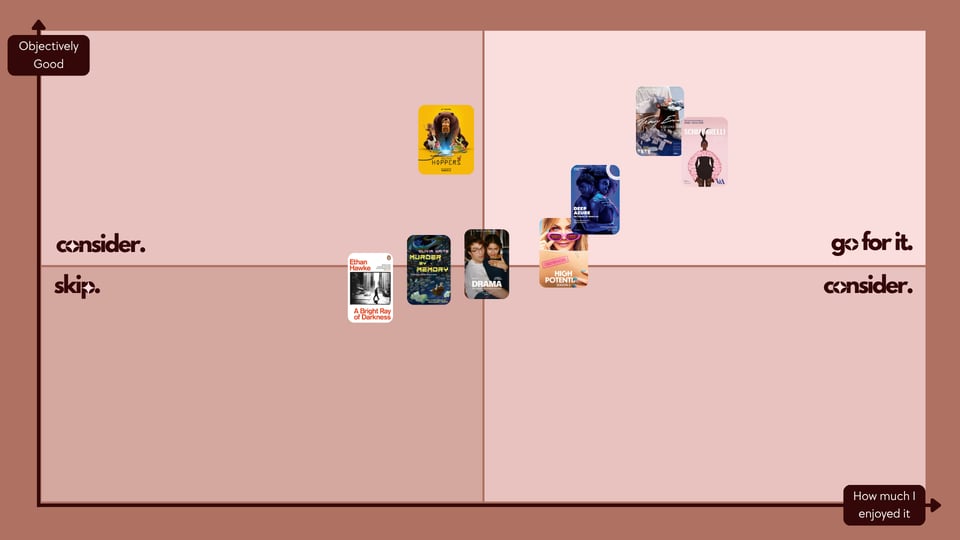
Read/Watched/Visited in Q1 2026
We all seem to have had a rather rubbish start to 2026. We’re all going through personal and collective levels of grief, anxiety and uncertainty. In the midst of all this, I find comfort and try to make sense of the micro and macro worlds through art and creativity. Even if I’m too anxious to focus on a book, two hours in a dark movie room will get me through a lot.
There is no music on this list because I know little about music, but when I was in Paris, I found myself listening to the soundtracks of Le Courage d’Aimer & Les Parisiens while walking by the Seine during Golden Hour. It was a perfect moment when I felt incredibly lucky.
The Best
📖
The Bandit Queens (Parini Shroff) – A thriller about a group of Indian women who decide to take justice into their own hands and kill their abusive husbands. The themes are interesting, but mostly the tone, seeped in dark humour, is great.
🎞️
The voice of Hind Rajab – A movie about the murder of a 6-year-old girl and two Red Crescent workers by the IDF in Gaza two years ago. The story is mostly told through phone calls, and we already know the outcome, yet it is tense and impossible to look away from. The way Kaouther Ben Hania mixed real footage and recordings from the events with re-enactments was particularly well done. In the end credits, there is a very long list of recognisable Hollywood names acting as producers, which woke up the cynic in me (who is never that fast asleep anyway).
Bottoms – Not sure why it took me so long to watch this satire of teen movies, which is really dark, funny, and very well written and acted.
Project Hail Mary – I usually find the broadness of space stressful and claustrophobic, a bit like underwater scenes, but this is a safe movie. About halfway through, I realised that there might be tense moments, but nothing bad would happen, so I let myself be carried along by Ryan Gosling and the alien puppet. Amaze! Amaze!
Bridgerton Season 4 – Loved Benedict and Sophie as a couple, and for once, it didn’t feel like they dedicated too much time to secondary plots I didn’t care about. My new Bridgerton ranking is: Season 2 (despite the sister storyline); Season 4; Season 1 (despite the Simon-doesn’t-want-children storyline); and Season 3 (boring).
(Re-re-re) Heated Rivalry – There have been days in the past three months when rewatching Heated Rivalry has been the only source of joy in my entire day. It’s not just the series, it’s also the community that has sprawled around it, as it’s been fascinating to watch people discover the world of Internet fandoms. Of course, since we can’t have nice things, some of this has soured really fast. (Not covered in this newsletter: all the fan fiction I read during Q1, but if I’m going to only recommend one, it’s Concussion Protocol)
🖼️
THE SINGH TWINS: Botanical Tales and Seeds of Empire at Kew Gardens (until 12 April) – Art about the role of plants and seeds in European colonisation. Displayed in fabric light boxes, the art is bright, colourful, and very witty. Each artwork packs a lot of storytelling.
Azzedine Alaia’s Dior Collection, Galerie Dior (until 17 May) – Alaia’s collection mostly covers the Dior – Yves Saint-Laurent – Marc Bohan period, with a few pieces from John Galliano. I assume this worked well for Dior’s branding as they moved from Maria Grazia Chiuri to Jonathan Anderson, who is represented only by a few red-carpet dresses. The finale room, with three levels of dresses and changing lighting, remains one of the most stunning exhibition rooms I’ve ever been to (it’s the same concept as they had at the Dior exhibition at the Art Deco Museum).
Tisser Broder Sublimer, Palais Galliera (until 18 October) – This was even better because I got to see it with my sister, who is training as an embroiderer. I always find embroidery moving because I imagine the women who worked on the dresses, their lives and the fact that their skills reached us centuries later. There is a blouse a woman wore when France was freed in 1944, which she had been embroidering for months before, in an act of both resistance and hope.
The Good (a lot of Gothic)
📖
Entitled The Rise and Fall of the House of York (Andrew Lownie) – Nothing new in this book, and yet it kept me angry from the first to the last page. It’s not just the sheer volume of entitlement, corruption and stupidity. It’s the fact that no one ever took the steps to stop him.
Ask me How it Works, Love in an Open Marriage (Deepa Paul) – The story arc of this memoir is going from being in an open marriage to being polyamorous. There are scenes with drugs that made me really uncomfortable, but aside from that, it reads like an honest account of the emotional work involved between wife and husband to sustain an open marriage.
The Mysterious Affair of Judith Potts (Robert Thorogood) – A bit of a reset in the Marlow Murder Club series as we finally get the answer to a mystery first hinted at five books prior. It’s a predictable storyline, but it enables Thorogood to split his detective trio and to revert to what made the beginning of the series endearing.
The Hollow Man (John Dickinson Carr) – Read it thanks to Wake-up Dead Man. The mystery is decent, but it is mostly memorable for the lecture the main detective, who suddenly seems aware of the type of story he is experiencing, delivers on locked-door mysteries.
Great Big Beautiful Life (Emily Henry) – I was in an anxious reading rut in February. Emily Henry snapped me out of it, so I am fonder of this novel than it deserves. Two journalists fall in love as they compete to write the memoirs of a reclusive heiress – with echoes of Evelyn Hugo. The biggest issue is that by the end of the book, it is clear Henry didn’t pick the most interesting pov to tell the story.
Je Voulais Vivre (Adélaïde de Clermont-Tonnerre) A retelling of Milady de Winter’s story, the baddie in Alexandre Dumas’ Three Musketeers, which wants to give her back her agency and would succeed if it weren’t so focused on the men of the original novels.
The Infamous Gilberts (Angela Tomaski) – Tells the story of the once-wealthy Gilbert family through their big country estate. At any point, every room contains the past, present and future of each character. Reads nostalgic and melancholic.
Moi Qui N’ai Pas Connu Les Hommes (Jacqueline Harpman) — Influenced by Stuart Turton’s The Last Murder at the End of the World, I read this as part sci-fi, but you can argue over its genre. I have seen many comparisons with The Handmaid’s Tale, which is lazy; let’s read more dystopia people. It’s about a group of women who end up stranded far from any other human, so they come together to survive, but what is the point of surviving?
Heated Rivalry and Tough Guy (Rachel Reid) – I read all six novels in the Game Change universe in two weeks, so they have somewhat merged into one. The most interesting thing is that with each book, Reid explores different tropes, but if I hadn’t gotten extremely attached to the characters because of the TV show, I’m not sure I would have finished the first one. Across the hexalogy, my three main issues are: 1/ there is no difference between privacy and secrecy, which is a problem I have with celebrity romances in general 2/ it’s very homonormative – you can be gay but preferably with a wedding ring, a dog, children and a picket fence 3/ either you have a magic rainbow family or you are miserable in the closet and know nothing about queer communities, as if neither books nor the Internet existed. But Ilya shows up in every book as an empathetic chaos gremlin, so there’s that.
🎞️
“Wuthering Heights” — I wrote 4,687 words about it in a previous newsletter and have since seen it two more times. I’d say I have nothing left to say about it, but that’s not true, so why don’t you watch it and then we can discuss?
Frankenstein – Watch it for the drama of the veils and opening funeral scenes alone. The story arc goes big on the father-son relationship as a theme. There is an interesting companion documentary on Netflix and a book by Sheila O’Malley that include details of costume designer Kate Hawley’s process, such as how the Creature’s coat features the imprint of the spine of the soldier who used to wear it. I was reminded of it seeing Schiaparelli’s skeleton dress at the V&A this weekend.
The Bride! – I watched this as a movie about writing because Mary Shelley opens and closes the film, which takes place in a world where Frankenstein is real, so I think The Bride is a Shelley character who bleeds and spits ink. This is a movie that suffers from having too many ideas and therefore never fully exploring any – the strand with women’s rage and revolt, for instance, didn’t have the space to breathe properly.
Priscilla (rewatch) and the companion A24 screenplay book — I read “Elvis and Me” when this first came out and thought Sofia Coppola did a great job in capturing the creepiness of the relationship. I’ve been thinking, since rewatching it, that this is really a Gothic movie, which I plan to write up soon.
Marie-Antoinette (rewatch) – A rewatch inspired by the V&A exhibition, which displayed some of the costumes as well as dresses Kirsten Dunst wore in her tie-in US Vogue cover. The movie really holds up, both in the world Coppola built and in how it aligns with the right and wrong ways we are reassessing historical women. The cast is stacked.
Le Crime du 3e Etage — Based on Francois Truffaut's argument that Hitchcock’s movies are really about the relationship between the main couple. Colette is a Hitchcock expert; Francois is a successful historical mystery writer. When she spots their neighbour murdering his wife, Rear-Window-style, Colette is determined to expose him. This would work better if the script picked either the mystery writing or the Hitchcock references to frame the story.
🎭
Dracula (until 30 May) with Cynthia Erivo playing every single character in the adaptation – same concept as Dorian Gray with Sarah Snook. Some of the feedback on my manuscript has been about showing how characters express emotions through their bodies, so I am paying close attention to that in actors. Seeing how Erivo changes her physicality as she plays different people was fascinating. I’d also love to see a documentary about the crew that films the play live, as they are key to the production coming together.
🖼️
Leonora Carrington, Musee du Luxembourg (until 19 July) – I came to Leonora Carrington through her tarot deck, which is not on display here. There is, however, a whole room dedicated to her juvenilia, which is one of the most interesting parts of the exhibitions because it allows you to track how her mind worked from her teens.
1925 – 2025, 100 years of Art Deco, Musee des Arts Decoratifs (until 26 April) – I had this fantasy of travelling on the Orient Express for my 40th birthday, but since I can’t afford it, visiting the reconstitution of its cars at this exhibition will do. This was a very comprehensive exhibition which covered furniture, jewellery, fashion, interior decoration and even transatlantic liners.
Beyond our Horizons: From Tokyo to Paris, le19M (until 26 April) – Le 19M is the free exhibition space for all the artisan houses Chanel purchased – embroiderers, jewellers, feather specialists, etc. Here, they created artwork in dialogue with artists from Japan, and the result is poetic and often ethereal.
Marie-Antoinette, the V&A (closed) — The artefacts were interesting, but in the end, the exhibition never went beyond the standard “oh look how much she bought and spent”. Marie-Antoinette, the woman, was weirdly absent from the exhibition. There was a room dedicated to her time in jail and beheading, which gave me the creeps.
Joyaux Dynastiques, Hotel de la Marine (closed) — Royal families commissioned shiny baubles was the slightly weak link for this exhibition. A lot of what was on display came straight from the Cartier exhibition at the V&A, which I saw five times, a problem specific to me. Cartier is clearly deploying an advertising-through-exhibition strategy; they are also well represented at the MAD 100 years of Art Deco exhibition (Tiffany’s was not, which is weird, and we can discuss how relying on brands impacts curation and, therefore, our perception of a topic. Capitalism scooping in when governments don’t fund the arts and whatnot.)
The Meh
📖
Wintering (Katherine May) – This book works well for some people, and I can see why – the nature writing is great, and I liked the sections about seasonal rituals. It just didn’t deliver on the cover promise of wintering as a state of mind rather than a season.
Under the Whispering Door (TJ Klune) – A better version of Matt Haig’s The Midnight Library. It’s a book about death I read while my grandmother was dying which left me cold. It probably hit my wall of cynicism because I don’t believe anyone can change as quickly as the MC, in life or in the afterlife.
Bad Fiction (Rebecca Sarah Ley) — I was curious to read this because it’s a hardback that received no promotion from the publisher, Borough Press. Alice is enrolled in a creative fiction post-grad program where the tutor turns out to be abusive and steals her students’ ideas. It’s not an original premise, but maybe someone in Marketing decided they didn’t want to deal with the online discourse around a queer female academic harassing her male student — or maybe they just prioritised a different book.
🎞️
People we meet on Vacation — Perfectly serviceable while you’re watching it, except the male love interest is so underdeveloped, I don’t understand why the woman falls in love with him. She, in turn, is a manic pixie girl of sorts. I have been thinking about her WOS earrings for three months, so props to the costume department.
Is this thing on? — Do we need another story of a straight white dude finding himself as he works through his divorce – this time thanks to stand-up comedy in New York? Nope. Everything about this film is fine, and it adds up to something fine. At least Bradley Cooper doesn’t seem set on proving that he has the technical knowledge to direct the way he did in Maestro, so improvement.
Hamnet — If you’re telling me a film is going to be heart-wrenching, it better be heart-wrenching, but this never gave me a reason to feel sad about Agnes Shakespeare beyond how sad it is to lose a child, generally. Also, please subtitle movies. I understand the Hamlet monologue at the end is meant to deliver a punch about the cathartic power of art, but I, like many people, struggle with spoken Shakespeare, so it went over my head.
The Reluctant Widow — Watched for the “Falling in love with love: A History of Popular Romance” course I did at Liverpool University. This is a Regency romance, so the French are the bad guys. Released in 1950, it is funny in ways I don’t think were meant to be funny. This is the only movie based on a Georgette Heyer novel, and she disliked it so much (though not necessarily for the reasons I did) that no other has been made since. Though we could discuss how every Regency movie/series partly adapts Heyer.
How to Make a Killing — This is a movie about the enduring lexicon of Chanel as a shorthand for generational wealth, which shoots Margaret Qualley’s legs in an almost disembodied way I hoped we’d moved past by now. Most of it could be good, but it never comes together.
Love Story John F. Kennedy Jr. & Carolyn Bessette — Starts out well, but takes a turn for the icky when the storyline moves from the personal to filling the gaps between pap pictures and starts focusing too much on the foreboding. Watch the first four episodes and then drop it – we all know how it ends anyway.
🖼️
A Day in the Life of an 18th-Century Hotel Particulier, Musee des Arts Decoratifs (until 5 July) – I liked the concept and the way it takes us into the intimacy of day-to-day life in a wealthy household in 18th-century Paris. Also, this is a rare exhibition that integrates the lives and work of servants.
Fashion in the 18th Century. A fantasized Legacy, Palais Galliera (until 12 July) – This exhibition had two me-problems: 1/ it had a lot of overlap with the Marie-Antoinette exhibition, and featured limited new-to-me information 2/ This was my sixth exhibition in three days and so I was a bit overloaded. The gallery with contemporary dresses inspired by 18th century fashion was my favourite, though a bit tenuous at times.
The Worst
📖
Once was Willem (M.R. Carey) – The story is all over the place, the medievalism is dubious, the narrator isn’t the most interesting character, and some big questions get solved through a facile narrative device. There are some interesting ideas and moments – one with a witch for instance, another with the zombie body of the narrator – but sadly they’re not enough and this is a slog to read.
🎞️
The Kissing Booth 1, 2 and 3 — I went into this knowing it would be bad, and it was bad. The third one is the best one because it is realistic about the prospects of the main couple, i.e. no way they would stay together, but it’s still not good enough to justify sitting through the first two, even as background TV.
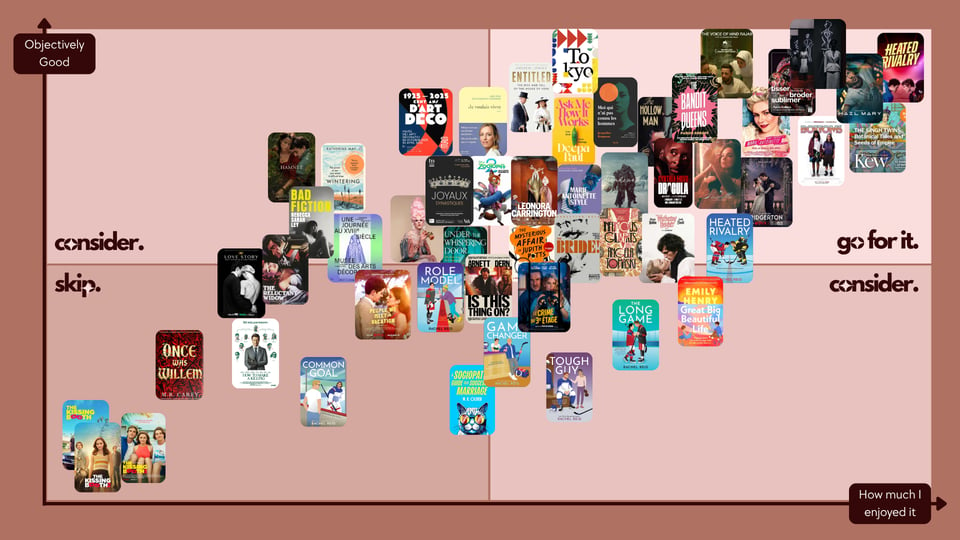
A few words about the graphic – It’s not scientific
Sometimes I rate books or films based on my enjoyment, sometimes I rate them based on how good they are objectively. Even enjoyment is, in many ways, an odd rating scale – is it the right word for The Voice of Hind Rajab? Or for Entitled, where my dominant emotion was anger? Then there is a format bias – I would have enjoyed Frankenstein more had I seen it at the cinema at least once. There is a recency bias – I remember I enjoyed Zootopia 2 while I was watching it, but I can’t remember why. Lastly, there is a layout bias – when an area of the graphic was already full, I might have added a cover next to a movie poster where there was a hole, rather than the exact place where it belonged.
Bonus: Here is a preview of Q2 so far