
Films to Watch/Books to Read (or Skip)|October 2026
11 films, 2 series, 5 novels
I turned 40 this October in the best possible way – with a friend, an exhibition of Burberry looks at the Victoria & Albert Museum followed by Digger in a mostly empty cinema. I spent most of October thinking about how lucky and privileged I am in our burning world. I got to see, in a museum, fashion collections I worked on – how many people have the chance to say that? I posed, in my purple metallic trench coat, next to a mannequin wearing its brother from the S/S13 menswear collection.
Then a week later, I finally visited Charleston with some of my closest and dearest, a place I have wanted to go to since Christopher Bailey did his A/W14 Bloomsbury collection, also on display at the V&A. I ended the month in Versailles, one of my favourite places, where I saw an exhibition retracing the making of Sofia Coppola’s Marie-Antoinette – and yes, it was a bit on the nose to do that the same week French protests about the cost of living crisis and lack of investment in education were mired in localised unrest.
In between, I covered the London Film Festival for Obscurae, and saw six movies ahead of their release. I read fewer books, mostly from the 1990s, and two of them somehow linked to Bennington College.
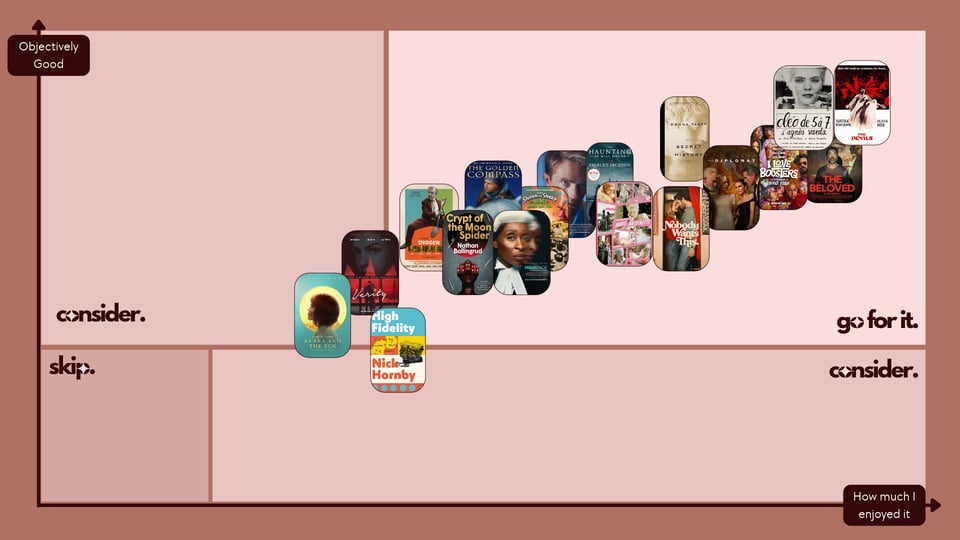
The Great
- 📺The Diplomat Season 4, Debora Cahn (2026, Netflix) | This season opens with a great miscommunication bit about whether the President has a crush on her VP (no, it wouldn’t happen if POTUS were a man). Allison Janney and Bradley Whitford have meatier roles, a delightful decision, even though that means the storyline has sidetracked both Aidan Turner and David Gyasi, Kate’s polyamorous love interests. She remains busy though, including by toppling two governments in less than a week. It’s so entertaining, I almost forgot to wonder why the Wylers are staying married.
- 🎞️I Love Boosters, Boots Riley (2026, London Film Festival) | One of the most creative films I have seen this year. Every strand of the story, from the costumes to the various plotlines, is incredibly imaginative. This is a joyful anti-capitalist movie critical of the fashion industry, especially fast fashion and working conditions both in factories and on the shop floor, that posits that community and protests are two effective ways to change the system. There are a couple of strands that are good on their own but don’t merge so well in the whole – one about a super expensive suit featuring stop-motion animation, and another where LaKeith Stanfield plays a demon who steals women’s souls by going down on them.
-
🎞️Ken Russell’s The Devils, Ken Russell (1971/2026, BFI in 35 mm) | This opens on a stunning funeral scene on the set by Derek Jarman, all futuristic buildings and monochromatic costumes, and closes with the film switching to actual black and white. The Devils is about abuse of power and religion. It is at times wickedly funny – there is a scene with a woman dying of the plague and a fake crocodile, and Michael Gothard looks like the 6th Beatles in a way that can be distracting; no 17th-century priest had biceps like that. This re-released, uncensored version includes an orgy in a church with nuns, but it is filmed in a way that never suggests it's aspirational. Depiction of a topic doesn’t equal its endorsement, an issue we apparently struggled to understand in 1971 as much as we do today, and one of the many ways The Devils has stayed relevant.
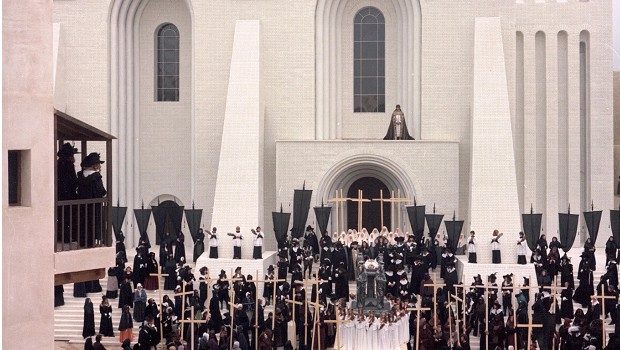
The Devils’ opening fune-real scene
- 🎞️The Beloved, Rodrigo Sorogoyen (2026, London Film Festival) | Men will produce, write and direct a movie rather than go to therapy or take accountability. Here, the man is Esteban, a cult, Oscar-winning director who has decided to cast his daughter in his latest film to rekindle their relationship. Rather than apologising for the hurt he has caused or doing any of the work of rebuilding their relationship, he expects her to be grateful. There is a saviour-y aspect to the whole enterprise, which gives a whole different meaning to the fact that he is shooting a film about Spain’s colonisation of Western Sahara. Javier Bardem and Victoria Lungo, whom I recently liked in another movie about movies, Almodóvar’s Bitter Christmas, are both great, filmed in a lot of close-ups. | Full review on Obscurae
- 🎞️Cléo de 5 à 7, Agnès Varda (1962, Le Louxor, Paris) | My Eurostar got cancelled, so I went to a 10:30 am showing of Cléo de 5 à 7 at the iconic Louxor cinema in Barbès (related: what is it about 1920s cinemas and orientalism?). Rosalie Varda, the director's daughter, introduced the movie, talking about her mother’s budget concerns and how she got Jean-Luc Godard to remove his sunglasses for a bit. All in all, a serendipitous Eurostar cancellation. The movie follows famous singer Cléo as she walks around Paris between 5 and 7 pm, anxious to hear back from a doctor about a biopsy, questioning how she is seen and how she sees herself. Like many Nouvelle Vague movies, it is first and foremost a vibe, complete with great outfits and an interesting soundtrack.
The Good
-
🎞️The Making of Marie Antoinette, Eleanor Coppola (2026, London Film Festival) | Family holiday film, but the family are the Coppolas and the holiday is Sofia directing Marie Antoinette at Versailles. The film repeatedly emphasises Sofia’s determination to deliver on time and on budget, even if it means pushing through bronchitis and working long hours. It’s hard not to see a gender component here, especially given that Eleanor’s most famous documentary was about how Apocalypse Now was the exact opposite. Also interesting that Sofia’s team was mostly men. Sometimes she has to push back when they ask for a male POV, such as Louis XVI and Fersen’s. In her trailer, she talks about having to stand firm on her vision. As someone who admires but doesn’t understand acting, I was also fascinated to see how Sofia asks her actors for consecutive takes portraying slightly different feelings, and Kirsten Dunst immediately does it. How do you do that?
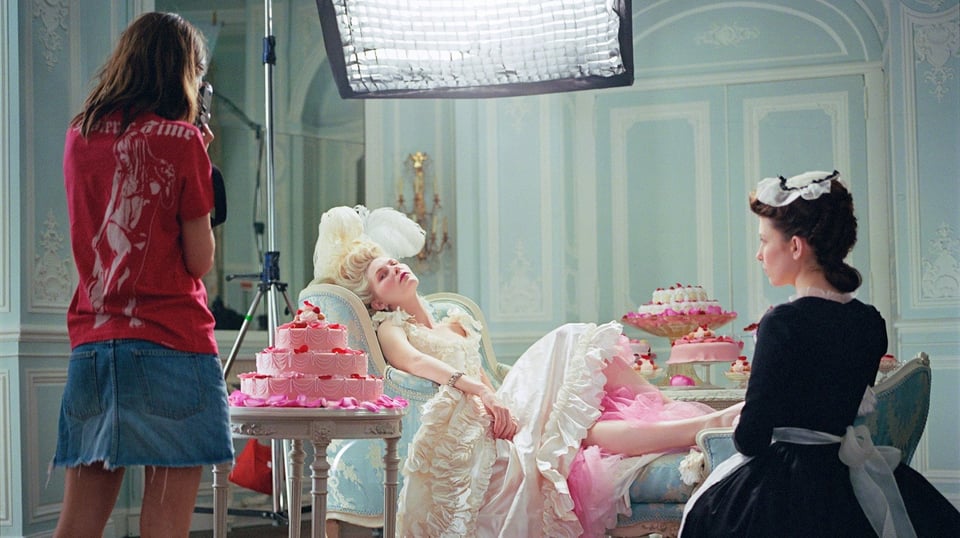
This still made me think of an interview I once read, where Coppola talked about the importance of wearing skirts on set as a woman director
- 🎞️Shaun the Sheep and the Beast of Mossy Bottom, Steve Cox and Matthew Walker (2026, Le Grand Rex, Paris) | My knowledge of Shaun the Sheep was limited to The Farmer’s Llamas, a mean, not-funny short. But the 5-year-old is a fan, so we went to see The Beast of Mossy Bottom at the Grand Rex, after visiting the studios. This one was actually funny – after the farmer destroys by mistake all the pumpkins his sheep have been growing for Halloween, Shaun gets hold of a chemistry schoolbook and mixes a speed-growth potion. Meanwhile, the farmer is working up the confidence to ask the vet for a date, and ends up putting some of the potion on his bald head, turning himself into Bigfoot/a yeti. I enjoyed all the winks to horror – the Frankenstein mob, the shadow behind the curtain, the mysterious footprint in the mud, the hockey masks à la Friday the 13th – as well as the low-key social commentary from torches on mobile phones to a soon-to-be-married lesbian couple. Plus, watching a movie through a child's eyes is always an experience, switching seamlessly from “no, I can’t, this is too scary” to laughter.
- 📺Nobody Wants This Season 3 (2026, Netflix) | Season 2 was average, too stuck in the same will-they-won’t-they as Season 1, so I was going to skip the new season. But then I saw a reel on Instagram where two secondary characters whose relationship I love finally kissed, so I had to watch it, and I’m glad I did. The series is much more balanced between Joanne and Noah, the original couple, and Morgan and Sasha, their siblings. It is an easy, light watch with more sweet moments and fewer annoying ones than before.
- 🎞️Digger, Alejandro González Iñárritu (2026, Odeon Limitless) | Digger isn’t a nice watching experience. The actors shout, the accents are so strong I struggled at times (why can’t films have subtitles by default?), and the climate apocalypse topic is stressful. It’s also a movie you can read as everything and its opposite. Digger can be about the power of art in bringing us together – the play within the movie is a rare opportunity to breathe (literally) and come together, and to experience catharsis that Digger, the man who destroyed the world, is dead. But you can also argue that it is cynical about what art can achieve. The play is financed by Digger’s nephew, who profits from the poisonous world through the masks his mother’s company makes and his ownership of communication systems. Pointing the finger at Digger as the sole responsible for this mess works for him – this is art as a form of reputation washing. Most likely, especially as Digger came out the week the Warner Bros./Paramount merger went through, it’s both – it’s hard to find art untainted by capitalism in 2026.
- 🎞️Primetime, Lance Oppenheim (2026, Odeon Limitless) | Primetime is technically brilliant – the voyeuristic camera angles, the harsh and primary colour lighting that mirrors Chris Hansen’s evolution, the grainy, camcorder-like quality of the film. I was already living in the UK in 2006 and completely missed the To Catch a Predator controversy, but even without that cultural background, Oppenheim’s points about reality TV and true crime then and now, and the links between the two, aren’t exactly subtle.
- 🎞️Prima Facie, Susanna White (2026, London Film Festival) | Prima Facie calls for reform of the British legal system when it comes to rape trials, an important cause. It does so by embedding us in Tessa’s story, a brilliant and successful lawyer who believes in the current system until she is herself raped by her boyfriend, another hot-shot lawyer. In its movie iteration, Prima Facie covers a lot – British attitudes to race and class and their intersection, generational trauma, women’s complicity, etc. Cynthia Erivo is great, but the director and writer do her a disservice by including a voiceover where she is constantly telling us how she feels, as if she couldn’t act well enough for the audience to understand. | Full review on Obscurae
- 📚The Crypt of the Moon Spider, Nathan Ballingrud (2024, Borrowed from my Sister) | Veronica’s husband has abandoned her in an asylum on the moon to treat her depression. There, she submits to an unusual healing plan that uses the magical spiders that populate the place. Cue creepy body horror where web weaving and brain surgery are one and the same. There is a mad doctor, medical sexism, and a weirdly out-of-time vibe. This is definitely an atmospheric novella, although I struggled to translate the words on the page to pictures in my mind.
- 📚The Haunting of Hill House, Shirley Jackson (1959, Libby audio) | Dr Montague gathers three people in Hill House to study how it affects their fear levels. Eleanor, quiet, lonely Eleanor, is the most affected one – possibly because she is the most susceptible to external suggestions, possibly because she has some kinetic power. Hill House, for all the fear and the supernatural events she experiences there (there is a scene at night with an unexplained cold current that is particularly effective), is a paradise for Eleanor. For the first time in her life, she feels wanted and interesting to other people – especially to Theodora. There are definitive sapphic vibes to that relationship, and I’m not saying this just because Catherine Zeta-Jones looks hot in The Haunting.
- 📚Northern Lights, Philip Pullman (1995, Owned) | First read as a teenager, but I realised, re-reading this for a book club, that my memory of the trilogy was shaped by the Chris Weitz 2007 movie and the BBC series. There are captivating moments, especially once Lyra leaves Oxford and the bear Iorek Byrnison joins the story, and the aletiometre and daemons are brilliant strokes of Pullman’s imagination. I found the exposition dragged a bit – possibly because it rehashed bits I already knew, or maybe because this is a book aimed at young teens.
- 📚The Secret History, Donna Tartt (1992, The London Library) | It took me years to get to The Secret History because it is such a monument, I dreaded reading it (see also: Madeleine Miller’s Circe). Maybe it could never live up to what I had built up, even though that build-up was fuzzy since I had little idea what this novel was actually about. The first half is a bit slow; the second one much quicker, a writing skill that always fascinates me. Overall, the writing is beautiful and atmospheric, but the story doesn’t live up to it. The generous reading is to say that this is one of the ways Tartt makes her points about beauty and illusion: the form is stunning and smart, but the soul is hollow. I was frustrated by the poor development of many characters, especially the main female character, Camilla, who seems to exist mostly so the narrator can fancy her.
The Meh
- 🎞️Verity, Michael Showalter (2026, Odeon Limitless) | This is a Jane Eyre/Rebecca retelling; you cannot convince me otherwise. Not a particularly good one at that, and not even bad enough to become great. Anne Hathaway seems aware of how bad the source material is and leans full on into the camp. Something potentially interesting emerges as the story unravels about monstrous motherhood. In an unpublished manuscript, Verity explains that she hated being pregnant and having children but felt she had to hide it because of societal expectations and her husband, until she couldn’t take it anymore and drowned one of her twins. But it turns out it was all fiction, not memoir, so… Verity loved being a mother? Didn’t actually murder her dead child? Who knows; this is never fully explained. It would have been more interesting to explore the idea of forced motherhood, postpartum, and how we address that, rather than make a plot twist out of it.
- 🎞️Klara and the Sun, Taika Waititi (2026, London Film Festival) | I left this movie and shrugged, and two weeks on I am still shrugging. This is frustrating because in 2026, when AI is threatening everything from our livelihood to our mental health, many themes should resonate. Somehow, Taika Waititi didn’t manage to give his adaptation a forever relevant angle, the way, for instance, The Devils still feels relevant. | Full review on Obscurae
- 📚High Fidelity, Nick Hornby (1995, Libby Audio) | I stumbled upon this as part of a deep dive into Britpop, brought on by the Oasis documentary I watched in September (now on Disney+, in case you haven’t watched it yet). This might be the first time I have felt judged by a narrator – Rob owns a record shop in London and has strong opinions on what constitutes good music. I had never heard many of the songs he lists (there is a playlist I am quite enjoying). Aside from the fact that Rob would think I have terrible musical taste, possibly no taste at all, he is also a whingeing, self-pitying man who has no interest in experiencing growth during his story arc. One of his biggest evolutions is probably learning that you can like bad music and still be a good person. Phew.