NIH grants changes
Proposed changes to NIH grants processes (to better align with health priorities, like giving everyone measles...)
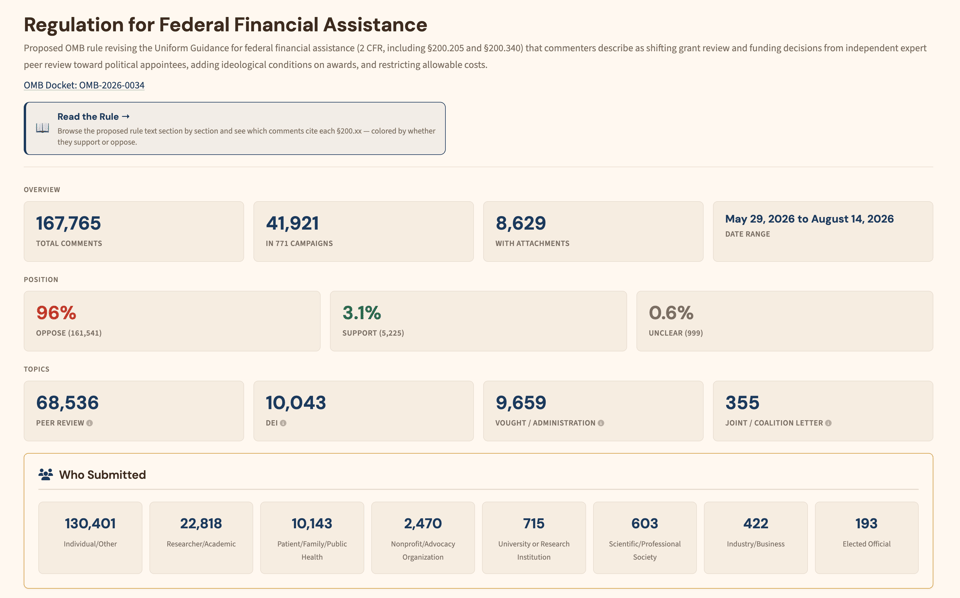
OMB Grants Comments Analysis
Look at those lovely OMB grants docket comment analytics courtesy of Abigail Haddad. It appears all comments are posted!

The U.S. Senate giveth, the U.S. Senate and taketh away
Good and bad news from the Senate this week: OMB grants rule change likely to be held off for awhile; Dr. Fauci held in criminal contempt by a Senate committee.
Transcript of HSGAC Business Meeting August 6
A quick-and-dirty transcript.

NSF proposed changes to the PAPPG (NSF 24-1 >> NSF 27-1)
There's still plenty of time to comment on the docket (Aug 24, 2026 at 11:59 PM EDT), but don't put it off into syllabus-revision season!

Fresh hell for F and J visa holders
DHS finalized a rule removing "duration of status" for F, J, and some other visa types. These changes affect international students, postdocs, some faculty members, and others in the academic pipeline.

Are you tired of Regulations.gov yet?
TOO BAD. There’s an NSF RFI (heavily depended on the OMB proposed rule change that just closed for comments) with a due date in August. In this issue, my strategy thoughts for responding, plus initial reactions!

My OMB-2026-0034 Comment
Wherein Courtney shares her really, really long comment on OMB-2026-0034.

How do grants and cooperative agreements affect your community?
Ever wonder how to find out what federal grant money is supporting in your community? (Or what the federal government is spending money on in general?) I'll walk you through USASpending.gov to show you how to find out.
13 Days Left to Submit Your Comment
Need to write that comment on the OMB grants docket? Here's a kickstart for you: https://tinyurl.com/MF-omb
Forward to your friends!
This resource can be accessed from tinyurl.com/MF-omb if you want a memorable link to write on your department blackboards (for instance)

MOTHERFUNCTOR Guide for "UGR" Comment Writing, PUI edition (3/3)
Are you at a small institution like a PUI? This guide is yet another way to support you in your comment-writing if you want to comment on that darned OMB grants docket!

MOTHERFUNCTOR Guide for "Uniform Grants Regulation" Comment Writing (2/3)
As promised, today you will pick your player to write a comment. It's not perfect, it's not exhaustive, but I tried to give concrete starting points for many perspectives!

MOTHERFUNCTOR Guide for "Uniform Grants Regulation" Comment Writing (1/3)
Part 1: what's in the OMB proposed grants regs? Why should you care? How will you use this guide? More parts coming!

Can't drop a bomb without OMB!
July 13, 2026 is the deadline to leave a comment on the regulations.gov docket explaining why the new regulations are a TERRIBLE IDEA.

On overloading notation (and underfunding basic science)
The Trump Presidential Budget proposed ~$4 billion for NSF, so the NSF X-Labs would eat almost half the budget Trump (and Vought) envision outlaying. Wolverine would never.

Census Data API to require API key starting 5/12/2026
Beginning Tuesday, May 12, 2026, the Census Bureau is implementing a policy that requires an API key be used with all queries that are made to the Census Data API.

The Federal Register Friday Round Up
Filed under #⌈FRiday⌉. Here's what caught my eye on the FR this week.

WHERE HAVE ALL THE DATA GONE?
Filed under #TechnicalLemma So, uh, federal data is disappearing off the .gov namespace (more thoughts on .gov later). Read about it and considerations for...

The National Science Foundation is officially rudderless
Did you see the Canceled NSB Sunshine Act Meetings Notice on last week's Federal Register? That cancellation hits a little different now that the entirety of the National Science Board was fired by the current president.

The United States Needs to Keep its Eye on the Ball
In the U.S.? If you think American leadership in science is worth keeping, or if you simply think the U.S. President’s posture is unbecoming of a Peace Prize recipient, tell your senators and your representative that the January visa pause, the ESTA data collection expansion, and unauthorized, unprovoked wars are bad for U.S. competitiveness and scientific innovation.