
Meta is back
Meta’s comeback, cheaper Claude, and why the price cuts stick.
Ladies and Gentlemen, Meta is back!
This spring, Meta moved about 6,500 engineers into data labeling, writing coding puzzles and grading model output to train its AI. Its own CTO said morale was the worst he'd seen in 20 years. I had some fun with it at the time:
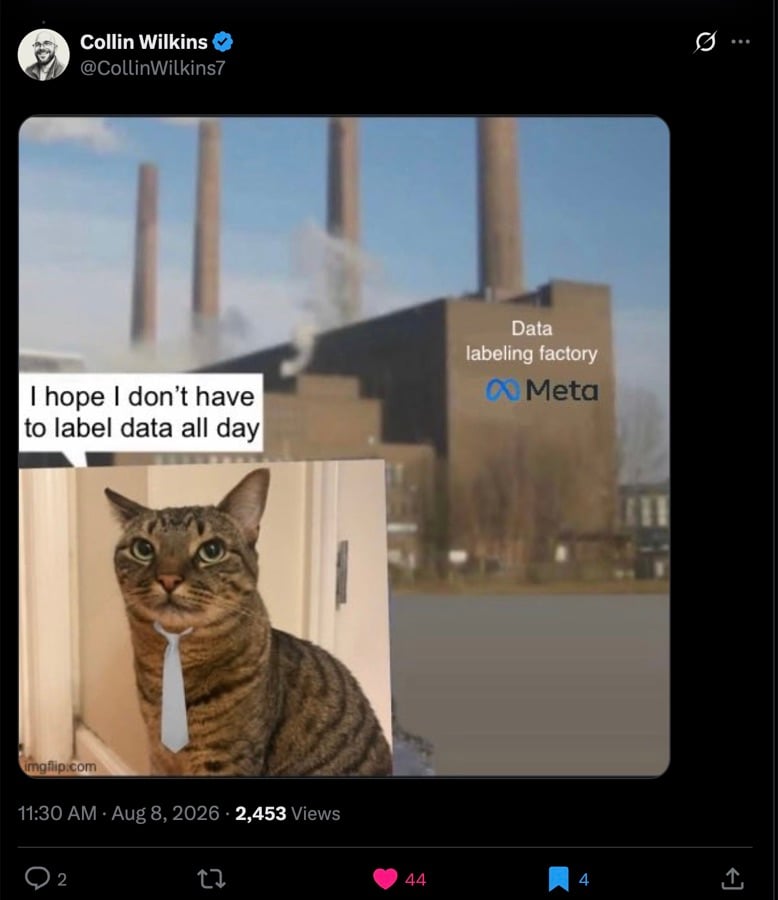
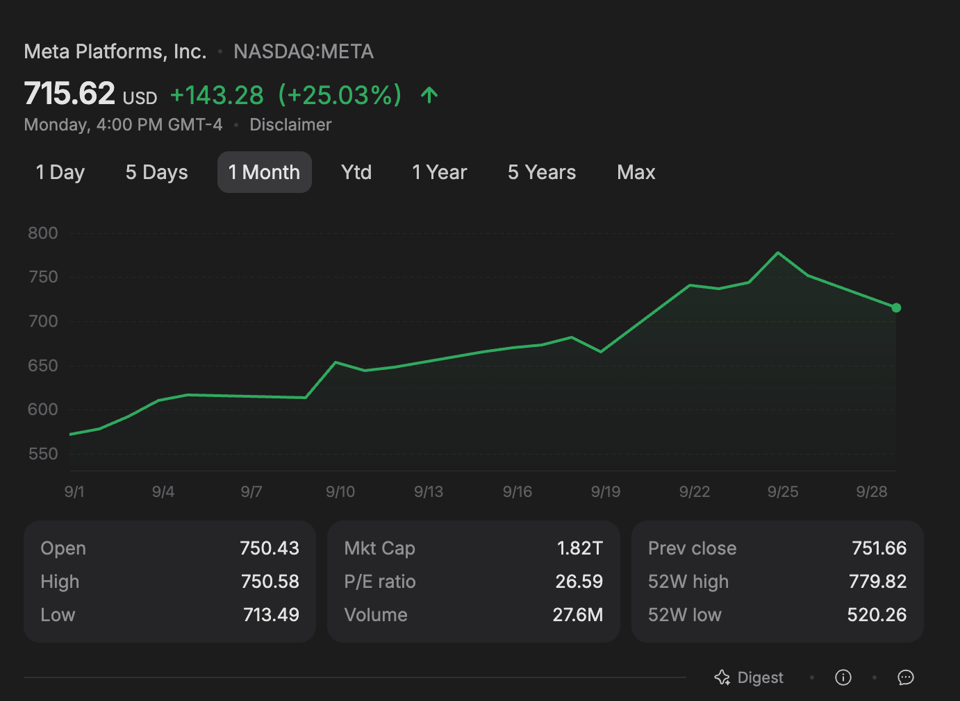
Few months later, $META jumped 11% in a single day after its latest Muse news. Three things are behind it.
- Muse. Meta's personal agent launched September 8 and passed ChatGPT at the top of the App Store. It books tickets, shops, and sends messages for you. It's free for most people, with $20 and $100 tiers for power users. Muse isn't built for builders (use Grokbot or Claude/ChatGPT custom agents for that). It's for the "make me a dinner reservation" crowd, especially people who already live on Facebook and Instagram, which is a lot more people than read this newsletter. The reviews have been very good.
- Compute to sell. Meta has spent years actually completing data centers (cough cough Oracle - which just sent a force majeure notice so it can delay payments if/when its New Mexico Stargate site comes online late), and since July it's been setting up a cloud business to rent the extra capacity to outside customers. That's one more supplier in a market where prices are already falling (more on that below).
- A real enterprise hire. On Monday Meta hired MongoDB CEO CJ Desai to run a new Meta Enterprise Platform that sells Muse, its API, and its business agents to companies. Before MongoDB he ran product and engineering at Cloudflare and was COO at ServiceNow. MongoDB’s ($MDB) stock fell 17% on the news. I think this is the most bullish of the three. Meta has the models and the compute, and now it has someone who has sold software to enterprises for a living.
Frontier is NOT being paced
Anthropic shipped Opus 5.5 and Sonnet 5.5, and for me the headline is the price.
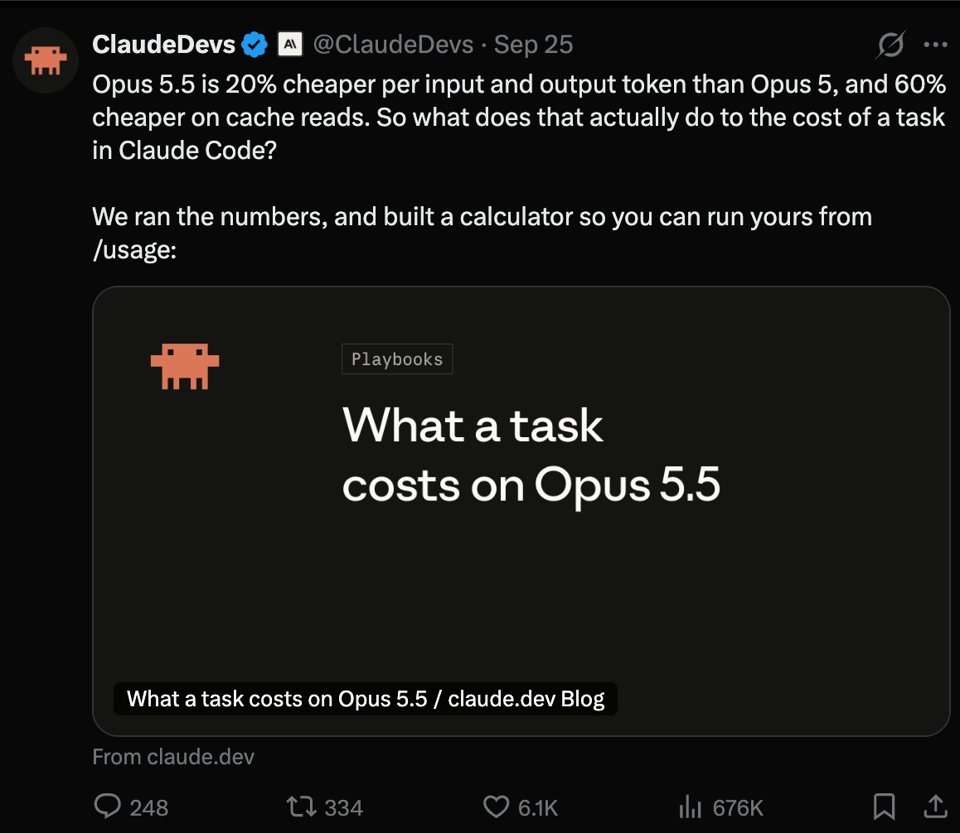
Every Opus since 4.5 has cost $5 per million input tokens and $25 per million output. Opus 5.5 is $4 and $20, a 20% cut, and cache reads are 60% cheaper (Simon Willison has the full pricing table). Anthropic's own breakdown of what a task costs on Opus 5.5 puts a typical Claude Code session about 31% cheaper from the price change alone, and it has a calculator you can fill in from /usage.
Sonnet 5.5 landed the same day as the Desai news, at the same $2 and $10 as Sonnet 5. Anthropic says it runs more than 30% faster and costs up to 30% less per task because it needs fewer steps. It also edged out Opus 5.5 on Terminal-Bench 4.0 (70.6% vs. 66.4%) at half the price.
If you've been reading since Issue 10, you know I've barely touched Claude since Opus 4.7. GPT has won most of my work for the last four or five releases. Opus 5.5 is the first Claude model that may pull me back:
- Briefs and drafts come back with fewer obvious AI writing patterns.
- It's cheaper than GPT-6 Astra on the same tasks (Astra lists at $10/$50).
- I personally like reading thinking traces when I'm synthesizing research (something ChatGPT obscures based on model).
Astra still has its uses. I'll get into those in the next Coding Wars.
Why I think the cut sticks
The cynical read is pre-IPO pricing: buy market share now, raise prices later. Both labs have confidentially filed S-1s (Anthropic, OpenAI), and Anthropic's numbers show a roughly $42 billion loss in 2025. That loss covers the entire company: training runs, data centers, and compute commitments. It isn't what it costs to serve you a token. I don't think the cut is a promo.
In Issue 14 I argued that API list prices aren't provider costs. Those costs are also falling. Better hardware, caching, and efficiency work keep lowering the cost of serving a token, so a lab can cut prices without losing money on each call.
Competition keeps them honest. OpenAI priced GPT-6 Sol at $2/$10, half of GPT-5.6 Sol, and GPT-6 Luna at $0.10/$0.50. Open models put a floor under all of it. In June, Lindy moved all of its traffic from Anthropic to DeepSeek and said it saved millions. Plenty of routine work doesn't need a frontier model, and as long as something cheap can handle it, the frontier labs can't charge whatever they want for the hard stuff.
Where this is going
Accenture and Google Cloud are putting 1,000 forward-deployed engineers inside client teams to build agents on those clients' own systems. If a better model were enough, nobody would pay for that. Expect every major lab and cloud to sell this kind of help.
Simon Willison explains why in his latest blog (linked below, see: Worth Reading).
Your project this week
Start with the document you rebuild by hand every week: a status email, a client update, a proposal.
- Upload your best example to Claude CoWork or ChatGPT Work. If it needs to match your brand, point it at your website first and ask for a style guide.
- Approve any connectors (outlook, gmail, powerpoint, etc.)
- Ask: "Turn this into a reusable template. Keep the structure, tone, and formatting. Mark every part that changes each time."
- Next time, give it the new inputs (notes, a call transcript, last week's numbers) and have it fill the template. When it gets something wrong, fix the template so the mistake doesn't come back.
Proposals are where this pays off. Drop in a prospect call transcript and you'll have a proposal the same day. For slide decks, Claude Design does the same thing and exports to Canva.
As Corey Ganim puts it: "Build the template once. Fill it a hundred times."
Update Claude Code
A malicious git config in a repo could make AI coding tools run code on your machine as soon as you opened the project, with no prompt (writeup). Run claude --version, make sure you're on 2.1.247 or later, and keep avoiding repos you don't trust.
Worth Reading
2026 in LLMs (so far) — Simon Willison The best recap of the year I've read: the November 2025 point where coding agents got reliable, Claws, the dark factory, tokenmaxxing, Fable getting shut down and coming back, and why his job feels harder even with agents doing the easy parts. He also watched Opus 5.5 at max effort think for 128,000 tokens and never answer, so keep that in mind.
The Harness Playbook — Can Bölük The creator of omp (the coding harness I use every day) is rebuilding it as omp², with Rust in the stack, and this is his postmortem on what broke in version one. Session state that doesn't survive rewind and resume, sandboxes that make decisions when they should only execute, and why he borrows ideas from game engines. It's a must-read if you're building your own agent tools.
OpenAI DevDay 2026 — OpenAI The keynote streams free on September 29 at 10 a.m. PT, and the replay is worth watching afterward. Look for any API pricing changes: that's the next data point for everything above.
Quote of the Week
"You don't need God to write your email." — Flo Crivello, founder of Lindy, on switching to DeepSeek
If this was forwarded to you and want to read more like this, subscribe here.
— Collin