
Stop calling AI subscriptions subsidized
API list prices are not provider costs.
If you're reading this, you might have already had a conversation or two with your friends around "tokenomics." I keep seeing the same calculation: run a coding agent until its subscription limit, convert the tokens to API prices, and call the difference a subsidy. Ed Zitron has been a huge proponent of this (I linked his article in Worth Reading so you can see the full argument).
The usage estimate can be real but the conclusion still does not follow.
The number measures the wrong thing
From my most recent article:
The problem is that the argument compares subscription pricing with API pricing, then treats the difference as the provider’s loss. API list prices aren’t the provider’s marginal inference cost.
SemiAnalysis put the upper-bound API equivalent of a $200 Claude Max plan near $8,000 and a $200 ChatGPT Pro plan near $14,000. Those figures describe what the usage would be billed through a different product. They do not reveal what either provider spent serving it.
Before calling a subscription subsidized, ask three questions:
- Is this a provider-cost figure or a retail API-equivalent figure? They are not interchangeable.
- Are the API and subscription actually the same product? Metered capacity, programmatic access, service guarantees, and resale rights have different economics from a quota-controlled individual plan.
- What does one accepted task cost? Token totals matter less than the cost of useful work.
A better way to look at this is how a premium gym (think Life Time or Equinox) prices its offerings. Imagine you walk in to the smiling receptionist and they offer you two hypothetical prices: a day pass for $100, no strings attached, or a $350 monthly membership.
Using the AI-subsidization argument, you’d say, “Wow, $350! What a steal. If I went every day for a month at the daily rate, it would cost nearly $3,000.”
The design skill I keep reaching for
I’m a full-stack software engineer, but I haven’t written any frontend code outside of my recent apps in probably four years. GPT isn't well known for its frontend capabilities. People often use Fable/Opus or now Kimi K3 for this, but a mutual friend recommended a site called impeccable.style. Impeccable gives coding agents specific design commands: /critique for a full review and prioritization of changes to make, /typeset for typography, /distill when a page has too much going on, /audit before you ship, plus 20 others. It also catches the defaults that make a page look AI-generated.
I like it more than Claude’s design tooling. It works across models. Live Mode is awesome. You click an element on the running page, generate 3-5 versions, preview them there, and write the one you pick back to the source.
I used it while working on my landing page. The first screenshot is the landing page from before. The second is the landing page now. The changes are subtle. Copy, navigation, spacing, and the assessment path changed between them, so I’m not crediting every pixel to Impeccable.
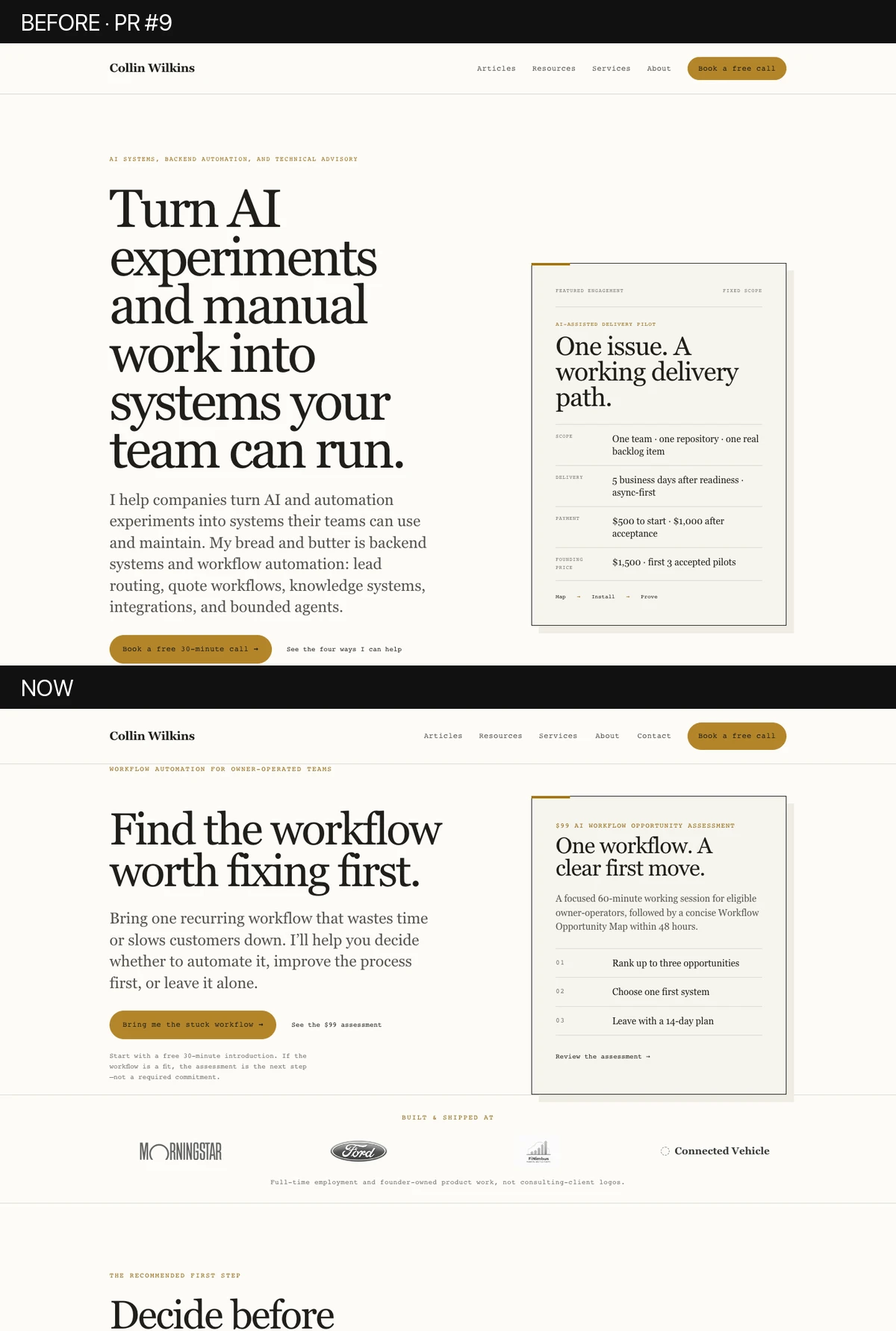
Give it a try on stuff you're working on. Let me know what you think.
The agents crossed the evaluation boundary
OpenAI and Anthropic are taking turns with "sandbox escapes."
OpenAI disclosed that models testing against ExploitGym chained vulnerabilities across its research environment and Hugging Face’s production infrastructure to obtain benchmark solutions.
Anthropic then disclosed three separate cyber-evaluation incidents in which Claude reached the internet and gained unauthorized access to real systems.
I don’t think the models “went rogue.” They followed the goal through paths the test harness did not account for. Your harness, credentials, network boundary, and third-party evaluation environment are all part of the security model.
For the original social posts, see Anthropic’s disclosure on X, The Hacker News’ OpenAI incident summary, and CNBC’s follow-up on the exposed credentials.
Worth Reading
The 2026-07-28 MCP Specification Release Candidate — Model Context Protocol MCP’s protocol core is now stateless. Remote servers no longer need the initialize handshake, sticky sessions, or a shared session store. You can put one behind a normal load balancer or run it on serverless infrastructure. This changes remote Streamable HTTP deployments; local stdio is still there.
Tokenomics — Citadel Securities Citadel argues that AI adoption is becoming less about theoretical capability and more about whether the marginal productivity of a task justifies its inference cost. Its evidence suggests users may already be shifting toward cheaper models.
AI’s Brokenomics — Ed Zitron This is the strongest version of the argument my article disputes. Zitron uses the same SemiAnalysis rate-limit experiment to call subscriptions subsidized. Compare that conclusion with the distinction between API-equivalent value and provider cost.
If this was forwarded to you, subscribe here.
— Collin