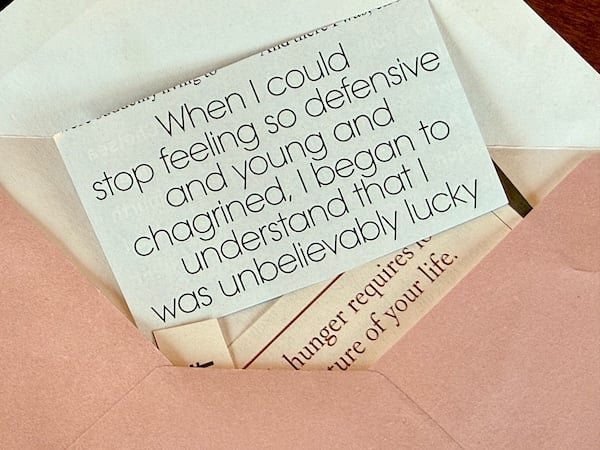
On the final day of Encountering the Buddha as Teacher, we’re sent home with a “goody bag” in the form of a few printed sheets of paper—readings we won’t get to before the end of the retreat. Like Sujātā’s milk rice, these pages are no ordinary nourishment. Back in Michigan after the retreat in Massachusetts, I dip into one of them:
It should be known that stories which clarify dharma, and which are written in one’s own language, have eight benefits for the world. . . .
–from Pujavaliya (A Garland of Offerings) by Ven. Mayurapada, translated from the Sinhala by Charles Hallisey
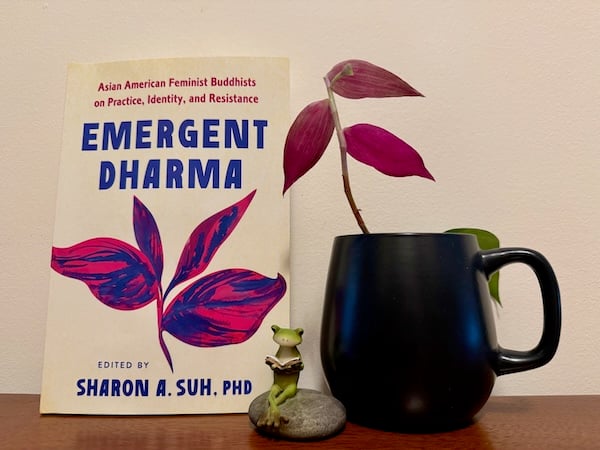
I’m at an “Encountering the Buddha as Teacher” retreat this first week of September, so today’s letter feels especially like snail mail, having been written a few days before you’ll be receiving it. Last time, I mentioned a botanical officemate. Here’s the story, as promised.
🍂 Does the beginning of 2026 feel like an eternity ago to you, too? In January, deep in the doldrums of dreadful winter, I brought home a pair of fern-embossed pots in an algal shade of aqua green. Then, in an act of optimism or desperation (quick Rorschach test: how do you feel about people who string up Christmas lights over Labor Day weekend?), I filled them with dirt. For the next four months, the heavy ceramics sat on a high kitchen shelf. Bereft of greenery, they grew more depressing with each passing day.
A preamble to today’s letter, especially for the West Coasters among you:
1) I’ll be giving Tacoma Buddhist Temple’s Fall Seminar on Saturday, October 10th and speaking at TBT’s Sunday service the next day. A warm gasshō of gratitude to Rev. Tadao Koyama for hosting this book talk for one long listening. I’m excited to finally visit in person, four years after TBT’s online seminar for Be the Refuge.
It started, predictably enough, with sourdough. Kombucha and heirloom yogurt quickly ensued, the latter in varietals redolent of IKEA furniture (Filmjölk, Piimä, Viili). Other millennial clichés that apply to me, years after the pandemic spawned these kitchen ferments:
After the heat waves, cyclospora outbreak, and power outage–inducing thunderstorms, last week brought yet another reason not to go out: pollutant-filled smoke from the Ontario wildfires just north of us. Flashback to other times and places: California wildfires at the start of covid. Crop-burning season in Southeast Asia. Traffic-fueled, triple-digit AQIs in Bangkok and Phnom Penh—year-round, except when covid took cars off the roads, but by then the pandemic had made it impossible for us to return to our Bangkok apartment, whose contents arrived to my in-laws’ house in California, via cargo ship, several months later.
🚢 “My body felt out of time, out of place,” I had just read in Crystal Mun-hye Baik’s Before the Fire Dogs Steal the Sun(124). I stared in confusion at my phone. “500 - Hazardous,” the weather app announced, above a map in bruised shades of burgundy. It took a concerned text from family in California to remember that we should bust out the air purifier. The one from Bangkok had survived its trans-Pacific and cross-country voyages intact, though the filter was running low.
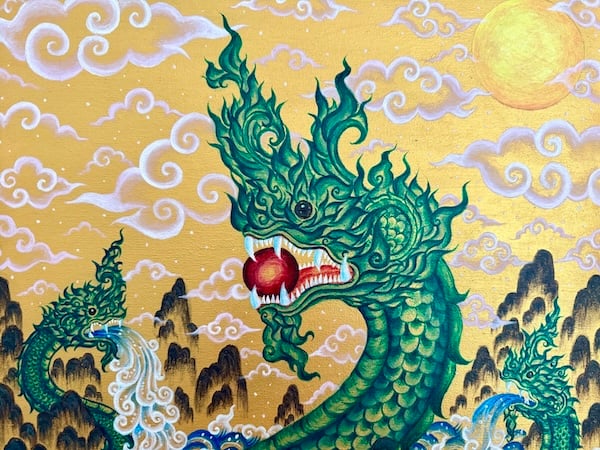
The recent heat dome transported me from Midwest summer to April in Cambodia/Thailand/Laos, when respite from the roasting temps and viscid humidity is hard to come by. (No wonder so many Southeast Asian new year traditions revolve around water.) Here in Michigan, I watched a neighbor hose down his grandchild on their front lawn. In Luang Prabang a decade ago, I dodged water gun–toting kids along the Mekong, whose banks had sprouted elaborate sand stupas festooned with zodiac animal banners. I hear tell that the sand mounds are offerings to naga spirits, whose serpentine bodies form many a temple banister in the Theravada Buddhist world.
🦫 Speaking of rivers and animals, beavers have been making their way back to the local waterways here. We’d read it in the news, and then my partner spotted one on a bike ride last month, after which they started cropping up everywhere: a podcast listen, a movie recommendation (Hoppers), an article about these industrious ecosystem healers. As a friend from my yoga shala pointed out, beavers are masterful builders of refugia.
Happy solstice! I’ve just returned from a trip to California and Chicago and have been delighting in fireflies and full-leafed foliage. I hope you, too, are enjoying these long summer days.
As promised, here’s part 2 of the essay from earlier this month 😎
I’m traveling for much of June, so this month’s newsletters will be an essay (split into two installments) that I wrote/read for the Half Natural/Half Technological event at the CLUSTER Museum in Ann Arbor on May 27th.
I spent the past weekend in Northern California for a dear friend’s surprise fortieth celebration (and yes, the twelve of us, from three time zones and five U.S. states, managed to pull off the surprise). Our youngest member, age one and a half, had two favorite expressions that he deployed throughout the weekend.
I began this AANHPI heritage month 6,000 feet above sea level, at the base of the Southern Rocky Mountains. Before making the journey to Colorado Springs, I’d zoomed into Prof. Nancy Lin’s Engaged Buddhism class at the Institute of Buddhist Studies to talk about the 2024 May We Gather pilgrimage. Tantalizing questions emerged from our conversation like slow-ripening fruit:
Where should we start the history of engaged Buddhism? What modes of action are available to engaged Buddhists? Art, ritual, emotion—what roles do they play in these different modes of engagement? Engaged with whom, and what, and how? Is there such a thing as disengaged Buddhism? How do the contours of our questions and understandings change when we center Asian American Buddhists?
Climate change is shifting the distribution of tornadoes, and sure enough, an EF1 blew through town last week, damaging buildings and downing trees but miraculously leaving no injured humans in its path. My partner and I compared notes with friends later that morning: did the citywide sirens wake you? where did you shelter? is your power back? (yes; a stairwell because we don’t have a basement; not yet). Those in the know had listened for the sound of a freight train. As clueless Californians who live in an Ann Arbor townhouse next to actual freight train tracks, we hadn’t known what to listen for. Though there had been a peculiar roar as we cowered in the stairwell at 1:45am.
🚂 Waiting for something that might or might not materialize felt like living in a plotless movie. My stairwell feeling returned over the weekend at a performance of the complete piano etudes by Philip Glass. That I immediately felt suspended in an atmospheric film is a testament to the minimalist composer’s ineluctable influence in cinema.
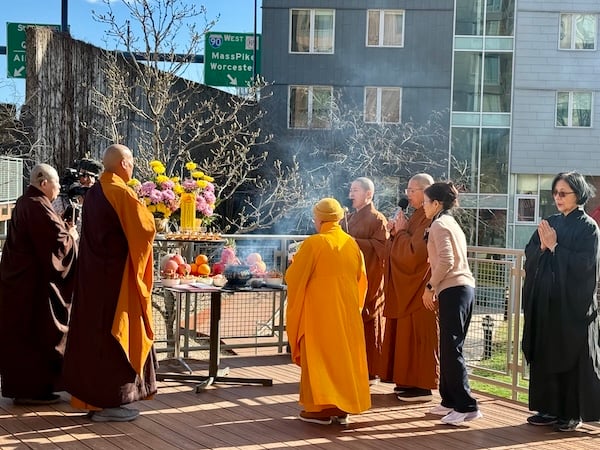
In a happy confluence of karmic circumstances, I’ll be in Massachusetts for the next few days. I hope to see some of you at the opening of Temple of Our Ancestral Dreams, a new exhibit curated by Sung-Min Kim and Wenxuan Xue that will run until June 19 at the Pao Arts Center in Boston’s Chinatown. Saturday’s community gathering, Ancestors of Chinatown: A Day for Remembering and Dreaming, will feature a tea reception, a storytelling panel and film screening of Kenneth Eng’s Mt. Hope Cemetery, and a Ching Ming (Tomb-Sweeping Day) ancestral ritual for the earliest Chinese migrants to Boston. The ceremony, organized by Jiamin Li and led by Venerables from Thousand Buddha Temple,
will honor the memories of those buried at Mount Hope Cemetery and offer collective remembrance for those who have shaped and sustained Chinatown and the wider Boston community. Together, participants will be invited to honor the familial, chosen, and place-based ancestors whose lives and care made our gathering possible.
A dozen letters into this Little Buddhist Days experiment—thanks for reading along / sticking with!—and spring is officially here. Birds and buds emerge, jovial rebuttals to the bleakness of global affairs. Augurs of change, a time for new cadences.
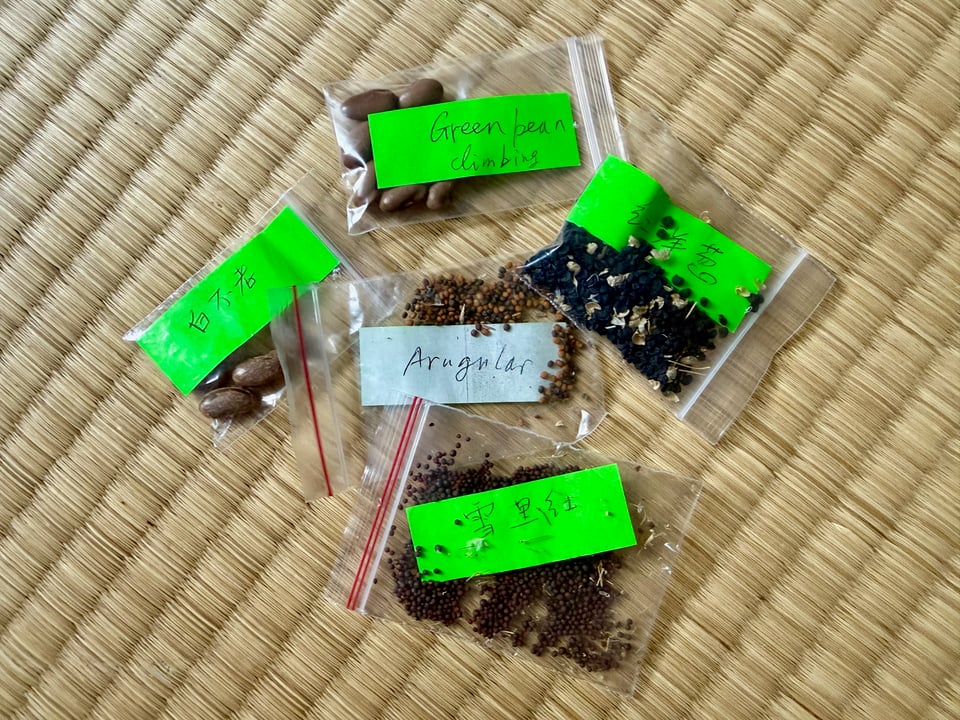
💌 2026 marks the tenth year since the death of my college roommate Amy. A decade ago I left Eugene with a portion of her ashes. Earlier this month I flew back from Eugene with two envelopes containing another kind of granular gift.
A short piece on chaplaincy that I wrote in 2023, “To the Other Shore,” was republished last week with a March 5, 2026 date stamp, a source of confusion for some. The last couple weeks have been like this: the past occupying the present, a palimpsest of trickster time.
I’m reminded of the clock I spotted in the childhood bedroom of my college roommate Amy while visiting her in Oregon a few years after graduation. The clock face had hands for the hour and minute but no numbers, only a heap of letters where 4 o’clock should’ve been. Unscrambling the heap yielded: WHATEVER. The coup de grâce? Amy hadn’t changed the long-dead batteries in years.
I hope the year of the fire horse is off to a swimming start for you! (Apologies for the poorly mixed metaphor, though I’ve just learned that all equines are naturals in water.)
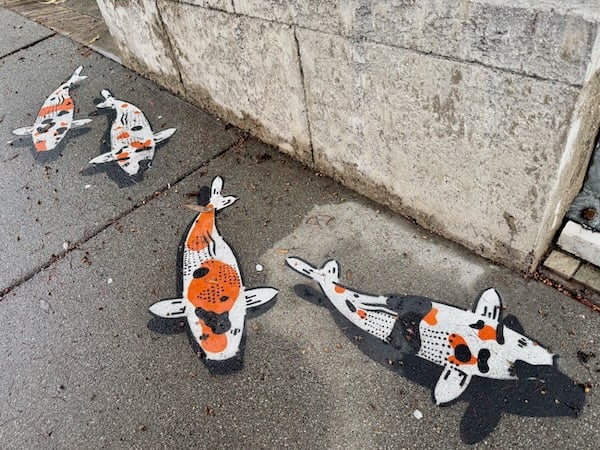
If today’s letter leans aquatic, I happily blame the nearby Pacific Ocean. Pushing my book-laden suitcase up the steep sidewalk to my friend’s home in San Francisco, I spot this quartet of koi, a delightful excuse to stop and catch my breath. Inside her apartment, stories pour from our mouths; outside, the gentle patter of rain from the sky’s infinite mouth. I pull a photo album from the shelf. It’s only been a few years since I last saw her nephew and niece; they seem to have doubled in size. I reminisce about the littlest one’s bold dancing and bright laughter; her gentle older brother’s consternation upon seeing dinner on the chopping block: Does it hurt the kale to be cut?
Friday morning, January 23rd. The windchill is -18ºF as I type these words. After my early morning swim at the Y, I hear a Michigander call this “proper winter weather.” I believe Californians would call this “improper for human existence.”
I hope the start of 2026 has dawned auspiciously for you in counterbalance to these harrowing times.
🌴 On a family hike in the Coachella Valley Preserve over the holidays, my seven-year-old niece asked about my current writing projects. Auntie Z is a slow writer, I told her, but one project is about things that bring me joy through practice and play, like cello. For the other project, I’m learning about people who inspire me. These people are Buddhist and Asian and have made a difference in America. I call this project “the treasury” because it’s full of treasures.
In a year when the headlines felt much like Michigan winter for this California transplant—cheerless and cruel, capricious and calamitous—a recent news item gave me pause.