Dear friends,
Summer weather beckons, so I’ll keep this short, in the spirit of screentiming less and grasstouching more 🌞🌾
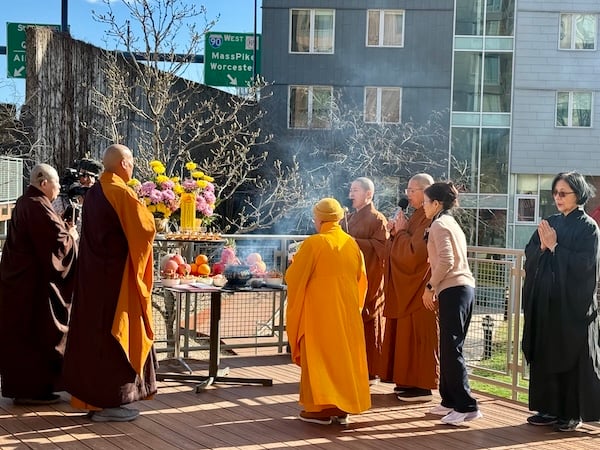
I have a new article out in Tricycle today, “The Spirits Shape-Shift,” inspired by my recent visit to the Temple of Our Ancestral Dreams exhibition at the Pao Arts Center. The opening paragraphs read:
When Dr. Peter Kiang first brought UMass Boston students to Mount Hope Cemetery in the fall of 1993, they found the Chinese immigrant burial area—New England’s oldest and densest—in utter disrepair. Broken glass stippled the leaf litter. Hundreds of gravestones lay damaged, displaced, and eroded. If the tomb markers were the teeth of a vanquished boxer, a full mouth dental implant would be in order. But stones, like teeth, hold ancestral history, so Dr. Kiang and his Asian American Studies students walked the grounds with reverence as they paid respect to Boston’s earliest Chinese immigrants: born as early as the 1860s, with death years from the 1930s to 1960s.
Though she couldn’t read the Chinese characters on the markers, one of the students moved from grave to grave long after her classmates had stopped, offering incense and three bows before each stone. Sophia Nun’s mother had been killed by the Khmer Rouge. There had been no chance to say goodbye; she didn’t even know where her mom was buried. Sophia felt an unexpected sense of connection at Mount Hope, and she urged Dr. Kiang not to let this field trip be the last.
Here’s a gift link to the full article, with photography by Mel Taing. Special thanks to Sarah Fleming for her keen editorial eye, and to Wenxuan Xue, Jiamin Li, Khanh Nguyen, and Ga Tsung Chan for the thoughtful conversations that shaped this piece.
Til the next quarter moon,
~Chenxing
Thanks for reading Little Buddhist Days! 🙏 You can support this newsletter by sharing the subscribe link with others, and by joining the sustainers circle at $3/month.
You just read issue #17 of Little Buddhist Days. You can also browse the full archives of this newsletter.


