
Dear friends,
A preamble to today’s letter, especially for the West Coasters among you:
1) I’ll be giving Tacoma Buddhist Temple’s Fall Seminar on Saturday, October 10th and speaking at TBT’s Sunday service the next day. A warm gasshō of gratitude to Rev. Tadao Koyama for hosting this book talk for one long listening. I’m excited to finally visit in person, four years after TBT’s online seminar for Be the Refuge.
2) My partner Trent and I will be co-teaching at Spirit Rock for the first time on Saturday, November 7. For this daylong, “Rituals of Care: Buddhist Chant and Culture,” we’ll explore the questions:
What is the role of chant in Buddhist practice? How does it shape communities of belonging and cultures of care?
Hope to see some of you at Tacoma Buddhist Temple and Spirit Rock! I’ll be sticking around for a couple extra days in both Seattle and the Bay Area, so let me know if you’d like to join me for a walk/tea/meal.
And now back to our regularly scheduled (if unpredictably substanced) programming…
🦋
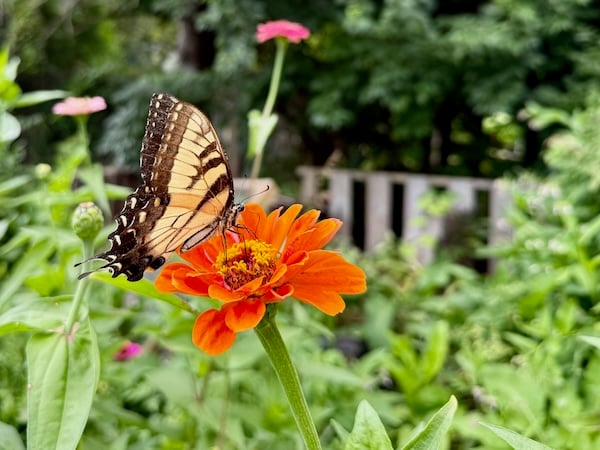
Like the jade plant on my office sill, I have spent too much of this summer gazing out the window. Unlike my poorly plant-parented officemate (a story for another time), I am now writing to you from a garden of wildflowers.
Not so long ago, this community garden was a trash-strewn, weed-infested dumping ground for stolen bikes. Then, a local couple walked by, glimpsed a flash of color, and dove into the thickets to discover a patch of wildflowers. A vision was born.
In 2009, an intergenerational neighborhood crew turned out for the first round of planting. This modest 171-feet stretch is now home to 70+ species of plants, almost all of them native. At the end of a video about the visionaries behind Old West Side’s Mulholland Gardens, Jack & Carolyn Wallace are credited as the master gardeners, followed by:
Shrubs
Butterfy Weed
Bushy Aster
Sage
Marginal Wood FernFlowers
Blazing Star
Black-eyed Susan
Columbine
Culver’s Root
Daisies
Day Lillies
Globe Thistle
Royal Catchfly
Solomon’s Seal
Summer Flocks
Trillium
Trout Lilly
Wild Geranium
Wood FlowerHerbs
Basil
Mint varieties
Parsley
Sage
Rosemary
ThymeTrees
Black Walnut
Oak
Witch Hazel
Eastern Wahoo
I’m charmed by the substitution of Flocks for Phlox, and the butterfly that has lent its “l” to the lilies. Why don’t our non-human, non-motile kin feature in film credits more often?
💎
Last weekend, a group of local writers gathered here for a “Writing in the Garden” potluck. Starstruck by the spread of food and flowers and friends, we didn’t actually get to the writing. It was a bigger turnout than the previous year, a different cast of folks. At sunset, our dwindling numbers formed an impromptu sharing circle. We were soon too engrossed in each other’s words to register the mosquitoes nibbling at our ankles, the fireflies winking on.
Someone read from Joy Harjo’s poem “For Calling the Spirit Back from Wandering the Earth in Its Human Feet” in Conflict Resolution for Holy Beings:
Don’t worry.
The heart knows the way though there may be high-rises, interstates, checkpoints, armed soldiers, massacres, wars, and those who will despise you because they despise themselves.The journey might take you a few hours, a day, a year, a few years, a hundred, a thousand or even more.
Watch your mind. Without training it might run away and leave your heart for the immense human feast set by the thieves of time.
Someone else performed from the Staying Power youth artist-activists’ collection Spoke from the Soil: When Love is a Thing Called Home, released last month by local publisher Dzanc Books. The last few days have been gray, he said. (High-altitude wildfire smoke has been blocking the sun.) But it’s good to be here with all of you and feel the sunlight in other ways.
Another person captured the mood of this lush season with a piece they’d just penned, on queerness and kink. (Lots of oohs and laughter in response.) As a person of color in these times, they said, channeling adrienne marie brown, pleasure feels like resistance.
I thought of the pleasure gardens that have been so foundational to Buddhism, the grounds on which monasteries were built. Ārāma: (gifts of) gardens, delights (of the dharma). From the verbal root ram, to delight in, rejoice, rest, find pleasure in.
I remembered reading the Pure Land Sutras for the first time, around when Jack and Carolyn were dreaming up Mulholland Gardens.
At one time the Buddha was staying in the Jeta Grove monastery of Anāthapiṇḍada’s Garden at Śrāvastī…
The Buddha goes on to describe the Western Pure Land of Amitāyus, which I imagined to be a souped-up version of Anāthapiṇḍada’s ārāma.
Śāriputra, why is that land called Utmost Bliss? The beings in that land suffer no pain but only enjoy pleasures of various kinds. For this reason, that land is called Utmost Bliss. Again, Śāriputra, in the Land of Utmost Bliss there are seven rows of balustrades, seven rows of decorative nets, and seven rows of trees. They are all made of four kinds of jewels and extend over the whole land, encompassing everything. For this reason, that land is called Utmost Bliss. Again, Śāriputra, in the Land of Utmost Bliss there are seven-jeweled ponds filled with water possessing the eight excellent qualities. The beds of the ponds are covered solely with gold sand, and from the four sides of each bed rise stairs of gold, silver, beryl, and crystal. Above these stand pavilions adorned with gold, silver, beryl, crystal, sapphire, rosy pearls, and cornelian. In the ponds are lotuses as large as chariot wheels—the blue ones radiating a blue light, the yellow a yellow light, the red a red light, and the white a white light. They are marvelous and beautiful, fragrant and pure. Śāriputra, the Land of Utmost Bliss is filled with such splendid adornments.
I admit my initial reaction was more skeptical than delighted. I thought Buddhism was all about renunciation? Isn’t this a little… extra?
🐛
On the last day of this year’s Roots & Refuge retreat, a calf was born just down the road from us. I took it to be an auspicious sign, though I’d have been none the wiser had I not gotten a ride to the airport with Tony, whose (largely one-man) Worcester-based Relaxie-Taxi service is not to be confused with Phoebe-of-the-TV-show-Friends’ idea of combining transportation with massages.
Tony has been shuttling retreatants between the Boston airport and Barre’s two dharma centers (IMS and BCBS) for decades. Tony is also a patron saint of animals who will stop his SUV at any hour to remove a turtle from the road, and will cry if he sees so much as a caterpillar flattened on the tarmac. No surprise, then, that he spotted the cow with her legs in the air before the bovine’s owner (a friend of Tony’s—who in Worcester County isn’t?) had the slightest inkling. Tony immediately burst into tears, sure that the cow was in real trouble. But no trouble, just a calf-birth, witnessed by awestruck, tear-filled, compassion-sharpened eyes.
Maybe stopping on a 45-mile-an-hour-road to remove a caterpillar is a bit extra, but in this world of massacres and wars and too much despising, I am saved from despair knowing there are people whose generosity is as extravagant as the Western Pure Land. People who think nothing of losing a night’s sleep to rescue a roadside owl, people who say nothing of the time and expense of transforming a trash heap into a pleasure garden because “when you have a garden, you really can’t stop—they’re such fun!” and besides, “it’s a good thing for the neighborhood, and it’s a good thing for Carol and I too—we really love it.”
A Roots & Refuge alumni once likened our retreat to a 世外桃源 shìwài táoyuán (the phrase originates from Eastern Jin dynasty writer Tao Yuanming’s The Peach Blossom Spring). In this alum’s poetic estimation, 世外桃源 refers to a utopic place, without war or oppression, where humans live in balance with nature, where there is an abundance of joy and peace. The retreat, they said, felt less like an escape and more like a safe, compassionate, caring place to intimately engage with the suffering of the world. Would that all our pleasure gardens could serve as such.
Thank you, dear readers, for compelling me to take the fifteen-minute walk to this local ārāma for only the second time in my life. In the span of writing to you all, I befriended Nick, volunteer gardentender for the past six years and sculptor whose faculty bio page begins: “I once saw an elephant walk through midtown Manhattan in the middle of the night.”
You might not spot an elephant and it might not be in the wee hours of night, but I hope you’ll make time before summer’s end to enjoy your favorite local ārāma. I wonder what magic you’ll find there?
Til the next quarter moon,
~Chenxing
Thanks for reading Little Buddhist Days! 🙏 You can support this newsletter by sharing the subscribe link with others, and by joining the sustainers circle or offering a donation. Your generosity helps keep LBD’s digital lights on—thank you! 💡
You just read issue #23 of Little Buddhist Days. You can also browse the full archives of this newsletter.


