
Dear friends,
To those I inadvertently worried last time—thank you for the kind messages! I am indeed feeling much better, and safely home after my travels to central Michigan and Washington state.
In Kalamazoo earlier this month, I found myself in the company of a couple dozen people of varying ages, professions, and faith backgrounds. Over four glowing autumn days, generously supported by the Fetzer Institute’s practice of sacred hospitality, we grappled with the topic of spiritual innovation. “New Growth, Ancient Roots” was the name of this exploratory gathering; grafting served as our central metaphor. The first example we pondered: Old World European grape vines onto New World American rootstock. I couldn’t think of any Buddhist sutras that speak of grafting (if you know of any, please edify me!), but a member of our group raised Romans 11 (“…you, a wild olive shoot, were grafted among the others to share the rich root of the olive tree…).
Each of our rooms had a small interfaith library of religious texts. I took the NRSVue off the shelf and flipped to Romans 11. Later, I confessed to the group that my initial reaction was not exactly sanguine. How did I respond to the text? I can convey it better through anecdote than adjective:
Before moving from Massachusetts to New Jersey, a dear friend (also a Dharma brother) would sometimes take his young children to the Harvard Art Museums. His oldest, who was about five at the time, was going through a Buddhas-and-bodhisattvas phase (as with dinosaurs, who can resist the epic proportions and multisyllabic names?). They strolled slowly and admiringly through a gallery of Buddhist sculpture. Upon crossing into the next room, a collection of medieval Christian art featuring many a bloody crucifixion scene, my friend’s son yelped:
What are these Buddhas doing?!
🩸
Not that Buddhism is free of violence, but as I reflected on the way Romans 11 speaks of peoples and punishments (“…be afraid. For if God did not spare the natural branches, neither will he spare you”), I wondered about my “What are these Buddhas doing?!” alarm in response to the passage.
In addition to being a Buddhas-and-bodhisattvas superfan, my friend’s son was fast becoming a Globle whizz whose interest in geography seemed only to be rivaled by his intrigue with time. No need for YouTube to pacify this kiddo; he would peacefully stare for long minutes at a timer counting down, the numbers ticking toward zero.
I have a hunch that my difficulty in grasping Romans 11—which extended into my failure to apprehend the grafting-as-spiritual-innovation metaphor—has something to do with the way Buddhism relates to space and time. As Rupert Gethin writes in chapter 5 of The Foundations of Buddhism, “The Buddhist Cosmos: The Thrice-Thousandfold World”:
How long, according to Buddhist thinking on the matter, have you and I together with other beings been wandering from birth to death through saṃsāra?
The answer is given not in numbers but in similes:
In response to just this question the Buddha is said to have declared that saṃsāra’s beginning was inconceivable and that its starting point could not be indicated; he went on to ask the group of monks he was addressing which they thought was greater, the mother’s milk they had drunk in the course of their long journey through saṃsāra or the water in the four great oceans. (113)
The answer to this multiple choice test, as the Buddha reveals, is A.
♾️
So we’ve been wandering in saṃsāra for aeons, for kalpas. And just how long is that? Here again, similes say more than figures.
Suppose there was a great mountain of rock, seven miles across and seven miles high, a solid mass without any cracks. At the end of every hundred years a man might brush it just once with a fine Benares cloth. That great mountain of rock would decay and come to an end sooner than ever the aeon. So long is an aeon. And of aeons of this length not just one has passed, not just a hundred, not just a thousand, not just a hundred thousand. (113)
Limning the limits of space, as the Kevaddha Sutta conveys, requires a similar exercise in mental gymnastics.
There is no spatial limit to the extent of world-systems: Buddhaghosa tells us in the Atthasālinī (“Providing the Meaning”) that if four Great Brahmas from the realm of the Supreme Gods were to set off in the four directions at a speed which allowed them to traverse a hundred thousand world-systems in the time it takes a swift arrow to pass over the shadow of a palm tree, they would reach nirvāṇa without ever finding the limit of world-systems. Great Brahmas of the realm of the Supreme Gods are beings in their last existence who are certain of reaching final nirvāṇa at the end of their lives, which last 16,000 aeons. Bearing in mind the simile for the length of an aeon, I leave it to the reader to ponder how many hundreds of thousands of world-systems these Great Brahmas might traverse in 16,000 aeons (115)
My partner recently posed this puzzle to the students in his Introduction to Theravada Buddhism class. The physics majors may have had a head start, but like their classmates, they stumbled over unknown variables. Some students started with the mountain of great rock (what’s the volume of a cone?) and estimated the loss with each rub (a cubic meter—quite the impressive Benares cloth). Others tried to extrapolate the size of a world system to Jambudvīpa (if comparable to India, about 3,000 km long). And were these Brahma deities traveling faster or slower than the speed of light?
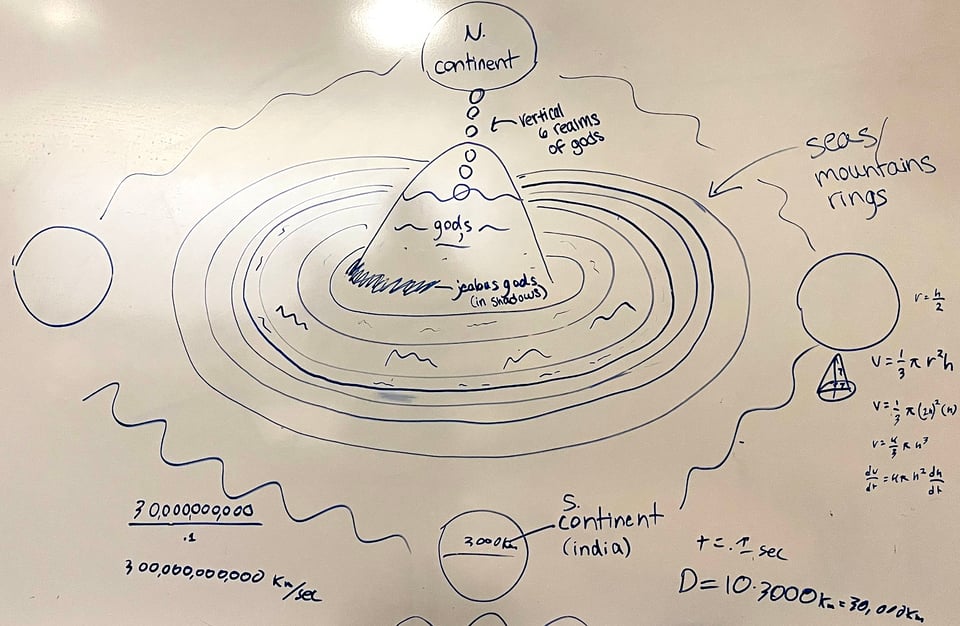
The groups agreed the Great Brahmas were going far faster than 300,000 km/s. Otherwise, their investigations yielded vast—and vastly different—numbers.
🧩
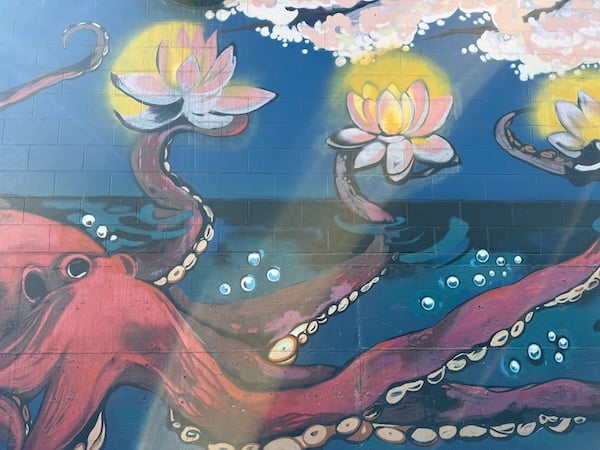
I thought of these liquid numbers (liquid in the free-flowing, not financial, sense) after spotting the aquatic-themed mural behind Tacoma Buddhist Temple. (A red octopus proffering glowing pink lotuses upon several of its extended arms.) Lotuses glow from the stained glass windows of the Hondo of this historical temple, where I had the honor of giving a seminar on one long listening. The next day, I spoke at a service in celebration of Eshinni and Kakushinni, whose foundational roles in transmitting Jodo Shinshu Buddhism remain shrouded in mystery. At coffee hour afterward, a temple member and I talked about how the 1921 discovery of a tranche of letters between this mother-daughter pair offered only a tiny, tantalizing glimpse into the fullness of these women’s lives.
If we are attentive, life is full of these moments when our sense of time becomes liquid and our imagination of other worlds blooms open: a cache of letters, a cloth-erased mountain, milk-overflowing seas. Or, as I recently learned (to continue the aquatic theme): Greenland sharks, 21 feet long and 2,200 pounds, swim slower than an escalator in below-freezing Arctic waters. They are believed to have gestation periods of up to 18 years and lifespans up to 510 years—the longest of any known vertebrate. One researcher lovingly describes the sharks as “look[ing] like [they’re] already dead.” The process of studying these creatures, in the words of another researcher,
is like finding a handful of puzzle pieces, but then realizing it’s a thousand-piece puzzle
As we traverse our magical-mysterious swaths of time and space, may the puzzle pieces we find hold the keys to a realization more vast and profound than anything we can yet picture. As with Greenland shark researchers to their subjects, may we discover, again and again, that we have profoundly underestimated ourselves.
Til the next quarter moon,
~Chenxing
Thanks for reading Little Buddhist Days! 🙏 You can support this newsletter by sharing the subscribe link with others, and by joining the sustainers circle or offering a donation. Your generosity helps keep LBD’s digital lights on—thank you! 💡
You just read issue #27 of Little Buddhist Days. You can also browse the full archives of this newsletter.


