
The AI-DLC: AI-Driven Development Lifecycle
Breaking down for you the AI-DLC — AWS's AI-driven development lifecycle — covering its ten principles, artifacts like Intents, Units, and Bolts, and how it stacks up against the traditional SDLC.

Key Takeaways
What is AI-DLC
Ten Key Principles of the AI-DLC
The AI-DLC Artefacts, defined
The AI-DLC Phases
AI-DLC vs Traditional SDLC
💡 Key takeaways
AI-DLC is
Iterative — Continuous loops instead of linear waterfall
Non-linear — Loosely coupled units allowing recursive validation & refinement for autonomous development and independent deployment
Context-Aware — Informed by project knowledge
AI-Augmented — Human oversight and judgment plus AI acceleration
What is AI-DLC
In 2025, Raja SP from Amazon Web Services (AWS) coined the AI-Driven Development Lifecycle (AI-DLC) Methodology. He described and presented it in his white paper as a human-and-AI collaboration, to fully integrate AI in the work, “settling the foundations for the next evolution in software engineering."
Ten Key Principles of the AI-DLC
Reimagine rather than retrofit
Instead of using AI with the Software Development Lifecycle (SDLC) or Agile (e.g. Scrum), they choose to reimagine based on first principles thinking.
AI-DLC is dropping traditional rituals (daily standups, retrospectives, and story points), and shortening the number of phases it takes between planning and coding. They’re replacing metrics with Business Value on the get go. The result is an AI-native SDLC.
Reverse the conversation direction
In AI-DLC, AI initiates and directs the conversations instead of the “traditional” prompting to generate the code. AI will ask developers to approve, validate, select options, and confirm decisions. Humans’ task will be on oversight, high-value decision-making, and moderation.
Integration of design techniques into the core.
AI-DLC standardizes engineering quality by integrating design techniques into the workflow: Domain Driven Design (DDD), Behavior Driven Development (BDD) or Test-Driven Development (TDD). AI will apply the techniques during planning and task decomposition phases and will just ask developers to validate and adjust.
Align with AI capability
The author recognizes that AI can’t be 100% autonomous yet so they leave the validation, decision-making, and oversight to humans – the critical importance of judgment.
Cater to building complex systems
AI-DLC caters to large complex systems that involve multiple teams in large organizations; those that have different kinds of stakeholders and multiple custom requirements. Simpler systems that can be developed by non-developers are not covered by AI-DLC.
Retain what enhances human symbiosis
User stories and Risk Register are among the artifacts that will be retained in the AI-DLC. This ensures human validation and risk mitigation and that rapid iterations don’t compromise alignment or safety.
Facilitate transition through familiarity
The author points out that people can start practicing it in a single day, without needing to undergo extensive training. They are retaining familiar terms while also introducing new terminology. For example, in AI-DLC, sprints have turned into bolts — rapid intense cycles that replace sprints in Scrum.
Streamline responsibilities for efficiency
AI-DLC will require minimal handoffs and specialized roles. Product Owners and developers will remain essential to align business objectives, maintain design quality and compliance.
Minimize stages, maximize flow
Streamlined roles and responsibilities will enable for a continuous iterative flow. AI-DLC will blur the lines between some of the phases in traditional SDLC, emphasizing the role of humans in oversight and judgment.
No hard-wired, opinionated SDLC workflows
AI-DLC prescribes an AI-First approach, where AI recommends the Level 1 Plan based on the given pathway intention. Humans will then verify and moderate the plans throughout the succeeding levels. All while collaborating with AI.
The AI-DLC Artifacts, defined
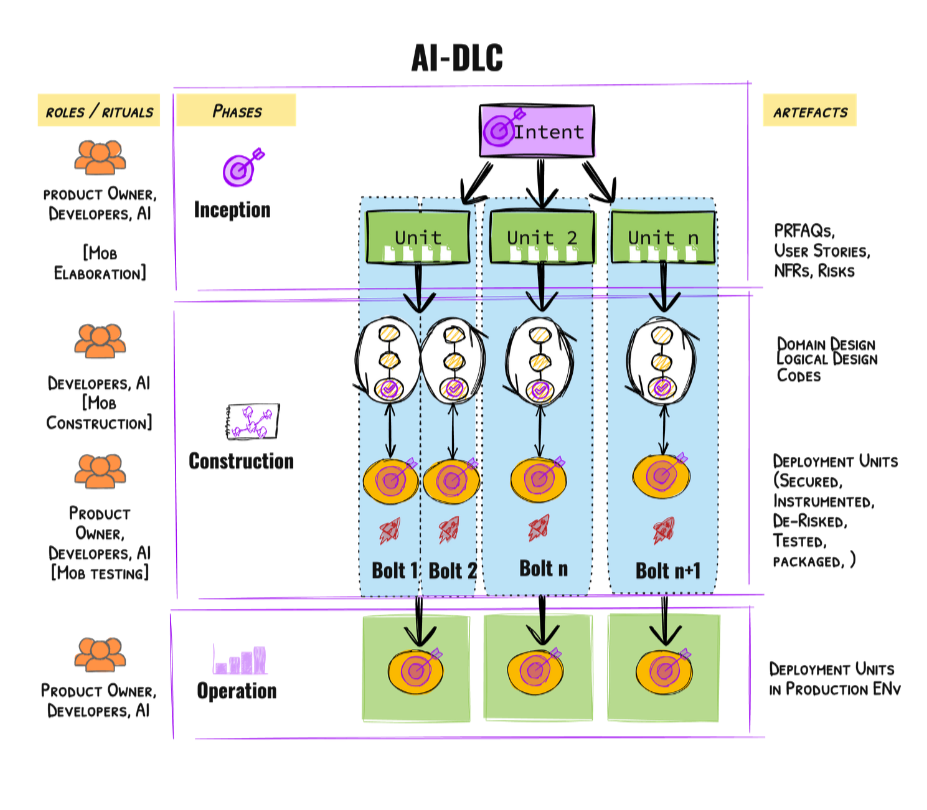
Intent – a high-level statement of a purpose that covers what needs to be achieved: a business goal, a feature, or a technical outcome (e.g. performance scaling). This is the starting point in aligning human objectives with AI-generated goals.
Unit – represents a cohesive, self-contained work element derived from an Intent to deliver measurable value. Simply put, Units represent Epics in Scrum. These will have a set of tasks or user stories, which Developers and/or Product Owners will then validate and refine.
Bolt – the smallest iteration in AI-DLC that’s similar to a Sprint in Scrum.
Domain Design – the core business logic of a Unit
Logical Design – translates Domain Design by extending them for meeting the non-functional
requirements using the right choice of architectural design patterns.
Code and Unit Tests – to be generated by the AI from the Logical Design specification
Framework Structure
AI-DLC consists of two primary dimensions

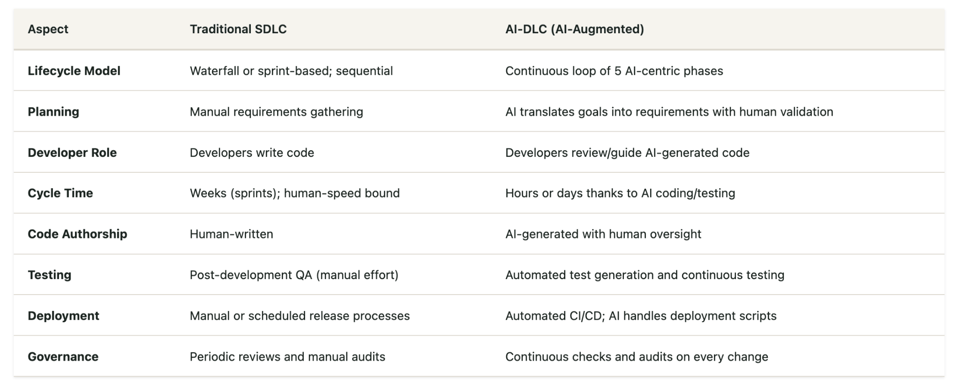
AI-DLC vs Traditional SDLC
AI-DLC vs Traditional SDLC as presented by Avashya in their AI-DLC Reference Guide.
You might prefer reading Avashya’s Reference Guide that has a layout that’s more readable than the white paper and easier for your eyes. This was made by ex-AWS people.
What topic would you like to see next? Let us know by sending us a message! We’ll feature you when your idea gets picked!

Sources:
Raja SP 2025. AI-Driven Development Lifecycle (AI-DLC) Method Definition
IBM 2026. The AI-DLC: The AI-driven development lifecycle
Avashya 2026. AI-DLC Reference Guide
