
Gen Z’s AI-Driven Development Lifecycle
Here's the AI-Driven Development Lifecycle broken down phase by phase - also drilling what skills actually matter now, and the catches no dev should ignore.

Coding used to mean hours of Googling error messages, Stack Overflow deep dives, and that one senior dev who always knew how to handle incidents. And this AI era is kind of trying to put that era in ancient history.
Let’s talk about the AI-Driven Development Lifecycle (AI-DLC) – where they say your dev workflow gets a glow-up from ideation to deployment.
What Is the AI-DLC?
Why This Hits Different for Gen Z
The Lifecycle, Phase by Phase
The Skills That Actually Matter Now
But Real Talk – The Catches
The Takeaway
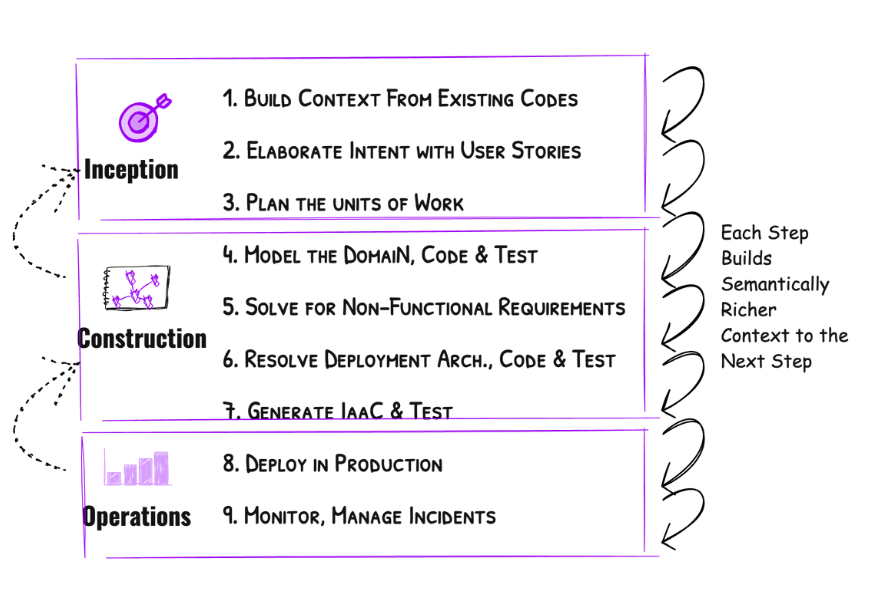
What Is the AI-DLC?
The AI-DLC was coined by AWS’ Raja SP. It’s a full-stack transformation where AI agents assist at every phase of software development: planning, design, coding, testing, deploying, and monitoring.
It’s like having a senior engineer, QA tester, and DevOps specialist rolled into one. It’s a tireless bot that never sleeps, never judges your variable names, and never asks "why?" in code review.
Why This Hits Different for Gen Z
You grew up with algorithms curating everything – playlists, feeds, even where to eat next.
Applying that same intelligence to building software feels like the natural next step. Plus, you're entering a job market where "knowing how to prompt an LLM" becomes just the same as knowing Git. A lot of devs thriving right now are orchestrating AI tools like their second nature.
The Lifecycle, Phase by Phase
Raja SP listed three phases: Intention Phase, Construction Phase, and Operations Phase.
Avashya listed five phases: Intend, Structure, Develop, Launch, Continuously Evolve.
I’m listing here five, adapted from the latter.
1. Intend: Planning & Requirements (From Vibe to Specs)
Product managers drop requirements and AI translates them into structured user stories, acceptance criteria, and edge-case checklists. Tools can even simulate how different user personas might interact with a feature before a single line gets written. Then, the human constantly confirms or re-evaluates.
2. Structure: Design & Architecture (Skip the Blank Canvas)
Instead of whiteboarding from scratch, you describe the system and AI drafts architecture diagrams, suggests tech stacks based on your constraints (budget, team size, latency needs), and flags anti-patterns. It's like getting a free consultation from an architect who's seen it all.
3. Develop: Implementation (Pair Programming With the Machine)
The headline act. AI pair programmers generate source code, write tests alongside implementation, configuration files, and tech documentation. But here's the twist – the best results come from treating AI output as a first draft. You're still the director and the AI model is your very fast intern that’s occasionally hallucinating.
Pro tip: context engineering beats prompt engineering. Feed your AI relevant docs, existing patterns, and style guides instead of hoping it guesses your conventions correctly.
4. Launch: Testing, Code Review, QA & Deployment (All-in-one Phase)
AI writes property-based tests, containerization, infrastructure provisioning, and deployment to staging/production environments. Automated test suites and compliance audits run during this phase.
AI scans for security vulnerabilities, performance bottlenecks, accessibility gaps, and style violations. Humans then focus reviews on final approvals including logic, maintainability, and whether the solution fits the product vision. And of course, monitors deployment progress.
5. Continuously Evolve: CI/CD (AI Is the Main Character Now)
AI monitors production to detect which builds are likely to fail based on unusual patterns, optimizes pipeline order, auto-generates improvement backlog, and can even restart services.
AI identifies technical debt and legacy spaghetti for refactoring.When something breaks, AI drafts the incident summary, and suggests the fix.
The Skills That Actually Matter Now
The AI-DLC doesn't make developers obsolete – it shifts what you’re valued for and "being good in dev" means:
Systems thinking over syntax memorization (don’t get me wrong, syntax memorization is also still important)
Prompt and context engineering as core competencies
Critical evaluation of AI outputs (spotting confident AI blunder is a superpower)
Domain knowledge – AI can't tell you what users actually need
Communication – translating between stakeholders, AI agents, and teammates
This lifecycle rewards T-shaped people who go broad across the stack and deep in judgment calls.
But Real Talk – The Catches
Not all sunshine here, though.
Over-reliance risk. Juniors skipping fundamentals because AI handles it – creates knowledge gaps that hurt during incidents. Three Samsung employees reportedly slipped in 2023 when they consulted with ChatGPT.
Security debt. AI-generated code can introduce vulnerabilities if nobody audits it. It’s already happening everywhere.
IP and licensing questions. Who owns code trained on public repos? Still no answer to that.
Alert fatigue. If every AI tool has opinions, you drown in suggestions; overstimulated at the end of the day. Are all humans designed for this? The orgs that are winning treat AI as leverage, not autopilot.
And despite AI-DLC, human oversight stays non-negotiable – especially around security, privacy, and anything about money or health data.
The Takeaway
The AI-Driven Development Lifecycle (AI-DLC) isn't science fiction – it's being used by teams shipping today.
For Gen Z devs, this may be truly exciting – the barrier between idea and working software has lowered.
Just remember to continue to upskill and that it’s still good to learn the basics – like the previous generations did. No need to out-grind each other because in Tech’s challenging times, we’ll be in it together.
For the full details, read Raja SP’s whitepaper and ex-AWS guys’ Avashya AI-DLC Reference Guide
What topic would you like to see next? Let us know by sending us a message! We’ll feature you when your idea gets picked!

Sources:
Raja SP 2025. AI-Driven Development Lifecycle (AI-DLC) Method Definition
IBM 2026. The AI-DLC: The AI-driven development lifecycle
MIT AI Risk Initiative 2023. ChatGPT Implicated in Samsung Data Leak of Source Code and Meeting Notes
Avashya 2026. AI-DLC Reference Guide
