
How to Answer Behavioral Questions with the STAR Method
I'm breaking down the STAR method for behavioral questions like "tell me about a time you failed" — with sample answers, timing tips, and the mistakes to skip.

So you landed the interview. Congratulations 🎉
Then comes the part where the interviewer says, "Tell me about a time you failed" and your brain goes blank.
Enter the STAR method — a simple framework that turns your crazy work stories into impressive answers. No corporate-speak needed.
Download 27 samples of mock interview Q&A here
In this issue:
What is the STAR Method?
Why is it important?
Examples
More tips
Avoid these common mistakes
Save the infographic!
What is the STAR Method?
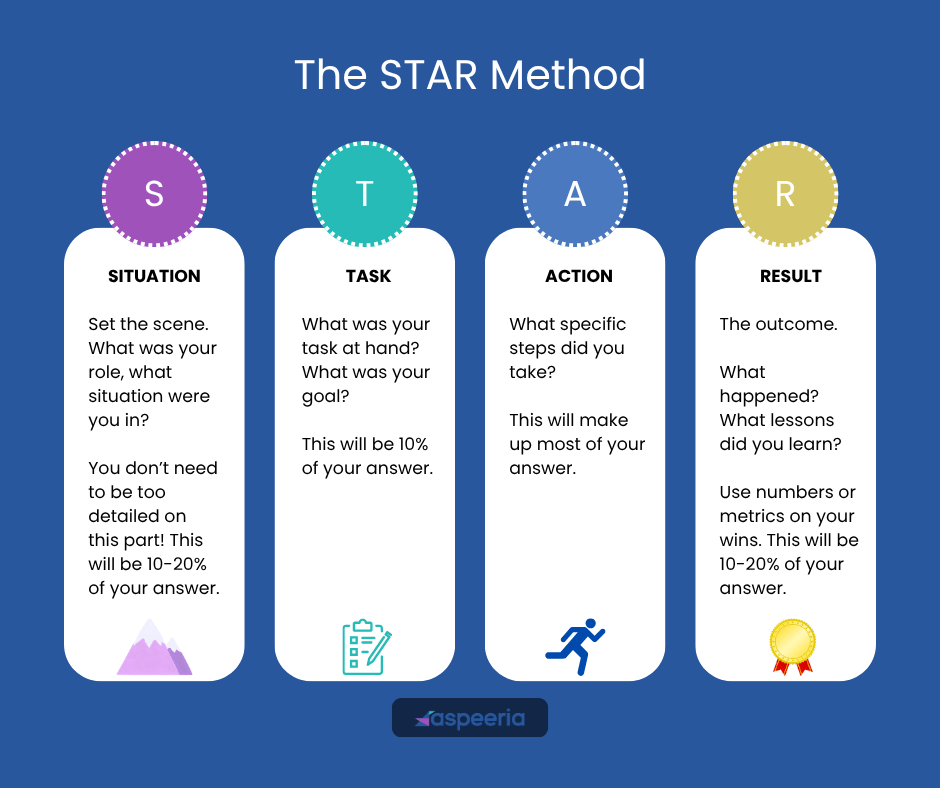
STAR is an acronym for four things you “hit” in sequence when answering behavioral questions (the "tell me about a time..." ones):
S Situation. (10-20% of your answer) Set the scene. What was your role, what situation were you in?
T Task. (10% of your answer) What was your task at hand? What was your goal?
A Action. (60% of your answer) What specific steps did you take?
R Result. (10-20% of your answer) What happened? Numbers, lessons, and wins.
It’s like a sandwich paragraph; you're basically telling a story with a beginning, middle, and end-results.
💡 Key takeaways:
Behavioral question → Situation, Task, Action, Result.
Spend most of your time on the Action and Result, keep it under 90 seconds, and always end on proof that it worked.
Why is it important?
Interviewers ask behavioral questions because past behavior predicts future behavior. Random, incohesive answers make you look unprepared. STAR keeps your answer glued, focused, and confident, even if you're nervous.
Manila Recruitment also shares a good take from a recruiter’s perspective.
Examples
Question: "Describe a time when you had to work with a difficult team member. How did you handle the situation?"
Situation: During a six-month software development project, I was assigned to a senior developer who was very resistant to feedback and often dismissed suggestions from junior developers like me.
Task: I had to find a way to collaborate effectively with him because we were co-leads on a critical feature that required constant coordination.
Action: Instead of escalating the situation right away or avoiding interaction, I scheduled a one-on-one coffee meeting outside the office. I asked about his working style and shared mine. I learned that he valued data-driven decisions and direct communication. So I adjusted my approach by always supporting up my suggestions with user data or technical benchmarks. I also made sure to acknowledge his expertise publicly and ask for his input before suggesting alternatives.
Result: Our working relationship improved significantly within two weeks after that meeting. We successfully delivered the feature ahead of schedule. He even mentioned to our manager that I was one of the most professional junior developers he’d worked with. In this situation, I learned that understanding someone’s communication and working style can prevent conflict and turn a difficult relationship into a productive one.
Question: "Give an example of a time you solved a difficult problem."
Situation: When I joined my previous company, I faced hundreds of issues that I needed to solve.
Task: Learning that there is a new staff, one of our clients demanded that my company settle the 2-year backlog immediately.
Action: As my team lead can no longer recall the background of the case, I did my research accordingly. Instead of exchanging multiple emails with the client, I called them to discuss the old and urgent cases. We collaborated to lay out a plan so I can clear the old and urgent cases while also working on the current ones.
Result: I was able to clear 50% of the 2-year backlog within 3 months and prevented the client from charging the company a $20 fine per overdue case. I developed a good working relationship with my client from then on and where appropriate, I applied the same technique in dealing with other clients.
Notice how the Action and Result carry the most weight. That's where you win.
More tips
Keep it short. Aim for 60–90 seconds per answer.
Keep Situation/Task to ~20% of the answer
Quantify the result. "Boosted sign-ups 25% in a month" instead of "Improved engagement."
Prep 3–5 stories ahead of time. Most questions map onto a handful of experiences – conflicts, failures, leadership, tight deadlines.
Avoid these common mistakes
Being too detailed on the backstory (don’t spend 3 minutes on it)
Don’t practice word-for-word; know your flow.
Being too vague (“It went well afterward.”)
Only sharing wins; failure + learning shows maturity.
Practice out loud a few times before the interview and it'll feel less like a test and more like just explaining what you did.
Remember, you can use the STAR Method for other things, too, like on your resume. Here’s how I explained it .
What topic would you like to see next? Let us know by sending us a message. We’ll feature you when your idea gets picked! 🥳
