
How to Format Your Cover Letter for Tech Job Applications
This edition helps you stand out by crafting compelling cover letters for job applications.


Do you know how to format your cover letter for tech jobs applications?
A strong tailored cover letter gets you one step closer to the application process.
It may be challenging to write at first but with this formatting guide along with Your Guide to Creating an Effective Cover Letter, you’ll be able to craft a compelling cover letter and have a better chance of scheduling an interview call.
In this issue:
Why do you need a cover letter?
When do you NOT need a cover letter?
How to write your cover letter
How to format your cover letter
Sample cover letter
Subscribe nowWhy do you need to write a cover letter?
Most companies require a cover letter to be sent with the resume in submitting your application. This is the first point of contact you make with the hiring manager, talent acquisition, or a recruiter from a recruitment agency.
Both the cover letter and resume state your professional background and achievements but they have different functions.
The usage of a cover letter is to show why you’re a good fit for the position. It’s a single-page conversation opener with the Hiring Manager.
A resume is (usually) a two-page summary of your skills, work experience, and education. It’s more straightforward and doesn’t have a conversational tone.
When do you not need to write and send a cover letter?
If the job post clearly says that you don’t need to send a cover letter, then you don’t have to.
Also, you don’t need to send one if you’re submitting digitally through an application portal and there’s no field to attach a cover letter.
What if there is no direct instruction to send a cover letter? Then, it would be safe to send one.
Remember, a cover letter is a chance for you to put your best foot forward so the hiring manager will consider to read your resume.
How to write your cover letter
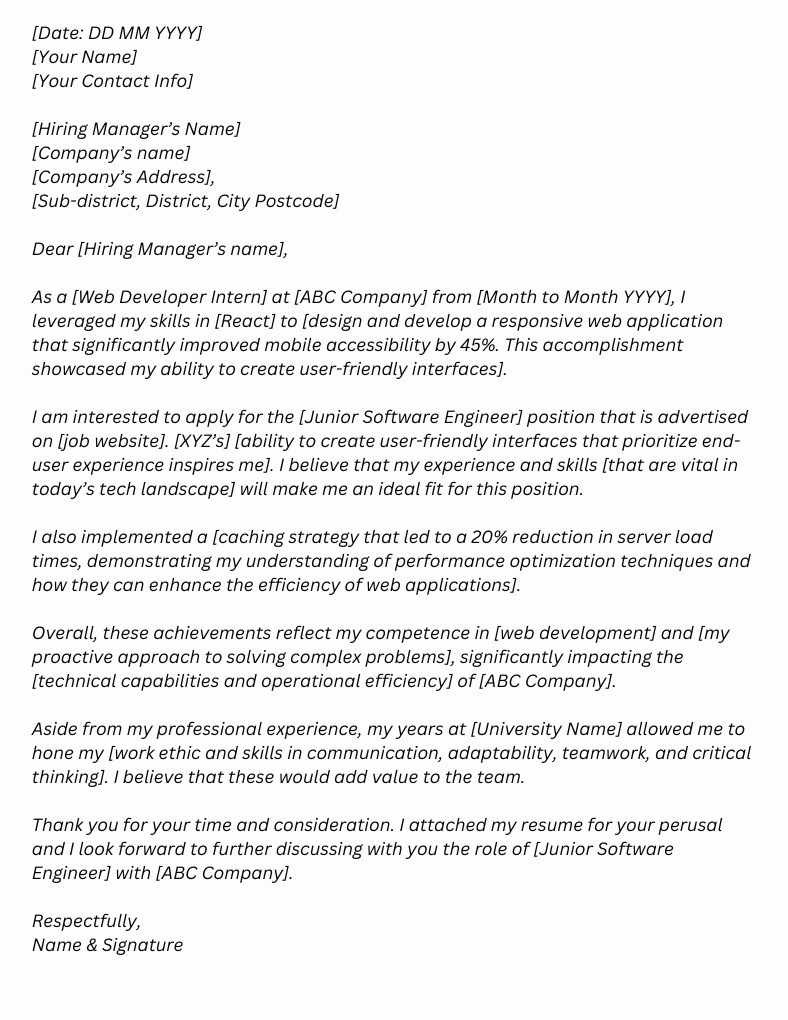
A standard cover letter will have the following structure:
[Date: DD MM YYYY]
[Your Name]
[Your Contact Info]
To:
[Hiring Manager’s Name/Team]
[Department Info]
[Company Address]
[Formal Greeting]
[Opening Paragraph]
[Body Paragraph 1]
[Body Paragraph 2]
[Optional Body Paragraph 3]
[Closing Paragraph]
[Salutation],
[Your Signature]
Start the body of your cover letter with a striking introduction or unique opening. Talk about your top achievement and relate it to why you are interested in their company.
Mention the company name to let them know that you researched about them and that you personalized your cover letter.
Explain why they should choose you and how you can add value to the company.
On the body paragraphs, show data and statistics in telling your success story. Here’s where you can also include your power skills.
You’ll be able to show your communication skills through good storytelling on a cover letter.
Also remember to align your cover letter with the job description on the job ad. This allows you a better chance to pass through Applicant Tracking Systems (ATS).
End your cover letter with a call-to-action. Give a proactive invitation to discuss your fit for the role to express that you’re eager to move the application further.
Use a formal salutation such as Regards, Sincerely, Respectfully, etc.
Read Your Guide to Creating an Effective Cover Letter for a comprehensive guide on writing your cover letter.
How to format your cover letter
Since your cover letter and resume are sent together in a job application, it would be appropriate to use the same format on both documents.
They will look more polished, professional, and easier to read from the hiring manager’s perspective.
Font style and size
Use a standard font between Serif and Sans Serif. Fonts like Times New Roman, Arial, and Calibri are popular fonts used for cover letter and resumes.
Other options may be Garamond, Helvetica, or Verdana. The key here is to avoid decorative fonts to show professionalism.
A font size between 10 and 12 points is ideal for the readability of a cover letter. For resume, likewise, you may use this size for content details. For resume section titles, use a font size between 14 and 16 points.
Length
An ideal cover letter should be easy to read yet packed with useful information that can convince the hiring manager to read your resume next.
Keep it to one page, with two to three concise paragraphs. A hiring manager will be more likely to read a cover letter that’s short and straightforward.
Spacing
A cover letter with plenty of white space looks fresh and easy to read.
It’s advisable to use the standard margin, which is 2.54 cm (1 inch) on all sides, aligned on the left.
For the spacing, it would be single-spaced with double spacing in between paragraphs. You don’t have to indent the first line of each paragraph if the paragraphs are double spaced.
When you’ve finished writing your cover letter, ensure that the file name is professional and identifiable.
Unless the company gave a specific instruction to name your cover letter and resume, you may opt to save your file like the following example:
Firstname_Lastname_CoverLetter.pdf
Joe_Smith_CoverLetter.pdf
Sample cover letter
Did you like this post? Let us know by sending us a message!
Also Read:
Your 2026 Guide to Creating an Effective Cover Letter
How to Write a Resume: Your 2026 Resume Guide
