Your 2026 Guide to Creating an Effective Cover Letter
Boost your chances of an interview with our guide to crafting an ATS-friendly, attention-grabbing cover letter


Hiring managers and recruiters usually skim through your cover letter and resume before they read them entirely. It is important to have an effective cover letter to begin with.
It is challenging, though, that many companies have adapted the use of Application Tracking Systems (ATS) to streamline hiring processes, including data collection and analysis features that come with them.
We made this guide to help you make your cover letter ATS-friendly and have better chances of getting an interview call.
In this issue:
Cover letter segments and paragraph structure
Your name and contact info
Hiring Manager’s information
Formal greeting
Opening paragraph
Body paragraphs
Closing paragraphs
Salutation
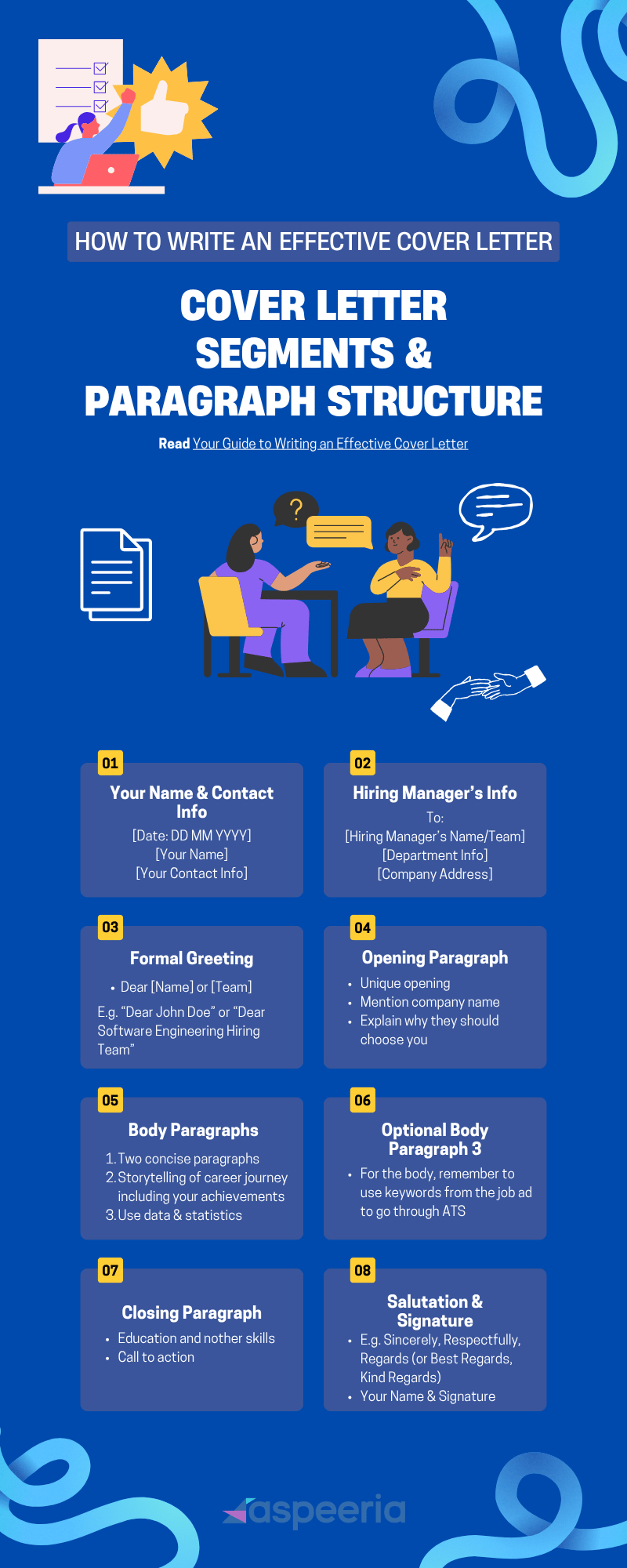
Infograph
Cover letter segments and paragraph structure
[Date: DD MM YYYY]
[Your Name]
[Your Contact Info]
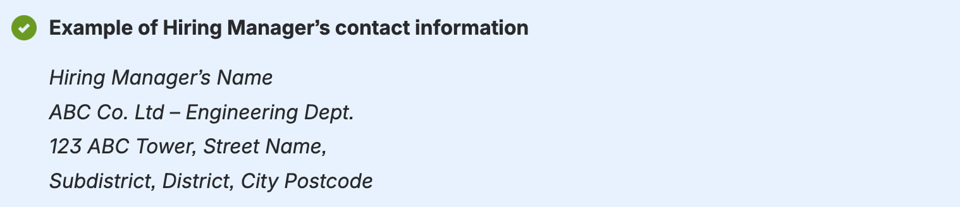
To:
[Hiring Manager’s Name/Team]
[Department Info]
[Company Address]
[Formal Greeting]
[Opening Paragraph]
[Body Paragraph 1]
[Body Paragraph 2]
[Optional Body Paragraph 3]
[Closing Paragraph]
[Salutation],
[Your Signature]
Your name and contact info
I know it’s pretty straightforward but we still have to be mindful on how to present it to make the best impression.
Details to include. Write your name, city and state/province, phone number, and email address. It is also common to include your LinkedIN URL to show the hiring manager your public profile and professional network.
Email address should be professional. You could make a new email address exclusively for your job applications to separate job emails from your personal ones. Ensure that your email address is not related to jokes, vulgar or offensive words, politics, or anything considered as unprofessional.
Where to place your name and contact info. In a formal letter, you need to place your name and contact info at the top of the page. When submitting digitally, you may choose to put it at the end of the letter, after your signature.
Hiring Manager’s information
As much as you can, research the name of the hiring manager to whom you will address the cover letter. Go back to the job post and look for the details of the hiring manager.
You can also try searching on the company’s LinkedIN page or even call the company and ask for the hiring manager’s name.
If you still can’t find it, you may address your letter to:
The Engineering Hiring Manager
The Software Engineering Hiring Team
The IT Recruitment Team
Formal greeting
❌ Avoid using “To Whom It May Concern,” or “Dear Sir/Ma’am.“ It is impersonal and could give an impression that you did not research about the company.
❌ Do not assume the gender of the hiring manager by saying, “Dear Ms. Hiring Manager” or “Dear Mr. Hiring Manager.“
✅ If you really can’t get the Hiring Manager’s name, you may use an opening greeting such as, “Dear Engineering Hiring Manager“ or “Dear Software Engineering Hiring Team.”
Opening paragraph
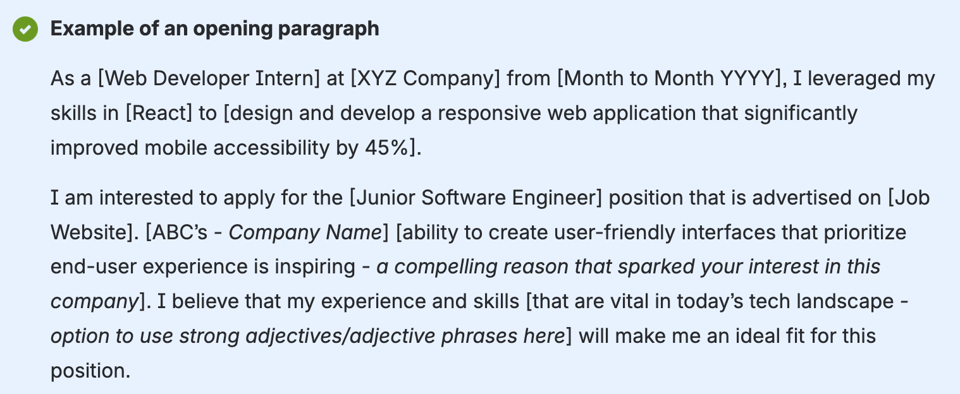
Start with a striking introduction or unique opening. State the most impressive achievement that you are proud of. Then, relate this to why you are interested in the role and their company.
Mention the company name. It is good to mention the company’s name to show that you personalized the cover letter instead of using a generic template.
Explain why they should choose you. Express intent to be a part of their company by saying why the job ad interests you and how it appeals to you on a personal level. Relate your achievement to how you can add value to the company.
Body paragraphs
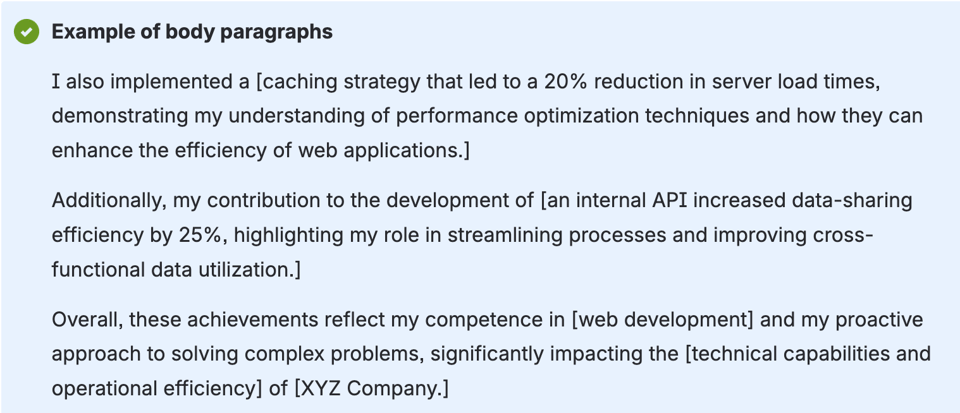
This part includes 2-3 concise paragraphs; you could elaborate your experience and skills that would elevate yourself as an ideal candidate.
Share a story about what you did and the results you achieved. This is the chance to expound the short details on your resume. Focus on an achievement that shows your power skills such as problem-solving, leadership, or resilience.
Say what happened, what actions you took, and what the outcome was. Your expertise and communication skills will shine through your success stories. Through storytelling, you can show your career journey and how it would be like to work with you in the future.
Share data & statistics. You are basically marketing your profile, so it would be apt to include numbers in your success story. Companies do appreciate impressive metrics.
Look at the job ad again and find key performance indicators (KPIs), which you can relate to your achievements.
Align your cover letter with the job description. Applicant Tracking Systems (ATS) are widely used nowadays to screen resumes and cover letters. By using the keywords from their job ad, you will be able to align your application and go through their system.
Closing paragraph
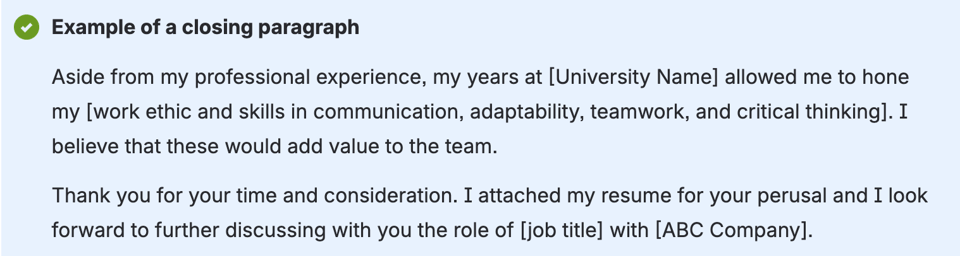
Education and other skills. You can add a brief paragraph about your education and other skills.
Call to action. End your cover letter with a proactive invitation to discuss your fit for the role, expressing that you’re eager to move further.
This may prompt the hiring manager to take the next step.
Salutation
Close your letter with a friendly and professional salutation. You can use any of the following:
Sincerely
Respectfully
Regards (variations: “Best Regards” or “Kind Regards“
Remember that the formatting of your cover letter must be the same as your resume’s.
Did you like this post? Let us know by sending us a message!