Predicting the Prospects of New Zealand Politicians
An analysis of the party lists of New Zealand's major parties by their chance of electoral success, featuring lots and lots of guessing and more detail than you ever needed on the results of the 2023 general election.
Three years ago on the old blog, I did a vibes-based prediction of who on the New Zealand Labour Party list would be re-elected. I have a lot of friends from New Zealand, but I have little stakes in New Zealand politics outside of my own nerdy interest, and indeed I got quite a bit wrong.
It was an interesting thought experiment for a couple of reasons. Labour was coming off a historic landslide in 2020 and looked set to lose a bunch of what they had gained. They ended up doing so in ways that were difficult to predict: I wonder if anyone would have called prior to the election that Labour would hold onto Nelson but lose Hauraki-Waikato.
Anyway, I’ve decided to do it again, but this time for both of New Zealand’s major parties. Labour is coming off of an election that they lost quite badly, and will probably gain a decent bit, but not as much as you might expect. Polling still shows a very close race between the left and right blocs1 in New Zealand. National is coming off an election where they won quite a few electorates, and where it seems like they might actually be hoping to lose a good chunk of those, lest some of their high-ranking list-only MPs be left out.
But let’s start with Labour, and a quick primer of New Zealand’s mixed-member proportional voting system. Seats in New Zealand’s 120-member parliament are allocated based off the size of the party vote — so, if you win 30% of the party vote, you should get approximately 30% of the seats. In order to qualify for seats in Parliament, you need to either poll above 5% of the party vote, or win one of New Zealand’s 71 electorates.
Subscribe nowThis means that sometimes, 30% of the party vote can amount to a bit more than 30% of the seats, because not all of the vote goes to parties who cross the 5% threshold. Sometimes this effect can be negligible, other times it matters quite a bit indeed.
Who within the party wins the seats is determined first by electorate winners. For example, if a party is entitled to 40 seats, but wins 30 electorates, those 30 electorate winners automatically go to Parliament. The remaining 10 seats are filled through the allocation of list seats. In New Zealand, each party submits an ordered list of candidates prior to the election, basically ranking their prospective MPs in order of how much they’d like them elected. You take the top 10 on this list who haven’t already been elected, and they become list MPs.
If a party wins more electorates than they’re entitled to on the basis of their party vote — say, they’re entitled to 40 seats but win 45 electorates — those extra 5 seats are added to Parliament as ‘overhang’ seats, meaning that Parliament would have 125 members instead of 120, and this party would elect no list MPs. Why this happens and whether it should happen is complicated, but for this blog post, all you need to know is that it happens. So let’s get into it.

The most straightforward way to start a prediction like this is seeing who will certainly win their electorate, as winning an electorate seat gives you a glide path to Parliament. This is easier to guess for Labour than it is for National, because you can take the 2023 election results and use them as a sort of baseline for the worst things might get for Labour.
I’d like to just quickly clarify that this is, for all intents and purposes, an educated guess on my part. There’s no fancy statistical models or calculations of what the polls, historic trends, etc might suggest. I am going to try and explain the heuristics I use to come to my predictions, but they are not particularly rigorous or evidence-based, and there is a large amount of ambiguity in these.
Anyway, to start with the Labour MPs who I thought would certainly win their electorates, I took all of the MPs who had won by a margin of greater than 1,000 votes in 2023 in their electorate, with some exceptions. Firstly, New Zealand has undergone a boundary redistribution since the last election, meaning the borders of electorates have changed, and thus they may have become more or less favourable for their incumbents. To analyse this, I’ve consulted the invaluable analysis by Rustie at the Overhang of the 2025 boundary review. Secondly, I’m only going to look at general electorates right now, both because my knowledge of Māori politics is limited but mainly because the Māori seats scare me to predict and I think it’s difficult to say any outcome is certain in any seven of the Māori seats.
From top-to-bottom of the Labour list, those MPs are:
Chris Hipkins, ranked #1, contesting Remutaka (won by 8,859 votes in 2023)
Carmel Sepuloni, ranked #2, contesting Glendene (won Kelston2 by 4,396 votes in 2023)
Barbara Edmonds, ranked #3, contesting Kenepuru (won Mana3 by 7,324 votes in 2023)
Rachel Brooking, ranked #11, contesting Dunedin (won by 7,980 votes4 in 2023)
Tangi Utikere, ranked #14, contesting Palmerston North5 (won by 3,087 votes in 2023)
Reuben Davidson, ranked #21, contesting Christchurch East (won by 2,397 votes in 2023)
Jenny Salesa, ranked #24, contesting Ōtāhuhu (won Panmure-Ōtāhuhu by 7,970 votes in 2023)
Ingrid Leary, ranked #39, contesting Taieri (won by 1,443 votes in 2023)
Arena Williams, ranked #41, contesting Manurewa (won by 7,113 votes in 2023)
Lemauga Lydia Sosene, ranked #42, contesting Māngere (won by 11,712 votes in 2023)
So that’s our 10 electorates that I think Labour is certain to win, and thus 10 people who I think will certainly be re-elected to the New Zealand Parliament this year. Let’s look at the other general electorates Labour won in 2023, of which there are six.
First of all, the safest of them, Christchurch Central, won by Duncan Webb by 1,841 votes. Webb is retiring this election, to be replaced by George Hampton, who is ranked #52 on Labour’s list. Boundary changes have been a wash here, and Christchurch Central is generally the sort of seat National only wins in good years for them (they last won it at the 2014 election). But given a vacancy here I’m not 100% certain that Labour will hold Christchurch Central, so it becomes the first entrant in the “probable” category — seats that Labour might not be certain to hold, but that all things considered they probably should. If I was making a US-style prediction of every seats, you could consider these “likely Labour”.
Staying in Christchurch we’ve got Wigram, won by Megan Woods by 1,179 votes. Woods is only contesting the party list this time around, and has been replaced in Wigram by Dominik Yanzick, #53 on Labour’s list. But unlike in Christchurch Central, boundary changes have negatively impacted Labour’s margin here, to the point where Woods would likely have lost this seat on its current boundaries. It’s not a massive change — per Rustie’s analysis, National would only have won new Wigram by 3 percent in 2023 — but it’s enough for me to not be confident that Labour will hold onto it, and so I’m going to put down Yanzick as a “might win” — again, in the US parlance, these are tossups. A good deal of them will be won by Labour on election night, but a good deal of them will not be. They’re the marginals, the too-close-to-calls, etc.
The four other seats left are Mount Albert, Nelson, Õhāriu, and Te Atatū. Mount Albert and Te Atatū are both Auckland-based seats only barely won by Labour in 2023 — Helen White held onto Mount Albert by only 18 votes, and Phil Twyford won by a slightly more comfortable 131 votes.
Mount Albert was somewhat of a three-way contest between White, National candidate Melissa Lee, and Green candidate Ricardo Menendez March, who placed third with 24%, but boundary changes have made the new Mount Albert less favourable for the Greens, and it’s likely National will struggle to win this in anything other than a landslide year. It’s a probable win for Helen White, #38 on the list. Te Atatū is now Henderson, and boundary changes have made it slightly friendlier for Labour. It’s a straightforward Labour-National contest, and I suspect it is also a probable win for Phil Twyford, #40 on the list.
Boundary changes have had no effect on Nelson, won by Rachel Boyack in 2023 by 26 votes. Her National opponent in 2023, Blair Cameron, is standing again, and given it’s a straightforward rematch I think Boyack, #37 on Labour’s list, ought to win here. And Ōhāriu, won by Greg O’Connor by 1,260 votes, has been abolished following the 2025 redistribution, and O’Connor is not seeking is re-election, so that’s all the general electorates won by Labour in 2023 dealt with.
Next, let’s look at the seats Labour lost in 2023, but only slightly. I used a bit more of a subjective margin for these, considering the following seats:
Banks Peninsula, lost by 396 votes
Hutt South, lost by 1,332 votes
Mount Roskill, lost by 1,564 votes
New Lynn, lost by 1,013 votes
Wairarapa, lost by 2,816 votes
West Coast-Tasman, lost by 1,017 votes
Excluding the Labour-Greens marginal of Rongotai, lost by 2,717 votes, this includes all seats Labour lost by less than 3,000 votes in 2023. However, in this case, I more or less scrolled through the list of electorate margins in 2023 and picked the ones I reckoned to be closest, rather than starting with a number and working from there.
Tracey McLellan, #28 on the list, lost Banks Peninsula narrowly in 2023 to National’s Vanessa Weenink, both of whom are standing again. Banks Peninsula’s boundaries are unchanged from 2023, but one thing in specific suggests to me that Labour will probably win it back — the performance of the Greens candidate, Lan Pham, who received about 17% of the candidate vote. Pham is now contesting Kenepuru in the North Island, and I suspect a number of these Greens candidate voters will now vote for Labour, given that Banks Peninsula is a marginal seat. I’ll rate McLellan as a probable win here.
Hutt South has been very competitive in the last few elections, and it was lost only slightly by Ginny Andersen, #12 on the list, to National’s Chris Bishop. Boundary changes make it ever-so-slightly more favourable to Labour, but I think this is a genuine uncertainty, so I’ll say Andersen might win, as opposed to will probably win.
Mount Roskill was quite a surprise on election night in 2023, as Michael Wood lost to National’s Carlos Cheung. Boundary changes have pushed this seat even further to the right, and as it happens, Wood has elected to not go on the Labour Party list, meaning he must win Mount Roskill to be elected. I think he might do it, but it’s not probable.
New Lynn is now Waitākere, and has actually seen its slight lead for National’s Paulo Garcia erased by the electoral redistribution. Deborah Russell, who lost in 2023, is now list-only at #27, but Vanushi Walters, now #8 on the list and formerly the MP for Upper Harbour, has taken her place as Labour’s standard bearer in Waitākere. I suspect she probably wins.
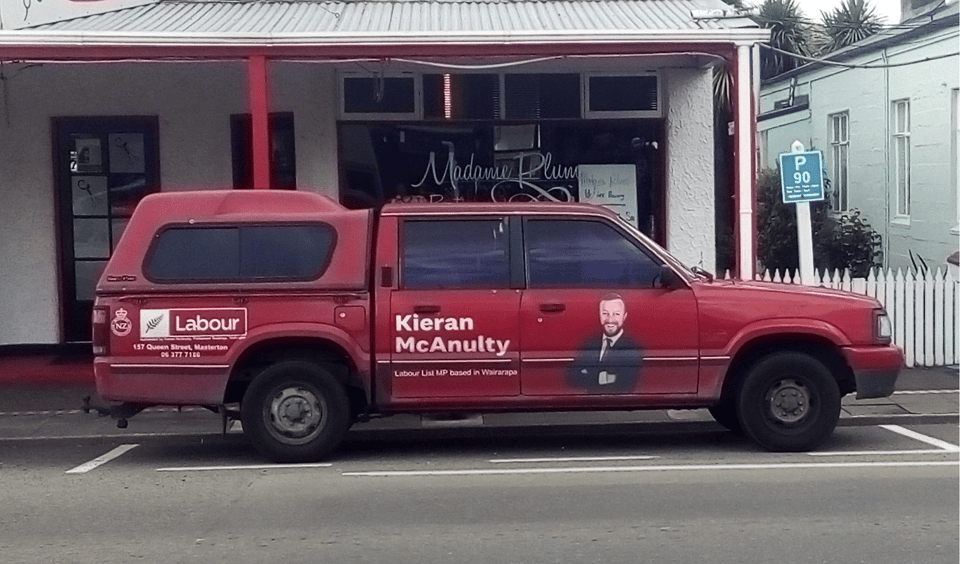
Wairarapa has the biggest margin against Labour here. Kieran McAnulty, #10 on the list, lost this seat to National’s Mike Butterick in 2023, and both are running again. Wairarapa was a more competitive seat in 2023 than you would have expected based off the party vote, and while I suspect it probably leans National, I think McAnulty has a decent chance to reclaim it this year.
Finally, West Coast-Tasman is the weirdest of all six of these to discuss. With the exception of a loss in 2008, Damien O’Connor had represented this seat and its predecessor since 1993, but lost in 2023 to National’s Maureen Pugh. Like Wairarapa, it was a closer race than it had any right to be based off the party vote, but it also had an independent, Patrick Phelps, in the race, who received about 14% of the vote. O’Connor, #16 on the Labour list, has set up shop in the comically safe National seat of Waitaki, Pugh is retiring, and there is no independent factor this time around. Rory Paterson, #54 on the Labour list, is the candidate in West Coast-Tasman now, and I think he might win, though like in Wairarapa, I think it’s an uphill battle.
So, that’s all the general electorates Labour won and almost won in 2023. After this, what I decided to do was look at seats I thought Labour was almost certain to lose, which mainly consisted of seats National won with a stonking majority. Some of these I will reconsider later on when looking at the National list ranking, but for the time being, I excluded these National-held seats:
Botany, Coromandel, East Coast Bays, Ilam, Invercargill, Kaipara ki Mahurangi, Kaikōura, Mount Maunganui, New Plymouth, North Shore, Northland, Pakuranga, Port Waikato, Rangitata, Rangitīkei, Rotorua, Selwyn, Southland, Taranaki-King Country, Taupō, Tauranga, Tukituki, Upper Harbour, Waikato, Waimakariri, Waitaki, Whangaparāoa, and Whangārei.
I also excluded the Green-held seat of Auckland Central, which is on paper not bad for Labour but I suspect voters will treat it as a contest between Green and National, and the two ACT-held seats of Epsom and Tāmaki, too right-wing for Labour to have a shot in. This left me with a list of about eleven general seats yet to categorise.
East Cape and the Hamiltons East and West both saw no boundary changes, and were all won by National by reasonable but not insurmountable margins.6 I’m classing the Labour candidates here (Jo Luxton at #17, Georgie Dansey at #33, Myra Williamson at #60), as might wins.
Ōtaki was lost by 6,271 votes in 2023. The compounding effects of Wellington lose a seat have seen Ōtaki become less rural and more left-leaning, being renamed to Kapiti. Sophie Handford, Labour’s new candidate here at #26, is also a might win.
Maungakiekie is a pretty traditional bellwether seat in Auckland, lost by 4,617 votes in 2023. Boundary changes have pushed it left, which push Priyanca Radhakrishnan, #18 on the list, to the point of being favoured in my mind, but not quite probable, so I will say only that she might win.
Northcote and Takanini are two seats from different parts of Auckland, but I feel similarly about them so they both go here. They were both lost by pretty big margins in 20237, and boundary changes would not change that by themselves (Northcote has seen a negligible shift, while Takanini has moved a bit to the left). Shanan Halbert at #19 and Kharag Singh at #61 are Labour’s candidates in these two seats, and I suspect both will only win in a best-case scenario for Labour. Consider them the inverse of the probables — it is improbable that they win, but not impossible, and they might just manage to pull through on a good night for the party.
Whanganui and Napier are both rural seats in the lower North Island. Whanganui was lost only by 5,512 votes in 2023, while Napier was a bit more insurmountable at 8,909 votes. Both are slightly more National-leaning than in 2023. I think Angela Roberts at #43 might win Whanganui, and Alex Hedley at #50 probably won’t win Napier.
Finally, there’s two other seats that aren’t held by National to discuss. The seats of Wellington Central and Rongotai were won by the Greens in 2023. Labour came in second in both seats, the difference being that Central was more of a three-way race (the Green won 41% of the candidate vote to Labour’s 27% and National’s 25.6%), while Rongotai was more cleanly a green vs red race (the Green won 39%, Labour 33%, National 21%).
Boundary changes have seen Wellington Central become Wellington North, and Rongotai become Wellington Bays. Wellington North, the safer of these seats, was shifted to the right, while Wellington Bays is slightly more Green-leaning. I am quite uncertain as to what will happen here — maybe the new Green MPs will enjoy a sophomore bump and be re-elected easily, maybe National voters will strategically vote Labour and kick out the Greens, maybe a slightly higher Labour vote sees them reclaim both seats anyway. In any case, I think Ayesha Verrall at #6 in North, and Craig Renney at #51 in Bays, can’t be put down as anything safer than a maybe.
And now I finally have to consider the seven Māori electorates. The decision I have made with them is on some level cowardly, but I think also justified. I’ve considered all the candidates standing in Māori seats, and I think all of them ought to be “might wins”. The Māori seats are fairly live political environments in the best of times, but Te Pāti Māori, who won six out of seven of them in 2023, have been going through severe strife throughout the parliamentary term, with two of its six MPs leaving to stand for re-election under their own banners. Theoretically, something like Rawiri Waititi’s 15,000-strong majority in Waiariki ought to be unassailable, but I’m not quite confident that this will be the case, especially considering that Labour will likely do better than they did in 2023 across the board.
To be frank, no outcome in the Māori seats would be particularly surprising or shocking to me, and given that I think I need to do the noncommittal thing and say that none of them are sure outcomes, at least in terms of Labour losing. Even in Ikaroa-Rāwhiti, the one seat Labour won in 2023 (by a margin of 2,874 votes), I suspect a big part of that would be due to the waka-jumping of Meka Whaitiri, and the Te Pāti Māori candidate who was meant to run that year is now standing for the Greens. If you ask me to make my own guess, I would say probably that Te Pāti Māori would win about four of the Māori seats, but I have little confidence in that prediction. So all seven of them, for our purposes, are maybes for Labour.

Now, we must consider how many list seats Labour is likely to win, as distinct from how many seats Labour is likely to win. The latter is theoretically quite easy — you look at how much Labour is polling and see how many seats that would equate to. In the most recent 1 News-Verian poll, Labour sat at 38 seats, and before that, RNZ-Reid Research had Labour at 43. But how many list seats they’ll win is dependent on the amount of electorates they’ll win.
To summarise the rundown above, I consider 10 Labour candidates to be certain to win their electorate seats, 6 to be probable, 20 to be possibilities, 7 to be unlikely8, and 28 to be impossible.
You could do a far more mathematical analysis of the polling to come to a conclusion, but I mainly guessed. I assumed that the likely bound of Labour seats was anywhere from 35 to 45. In the lower outcome, they might win all of their certains and probables, but only a few possibilities, which left them with 23 electorates. In the upper bound, perhaps they win most of their possibilities, giving them 31 electorates.
In a scenario where Labour overperformed on electorates, perhaps they’d win half their possibilities with 35 seats, giving them 26 electorates, or all of them with 45, giving them 36 electorates.
Thus, I concluded that Labour would certainly win 8 list seats, probably win 11, and might win up to 20, taking into account some uncertainty and unpredictability with electorate races. I could run you through what this means, but I can actually just show you my full prediction.
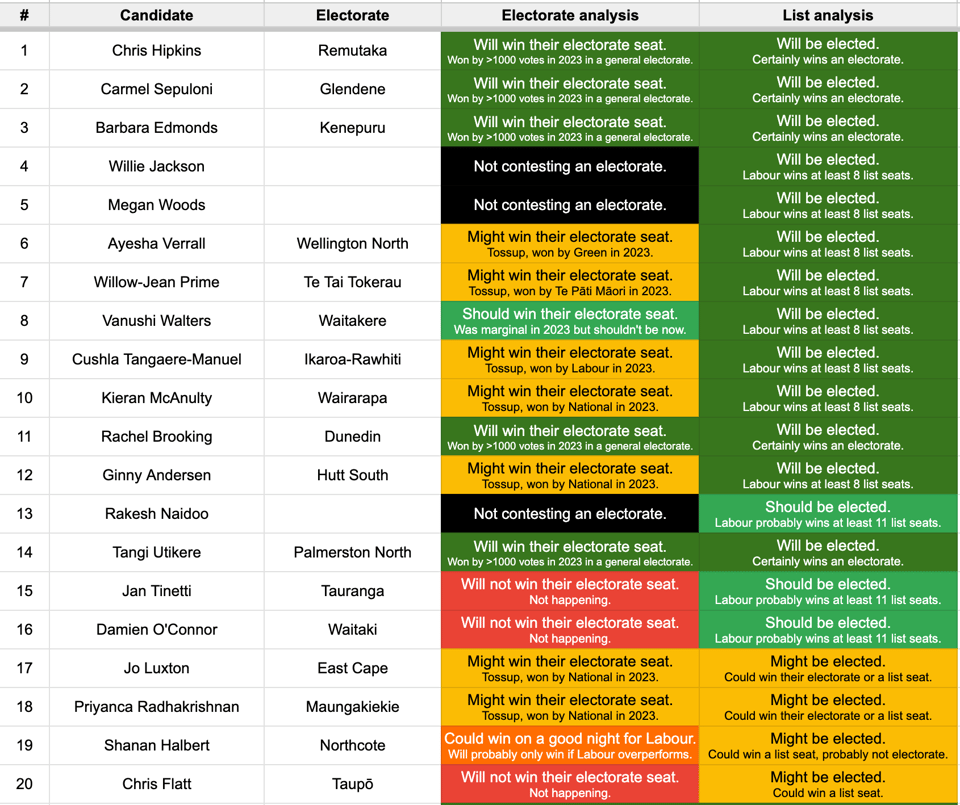
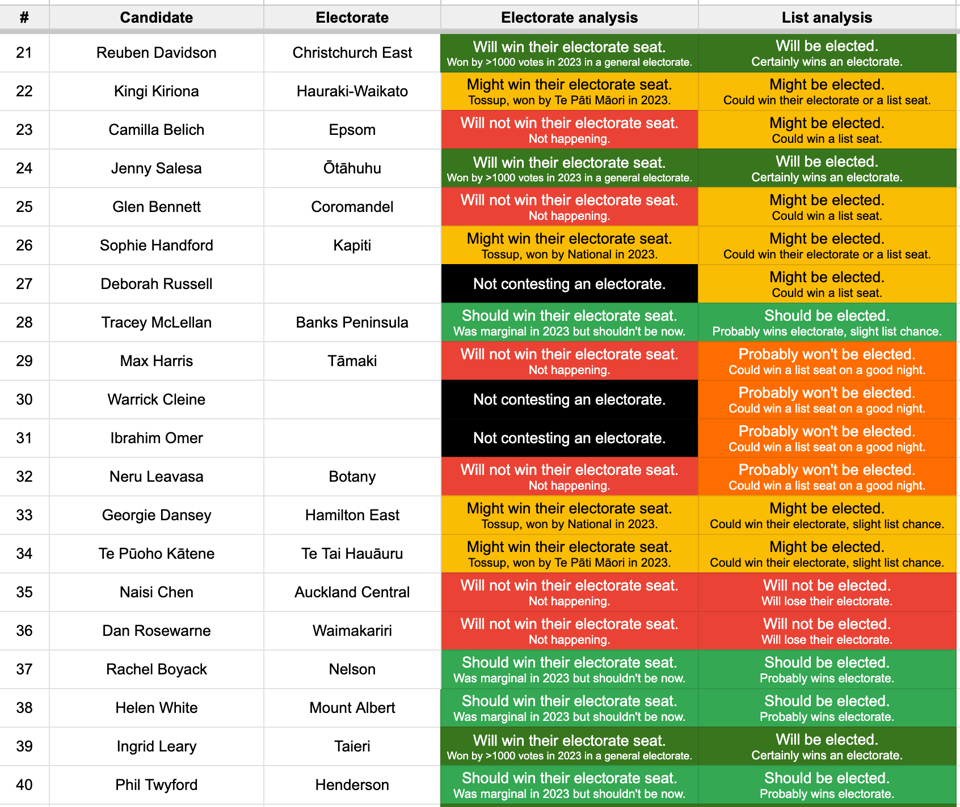
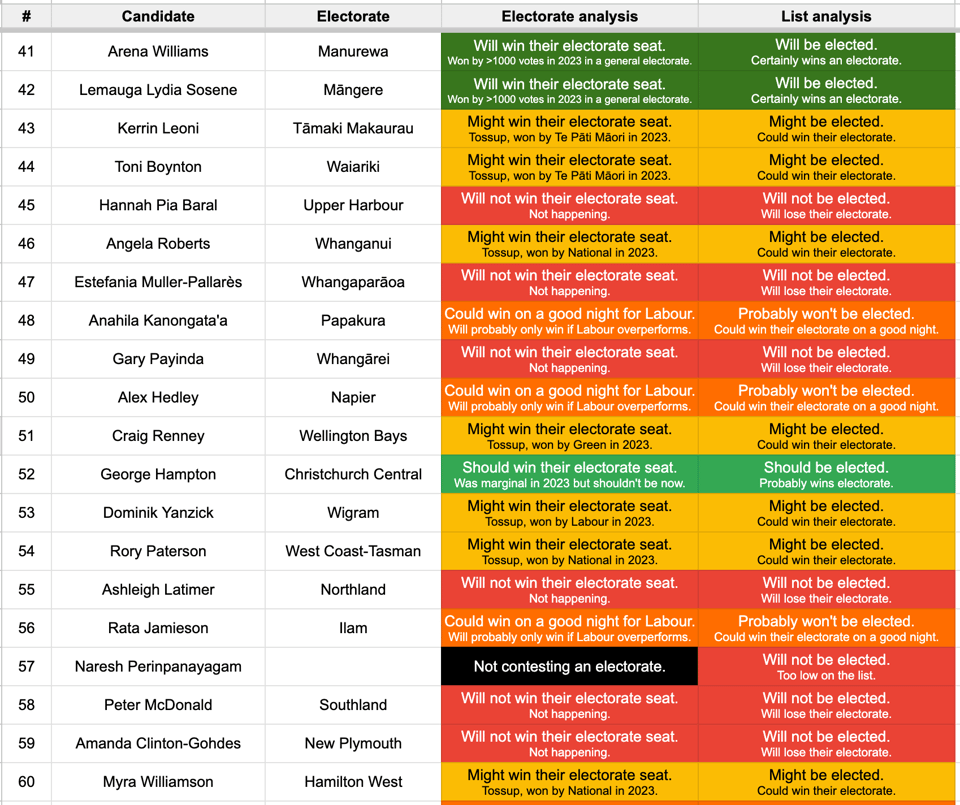
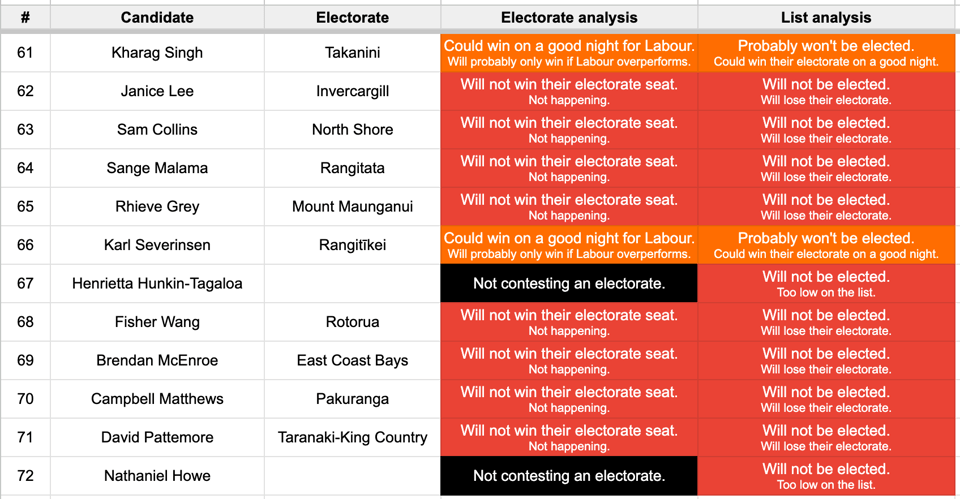
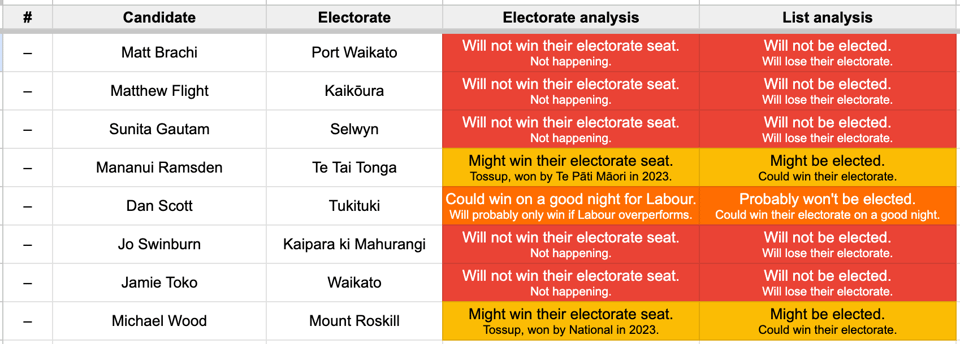
Do note that these analyses take into account some changes I made after looking at the National side of things that I haven’t yet detailed. These are mainly inconsequential (things like shifting Papakura from certain loss to probably a loss), but I’m mentioning it here in case there’s any confusion.
Now it’s time to look at the National Party side of things. I can’t quite believe that I’m only halfway through this post, but it should be easier as theoretically I should have done most of the work already. It should just be an exercise in reverse-engineering what I’ve done with the Labour side, right?
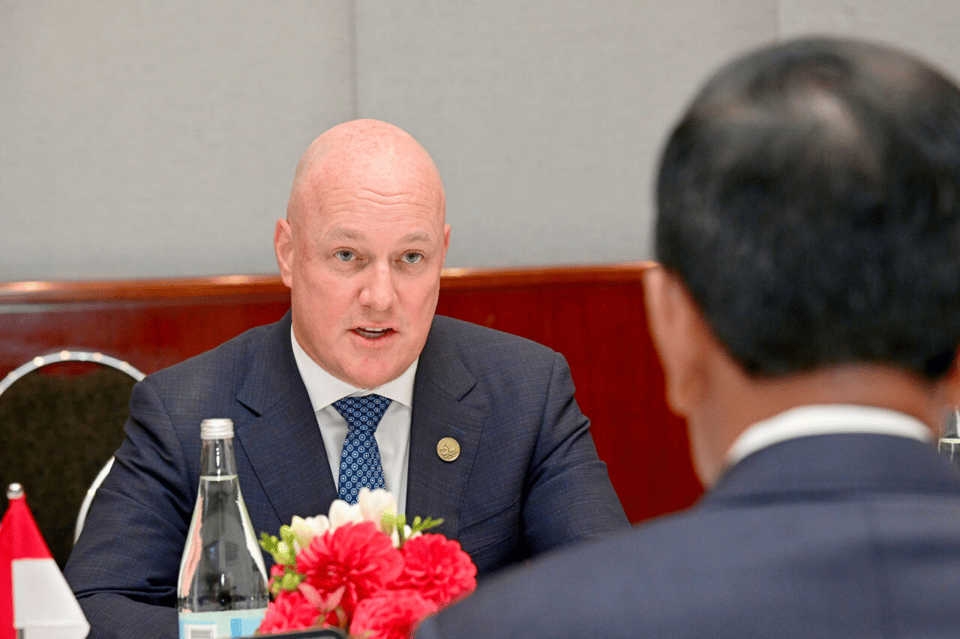
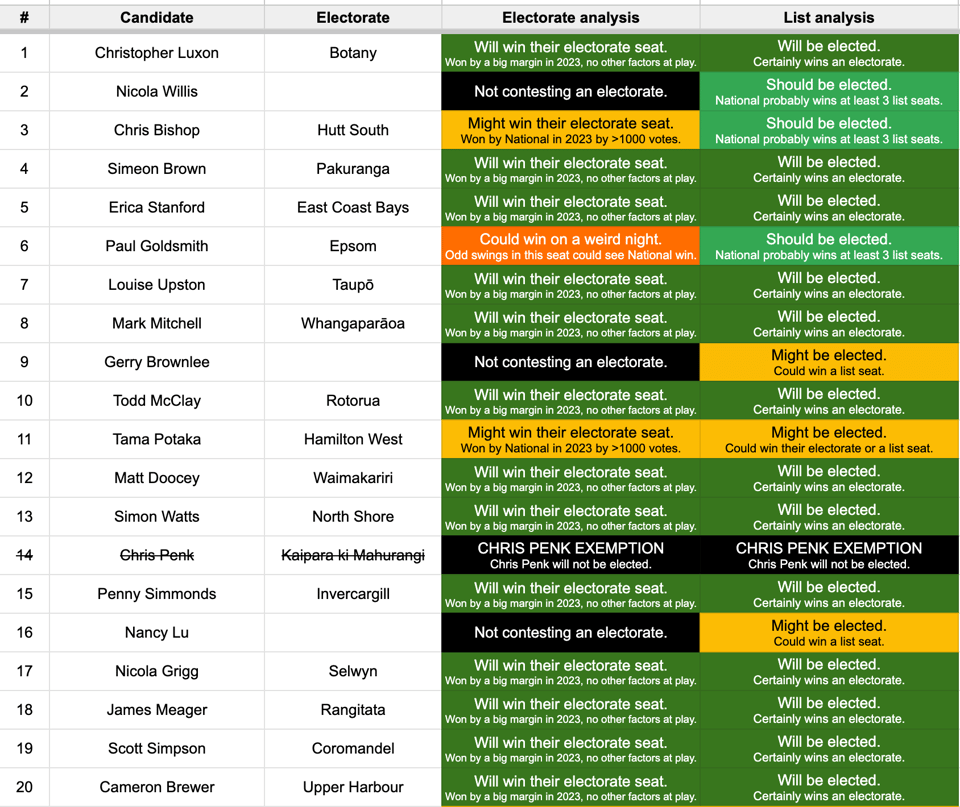
Well, there was one obvious and immediate assumption I could make. The National Party announced its list a week ago, and since then there has already been one withdrawal from it. Chris Penk, ranked at #14 and contesting the Kaipara ki Mahurangi electorate, announced on Wednesday that he would not be seeking re-election. Penk had been sacked from cabinet the same day, with the reasoning being that he had launched a challenge to Luxon’s leadership of the National Party.
So, Chris Penk will not be elected. Who else would lose? To figure this out, I started first with the seats I had already figured Labour would certainly win, which were Christchurch East, Dunedin, Glendene, Kenepuru, Māngere, Manurewa, Õtāhuhu, Palmerston North, Remutaka, and Taieri. I also chucked in Wellington Bays, a Green-held seat which National was not like to contend in, and Te Tai Hauāuru, the sole Māori seat National is contesting.
Subscribe nowThat left me with 12 seats out of reach for National. I then tried to figure out which seats National would certainly win through the same method I had done for Labour — seeing who had won by a big enough margin so as to be unassailable.
Initially, I had wanted to go with 10,000 — it’s a big round number — but I discovered it wasn’t quite what I wanted, so instead I went with a margin of 25%9 over the second-placed candidate, with cross-referencing to Rustie’s analyses. This means that I consider the following MPs certain of re-election:
Christopher Luxon, ranked #1, contesting Botany (won by 44.7%/16,323 votes in 2023)
Simeon Brown, ranked #4, contesting Pakuranga (won by 51.9%/18,710 votes in 2023)
Erica Stanford, ranked #5, contesting East Coast Bays (won by 53.3%/20,353 votes in 2023)
Louise Upston, ranked #7, contesting Taupō (won by 38.4%/16,505 votes in 2023)
Mark Mitchell, ranked #8, contesting Whangaparāoa (won by 50.5%/23,376 votes in 2023)
Matt Doocey, ranked #12, contesting Waimakariri (won by 28.3%/13,010 votes in 2023)
Simon Watts, ranked #13, contesting North Shore (won by 40.4%/16,330 votes in 2023)
Penny Simmonds, ranked #15, contesting Invercargill (won by 26.8%/9,874 votes in 2023)
Nicola Grigg, ranked #17, contesting Selwyn (won by 41.6%/19,782 votes in 2023)
James Meager, ranked #18, contesting Rangitata (won by 27.1%/10,846 votes in 2023)
Scott Simpson, ranked #19, contesting Coromandel (won by 37.5%/17,349 votes in 2023)
Cameron Brewer, ranked #20, contesting Upper Harbour (won by 27.8%/11,192 votes in 2023)
Stuart Smith, ranked #22, contesting Kaikōura (won by 27.5%/11,412 votes in 2023)
Tom Rutherford, ranked #28, contesting Mount Maunganui (won Bay of Plenty10 by 34.6%/15,405 votes in 2023)
Barbara Kuriger, ranked #43, contesting Taranaki-King Country (won by 36.3%/14,355 votes in 2023)
Miles Anderson, ranked #47, contesting Waitaki (won by 27.7%/12,151 votes in 2023)
Tim van de Molen, ranked #49, contesting Waikato (won by 44.3%/18,548 votes in 2023)
Joseph Mooney, ranked #50, contesting Southland (won by 44.1%/17,211 votes in 2023)
That’s a total of 18 electorates, there. There are three electorates National won by more than 25% that are excluded — Penk’s seat of Kaipara ki Mahurangi, which was won by 40% (or 19,459 votes), and is thus a certain retain for whoever the National candidate ends up being.11
The remaining two are Papakura and Whangārei, both held by retiring National MPs. Papakura is theoretically the safer one, as Judith Collins won it in 2023 with a 32.9% margin. But boundary changes have shifted it meaningfully to the left, and while I suspect it almost certainly goes to National, the vacancy of Collins, who has represented Papakura since 2008, leads me to think that if things have truly gone tits up for National that they could possibly lose it, so I placed this only as a probable win for Emma Chatterton at #52. This didn’t match the ranking I gave Papakura on the Labour side, and as they’re the only realistic competitors to National here, I did go back and change it to an improbable chance for them.
As for Whangārei, it was won by Shane Reti by a 26.7% margin. Boundary changes have had no impact here, so I suspect Lloyd Budd at #61 will be a certain thing.
There’s also one final caveat — Port Waikato, which actually didn’t elect an MP at the 2023 election, due to the death of a candidate. In a not very contested by-election, National’s Andrew Bayly won more than three-quarters of the vote, but the better indicator is probably the party vote in 2023. National won just shy of 50% there, so I will say Port Waikato is a certain win for Matthew Paul at #62.
Now, we’ve already got 21 certain wins for National, and I’m afraid we’re not quite done yet, because the 25-20% zone still contains a lot of seats I’m not quite sure National could lose, even if they tried.
The safest of these is Tukituki, held by Catherine Wedd at #37 by a margin of 24.9%. A redistribution here ever-so-slightly helps Labour, and I do think given Tukituki’s track record of being somewhat marginal in close races (and that I classed neighbouring Napier as not a sure thing on the Labour side), it is only probable for Wedd. This was another of the changes I went back and made on the Labour side.
Then there’s Rotorua, held by Todd McClay at #10 at also a 24.9% margin. Rotorua has changed almost not at all partisanship wise, but McClay has held it since 2008 and I see no reason to think he’ll lose.
Northcote, Takanini, and Napier were relatively simple matters — I had looked at them before on the Labour side, considered them just shy of safe for National, and I thought that analysis held up, so I reckon Katie Nimon at #27, Dan Bidois at #31, and Rima Nakhle at #45 are both probable.
That leaves us with three more electorates in the 25-20% zone — Rangitīkei, Ilam, and Tauranga. On the Labour side I had considered these all easily predictable losses, but taking a closer look for this I wasn’t quite sure.
Rangitīkei was the safest of the three in 2023, with Suze Redmayne at #32 winning by 24.2%, but boundary changes have meant that it’s had to move south towards Wellington, gaining a bunch of very Labour-friendly territory.
Subscribe nowIlam is actually only here because of a mistake in my spreadsheet12, but it makes sense to consider it here anyway so let’s do so. Hamish Campbell at #48 won Ilam in 2023 in a three-way race against Labour incumbent Sarah Pallett and The Opportunities Party leader Raf Manji. He defeated Manji by a margin of 16%, and Manji is not running again13, which should seem to suggest that enough of his vote would go back to National to make it a sure thing. But looking at the history, I wasn’t actually quite so sure. Labour outright won Ilam in 2020, and in 2017, Manji stood as an independent, again placing second. In all three of these cases, combining Manji’s vote with Labour would be enough to, if not unseat the National candidate, at least give them a fright.
In the end, I put both Rangitīkei and Ilam to the probable categories for National, and moved them accordingly out of the impossible category for Labour, which should mark the last of my changes on the Labour side. I also agonised over Tauranga, won by Sam Uffindell at #51 in 2023 with a 22.9% margin, but ultimately decided it was in fact too safe to lose.14
There are two more electorates I considered as certain wins for National — New Plymouth and Northland. New Plymouth was only won by David MacLeod at #46 by 16.4%, but this was with a Labour incumbent who had performed surprisingly well on the candidate vote. Said incumbent is standing again, but in the Coromandel, so I have put this down as a certain retain for MacLeod.
In Northland, the margin is a deceptively small 13.4%, but not only did Grant McCallum at #35 have to defeat incumbent Willow-Jean Prime (now standing in Te Tai Tokerau), but also a crowded field of largely ideologically aligned right-wing candidates. New Zealand First’s Shane Jones received 18% of the vote, and former MP Matt King received 8.4%. I suspect most of this vote will either consolidate around McCallum or around New Zealand First, but it shouldn’t present much of a threat to National so long as Labour voters stay with their candidate, so I’ve put it down as a certain retain.
So far, we have 25 certain wins for National15, 7 probable ones, and 12 impossible ones. Like on the Labour side, this leaves us with about twenty-one general seats yet to sort. But thankfully I’ve already looked at a bunch of these electorates on the Labour side, and most of these are National versus Labour seats, so I can make pretty confident assessments about them.
Zooming over the seats that I’ve already assessed as might wins for Labour candidates, there’s East Cape, Hamiltons East and West, Hutt South, Kapiti, Maungakiekie, Mount Roskill, Wairarapa, West Coast-Tasman, Whanganui, and Wigram as might wins for National candidates. Similarly, probable wins for Labour candidates get chucked into the improbable box for National, meaning Banks Peninsula, Christchurch Central, Henderson, Mount Albert16, Nelson, and Waitākere. This leaves us with four seats, all currently held by minor parties.
Of these, Tāmaki, won by ACT’s Brooke van Velden, is the most straightforward. van Velden defeated socially conservative National MP Simon O’Connor in 2023 by 4,158 votes. She is retiring, leaving this a race between ACT’s James Christmas and National’s Mahesh Muralidhar, at #24 on the list. I think this is a pretty close-run thing, so I’ll put Muralidhar down as a might win.
Weirdly enough, I’ll assess Epsom, Auckland Central, and Wellington North in the same category. Epsom has been held by ACT leader David Seymour since 2014, and National has more or less conceded the race to him ever since. But Paul Goldsmith at #6 did try and campaign to win here in 2023, and seems set to try again. It didn’t work, though, he lost by 8,142 votes to Seymour. Auckland Central and Wellington North are both held by the Greens, and National placed second here in 2023, seeming to suggest it’s a Green versus National seat. (Labour party voters in 2023 mainly gave their candidate vote to the Green Chlöe Swarbrick.) Similarly, National’s third place finish in Wellington North should suggest that it will be a Green versus Labour contest this year, with most National party voters being like to hold their nose and vote for the least-worst option.
Hence, I’ve put these three seats into a somewhat weird category. I think they are improbable wins for National, and while to some degree National could win here if they have a very good night, I think the better description is that they will win here if something weird happens, atypical with previous voting patterns. Maybe Labour voters in Epsom back Goldsmith to kick ACT out, maybe in Auckland Central Swarbrick loses some of the Labour vote she’s gained and National comes through the middle, I don’t know. Do I think these outcomes are likely? Certainly not. Do I think they are plausible? Yes.
As with National, we must look at how many list seats they might win, and I think I have a rather controversial opinion to put forward.
First of all, the summary. I consider 25 National candidates17 to be certain to win their electorate seats, 7 to be probable, 12 to be possibilities, 9 to be unlikely, and 12 to be impossible.
Again, the last 1 News-Verian poll has National on 36 seats, RNZ-Reid Research also has them on 36. I’ll use the same bounds I did for Labour to estimate likelihood, of 35 to 45 seats. Now, here is the problem. Even assuming that only a few of their possibilities win in the lower bound scenario, National wins 36 electorates. That would actually end up giving them a one-seat overhang, even if they lose eight out of twelve possibilities. In the upper bound we could assume they win two-thirds of possibilities — that gives them only five list seats.
And if you assume a more reasonable scenario for electorates, if National wins half their possibles on the lower bound, they have a three-seat overhang, and if they win all of the possibles on the upper bound, they win a total of one list seat.
As you could tell by the Labour side of things, National does tend to have more very safe electorates than Labour does, even in a neutral 50/50 environment. But the difficulty here is that while the National party vote is quite low, their support partners of ACT and New Zealand First are on about ~17-18% of the vote, and they are only liable to contend in a handful of electorates. This means that National could be in an unprecedented situation where they might win too many electorates for their own good.
To be clear, I tend to think that this is not the most likely outcome. I think ultimately, National will lose just enough electorates that an overhang will be avoided, and National will elect at least one list MP. But I am not confident enough to say that this is a certain thing, and given that National currently holds 43 electorates, they will have to lose at least some of these to elect list MPs given their current polling, and I would not take that as a given. Obviously National will lose electorates, but I do reckon it’s an unsettled question as to whether they lose enough given the sheer amount of places they’ll contend in.
Ultimately, I concluded that National was not certain of winning any list seats, but could probably win at least 3, might win 8, and has a possibility of winning up to 13. Here’s what that prediction looks like:
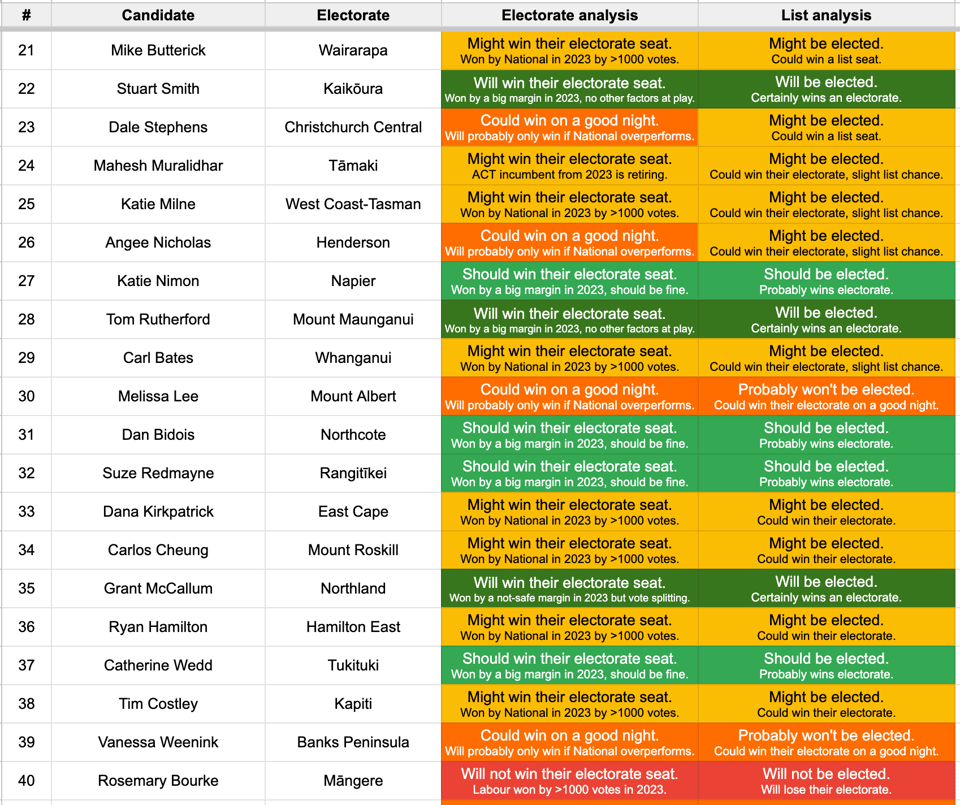
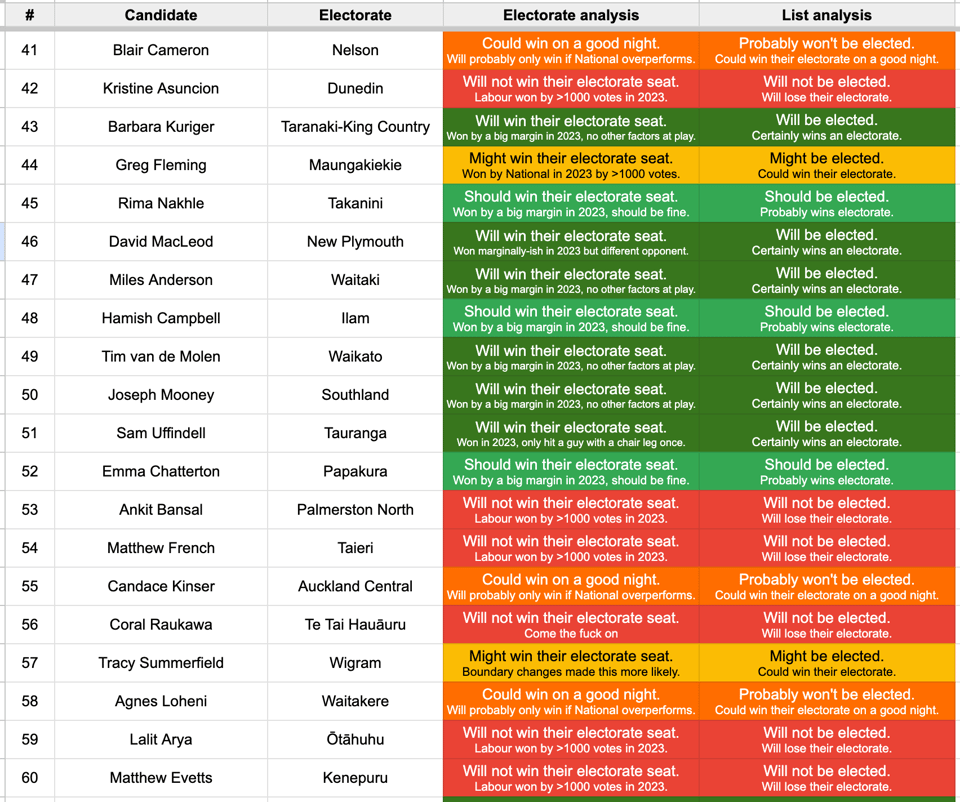
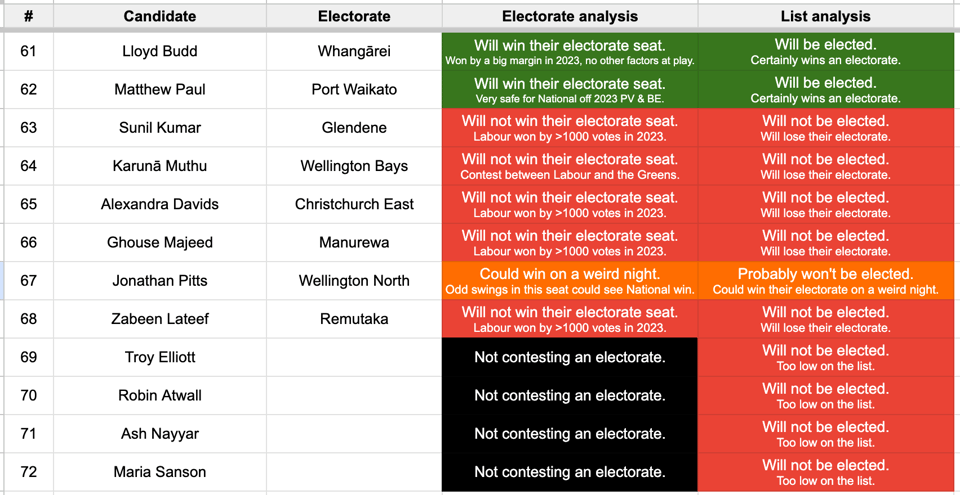
So that’s the end of my analysis. I could do this for the Green Party, ACT, and New Zealand First, but it would probably be substantially less interesting.18 If you’re interested, I might write a bit more about my thoughts on certain electorates, or perhaps on the prospects of the Opportunity Party, which I haven’t talked about much but which does interest me quite a bit. Thank you very much for reading this very nerdy post, and I hope you enjoyed it!
Subscribe nowThe ‘left’ is broadly considered to be Labour, the Green Party, and Te Pāti Māori, and the ‘right’ National, New Zealand First, and ACT. The centrist Opportunity Party, who are above the threshold in a good deal of polls, are not tied to either side, although National have seemed to suggest they won’t work with them. ↩
The new Glendene seat has actually moved pretty sharply to the right per Rustie’s analysis, but even taking that into account it still would have been an easy Labour hold in 2023. ↩
Again, looking at Rustie’s analysis, Kenepuru is both a replacement for Mana, Barbara Edmonds’ former seat, and Ōhāriu, a Wellington-based seat that is much more marginal for Labour, as the boundary changes left Wellington with one less electorate. But the new Kenepuru seat looks far more like Mana, a safe Labour seat, did candidate vote wise, so I’m treating it as if it’s safe for Labour here. ↩
This was against a National candidate, and on a party vote basis Dunedin looked a lot more like a Labour/Greens marginal in 2023. (Labour won 31% to the Greens’ 27%.) While Dunedin could be a target seat for the Green Party this year, I tend to think Rachel Brooking’s candidate vote margin is big enough to be unassailable, combined with broadly better fortunes for Labour nationwide. ↩
Palmerston North has moved meaningfully to the right, but per Rustie’s analysis ought to only be winnable for National in a landslide year, which this is not shaping up to be for them. ↩
What was then East Coast was lost by 3,199 votes, Hamilton East by 5,060 votes, and Hamilton West by 6,488 votes. East Coast was renamed to East Cape. ↩
9,270 votes in Northcote and 8,775 votes in Takanini. ↩
Keen readers will note I only considered three seats — Northcote, Takanini, and Napier — to be unlikely for Labour. This takes into account my final analysis after looking at National seats. It’s mainly unimportant now, and I will address it in the post in a moment, but this is a caveat to show that I didn’t make a typo or anything. ↩
Arguably this sort of margin analysis is what I should have started off doing with Labour, but I think looking at raw vote margins is sensible enough that I wasn’t tempted to go back and redo it. ↩
Bay of Plenty has been reconfigured to be based more around eastern Tauranga, which changes its boundaries significantly (it’s now been renamed to Mount Maunganui), but its political leanings not at all. ↩
Prior to 2020, Kaipara ki Mahurangi was known as Helensville, and John Key represented it while he was Prime Minister. ↩
To calculate these margins, I subtracted the National candidate vote percentage by the Labour candidate vote percentage. However, Labour came third in Ilam, meaning I thought National had won the seat by 23% and not 16%. ↩
The rebranded Opportunity Party appears to not be standing a candidate in Ilam either. ↩
Uffindell, who is perhaps most well known for beating a fellow student with a bed leg while in high school, is notably quite unpopular in Tauranga. He underperformed the party vote in 2023 and almost won less votes in the seat than Simon Bridges did in 2020, doubly impressive (?) given Bridges only barely held Tauranga that year. Maybe the effects of incumbency will make this fade, and maybe people will just forget about the bed leg thing this year, but I tend to assume that in a really bad night for National, his unique unpopularity might put Tauranga at risk. In this instance, though, I did put it as certain for National. ↩
Including one for a so-far unselected candidate in Kaipara ki Mahurangi. ↩
Not strictly a Labour versus National seat, but as I detailed above, I suspect that National will likely be the biggest opponent to Labour in Mount Albert. ↩
Again, 24 on the spreadsheet, but I do count the phantom candidate in Kaipara ki Mahurangi. ↩
ACT and New Zealand First have not released their party lists yet, but in any case are all only likely to contend in a couple of electorates. The Green Party has, but all of their prospective electorate winners are in the top six, so it would be a very boring analysis basically just of the polling averages. ↩